
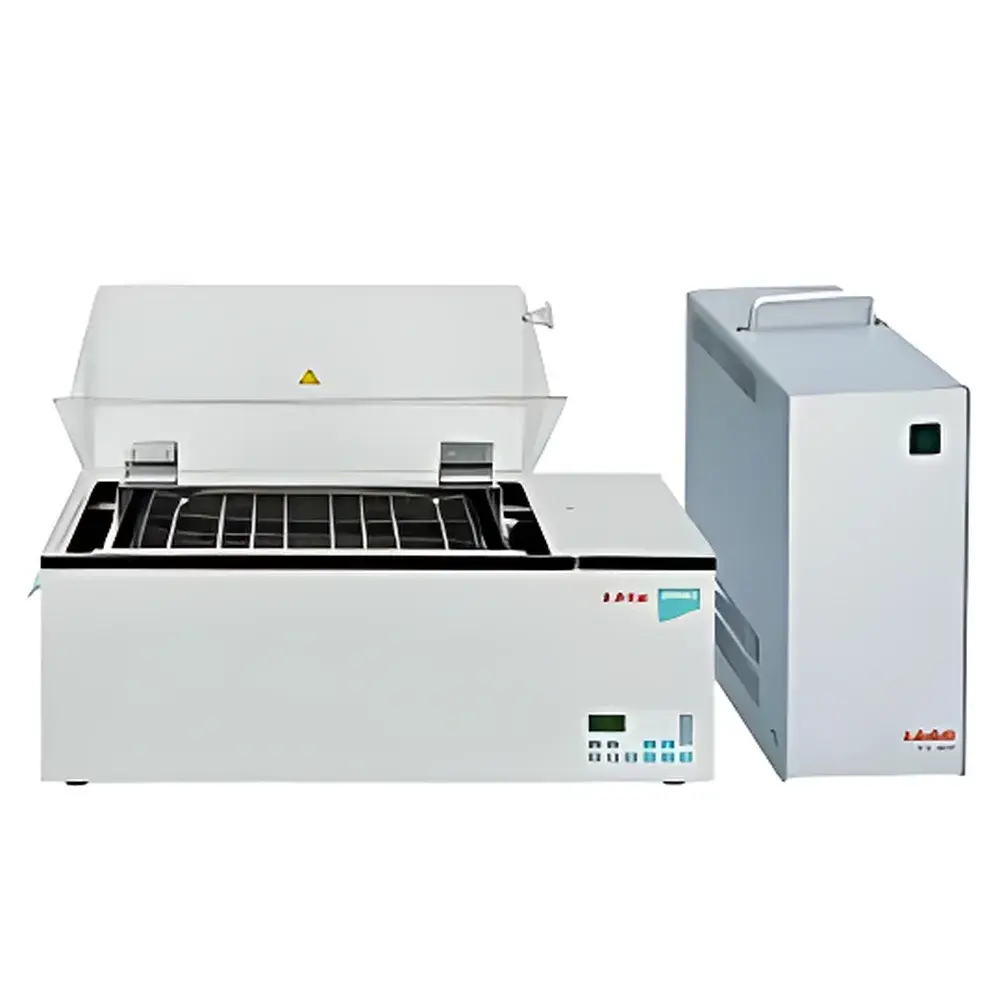
JULABO SW23L and SW22L Low-Temperature Orbital Shaking Water Baths
| Brand | JULABO |
|---|---|
| Origin | Germany |
| Model | SW23L / SW22L |
| Temperature Range | +6 °C to +99.9 °C (standard +20 °C to +99.9 °C) |
| Temperature Stability | ±0.2 °C |
| Temperature Resolution | 0.1 °C |
| Oscillation Frequency Range | 20–200 rpm |
| Oscillation Amplitude | 15 mm / 25 mm |
| Timer Range | 0:01–9:59 h:min |
| Bath Volume | 8–20 L |
| Bath Opening | 50 × 30 × 18 cm |
| External Dimensions | 70 × 35 × 43 cm |
| Heating Power | 2 kW |
| Circulation Type | Internal & External |
| Control Interface | Waterproof Keypad + High-Contrast LED Display |
| Communication | RS232 |
| Safety Features | Dry-run protection, audible/visual alarm, auto power cutoff |
| Optional Accessories | Makrolon transparent lid, stainless steel lid, tube racks, Erlenmeyer flask clamps, liquid level regulator (F250), cooling module (FD200) |
Overview
The JULABO SW23L and SW22L Low-Temperature Orbital Shaking Water Baths integrate precise temperature control with reliable orbital agitation in a single compact platform engineered for life science, microbiology, and biochemical laboratories. These instruments operate on a dual-function principle: thermoregulation via Peltier-assisted refrigeration combined with resistive heating, and mechanical oscillation using a brushless DC motor driving an eccentric cam mechanism. Unlike static water baths, the SW series maintains uniform thermal distribution across the bath volume while simultaneously enabling homogeneous suspension of microbial cultures, enzyme reaction mixtures, or cell-based assays. The system achieves temperature stability of ±0.2 °C across its operational range (+6 °C to +99.9 °C), validated per DIN 12879 and ISO 17025 traceable calibration protocols. The orbital motion—adjustable from 20 to 200 rpm with selectable amplitudes of 15 mm or 25 mm—ensures reproducible mixing without vortexing or shear-induced cell damage, making it suitable for sensitive applications such as aerobic bacterial growth, solubility studies, and protein refolding kinetics.
Key Features
- Microprocessor-controlled temperature regulation with real-time feedback loop, supporting both heating and active cooling down to +6 °C
- Waterproof membrane keypad and high-brightness LED display showing setpoint temperature, actual bath temperature, oscillation speed, and alarm thresholds
- Dual-circulation system (internal recirculation + external pump port) for enhanced thermal homogeneity and compatibility with external jacketed reactors or condensers
- Dry-run protection circuitry that detects low fluid level, triggers audible/visual alarm, and automatically de-energizes heating elements to prevent heater coil damage
- Precise digital timer (0:01–9:59 h:min) with auto-shutdown function for unattended overnight operation
- RS232 serial interface for remote parameter setting, data logging, and integration into lab automation networks (e.g., LIMS or SCADA)
- Robust stainless-steel bath chamber and corrosion-resistant housing designed for long-term use under humid or solvent-exposed conditions
Sample Compatibility & Compliance
The SW23L and SW22L accommodate standard laboratory vessels including test tubes (13–25 mm OD), culture flasks (up to 2 L Erlenmeyer), microtiter plates (with optional adapter), and custom bioreactor inserts. Bath volume flexibility (8–20 L) allows optimization for throughput versus thermal inertia. All models comply with IEC 61010-1:2010 for electrical safety and EN 61326-1:2013 for electromagnetic compatibility. When operated with validated accessories (e.g., Makrolon lids for vapor retention), the systems support GLP-compliant workflows. Data integrity features—including password-protected parameter locks and timestamped event logs—align with FDA 21 CFR Part 11 requirements when paired with compliant third-party software.
Software & Data Management
While the onboard interface provides full local control, the RS232 port enables bidirectional communication with JULABO’s optional LabSoft software or third-party platforms such as LabVIEW, MATLAB, or Python-based instrument drivers (PyVISA). Logged parameters include temperature setpoint, measured bath temperature, oscillation speed, elapsed time, and alarm events—all timestamped at 1-second intervals. Export formats include CSV and XML for audit-ready reporting. For regulated environments, audit trail functionality can be implemented through external middleware that captures user actions, configuration changes, and calibration history in accordance with ALCOA+ principles.
Applications
- Aerobic cultivation of Escherichia coli, Bacillus subtilis, and yeast strains under controlled thermal and agitation conditions
- Enzyme kinetic assays requiring constant temperature and gentle mixing to minimize denaturation
- Solubility profiling of pharmaceutical compounds across temperature gradients (e.g., USP <1059>)
- Cell lysis optimization using detergent-based or mechanical disruption protocols
- Hybridization and washing steps in nucleic acid hybridization workflows (e.g., Southern/Northern blotting)
- Stability testing of biologics and formulations per ICH Q5C guidelines
FAQ
What is the lowest achievable temperature with the SW23L/SW22L without optional cooling modules?
The base configuration maintains temperatures down to +6 °C. With the FD200 active cooling module, operation below 0 °C is possible—subject to ambient conditions and bath fluid selection.
Can the unit maintain ±0.2 °C stability while oscillating at 200 rpm?
Yes. Thermal stability is independently verified under dynamic load conditions per manufacturer’s test report TR-SW23L-2023-04.
Is the RS232 interface compatible with modern Windows/Linux operating systems?
Yes—using standard FTDI or CP210x USB-to-serial adapters and industry-standard terminal emulation or scripting libraries.
Are calibration certificates included with shipment?
Factory calibration certificates (traceable to PTB) are provided. UKAS-accredited calibration services are available upon request.
How does the dry-run protection detect low fluid level?
Via integrated capacitive level sensing within the bath chamber—no float switches or mechanical probes that degrade over time.



