
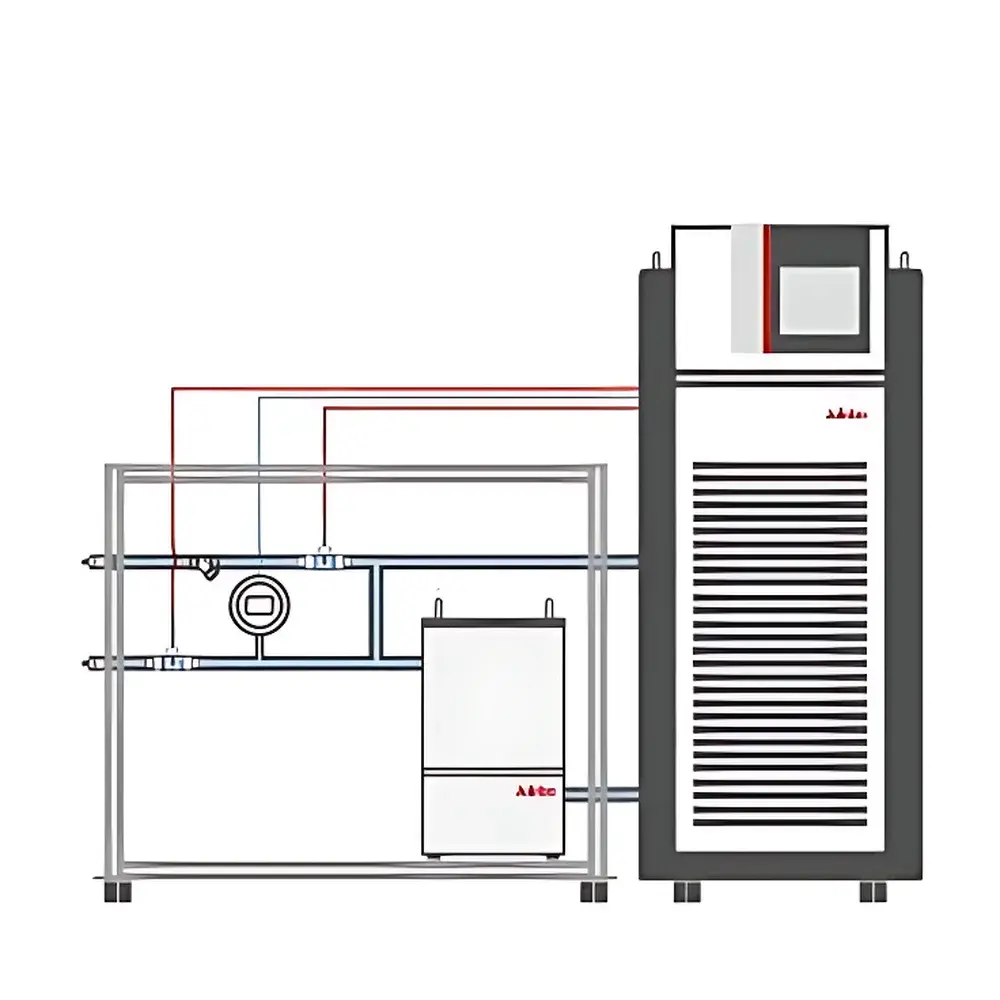
JULABO WCS Series Automotive Wireless Charging System Performance Test Bench
| Brand | JULABO |
|---|---|
| Origin | Germany |
| Model | WCS / WCS-45 / WCS-50 |
| Temperature Range | –35 °C to +90 °C |
| Flow Rate | 2–76 L/min |
| Temperature Stability | ±0.01 °C to ±0.1 °C |
| Display | 5.7″ TFT touchscreen (0.01 °C resolution) |
| Heating Power | 5–6 kW |
| Refrigeration Power (at 20 °C) | 3.5–7.5 kW |
| Pump Pressure | 0.48–3.2 bar |
| Compressor Type | Single-stage, air-cooled or water-cooled |
| Heat Exchanger | Integrated secondary circuit (WCS-45/WCS-50) |
| Circulating Medium | Antifreeze-compatible |
| Communication Interfaces | RS485, Ethernet, Modbus TCP, optional remote control unit |
Overview
The JULABO WCS Series Automotive Wireless Charging System Performance Test Bench is a purpose-engineered thermal management platform designed to replicate and validate the cooling requirements of electric vehicle (EV) wireless power transfer (WPT) systems under controlled, repeatable laboratory conditions. Based on resonant inductive coupling—the dominant topology for automotive WPT—the system demands precise thermal regulation of both transmitter (ground pad) and receiver (vehicle-mounted coil) assemblies to maintain efficiency, prevent thermal runaway, and ensure long-term reliability. The WCS bench integrates high-dynamic-range temperature control, programmable flow delivery, and real-time pressure monitoring to simulate coolant circuits found in OEM-grade wireless charging modules. Unlike generic chillers or heaters, the WCS series is specifically calibrated for the transient thermal loads and low-ΔT operating windows typical of bidirectional WPT validation protocols per SAE J2954 and ISO 15118-20 Annex D.
Key Features
- 5.7-inch industrial TFT color touchscreen with intuitive HMI—enabling direct configuration of setpoints, ramp rates, and alarm thresholds without external software;
- EHC (Enhanced Hybrid Cooling) segmented impact heat exchange technology—optimizing thermal response time during rapid load transitions while extending compressor service life;
- ACC (Active Compression Control) dynamic refrigeration algorithm—delivering stable sub-zero cooling performance even at elevated ambient temperatures, minimizing thermal overshoot during cooldown phases;
- ICC (Intelligent Cascade Control) digital PID architecture—achieving ±0.01 °C temperature stability over extended test durations, critical for evaluating coil efficiency vs. thermal drift;
- High-torque, brushless intelligent circulation pump—programmable for constant pressure (bar), constant flow (L/min), or pressure-compensated flow profiles per ISO 15118-20 thermal validation cycles;
- Hydraulic-sealed fluid path rated for ethylene glycol–water mixtures up to 50% concentration—eliminating compatibility concerns with OEM-specified coolants;
- Dual-stage filtration (inlet + inline)—preventing particulate ingress into sensitive EV cooling loops and ensuring compliance with ISO 4406:2017 cleanliness class 16/14/11;
- Multi-protocol communication stack—native support for Modbus TCP, RS485 (RTU/ASCII), and Ethernet-based SCADA integration for automated test sequencing and data logging;
- Rear-mounted hydraulic connections and front-access operator interface—designed for seamless integration into ISO/IEC 17025-accredited test cells and production line validation bays.
Sample Compatibility & Compliance
The WCS platform supports full-system thermal testing of SAE J2954-compliant ground assembly units (GAUs), vehicle-side receiver modules (VRMs), and integrated power electronics enclosures. Its modular design accommodates varying coolant volume requirements—from compact 2-L benchtop receivers to full-scale 15-L transmitter stacks—via scalable flow calibration and pressure compensation algorithms. All models meet CE, UL 61010-1, and EMC Directive 2014/30/EU requirements. The WCS-45 and WCS-50 variants include secondary-loop heat exchangers compliant with ISO 8502-2 for indirect thermal conditioning, enabling isolation of test articles from primary refrigerant circuits. Firmware supports audit-trail generation per FDA 21 CFR Part 11 and GLP/GMP traceability standards when paired with JULABO’s optional DataTrace software suite.
Software & Data Management
Native firmware provides real-time acquisition of temperature (±0.05 °C accuracy), volumetric flow (±1.5% FS), and system pressure (±0.02 bar) at 10 Hz sampling. Logged datasets are exportable in CSV, XML, or HDF5 formats—with timestamps synchronized to NTP servers. Optional DataTrace software enables automated test script execution (e.g., J2954 Cycle 3 thermal soak + ramp), multi-channel correlation analysis, and PDF report generation with embedded trend plots and statistical summaries (mean, std dev, min/max). Remote access via secure HTTPS portal allows off-site monitoring and parameter adjustment—fully auditable with user-level permissions and electronic signature support for regulated environments.
Applications
- Validation of WPT system thermal efficiency across SAE J2954 power classes (3.7 kW, 7.7 kW, 11 kW) under steady-state and dynamic load conditions;
- Accelerated lifetime testing of coil windings and ferrite shielding under cyclic thermal stress (–40 °C to +90 °C, ΔT ≥ 130 K);
- Thermal interface material (TIM) performance benchmarking between transmitter/receiver plates;
- Verification of vehicle-integrated battery thermal management system (BTMS) interaction during simultaneous wireless charging and drive-cycle simulation;
- Development and calibration of onboard thermal control algorithms for ISO 15118-20 Plug & Charge handshaking sequences;
- Third-party certification testing for TÜV Rheinland, DEKRA, or CSA Group WPT safety and interoperability assessments.
FAQ
What coolant types are compatible with the WCS system?
Ethylene glycol–water mixtures (up to 50% v/v), propylene glycol solutions, and specialized low-conductivity dielectric coolants meeting ASTM D1384 specifications.
Can the WCS bench operate continuously at –35 °C with full flow capacity?
Yes—the WCS-45 and WCS-50 models maintain rated flow (2–12 L/min) and pressure (0.48–3.2 bar) across the full –35 °C to +90 °C range, verified per IEC 60068-2-1 and IEC 60068-2-2.
Is the system suitable for use in an ISO/IEC 17025-accredited laboratory?
Yes—traceable calibration certificates (NIST-traceable Pt100 sensors, flow meters, and pressure transducers) are provided; firmware supports 21 CFR Part 11–compliant electronic records when used with DataTrace.
How does the ACC technology improve high-temperature refrigeration performance?
ACC dynamically modulates compressor speed and expansion valve position based on real-time superheat and condensing pressure feedback—reducing energy consumption by up to 22% during hold phases above 60 °C while maintaining ±0.03 °C stability.
What is the maximum allowable particle size in the circulating fluid?
The dual-stage filter assembly retains particles ≥5 µm; inlet fluid must comply with ISO 4406:2017 code 16/14/11 to prevent clogging of microchannel heat exchangers in WPT receiver modules.





