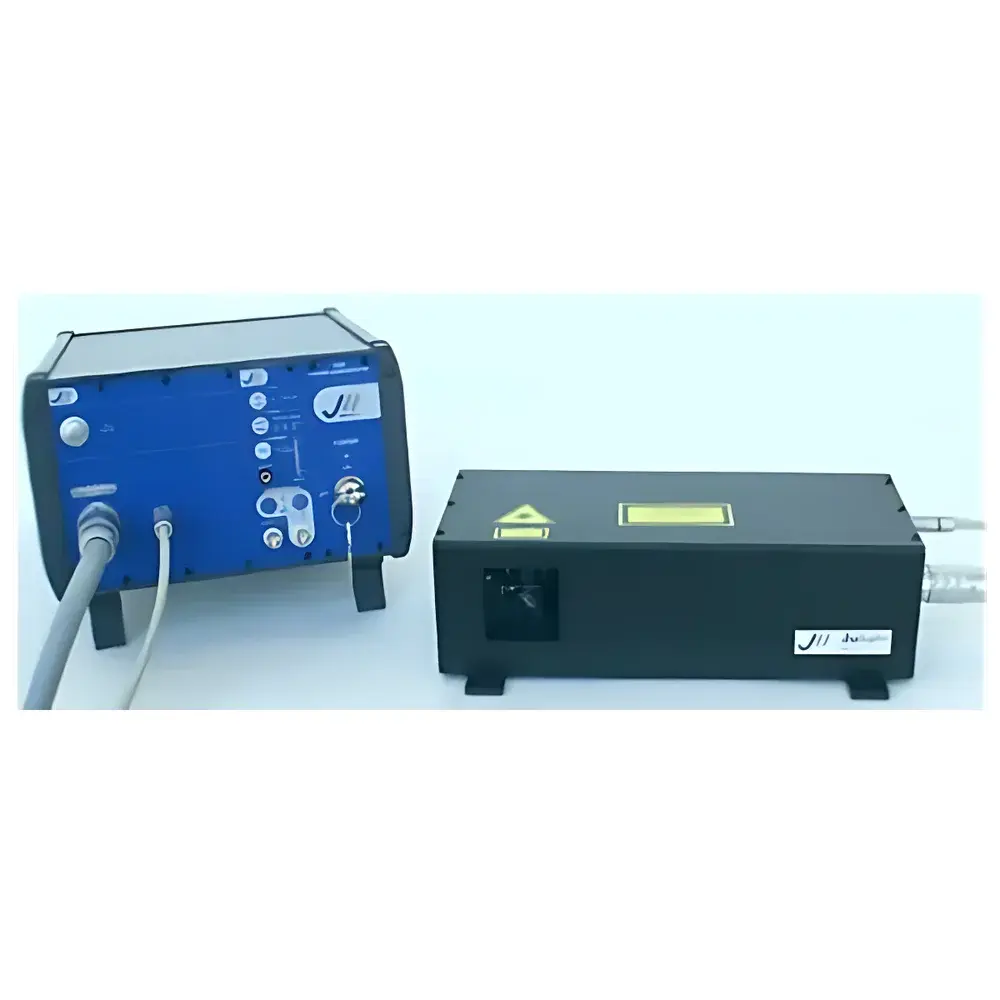
Julight SP-LV-1000 Single-Point Scanning Laser Vibrometer
| Brand | Julight |
|---|---|
| Model | SP-LV-1000 |
| Laser Source | Semiconductor Diode |
| Interferometry Principle | Self-Mixing Interferometry (SMI) |
| Measurement Axis | Normal-to-surface displacement/velocity |
| Operating Distance | 0.1–5 m (customizable up to 50 m) |
| Scan Angle Range | ±25° × ±25° |
| Max Scan Points | 1024 × 1024 per frame |
| Scan Speed | 0.5–50 pts/s |
| Frequency Range | DC–50 kHz (standard) |
| Signal Output | Analog voltage proportional to displacement or velocity |
| Data Acquisition Resolution | Up to 25,600 spectral lines |
| Surface Compatibility | Diffuse, rough, unpolished metals, plastics, rubber, wood, composites |
| Integrated Imaging | 96× real-time color zoom (24× optical + 4× digital), auto-focus, on-screen point selection |
| Software Features | Automated grid generation, programmable scanning, modal analysis, FRF quality assessment, time/frequency domain recording, 3D animation & visualization |
| Compliance | Designed for GLP/GMP-aligned workflows |
Overview
The Julight SP-LV-1000 Single-Point Scanning Laser Vibrometer is a high-precision, non-contact vibration measurement system engineered for laboratory, R&D, and industrial modal analysis applications. It operates on the principle of self-mixing interferometry (SMI), where scattered light from the target surface re-enters the laser cavity and interferes with the original beam—eliminating the need for external reference arms or complex optical alignment. This architecture delivers exceptional phase stability, high signal-to-noise ratio (SNR), and immunity to environmental vibration drift. Unlike traditional heterodyne systems, the SMI-based design enables compact, robust laser head integration with minimal sensitivity to air turbulence or mechanical perturbation. The instrument measures absolute normal-direction displacement and velocity in real time, supporting both steady-state and transient vibration characterization across a broad dynamic range—from quasi-static (DC) conditions to ultra-high-frequency resonance phenomena.
Key Features
- Integrated 96× real-time color imaging system (24× optical + 4× digital zoom) with auto-focus, enabling intuitive, pixel-accurate point selection directly on live surface imagery.
- Programmable ±25° × ±25° dual-axis galvanometric scanning with up to 1,048,576 points (1024 × 1024) per full-field acquisition—supporting modal testing of components ranging from millimeter-scale MEMS devices to multi-meter civil structures.
- Modular frequency extension capability: standard DC–50 kHz bandwidth, expandable to DC–3 MHz, DC–10 MHz, or DC–35 MHz via optional EXT hardware modules—enabling blade-tip dynamics, ultrasonic NDT, and micro-electromechanical system (MEMS) characterization.
- Automated scan workflow: one-click focus, one-click full-grid execution, and adaptive signal quality monitoring using real-time color-coded feedback (green/yellow/red) based on coherence, SNR, and fringe visibility metrics.
- Onboard analog output (±10 V) scaled to displacement (µm/V) or velocity (mm/s/V), synchronized with digital acquisition for hybrid test setups integrating shakers, force transducers, or acoustic emission sensors.
Sample Compatibility & Compliance
The SP-LV-1000 is validated for reliable operation on optically challenging surfaces—including unpolished aluminum, cast iron, injection-molded thermoplastics, carbon-fiber composites, rubber gaskets, and porous timber—without requiring retro-reflective tape or surface preparation. Its low-power semiconductor laser (Class 2M, <1 mW) ensures safe operation in shared lab environments. The system meets electromagnetic compatibility requirements per EN 61326-1 and is designed to support traceable metrology workflows compliant with ISO/IEC 17025. Data export formats (UFF58, HDF5, CSV) are structured to align with FDA 21 CFR Part 11 electronic record integrity guidelines when deployed in regulated GxP environments. All calibration certificates are traceable to NIST standards via Julight’s accredited metrology lab.
Software & Data Management
The proprietary VibroScan™ software suite provides a unified interface for configuration, acquisition, post-processing, and reporting. It includes automated modal parameter extraction (natural frequencies, damping ratios, mode shapes) using Enhanced Frequency Domain Decomposition (EFDD) and PolyMAX algorithms. Each measured point records synchronized time-history and FFT spectra (up to 25,600 spectral lines), with automatic scaling and anti-aliasing filtering. The software implements configurable FRF quality thresholds—flagging points with coherence <0.85 or SNR <40 dB for re-measurement. Audit logs capture user actions, parameter changes, and calibration events. Export modules generate publication-ready figures, interactive HTML reports, and 3D animated mode shape visualizations compatible with ANSYS Mechanical and Siemens Testlab interoperability protocols.
Applications
The SP-LV-1000 serves as a primary tool for structural dynamics validation in automotive NVH engineering—measuring brake disc chatter modes, windshield acoustic response, and powertrain housing vibrations under operational loads. In aerospace, it characterizes turbine blade flutter, winglet resonance, and composite panel delamination signatures. Acoustic engineers use it for sound source localization (SSL) on loudspeakers, HVAC ducts, and transformer enclosures. In materials science, it supports fatigue life modeling through strain field mapping derived from curvature-based differentiation of displacement fields. Additional use cases include non-destructive evaluation of bonded joints, aging assessment of aircraft fuselages, and ground vibration testing of satellite payloads prior to launch.
FAQ
What laser safety class does the SP-LV-1000 operate under?
It uses a Class 2M visible semiconductor laser (635 nm, <1 mW), requiring no special interlocks or laser safety officer oversight in typical lab configurations.
Can the system measure rotating components without triggering motion blur?
Yes—the galvo-scanned laser spot dwell time is adjustable down to sub-millisecond intervals, and phase-locked acquisition synchronizes with encoder signals for precise rotor position tracking.
Is third-party software integration supported?
Yes—DLL APIs and TCP/IP command protocols enable direct control from MATLAB, LabVIEW, Python (via PyVibro), and NI TestStand.
How is calibration maintained over long-term deployment?
The system includes built-in reference interferometer diagnostics and supports periodic verification using NIST-traceable piezoelectric shaker standards (e.g., PCB 352C33).
Does the software support automated pass/fail criteria for production line testing?
Yes—user-defined limit templates can be applied across frequency bands, amplitude thresholds, and coherence windows, with automated report generation and database logging.