
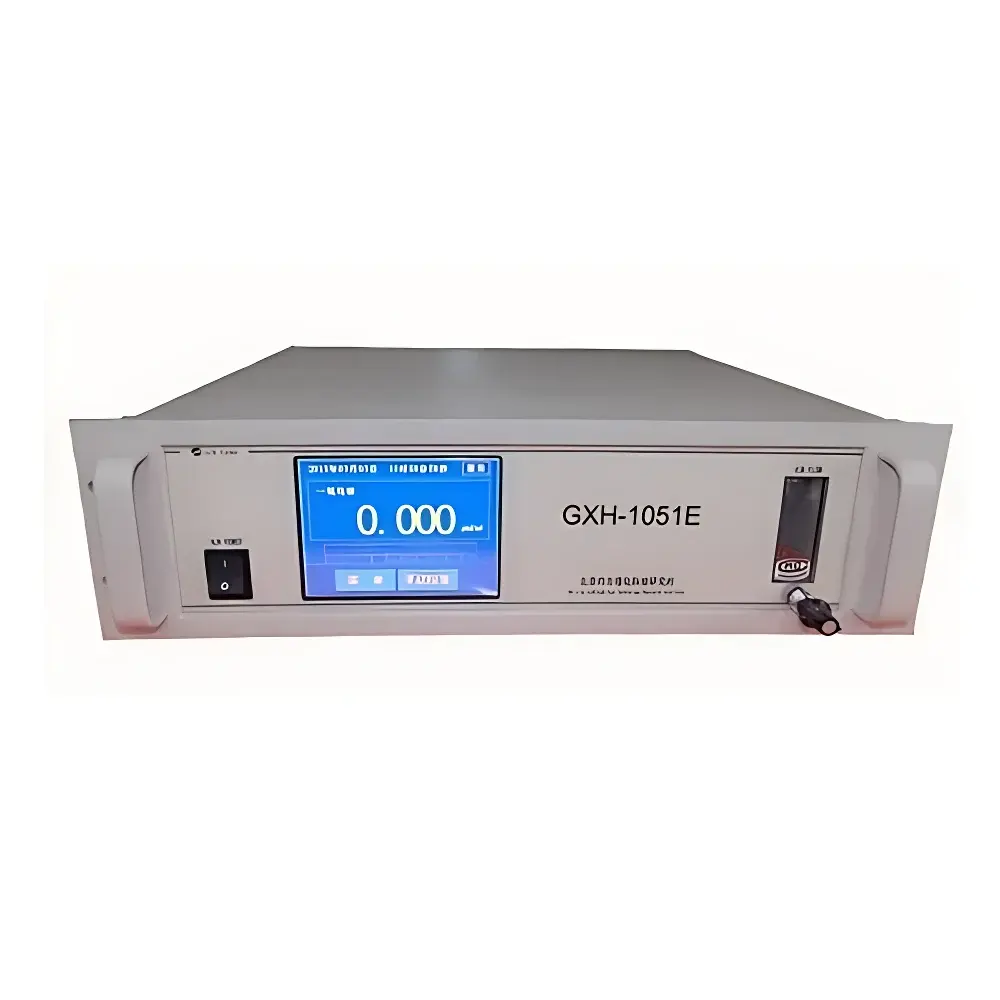
Junfang Lihua GXH-1051E Online Carbon Monoxide (CO) Analyzer with NDIR Detection
| Brand | Junfang Lihua |
|---|---|
| Origin | Beijing, China |
| Model | GXH-1051E |
| Instrument Type | Online Gas Analyzer |
| Detection Principle | Non-Dispersive Infrared (NDIR) Absorption |
| Target Gas | Carbon Monoxide (CO) only |
| Measurement Range | 0–50 ppm (standard), customizable up to 0–100% vol |
| Minimum Detectable Concentration | 0.1 ppm |
| Repeatability | ≤ ±1% FS |
| Linearity Error | ≤ ±2% FS |
| Zero Drift | ≤ ±1% FS / 24 h |
| Span Drift | ≤ ±1% FS / 24 h |
| Response Time (T90) | ≤ 60 s |
| Resolution | 0.1 ppm |
| Operating Humidity | ≤ 90% RH (non-condensing) |
| Power Supply | AC 220 V ±10%, 50 Hz ±5% |
| Output Signals | 4–20 mA analog + RS232 digital interface |
| Internal Sampling Pump | Integrated |
| Display | Backlit LCD with touch control |
| Data Logging | Onboard memory with USB/PC software download capability |
Overview
The Junfang Lihua GXH-1051E is an online, single-component carbon monoxide (CO) gas analyzer engineered for continuous, real-time monitoring in industrial process streams, environmental emission stacks, laboratory exhaust systems, and indoor air quality applications. It employs non-dispersive infrared (NDIR) absorption spectroscopy—a well-established, interference-resistant optical technique—where CO molecules selectively absorb infrared radiation at a characteristic wavelength (~4.6 µm). The instrument’s optical path is thermally stabilized to minimize thermal drift, ensuring stable baseline performance across ambient temperature fluctuations. Designed as a rack-mountable or wall-mounted process analyzer, the GXH-1051E integrates an internal sampling pump, flow regulation, and conditioned sample handling to support unattended operation in demanding environments. Its architecture conforms to fundamental requirements of ISO 12039 (stationary source emissions — determination of carbon monoxide) and aligns with measurement principles referenced in EPA Method 10 and EN 15267-3 for automated gas analyzers used in regulatory compliance contexts.
Key Features
- NDIR-based detection optimized for CO specificity—minimal cross-sensitivity to CO₂, CH₄, H₂O vapor, and common hydrocarbons due to narrow-band optical filtering and reference channel compensation
- Integrated sample conditioning system including particulate filtration, moisture removal (via Peltier-cooled condenser), and pressure-regulated flow control
- Thermally stabilized optical cell with dual-beam configuration for high signal-to-noise ratio and long-term zero stability
- Onboard microprocessor with embedded firmware supporting automatic zero/span calibration routines, diagnostic self-checks, and alarm thresholds
- Large backlit LCD touchscreen interface enabling local parameter configuration, real-time trend display, and event log review without external PC
- Robust mechanical design compliant with IP54 enclosure rating for dust and splash resistance in industrial settings
- Dual-output architecture: isolated 4–20 mA analog output (HART-compatible) plus RS232 serial communication for integration into SCADA, DCS, or data acquisition systems
Sample Compatibility & Compliance
The GXH-1051E is validated for use with dry, non-corrosive, low-particulate gas matrices typical of flue gas ducts, ventilation exhausts, biogas upgrading lines, and cleanroom ambient monitoring. It is not intended for direct measurement in high-humidity (>90% RH), high-acid-gas (e.g., SO₂ > 50 ppm), or high-dust concentration streams without upstream conditioning. The analyzer meets electromagnetic compatibility (EMC) requirements per GB/T 18268.1–2010 (equivalent to IEC 61326-1) and safety standards per GB 4793.1–2007 (IEC 61010-1). While not certified to UL/CE for hazardous area installation, it supports Class I, Division 2 (CID2) deployment when installed with appropriate barrier systems. Calibration traceability follows national metrological verification procedures outlined in JJG 695–2019 (Calibration Specification for CO Gas Analyzers).
Software & Data Management
A Windows-based configuration and data management software package is supplied for remote setup, firmware updates, and historical data export. The software enables time-stamped logging of raw sensor signals, diagnostic flags (e.g., low flow, optical contamination warning), calibration events, and user-access audit trails—supporting basic GLP documentation needs. Data files are stored in CSV format for third-party analysis in MATLAB, Python (Pandas), or statistical process control (SPC) platforms. All configuration changes and calibration actions are timestamped and logged internally with user ID tagging where enabled via password-protected access levels.
Applications
- Continuous emission monitoring (CEM) of CO from coal-fired boilers, waste incinerators, and cement kilns
- Process control in syngas production, hydrogen reforming, and Fischer–Tropsch reactors
- Indoor air quality (IAQ) surveillance in parking garages, tunnels, and underground facilities
- Leak detection and safety interlock in CO-handling laboratories and pharmaceutical manufacturing suites
- Research-grade CO quantification in combustion studies, catalyst testing, and atmospheric simulation chambers
FAQ
What gases can the GXH-1051E measure simultaneously?
It is a single-component analyzer configured exclusively for carbon monoxide (CO); multi-gas capability requires separate instruments or modular NDIR platforms.
Is factory calibration traceable to national standards?
Yes—each unit ships with a calibration certificate referencing certified CO standard gases traceable to China National Institute of Metrology (NIM) standards.
Can the instrument operate continuously without manual intervention?
Yes—it supports unattended 24/7 operation with scheduled auto-zero and optional span calibration; maintenance intervals are recommended every 3–6 months depending on sample cleanliness.
Does the GXH-1051E comply with FDA 21 CFR Part 11 for electronic records?
No—the onboard data logger does not provide electronic signature, audit trail encryption, or role-based access control required under Part 11; it satisfies basic GMP record-keeping but not full ALCOA+ compliance.
What is the expected service life of the NDIR optical module?
Under normal operating conditions, the infrared source and detector assembly maintains functional integrity for ≥5 years, with mean time between failures (MTBF) exceeding 15,000 hours.
Related Products







