
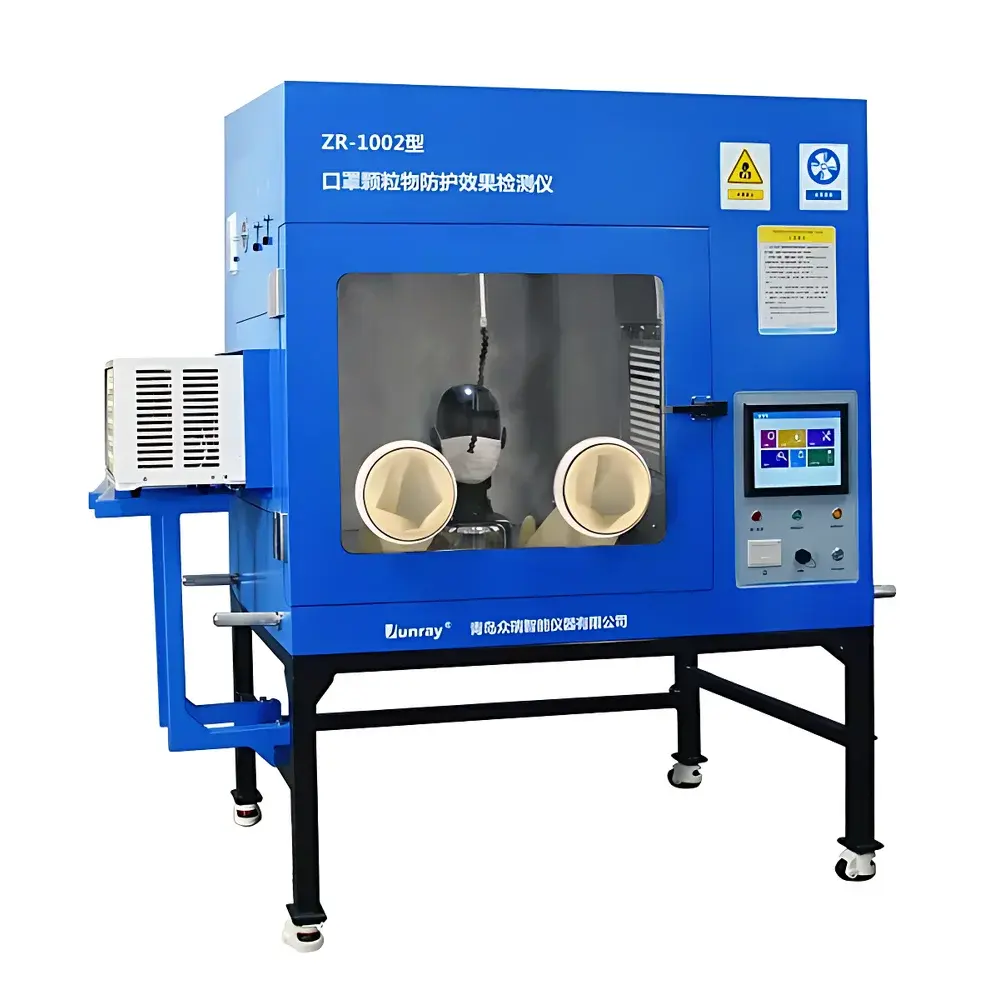
Junray ZR-1002 Aerosol Filtration Efficiency and Breathing Resistance Tester
| Brand | Junray |
|---|---|
| Origin | Shandong, China |
| Manufacturer Type | Direct Manufacturer |
| Country of Origin | China |
| Model | ZR-1002 |
| Instrument Category | Aerosol Testing System |
| Compliance Standards | GB/T 6165–2008, GB 2626–2006, GB/T 32610–2016 |
Overview
The Junray ZR-1002 Aerosol Filtration Efficiency and Breathing Resistance Tester is a fully integrated, laboratory-grade instrument engineered for standardized evaluation of particulate filtration performance and inhalation/exhalation resistance of respiratory protective devices—including surgical masks, KN95/N95 respirators, daily protective masks, and filter media. It operates on the principle of real-time photometric aerosol concentration comparison across a test specimen mounted on a standardized headform, using controlled challenge aerosols under simulated breathing conditions. The system conforms to the fundamental physical measurement paradigm defined in ISO 16890 (air filter testing), ASTM F2299 (filter efficiency by particle size), and aligned methodologies referenced in EN 149 and EN 14683. Its core architecture centers on a 500 L self-cleaning test chamber equipped with calibrated optical aerosol sensors, programmable sinusoidal flow generation, and dual-aerosol challenge capability—enabling quantitative determination of filtration efficiency (%) and differential pressure (Pa) across the specimen at specified flow rates.
Key Features
- Integrated dual-function design: simultaneous measurement of aerosol filtration efficiency and breathing resistance per regulatory test cycles.
- 500 L sealed, HEPA-filtered test chamber with integrated operator gloves for safe, contamination-free mask installation and removal.
- Interchangeable headform interface supporting three standardized anthropometric headforms (e.g., adult male, adult female, and adolescent per GB/T 2626–2006 Annex A), enabling rapid configuration without recalibration.
- Independent control of upstream salt-based (NaCl, median diameter 0.6 µm, concentration 25 mg/m³) and oil-based (DEHS or paraffin oil, median diameter 0.3 µm, concentration 25 mg/m³) aerosol generators—fully compliant with GB/T 32610–2016 and GB 2626–2006 challenge requirements.
- Real-time photometric detection using long-life laser light sources and high-sensitivity photomultiplier tube (PMT) detectors; upstream/downstream optical paths are independently calibrated and thermally stabilized.
- Automated breathing simulation: programmable sinusoidal airflow waveform (e.g., 30 L/min average flow, 15–45 L/min peak-to-peak) replicating human respiratory dynamics per ISO 16900–1.
- Embedded industrial touchscreen HMI (≥10.1″) with intuitive workflow navigation, live flow curve visualization, auto-calculated filtration efficiency, and dynamic pressure drop display.
- Comprehensive maintenance logging: automatic tracking of PMT operational hours, HEPA filter service life, and scheduled cleaning alerts based on cumulative exposure time and particle load estimation.
Sample Compatibility & Compliance
The ZR-1002 accommodates flat-panel filter media (up to 150 mm × 150 mm), pre-formed cup-style respirators, and folded flat-fold masks mounted on certified headforms. All mechanical interfaces adhere to dimensional tolerances specified in GB/T 2626–2006 Annex B and GB/T 32610–2016 Clause 6.2. The system supports full traceability required under GLP environments: audit trails record operator ID, test date/time, calibration status, aerosol generator settings, raw photometric voltage outputs, and final calculated metrics. Data integrity complies with principles aligned with FDA 21 CFR Part 11 (electronic records and signatures) when used with validated software configurations and access-controlled user accounts.
Software & Data Management
The embedded firmware implements deterministic data acquisition at ≥10 Hz sampling rate for both photometric channels and differential pressure transducers. All raw and processed data—including time-stamped flow waveforms, upstream/downstream extinction ratios, filtration efficiency (%), and ΔP values—are stored locally in CSV-compliant format. Export is supported via USB flash drive (FAT32 formatted) with folder-structured archives per test batch. Optional network-enabled firmware (via Ethernet port) allows remote monitoring and centralized database integration using standard OPC UA or Modbus TCP protocols. Built-in thermal printer provides immediate hard-copy output of summary reports including test ID, standard reference, pass/fail status per GB/T 32610–2016 Table 3 thresholds, and operator signature field.
Applications
- Regulatory compliance testing for medical device manufacturers seeking NMPA registration under YY 0469–2011 or GB 19083–2010.
- QC/QA validation of filter media batches in cleanroom environments prior to respirator assembly.
- Comparative R&D studies evaluating electrostatic charge decay, humidity effects on filtration, or multi-layer composite performance.
- Third-party certification laboratories conducting accredited testing per CNAS-CL01:2018 (equivalent to ISO/IEC 17025).
- Epidemiological support functions in CDC and provincial health institutes performing emergency PPE screening during public health events.
FAQ
Does the ZR-1002 meet international standards such as ISO 16972 or EN 149?
It implements test methodologies harmonized with key elements of ISO 16972 (respiratory protective devices — test methods) and EN 149:2001+A1:2009, particularly for aerosol generation, flow simulation, and efficiency calculation logic. Full conformance requires site-specific validation against the latest edition of each standard.
Can the system be used for testing nonwoven meltblown layers separately from finished masks?
Yes — the headform mounting fixture includes an auxiliary flat-sample holder compatible with 100 mm diameter circular specimens or 150 mm × 150 mm square samples, enabling direct filter media characterization.
Is external calibration of photometers required, and how often?
Initial factory calibration is traceable to NIM (National Institute of Metrology, China). Users must perform quarterly verification using NIST-traceable neutral density filters and annual full recalibration by authorized service engineers.
What safety provisions prevent operator exposure to challenge aerosols?
The chamber features negative-pressure containment (< −25 Pa relative to lab ambient), redundant HEPA exhaust filtration (≥99.99% @ 0.3 µm), and interlocked glove ports with automatic aerosol purge cycle prior to door opening.
How is breathing resistance measured — static or dynamic pressure?
Both: the system records instantaneous differential pressure across the specimen synchronized with the sinusoidal airflow waveform, then computes average inspiratory and expiratory resistance per GB 2626–2006 Section 6.4.2.
Related Products







