
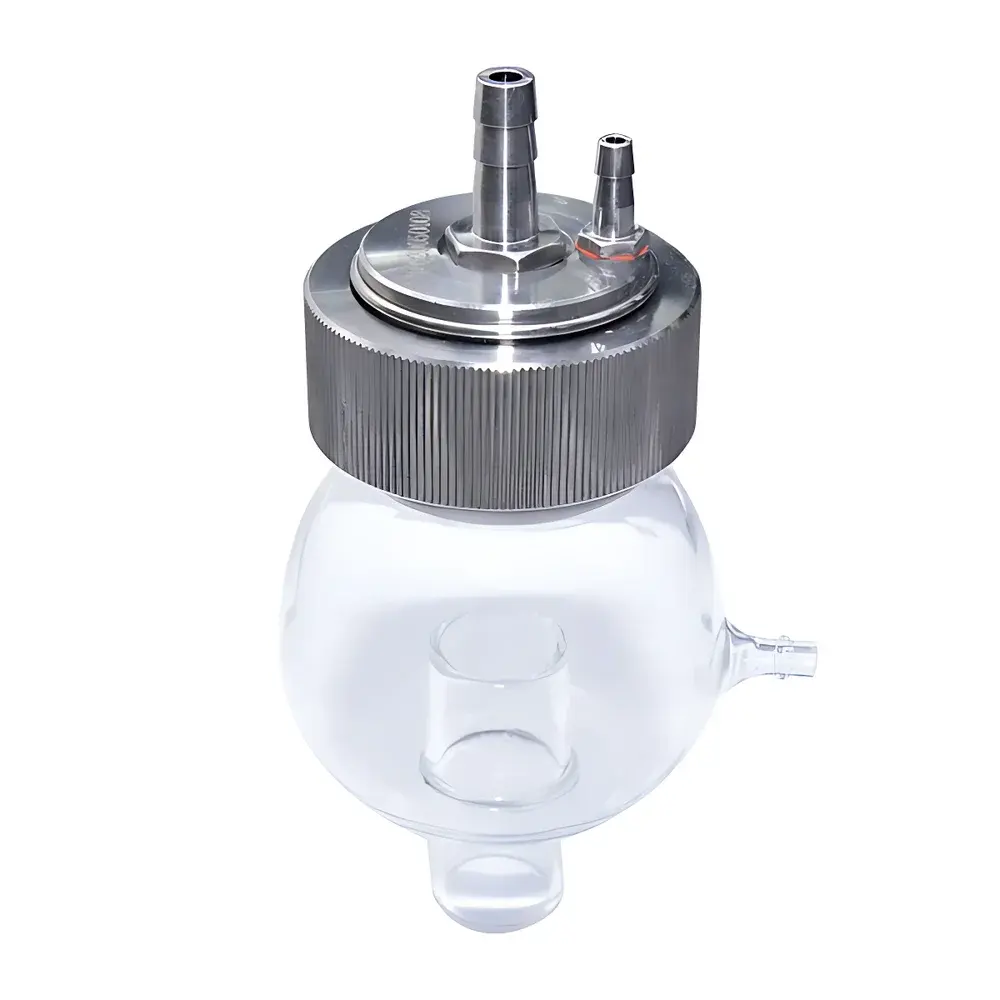
Junray ZR-C01A Microbial Aerosol Generator
| Brand | Junray |
|---|---|
| Model | ZR-C01A |
| Origin | Shandong, China |
| Manufacturer | Junray Instrument Co., Ltd. |
| Construction | Borosilicate Glass Body |
| Sterilization Compatibility | Autoclavable (121 °C, 20 min) |
| Interface Configuration | 5-port manifold (Gas Inlet, Liquid Inlet, Aerosol Outlet, Dual Cleaning Ports) |
| Fluid Delivery | Compatible with Peristaltic Pump via Silicone Tubing |
| Gas Supply Requirement | Compressed Air or Nitrogen (3–6 bar, oil-free, particle-filtered) |
| Regulatory Alignment | Complies with GB/T 18204.3–2013 (China National Standard for Microbial Aerosol Generation and Sampling) |
Overview
The Junray ZR-C01A Microbial Aerosol Generator is a precision-engineered accessory designed exclusively for use with the ZR-1000 Bioaerosol Detection System. It operates on the principle of pneumatic nebulization—utilizing high-velocity compressed gas to shear liquid microbial suspensions into monodisperse or polydisperse aerosol particles within the respirable size range (typically 0.5–5 µm aerodynamic diameter). This physical generation mechanism avoids thermal degradation of viable microorganisms and preserves biological integrity during aerosolization. The device is engineered for reproducible, low-loss delivery of bioaerosols into controlled test chambers, exposure ducts, or air sampling systems—enabling standardized challenge testing of air filtration media, disinfection protocols, biosafety cabinet performance, and real-time bioaerosol sensor validation.
Key Features
- Borosilicate glass construction ensures chemical inertness, optical clarity for visual process monitoring, and full compatibility with autoclave sterilization (121 °C, 20 minutes), supporting strict aseptic handling in GLP/GMP-compliant laboratories.
- Five-port modular interface design: dedicated gas inlet (3–6 bar), liquid inlet (peristaltic pump-coupled), aerosol outlet (direct connection to ZR-1000 aerosol chamber), and two auxiliary cleaning ports—enabling closed-loop rinsing with ethanol, hydrogen peroxide vapor, or sterile saline without disassembly.
- No moving parts or internal valves; aerosol output is governed solely by gas pressure, liquid flow rate, and nozzle geometry—minimizing maintenance requirements and enhancing long-term operational stability.
- Calibration-ready geometry: consistent orifice dimensions and fluidic pathways support traceable aerosol mass concentration estimation when paired with gravimetric or optical particle sizers (e.g., APS, SMPS) per ISO 21501-4 and ASTM D6674.
- Designed for integration within ISO 14644-3 classified environments; surface finish and joint sealing meet Class 5 cleanroom particulate control requirements.
Sample Compatibility & Compliance
The ZR-C01A accommodates aqueous suspensions of bacterial spores (e.g., Bacillus atrophaeus, Geobacillus stearothermophilus), vegetative bacteria (Pseudomonas fluorescens, Escherichia coli), fungal conidia (Aspergillus niger), and virus surrogates (e.g., MS2 bacteriophage) in concentrations ranging from 10⁴ to 10⁸ CFU/mL. All materials in contact with biofluids comply with USP Class VI biocompatibility standards. The generator meets the functional requirements outlined in GB/T 18204.3–2013 for microbial aerosol generation equipment used in public health and environmental hygiene evaluation. While not certified to ISO 14644-7 for cleanroom equipment, its design facilitates audit readiness for ISO/IEC 17025-accredited microbiological testing laboratories conducting filter efficiency (EN 1822, ISO 29463) or BSC certification (NSF/ANSI 49) studies.
Software & Data Management
As a hardware-only aerosol generation module, the ZR-C01A does not incorporate embedded firmware or digital interfaces. Its operation is fully manual and externally controlled: gas pressure regulated via precision needle valve, liquid flow rate modulated via programmable peristaltic pump (e.g., Watson-Marlow 323Du), and aerosol output duration timed using laboratory-grade stopwatches or external PLC triggers. When deployed with the ZR-1000 detection platform, aerosol challenge data—including timing synchronization, flow logs, and real-time viability counts—are recorded under 21 CFR Part 11-compliant audit trail functionality within the ZR-1000’s proprietary acquisition software. Raw aerosol generation parameters are documented in electronic lab notebooks (ELN) to satisfy GLP documentation requirements for method validation reports.
Applications
- Challenge testing of HEPA and ULPA filters per EN 1822-1 and ISO 29463-1 using standardized biological test agents.
- Performance verification of biosafety cabinets (BSCs) and isolators according to NSF/ANSI 49 and EN 12469 protocols.
- Calibration and response characterization of real-time bioaerosol monitors (e.g., UV-APS, fluorescence-based sensors).
- Development and validation of airborne disinfection technologies, including dry fog hydrogen peroxide, UV-C irradiation, and photocatalytic oxidation systems.
- Experimental simulation of occupational or environmental pathogen exposure scenarios in inhalation toxicology and aerosol medicine research.
FAQ
Is the ZR-C01A compatible with non-Junray detection platforms?
Yes—provided the receiving system accepts 6–8 mm ID silicone tubing input and maintains stable negative pressure or laminar flow conditions at the aerosol inlet port. Users must validate aerosol transport efficiency independently.
Can the generator be used with viscous or non-aqueous suspensions?
No. It is validated only for low-viscosity aqueous microbial suspensions (≤5 cP). Higher viscosity fluids risk clogging and inconsistent droplet formation.
What is the recommended maintenance interval between sterilization cycles?
Inspect glass body and tubing connections for microfractures or etching after every 10 autoclave cycles; replace silicone tubing after 20 uses or upon visible hardening/cracking.
Does Junray provide NIST-traceable aerosol output certification?
No. Traceable aerosol concentration calibration requires third-party particle sizing instrumentation and is performed by the end user per ISO 21501-4 Annex B guidelines.
Is the ZR-C01A suitable for Good Manufacturing Practice (GMP) environments?
Yes—when operated within validated cleanrooms and integrated into documented SOPs that include pre-use sterility checks, post-use decontamination logs, and operator training records.







