
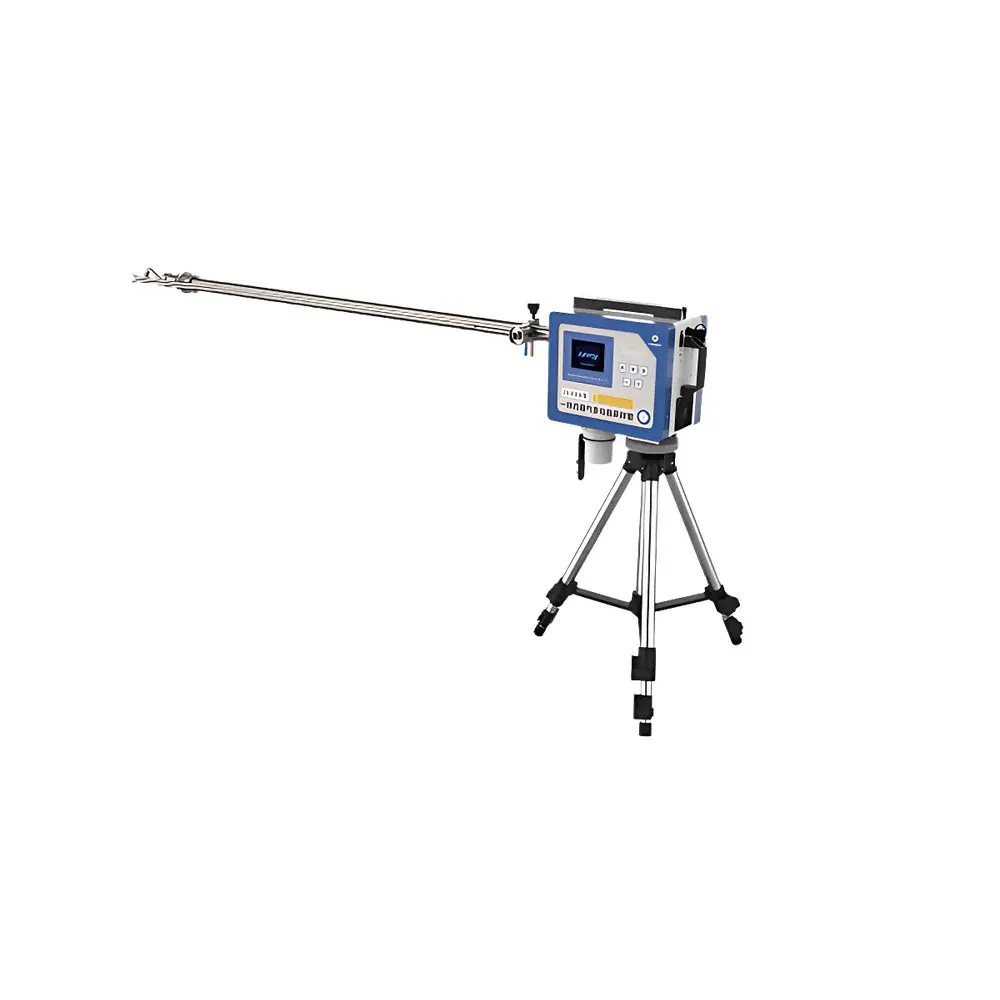
Junray ZR-D25A Integrated Multi-Function Flue Gas Sampling Probe
| Brand | Junray |
|---|---|
| Origin | Shandong, China |
| Manufacturer Type | Direct Manufacturer |
| Product Category | Domestic |
| Model | ZR-D25A |
| Instrument Type | Flue Gas Sampler |
| Sample Types | Particulate Matter (PM), Flue Gas, Moisture Content, Flow Velocity, Flue Gas Temperature |
| Flow Accuracy | ±2% |
| Sampling Flow Rates | 10–200 mL/min or 0.2–1.5 L/min |
| Flue Gas Velocity Range | 1–45 m/s |
| Moisture Content Range | 0–40 vol% |
Overview
The Junray ZR-D25A Integrated Multi-Function Flue Gas Sampling Probe is an engineered field instrument designed for simultaneous, in-situ sampling and real-time parametric measurement at stationary emission sources. It operates on the principle of integrated isokinetic sampling—combining gravimetric particulate capture with conditioned gas extraction, resistive-capacitive (RC) moisture sensing, S-type Pitot tube-based velocity determination, and direct-contact temperature monitoring via Pt100 platinum resistance thermometers. Unlike modular probe systems requiring external signal conditioning or separate calibration routines, the ZR-D25A embeds all sensor transduction, analog-to-digital conversion, and data synchronization within a single, thermally stabilized stainless-steel housing. This architecture ensures temporal coherence across co-located measurements—critical for regulatory compliance with mass balance calculations under ISO 16911-1:2013 and EPA Method 5/17/201A.
Key Features
- Monolithic probe design integrating five concurrent measurement functions: particulate filtration (via standardized quartz or glass-fiber filter media), acid-scrubbed gas sampling (with built-in PTFE-coated condensate trap and dual-stage cooling), RC-based moisture detection, S-type Pitot tube for velocity profiling, and flue gas temperature sensing.
- Isokinetic flow control maintained across dual selectable flow ranges (10–200 mL/min for low-flow absorption solutions; 0.2–1.5 L/min for high-volume particulate collection), each calibrated traceably to NIST-traceable flow standards.
- Real-time parameter display and logging via a 5-inch industrial-grade capacitive touchscreen with physical tactile keys—operable under ambient temperatures from −20 °C to +50 °C and relative humidity up to 85 % RH (non-condensing).
- Onboard data management supporting Bluetooth 4.2 wireless thermal printing, USB 2.0 mass storage export (CSV/Excel-compatible), and RS485 Modbus RTU protocol for integration into centralized SCADA or CEMS platforms.
- Modular nozzle set included (diameters: 4, 6, 8, 10, 12 mm) enabling velocity-adapted isokinetic sampling per GB/T 16157-1996 and HJ 836-2017 requirements for low-concentration PM testing.
Sample Compatibility & Compliance
The ZR-D25A complies with national and industry-specific standards governing emissions monitoring in China, including but not limited to GB/T 11605-2005 (humidity measurement), GB/T 16157-1996 (particulate and gaseous pollutant sampling), HJ/T 48-1999 (technical specifications for particulate samplers), HJ 836-2017 (low-concentration particulate gravimetric method), and DB37/T 2537-2014 (Shandong provincial adaptation of HJ 836). While not intrinsically rated for hazardous area use, its construction meets IP54 ingress protection for field deployment in non-explosive industrial environments. All electronic components are CE-marked for electromagnetic compatibility (EN 61326-1) and safety (EN 61010-1).
Software & Data Management
Firmware supports configurable sampling protocols—including time-weighted average (TWA), point-integrated, and velocity-tracked isokinetic modes—with automatic calculation of normalized dry standard cubic meters (Nm³) based on measured temperature, pressure, and moisture content. Audit trails record operator ID, timestamp, calibration history, and system diagnostics. Data files include embedded metadata compliant with GLP principles: sensor serial numbers, calibration dates, and environmental condition stamps. Exported datasets are structured for direct import into LIMS or regulatory reporting tools such as China’s National Emission Permit Management Platform.
Applications
- Regulatory stack testing for coal-fired power plants, cement kilns, waste incinerators, and chemical process heaters.
- Low-concentration particulate matter (PM₂.₅/PM₁₀) verification per HJ 836-2017 using quartz filter membranes and controlled drying/weighing workflows.
- Multi-point velocity profiling and moisture mapping in large-diameter ducts to validate CEMS probe placement per HJ 75-2017.
- Field validation of continuous emission monitoring systems (CEMS) for SO₂, NOₓ, CO, and O₂ through parallel solution absorption (e.g., KI for SO₂, sulfanilamide/NEDD for NOₓ).
- Pre-compliance assessment during boiler commissioning or post-retrofit performance verification.
FAQ
Can the ZR-D25A be used for EPA Method 5 sampling?
Yes—the probe satisfies all mechanical and procedural requirements of EPA Method 5 when paired with a certified vacuum source, impingers, and appropriate filter holders. Its ±2% flow accuracy and isokinetic nozzle selection meet Method 5’s flow tolerance criteria.
Does the device support automated isokinetic tracking during traverse?
No—it provides manual isokinetic adjustment via pre-calculated nozzle selection and fixed flow rate setting. Real-time velocity feedback enables operator-driven correction during multi-point traverses.
What filter media are compatible with the particulate sampling module?
Standard 47-mm quartz fiber filters (e.g., Pallflex Tissuquartz QAT-UP) and glass-fiber filters meeting GB/T 16157-1996 specifications are supported. Filter cassettes are removable and reusable after solvent cleaning.
Is firmware update capability available over USB or Bluetooth?
Firmware updates require connection via USB to a Windows PC running Junray’s proprietary configuration utility. Bluetooth is reserved for data transfer and printing only.
How is moisture measurement validated against reference standards?
RC sensor output is factory-calibrated against chilled-mirror hygrometer references (Rotronic HC2-AW) across 5–40 vol% at 120 °C flue gas temperature. A two-point verification routine is accessible in service mode using NIST-traceable saturated salt solutions.
Related Products







