
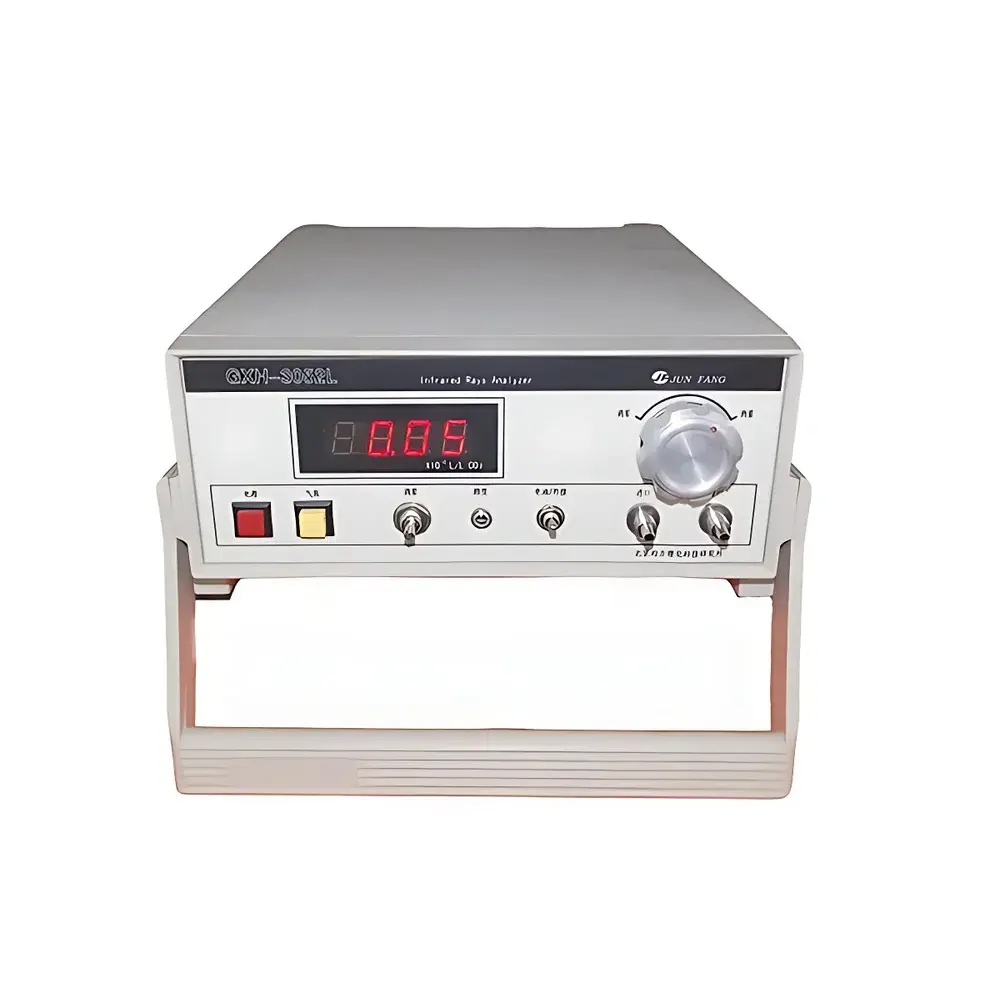
Junsquare GXH-3052L Portable NDIR Carbon Dioxide Analyzer
| Brand | Junsquare |
|---|---|
| Model | GXH-3052L |
| Instrument Type | Portable Gas Analyzer |
| Detection Principle | Non-Dispersive Infrared (NDIR) |
| Target Gas | CO₂ (single-component) |
| Measurement Range | 0–1000 ppm |
| Resolution | 1 ppm |
| Repeatability | ±1% FS |
| Linearity Error | ≤±2% FS |
| Zero Drift | ≤±2% FS |
| Span Drift | ≤±2% FS |
| Response Time (T₉₀) | ≤30 s |
| Power Supply | DC (battery-operated) |
| Compliance | Designed per GB/T 18204.2–2014, HJ 870–2017, and ISO 8573-1 for ambient and stack gas CO₂ monitoring |
Overview
The Junsquare GXH-3052L is a portable, battery-powered non-dispersive infrared (NDIR) carbon dioxide analyzer engineered for field-deployable, high-fidelity CO₂ concentration measurement in ambient air, indoor environments, soil gas efflux, respiratory gas sampling, plant canopy studies, and low-concentration flue or tail gas streams. Unlike electrochemical or metal oxide semiconductor sensors, the GXH-3052L employs dual-wavelength NDIR detection with a thermopile detector and temperature-stabilized optical path—ensuring immunity to cross-sensitivity from CO, CH₄, SO₂, NOₓ, and water vapor within typical environmental matrices. Its optical architecture features a sealed, gold-plated sample chamber with integrated pressure and temperature compensation algorithms, enabling stable operation across 0–40 °C and 30–90% RH without active drying or scrubbing. The instrument meets the metrological requirements of Chinese national standards GB/T 18204.2–2014 (for public place air quality) and HJ 870–2017 (for greenhouse gas monitoring in stationary sources), and its measurement traceability aligns with ISO 8573-1 Annex C for compressed air purity assessment.
Key Features
- True single-gas NDIR platform optimized exclusively for CO₂—no calibration drift induced by co-present gases such as CO, H₂S, or VOCs
- High-stability microprocessor-controlled optical system with auto-zero referencing cycle every 2 hours (configurable)
- Integrated stainless-steel sampling probe (600 mm length, 6 mm OD) with PTFE-lined tubing and particulate filter (5 µm)
- Real-time digital display with backlight, simultaneous ppm and %v/v readout, and data hold function
- Onboard memory stores up to 10,000 timestamped records (date/time, CO₂ value, temperature, battery voltage)
- Rugged ABS housing rated IP54 for dust and splash resistance; operational weight < 0.9 kg including battery
- DC power architecture supports 4×AA alkaline batteries (≥12 h continuous use) or optional external 6–12 V DC input
Sample Compatibility & Compliance
The GXH-3052L is validated for direct analysis of undiluted ambient air, headspace gas from soil cores, exhaled breath (with optional moisture trap), and diluted stack emissions (up to 5% CO₂). It complies with sampling protocols defined in GB/T 18204.2–2014 (Section 7.3.2 for indoor CO₂ monitoring) and HJ 870–2017 (Annex A for portable CO₂ verification in emission inventories). While not certified for Class I Div 1 hazardous locations, it carries CE marking per EMC Directive 2014/30/EU and RoHS 2011/65/EU. For GLP-compliant laboratories, audit trails—including calibration history, zero/span events, and firmware version—are exportable via USB-C interface and support 21 CFR Part 11–compatible metadata tagging when used with Junsquare’s optional LogView Pro software.
Software & Data Management
Data retrieval is supported through a USB-C port using Junsquare’s cross-platform LogView Pro desktop application (Windows/macOS/Linux). The software enables full dataset download, time-series visualization with adjustable smoothing filters, statistical summary (min/max/mean/stdev), and PDF report generation compliant with ISO/IEC 17025 documentation requirements. All exported files include embedded device ID, sensor serial number, calibration certificate reference, and UTC timestamps synchronized to host PC. Firmware updates are delivered via signed binary packages with SHA-256 checksum verification to ensure integrity and prevent unauthorized modification.
Applications
- Indoor air quality (IAQ) audits in offices, schools, and healthcare facilities per ASHRAE Standard 62.1 ventilation guidelines
- Soil respiration flux quantification in ecological field studies using closed-chamber methodology
- Plant physiology research: real-time monitoring of photosynthetic CO₂ uptake in growth chambers or open-field canopies
- Industrial hygiene assessments for confined space entry—verification of CO₂ levels below OSHA PEL (5,000 ppm TWA)
- Calibration verification of fixed-mount CO₂ monitors in HVAC control systems
- Educational labs: hands-on instruction in gas law applications, infrared absorption spectroscopy, and environmental sensor validation
FAQ
What is the recommended calibration interval for the GXH-3052L?
For routine environmental monitoring, annual calibration against NIST-traceable CO₂ standards (e.g., 500 ppm in synthetic air) is advised. Field users performing critical IAQ assessments should perform zero/span checks before each daily shift.
Can the instrument measure CO₂ in high-humidity samples without condensation errors?
Yes—the optical cell incorporates passive thermal management and hydrophobic internal coatings. For sustained operation above 90% RH or in dew-prone environments, optional desiccant cartridge (Part #GXH-DSC-01) is available.
Is the GXH-3052L compatible with third-party data loggers or SCADA systems?
It provides ASCII serial output (RS-232 over USB-C, 9600 bps, NMEA 0183–formatted strings) for integration into Modbus RTU or BACnet MS/TP gateways via standard protocol converters.
Does the device require factory recalibration after mechanical shock or temperature shock?
No—its monolithic optical bench and solid-state detector eliminate alignment sensitivity. However, post-impact verification using certified span gas is recommended if readings deviate >2% FS from baseline.
How is measurement uncertainty quantified for regulatory reporting?
Expanded uncertainty (k=2) is ±3.2% FS at 23 °C, derived from Type A (repeatability) and Type B (calibration standard, temp/pressure compensation, linearity) components per GUM (JCGM 100:2008).







