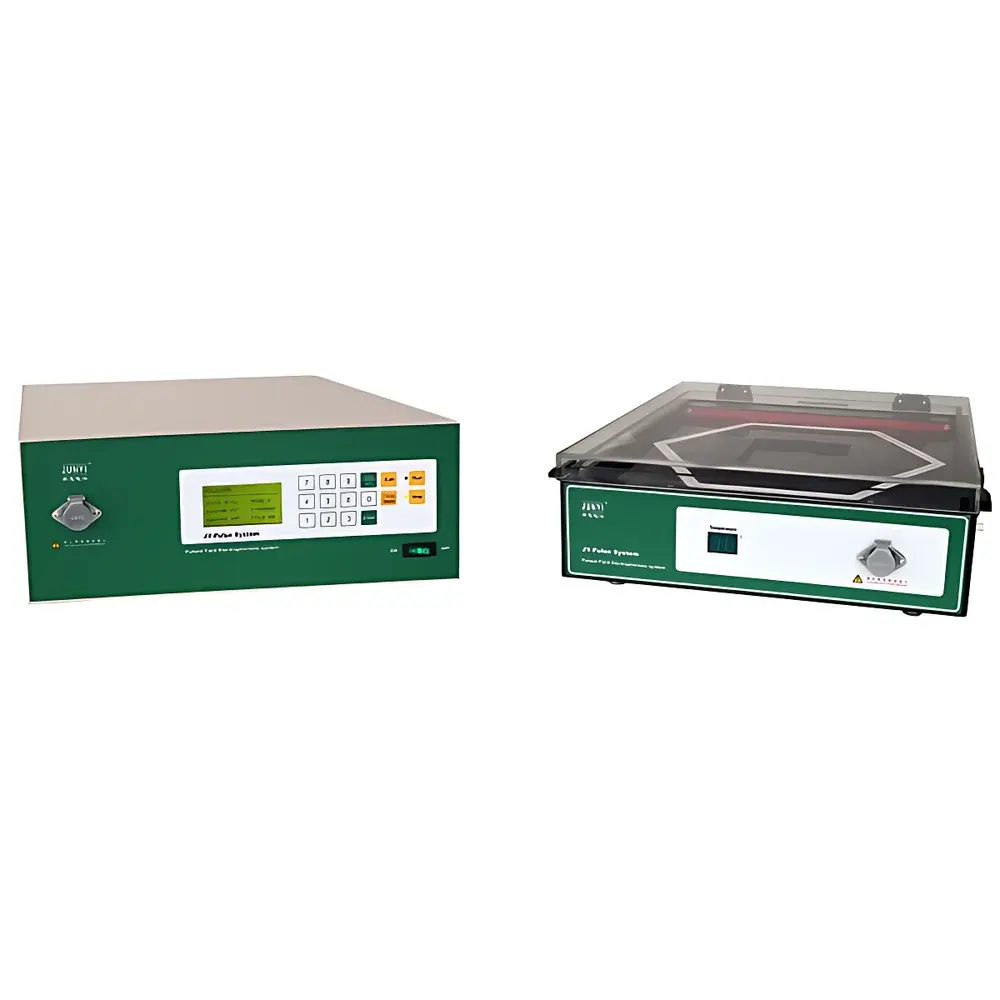
Junyi JY-Pulse System Pulsed-Field Gel Electrophoresis (PFGE) System
| Brand | Junyi |
|---|---|
| Origin | Beijing, China |
| Model | JY-Pulse System |
| Gel Dimensions (W×L) | 120 × 120 mm |
| Sample Capacity | 13 lanes |
| Voltage Gradient | ±1.0–±9.5 V/cm |
| Fixed Pulse Width Range | 1–99,999 s |
| Incremental Pulse Width Resolution | 0.01–99.99 s |
| Buffer Volume | ~2100 mL |
| Instrument Form Factor | Horizontal |
| Electrode Material | Platinum (Φ0.5 mm), Molded Electrode Holder |
| Net Weight | 70.0 kg |
| Dimensions (Electrophoresis Unit) | 400 × 400 × 170 mm |
| Dimensions (Gel Tank) | 395 × 440 × 140 mm |
| Dimensions (Circulator) | 350 × 200 × 480 mm |
Overview
The Junyi JY-Pulse System is a horizontally configured pulsed-field gel electrophoresis (PFGE) platform engineered for high-resolution separation of large DNA fragments ranging from 100 bp to 6 megabases (Mb). Unlike conventional slab gel electrophoresis—limited by entropic trapping in agarose matrices—the JY-Pulse System applies precisely timed, alternating electric fields across orthogonal electrode pairs. This induces controlled reorientation and differential migration of megabase-sized DNA molecules through the gel matrix, enabling size-based resolution unattainable with standard DC electrophoresis. The system is designed for reproducible, protocol-driven genomic analysis in regulated and research-intensive environments, including core genomics facilities, public health laboratories, and academic molecular biology labs.
Key Features
- Programmable pulse parameters: fixed pulse width adjustable from 1 s to 99,999 s; incremental pulse width resolution of 0.01 s with multi-step ramping modes (linear, exponential, logarithmic)
- Digital control interface with dedicated numeric keypad and function shortcut keys for rapid parameter entry and real-time adjustment
- Embedded real-time clock with leap-year and daylight saving time compensation, ensuring accurate timestamping of long-duration runs (up to 168 h)
- Robust electrode architecture: precision-molded platinum electrode holder with Φ0.5 mm platinum wires—resistant to deformation and corrosion, maintaining field uniformity over extended operational cycles
- Intelligent power management: automatic interruption logging, resume-on-power-restoration functionality, and persistent runtime tracking even during unexpected outages
- Comprehensive experimental logging: on-device storage of run parameters, timestamps, error events, and user-defined notes—exportable via USB for audit trail compliance
- Integrated error-handling system: input validation at configuration stage and dynamic program integrity verification during execution prevent misconfigured or unstable protocols
- Pause/resume capability without loss of timing synchronization or pulse phase alignment
Sample Compatibility & Compliance
The JY-Pulse System accommodates standard 120 × 120 mm agarose gels (2.0 mm thickness), supporting up to 13 sample lanes per run. Compatible with certified low-melt and PFGE-grade agarose formulations, it operates with common electrophoretic buffers including TAE, TBE, and CHEF-compatible variants. The system meets mechanical and electrical safety requirements aligned with IEC 61010-1 for laboratory equipment. While not certified under FDA 21 CFR Part 11, its data logging architecture supports GLP/GMP-aligned documentation practices when integrated into validated laboratory information management systems (LIMS). Protocols conform to widely adopted standards including CDC PulseNet guidelines for bacterial subtyping and ASTM E2777-21 for nucleic acid separation method validation.
Software & Data Management
The JY-Pulse System operates via embedded firmware with no external PC dependency. All protocols—including preloaded classic methods (e.g., CHEF-DR III, FIGE, OFAGE)—are stored in non-volatile memory. Firmware updates are delivered via USB flash drive, with version-controlled release notes and backward-compatible parameter mapping. Experimental metadata—including voltage gradient, pulse symmetry, switch angle, run duration, and ambient temperature (via optional external sensor input)—is recorded with ISO 8601-compliant timestamps. Exported logs are plain-text CSV files, facilitating integration with institutional data repositories and statistical analysis pipelines. Optional database upgrade service provides access to newly validated protocols published in peer-reviewed literature and public health bulletins.
Applications
- Whole-chromosome and megabase-range genomic DNA separation for karyotyping and structural variant detection
- Construction, quality control, and fingerprinting of large-insert genomic libraries (BAC, YAC, fosmid)
- Molecular epidemiology: strain-level discrimination of Salmonella, Listeria monocytogenes, E. coli O157:H7, and other priority pathogens per PulseNet protocols
- Transgenic organism characterization, including insertion site mapping and copy number assessment
- Analysis of DNA double-strand break induction and repair kinetics following ionizing radiation or chemotherapeutic agents
- Apoptotic DNA laddering profiling in mammalian cell models, particularly where fragment sizes exceed 50 kb
- Validation of CRISPR/Cas9-mediated large deletions or chromosomal rearrangements
FAQ
What is the maximum recommended run duration for continuous operation?
The system supports uninterrupted runs up to 168 hours (7 days) with active thermal monitoring and buffer circulation—subject to adequate cooling capacity and buffer replenishment protocols.
Does the JY-Pulse System support asymmetric or variable-angle switching configurations?
Yes—pulse symmetry (duty cycle) and inter-electrode switching angles are programmable within user-defined limits, enabling adaptation to CHEF, FIGE, and hybrid PFGE modalities.
Is platinum electrode replacement required periodically?
Platinum electrodes exhibit negligible erosion under standard PFGE conditions; routine inspection and cleaning are sufficient for >5 years of typical usage. Replacement kits are available as field-service components.
Can the system be integrated into an automated workflow with LIMS or robotic liquid handlers?
While native API integration is not supported, exported CSV logs and standardized parameter nomenclature facilitate middleware-based orchestration in validated automation frameworks.
How is buffer temperature stabilized during extended runs?
The system requires connection to an external recirculating chiller (not included); the integrated circulator maintains flow rates compatible with industry-standard chillers (e.g., Thermo Fisher Polyscience 4510, Huber CC-206).