
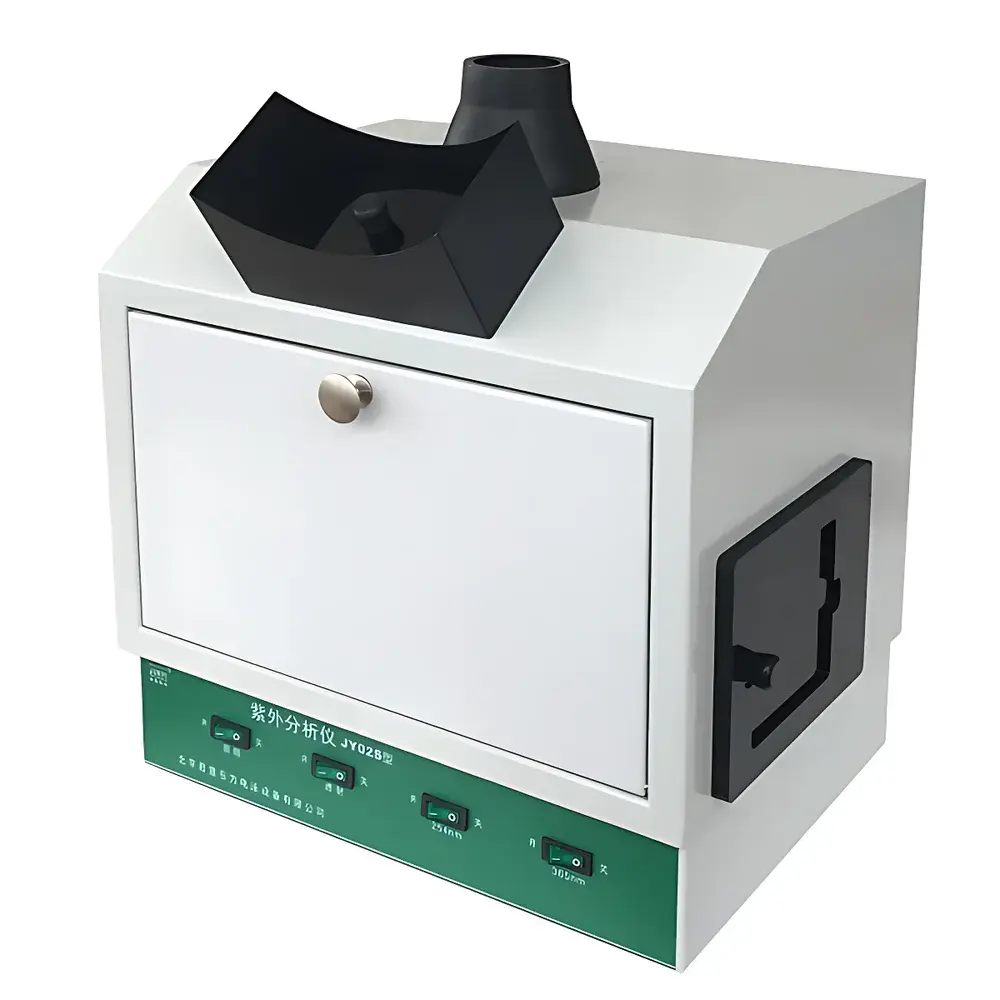
Junyi JY02S UV/Blue Light Transilluminator and Gel Cutter
| Brand | Junyi |
|---|---|
| Origin | Beijing, China |
| Model | JY02S |
| Instrument Type | Darkroom-Free Enclosed Transilluminator |
| Wavelengths | 254 nm (reflective), 302 nm (transmissive), 365 nm (reflective) |
| UV Filter Glass Dimensions | 200 × 150 mm |
| UV Lamp Power | 8 W (302 nm transmissive), 11 W (254 nm reflective), 11 W (365 nm reflective) |
| Overall Dimensions (L×W×H) | 435 × 295 × 490 mm |
| Net Weight | 16.9 kg |
| Lamp Type | Quartz UV Lamps |
| Viewing Chamber | Integrated dark-box design with ergonomic gel-cutting access port |
| Camera Mount | Adjustable vertical camera lift assembly (camera not included) |
Overview
The Junyi JY02S UV/Blue Light Transilluminator and Gel Cutter is an integrated, benchtop-grade electrophoresis visualization and nucleic acid excision system engineered for routine molecular biology laboratories. It operates on the principle of ultraviolet-induced fluorescence: when nucleic acids intercalated with ethidium bromide (EtBr), SYBR® Safe, or similar DNA-binding dyes are exposed to specific UV wavelengths, they emit visible light in the orange-red spectrum (typically ~590 nm), enabling high-contrast detection of DNA/RNA bands within agarose or polyacrylamide gels. The JY02S employs a triple-wavelength optical architecture—254 nm (high-energy, optimal for direct DNA visualization and crosslinking), 302 nm (balanced sensitivity and reduced photodamage for standard EtBr-stained gels), and 365 nm (low-damage, ideal for SYBR® Gold or other long-wavelength dyes)—to support method flexibility across diverse staining chemistries and regulatory requirements. Its fully enclosed dark-box configuration eliminates ambient light interference without requiring dedicated darkrooms, ensuring consistent imaging conditions under normal laboratory lighting.
Key Features
- Triple-wavelength UV illumination system (254 nm, 302 nm, 365 nm) with independently controlled lamps for application-specific optimization
- 200 × 150 mm quartz UV-transmissive filter glass surface providing uniform irradiance distribution (±5% spatial homogeneity across active area)
- High-stability quartz UV lamps: 8 W at 302 nm (transmission mode), 11 W each at 254 nm and 365 nm (reflection mode), rated for ≥5,000 hours of operational life
- Ergonomic front-access gel-cutting port with protective shield and precision blade guide slot, enabling safe, reproducible band excision under real-time visualization
- Integrated vertical camera lift mechanism (0–200 mm travel range) compatible with standard DSLR/mirrorless cameras and scientific CMOS sensors (tripod mount: 1/4″-20 UNC)
- Thermally stable aluminum chassis with ventilated heat-dissipation design to maintain lamp output stability during extended use
- CE-compliant electrical safety architecture with automatic lamp shutoff upon lid opening (interlocked safety switch per IEC 61010-1)
Sample Compatibility & Compliance
The JY02S supports standard slab gels up to 150 mm wide × 200 mm long, including agarose (0.7–3.0%), native and denaturing polyacrylamide (up to 20%), and gradient gels. It accommodates both horizontal and vertical electrophoresis formats when placed on a level benchtop surface. All UV optical components meet ISO 10993-5 biocompatibility standards for non-cytotoxicity, and the device conforms to IEC 62471 Photobiological Safety Classification (Risk Group 2 for 302 nm; Risk Group 3 for 254 nm — necessitating mandatory UV-blocking eyewear and skin protection per ANSI Z87.1). While not certified for GMP production environments, its design supports GLP-aligned documentation workflows, including manual log entry for lamp usage hours and exposure duration tracking.
Software & Data Management
The JY02S is hardware-only and does not include proprietary acquisition software. It is fully compatible with third-party imaging platforms such as ImageLab™ (Bio-Rad), AlphaView SA (ProteinSimple), and open-source tools like Fiji/ImageJ. When paired with a calibrated camera and appropriate lens (e.g., 25 mm f/1.4 macro), users can implement automated exposure bracketing, background subtraction, and band intensity quantification in compliance with FDA 21 CFR Part 11 guidelines when deployed within validated laboratory information management systems (LIMS). Audit trails for image capture metadata—including timestamp, wavelength selected, exposure time, and lens aperture—are preserved in EXIF headers.
Applications
- Visualization and documentation of DNA/RNA fragments following agarose or PAGE electrophoresis
- Excision of target bands for downstream cloning, sequencing library preparation, or mass spectrometry analysis
- Qualitative assessment of PCR product integrity, restriction digest efficiency, and RNA integrity (RIN estimation via 28S/18S ratio)
- UV crosslinking validation for membrane-based hybridization protocols (e.g., Southern/Northern blotting)
- Teaching laboratory demonstrations of nucleic acid mobility, dye binding kinetics, and UV photophysics principles
FAQ
Is the JY02S suitable for SYBR® Gold staining?
Yes — the 365 nm reflective mode provides optimal excitation for SYBR® Gold and other long-wavelength dyes while minimizing DNA photochemical damage.
Can I use this unit for protein gels stained with Coomassie or silver?
No — the JY02S is optimized for UV-excitable nucleic acid dyes; it lacks visible-light transillumination or white-light reflection capability required for protein gel documentation.
Does the system include a camera or lens?
No — the camera, lens, and memory card are optional accessories; only the mechanical lift assembly and mounting interface are supplied.
What safety certifications does the instrument carry?
It complies with IEC 61010-1 (electrical safety) and IEC 62471 (photobiological safety); full test reports are available upon request from Junyi’s technical documentation portal.
How often should the UV lamps be replaced?
Quartz lamps retain ≥90% nominal output after 5,000 hours; replacement is recommended based on radiometric verification using a NIST-traceable UV meter, not calendar time.



