
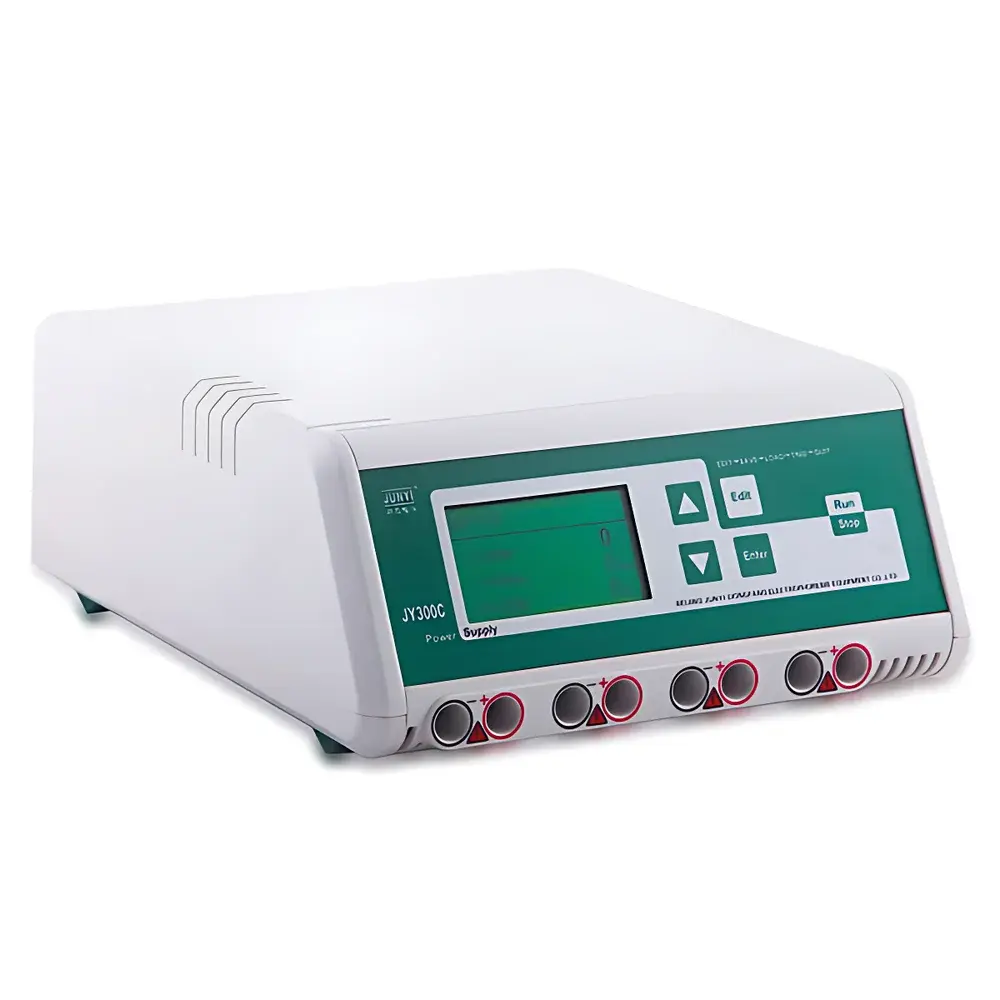
Junyi JY300C Electrophoresis Power Supply
| Brand | Junyi |
|---|---|
| Origin | Beijing, China |
| Model | JY300C |
| Output Modes | Constant Voltage / Constant Current / Constant Power |
| Voltage Range | 3–300 V (1 V resolution) |
| Current Range | 1–400 mA (1 mA resolution) |
| Power Range | 1–120 W (1 W resolution) |
| Timing Range | 1 min – 99 h 59 min |
| Display | Backlit LCD (128×64 pixels) |
| Output Ports | 4 independent pairs |
| Dimensions (L×W×H) | 280×237×118 mm |
| Net Weight | 3.2 kg |
| Safety Protections | Overload, open-circuit, leakage current, thermal shutdown |
| Memory Capacity | 10 pre-programmed methods |
| Compliance | CE-marked design principles |
Overview
The Junyi JY300C Electrophoresis Power Supply is a microprocessor-controlled DC power source engineered for precision and reliability in nucleic acid and protein electrophoresis applications. It operates on the fundamental principle of applying a controlled electric field across a conductive gel matrix—such as agarose or polyacrylamide—to drive charged biomolecules toward oppositely charged electrodes at rates proportional to their size-to-charge ratio. Unlike basic benchtop supplies, the JY300C implements real-time feedback regulation to maintain stable voltage, current, or power output under dynamically changing load conditions—critical for reproducible band resolution in horizontal slab gels, vertical SDS-PAGE systems, Western blot transfer units, and cellulose acetate membrane electrophoresis. Its compact footprint and robust internal architecture support continuous operation in shared core facilities and teaching laboratories where space efficiency and operational consistency are prioritized.
Key Features
- Triple-mode output control: Selectable constant voltage (CV), constant current (CC), or constant power (CP) operation with real-time digital monitoring of both setpoint and actual output values.
- High-resolution digital interface: Backlit 128×64-pixel LCD display enables clear visibility under varied ambient lighting, showing simultaneous readouts of voltage, current, power, elapsed time, and remaining runtime.
- Intelligent memory system: Stores up to 10 frequently used electrophoresis protocols—including common settings for DNA ladder separation (e.g., 100 V, 100 mA, 60 min) or high-voltage PAGE (e.g., 200 V, 35 mA, 90 min)—for rapid recall and method standardization.
- Programmable timing: Adjustable timer from 1 minute to 99 hours 59 minutes supports overnight transfers and extended native gel runs without manual intervention.
- Comprehensive safety architecture: Integrated protection circuits automatically interrupt output upon detection of open-circuit (no-load), short-circuit, excessive current draw, or abnormal temperature rise—ensuring instrument longevity and user safety.
- Ergonomic industrial design: One-piece molded housing with tactile membrane keypad minimizes dust ingress and simplifies surface decontamination—a key consideration in molecular biology labs adhering to GLP-aligned workflows.
Sample Compatibility & Compliance
The JY300C is compatible with all standard electrophoresis chamber configurations, including mini and midi horizontal tanks (e.g., for agarose-based DNA fragment analysis), vertical mini-PROTEAN®-style units, semi-dry and wet transfer systems for immunoblotting, and cellulose acetate membranes used in clinical serum protein electrophoresis. Its 300 V maximum output accommodates both low-field (≤10 V/cm) and high-field (≥20 V/cm) applications, while its 4-channel independent output ports allow parallel operation of multiple electrophoresis units—ideal for high-throughput teaching labs or QC environments. Though not certified to IEC 61010-1 as a standalone medical device, its electrical isolation, creepage/clearance distances, and fail-safe logic align with general-purpose laboratory equipment requirements under ISO/IEC 17025 Clause 5.5.2 for equipment verification and traceability.
Software & Data Management
The JY300C operates as a stand-alone instrument with no proprietary software dependency. All parameter entry, storage, and execution occur via the front-panel interface. However, its consistent output stability and programmable repeatability support integration into validated workflows requiring audit trails: users may document method IDs, operator initials, date/time stamps, and run logs manually or via LIMS-compatible templates. For laboratories operating under FDA 21 CFR Part 11 or EU Annex 11 guidelines, the unit’s automatic memory retention (even after power loss) and deterministic timer behavior facilitate retrospective verification of electrophoretic conditions during investigations or regulatory inspections.
Applications
- Agarose gel electrophoresis of PCR products, plasmid digests, and genomic DNA fragments (0.1–20 kb).
- SDS-PAGE and native PAGE of proteins (10–250 kDa), including gradient gels and zymography.
- Electroblotting (wet and semi-dry transfer) of proteins from polyacrylamide gels to PVDF or nitrocellulose membranes.
- Clinical serum protein electrophoresis using cellulose acetate or agarose substrates for albumin/globulin quantitation.
- Horizontal pulse-field gel electrophoresis (PFGE) when paired with compatible switch boxes and low-frequency timing modules.
FAQ
Does the JY300C support programmable ramping or gradient voltage profiles?
No. The JY300C delivers fixed-setpoint output only; it does not implement time-dependent voltage/current ramps or multi-step programs.
Can it be used with high-resistance native gels requiring >300 V?
No. The maximum rated output is 300 V DC. For applications exceeding this limit—such as some capillary or ultra-thin native gels—alternative high-voltage supplies must be selected.
Is calibration traceable to national standards?
The unit includes factory calibration documentation. End-user recalibration is not field-serviceable; periodic verification against NIST-traceable multimeters is recommended per ISO/IEC 17025 Section 6.5.
What type of output terminals does it use?
Four pairs of recessed banana jacks (red/black), each independently isolated and rated for ≤400 mA continuous current.
Does it meet electromagnetic compatibility (EMC) requirements for lab environments?
Yes. The design incorporates EMI filtering and meets EN 61326-1 Class B emission limits for laboratory use, minimizing interference with adjacent sensitive instrumentation such as CCD imagers or mass spectrometers.




