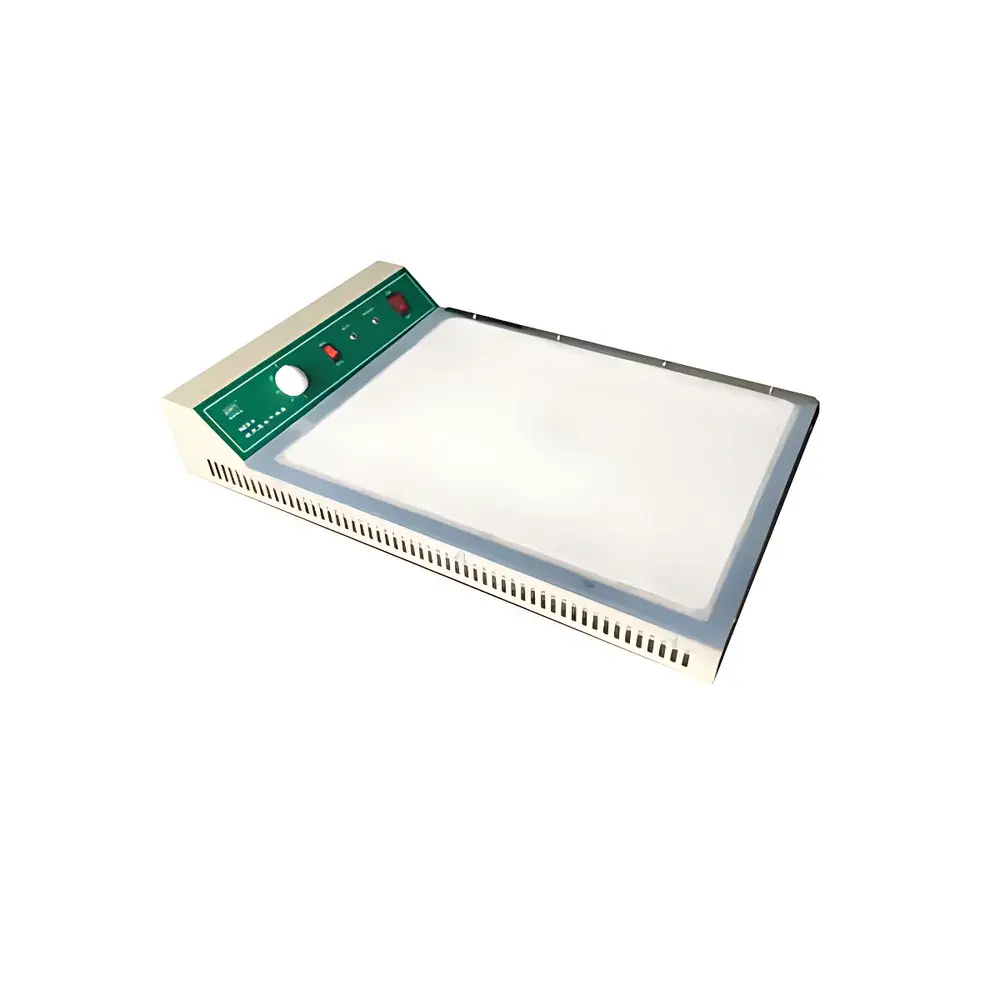
Junyi NZG-A Gel Dryer
| Brand | Junyi |
|---|---|
| Origin | Beijing, China |
| Model | NZG-A |
| Gel Drying Area | 450 × 330 mm |
| Temperature Settings | 60 °C and 80 °C (dual fixed-point heating) |
| Timer Function | Yes |
| Dimensions (L×W×H) | 690 × 480 × 185 mm |
| Net Weight | 16.5 kg |
| Category | Gel Dryer for Electrophoresis Applications |
Overview
The Junyi NZG-A Gel Dryer is a dedicated vacuum-assisted gel drying system engineered for post-electrophoresis processing of polyacrylamide (PAGE), agarose, and SDS-PAGE gels. It operates on the principle of simultaneous low-pressure desiccation and controlled conductive heating—enabling rapid, uniform water removal from hydrated gels while preserving band integrity, resolution, and molecular morphology. Unlike ambient air-drying—which introduces uneven shrinkage, surface cracking, and irreversible gel distortion—the NZG-A applies gentle vacuum (typically 0.08–0.1 MPa absolute, when paired with a compatible external rotary vane or diaphragm pump) to lower the boiling point of water, accelerating evaporation at moderate temperatures. Its dual-temperature heating plate (60 °C and 80 °C) ensures compatibility with both protein and nucleic acid gels, minimizing thermal denaturation risk while maintaining drying efficiency. Designed for integration into routine molecular biology workflows, the unit supports reproducible preparation of gels for long-term archival storage, autoradiography, densitometric analysis, and downstream blotting procedures.
Key Features
- Fixed dual-point heating plate (60 °C and 80 °C) with ±2 °C thermal stability across the full drying surface
- Large-format drying platen (450 × 330 mm) accommodating standard 20 × 20 cm and oversized 25 × 25 cm gels without trimming
- Integrated mechanical timer (0–120 min range) with audible end-of-cycle alert for unattended operation
- Robust aluminum alloy heating base with non-stick, chemically resistant silicone-coated surface for easy gel release and cleaning
- Sealed vacuum chamber design with reinforced acrylic lid and EPDM gasket ensuring consistent pressure retention during drying cycles
- Compact footprint (690 × 480 × 185 mm) optimized for benchtop use in core facilities, teaching labs, and QC environments
Sample Compatibility & Compliance
The NZG-A accommodates a broad range of electrophoretic matrices including native and denaturing polyacrylamide gels (up to 2 mm thickness), standard and low-melt agarose gels (0.7–2.0%), and gradient gels used in high-resolution separation protocols. It is routinely employed in applications requiring compliance with GLP-aligned documentation practices—including academic research, diagnostic assay development, and preclinical biomarker validation. While the dryer itself does not require regulatory certification, its operational parameters align with common laboratory quality standards referenced in ISO/IEC 17025 (clause 5.4.2, equipment verification) and USP <1058> (Analytical Instrument Qualification). Users are responsible for qualifying the external vacuum pump per site-specific SOPs and verifying final gel integrity via control lane comparison and Coomassie/silver stain consistency across batches.
Software & Data Management
The NZG-A is a standalone hardware system with no embedded microprocessor or digital interface. All operational parameters—including temperature selection and timer activation—are managed via front-panel mechanical controls. This analog architecture eliminates firmware dependencies, reduces validation burden, and ensures long-term operational continuity without software updates or cybersecurity maintenance. For laboratories operating under FDA 21 CFR Part 11 requirements, manual logbook entries—including date/time, gel type, temperature setting, duration, operator ID, and visual inspection notes—are recommended as part of instrument usage records. The absence of electronic data generation simplifies audit readiness and avoids complex electronic record retention protocols associated with connected instruments.
Applications
- Routine drying of SDS-PAGE gels prior to Coomassie Brilliant Blue or silver nitrate staining and densitometric quantification
- Preparation of autoradiography-ready gels following 32P- or 125I-labeled probe hybridization
- Stabilization of nucleic acid gels for Southern/Northern blot transfer with minimized diffusion artifact
- Teaching lab implementation where simplicity, reliability, and cost-effectiveness are prioritized over automation
- QC/QA labs performing comparative electrophoresis runs requiring consistent gel handling across multiple analysts and shifts
FAQ
Is a vacuum pump included with the NZG-A?
No. An external vacuum pump must be supplied by the user. A two-stage rotary vane pump capable of achieving ≤0.08 MPa (absolute) pressure is recommended for optimal drying performance.
Can the NZG-A dry gels containing ethidium bromide or SYBR Safe?
Yes—provided standard biosafety protocols for fluorescent dye handling are followed. The unit does not emit UV radiation or generate ozone; however, gels should be pre-rinsed per manufacturer guidelines to minimize residual dye migration during drying.
What is the typical drying time for a 1 mm thick 12% acrylamide gel at 60 °C?
Under standard vacuum conditions (~0.08 MPa), drying time ranges from 60 to 90 minutes. Thicker gels or higher percentage matrices may require up to 120 minutes at 80 °C.
Does the NZG-A support programmable ramping or variable temperature control?
No. It features only two fixed heating setpoints (60 °C and 80 °C) and lacks PID-based temperature profiling or ramp/soak functionality.
How is calibration verified for this instrument?
Users should perform annual verification using a NIST-traceable surface temperature probe placed directly on the drying plate at multiple locations. Deviation exceeding ±2 °C warrants service evaluation.