
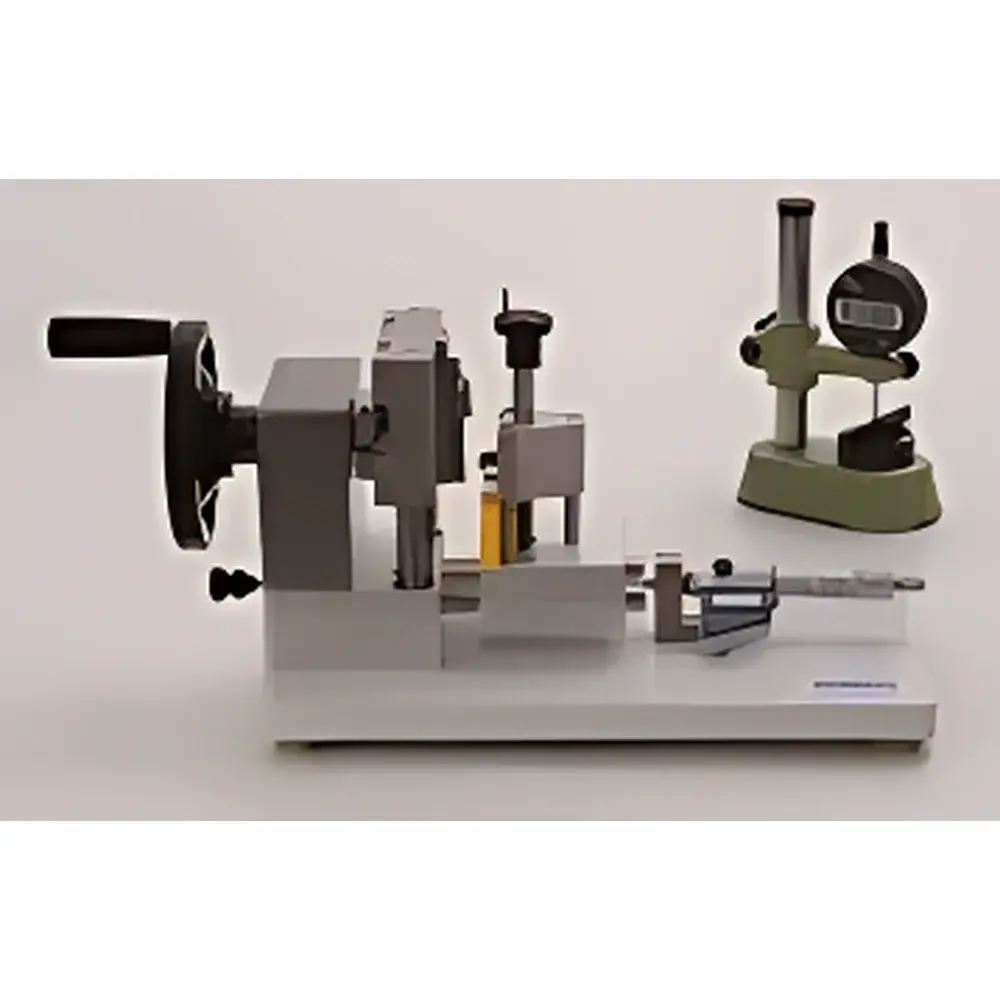
KaiGe MAK/MOK Notched Specimen Preparation Machine
| Brand | KaiGe |
|---|---|
| Origin | Germany |
| Model | MAK / MOK |
| Type | Manual/Electric Linear Notching Machine for Charpy/Izod Impact Test Specimens |
| Compliance | ASTM E23, ISO 148-1, ISO 180, DIN 53438, EN ISO 179-1 |
| Max Specimen Height | 30 mm |
| Tool Positioning Tolerance | < 0.01 mm |
| Feed Resolution | 0.001 mm (selectable) |
| MAK Cutting Speed | ~0.3 m/s |
| MOK Cutting Speed | up to 20 m/min |
| Power Supply | 230 V / 50 Hz |
| MOK Power Consumption | 0.4 kVA |
| Dimensions (W×H×D, mm) | MAK: 470 × 215 × 220 |
| MOK | 470 × 540 × 470 |
| Weight | MAK: 16 kg |
| MOK | 43 kg |
| Max Simultaneous Specimens | 7 |
| Safety | Integrated Polycarbonate Shield with Interlocked Safety Switch (MOK only) |
| Tool System | Interchangeable Carbide-Tipped Notching Cutters (V-notch: 45° ± 0.5°, root radius 0.25 mm ± 0.025 mm |
| U-notch | 1 mm ± 0.05 mm radius) |
Overview
The KaiGe MAK/MOK Notched Specimen Preparation Machine is an engineered solution for the precise, repeatable, and standards-compliant preparation of notched test specimens used in impact testing—specifically Charpy (ISO 148-1, ASTM E23) and Izod (ISO 180, ASTM D256) methods. Operating on a linear dual-motion principle, the system decouples specimen positioning from tool translation: one precision-guided axis controls specimen feed along the notch plane, while a second independent axis governs cutter advancement. This architecture eliminates mechanical coupling errors and ensures orthogonal, distortion-free notch geometry. The machine supports both manual (MAK) and electric servo-controlled (MOK) operation modes, with the latter incorporating a frequency-variable drive for fine-tuned cutting speed modulation (0–20 m/min). All models are designed and assembled in Germany to meet stringent European engineering tolerances, with tool orientation accuracy maintained within ±0.01 mm across the full operational envelope.
Key Features
- Dual-axis kinematic architecture isolates specimen motion from cutter motion, enabling high-fidelity replication of standardized notch profiles (V-notch: 45° ± 0.5°, root radius 0.25 mm ± 0.025 mm; U-notch: 1 mm ± 0.05 mm radius)
- Interchangeable hardened carbide-tipped cutters calibrated to ASTM E23 and ISO 148-1 dimensional specifications, with traceable geometry certification available upon request
- Sub-micron feed resolution (0.001 mm selectable) via high-precision linear encoder feedback on both MAK and MOK variants
- MOK model integrates a polycarbonate safety shield with certified interlock circuitry compliant with EN ISO 13857 and EN 60204-1, automatically disabling cutter motion when opened
- Rigid cast-aluminum base structure with vibration-damped mounting feet, ensuring long-term stability under repeated loading cycles
- Tool carriage guided by recirculating ball bearings with preloaded linear rails, minimizing backlash and thermal drift over extended operation
Sample Compatibility & Compliance
The MAK/MOK accommodates standard impact test blanks per ASTM E23 (10 × 10 × 55 mm), ISO 148-1 (10 × 10 × 55 mm), ISO 180 (80 × 10 × 4 mm), and ASTM D256 (63.5 × 12.7 × 3.2 mm), with maximum clamping height of 30 mm. Specimen materials include thermoplastics (e.g., ABS, PC, PP), thermosets (epoxy, phenolic), composites (CFRP, GFRP), and metallic alloys (aluminum, mild steel) up to HB 250. All notch geometries conform to the dimensional tolerances defined in ISO 148-1 Annex A and ASTM E23 Section 7. The system supports GLP-compliant documentation workflows when paired with validated laboratory information management systems (LIMS); audit trails for operator ID, date/time stamp, specimen ID, and notch type are recordable via optional RS-232 or USB interface.
Software & Data Management
While the MAK operates as a standalone mechanical system requiring manual feed control, the MOK variant includes an embedded microcontroller with programmable parameter storage (up to 10 user-defined notch protocols). Parameters—including feed rate, dwell time at notch apex, depth-of-cut, and return speed—are stored in non-volatile memory and recalled via front-panel keypad navigation. Optional KaiGe SpecimenLink™ software (v3.2+, Windows 10/11) enables remote configuration, real-time motion monitoring, and CSV export of process logs for 21 CFR Part 11–compliant environments. All firmware updates are digitally signed and delivered via secure HTTPS channel.
Applications
- Preparation of standardized Charpy V-notch specimens for metallurgical quality control in foundries and heat treatment facilities
- Routine notch fabrication for polymer impact qualification per ISO 179-1 and ASTM D256 in plastics R&D laboratories
- High-throughput specimen conditioning in accredited testing labs performing ISO/IEC 17025-certified impact assessments
- Validation of notch sensitivity in composite laminates subjected to low-velocity impact per ASTM D7136
- Calibration support for pendulum impact testers (e.g., Zwick Roell, Tinius Olsen, Instron) requiring NIST-traceable specimen geometry
FAQ
What standards does the MAK/MOK comply with for notch geometry verification?
The system is validated against ASTM E23 Annex A3, ISO 148-1 Clause 6.2, and ISO 180 Annex B, with cutter geometry certified using coordinate measuring machine (CMM) traceable to PTB (Physikalisch-Technische Bundesanstalt) reference standards.
Can the MOK be integrated into automated lab workflows?
Yes—the MOK supports Modbus RTU over RS-485 for integration with PLC-based sample handling systems and LIMS platforms supporting ASTM E1578-compliant instrument communication protocols.
Is tool calibration required between batches?
No routine recalibration is needed; however, periodic verification using certified gauge blocks and optical profilometry (per ISO 25178-601) is recommended every 500 operating hours or per internal QA schedule.
What maintenance intervals apply to the linear motion system?
Linear rail lubrication is specified at 1,000-hour intervals using Klüberplex BEM 41-132 grease; ball screw inspection and preload verification are scheduled at 5,000-hour service milestones.
Does KaiGe provide installation qualification (IQ) and operational qualification (OQ) documentation?
Yes—fully customizable IQ/OQ protocols aligned with ISO/IEC 17025 and FDA 21 CFR Part 11 requirements are available upon order, including as-built drawings, metrology reports, and electronic signature-capable execution checklists.



