
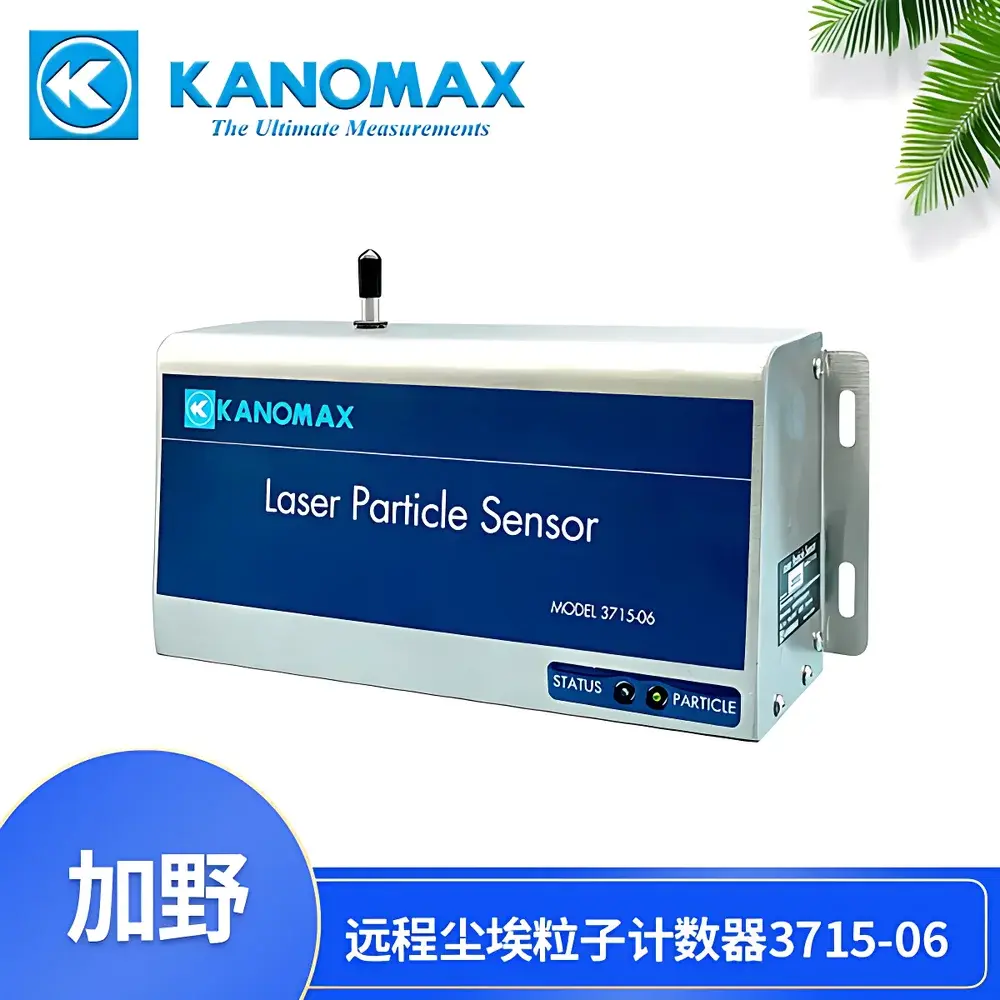
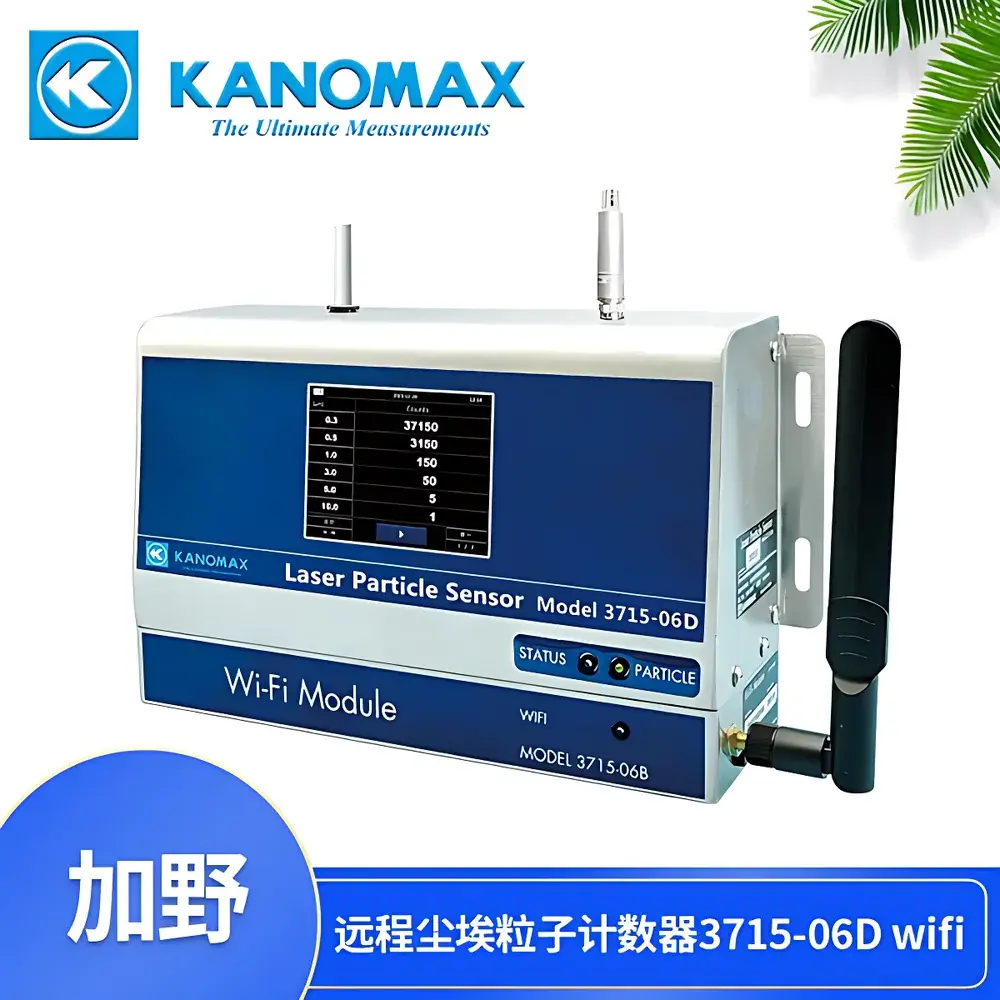
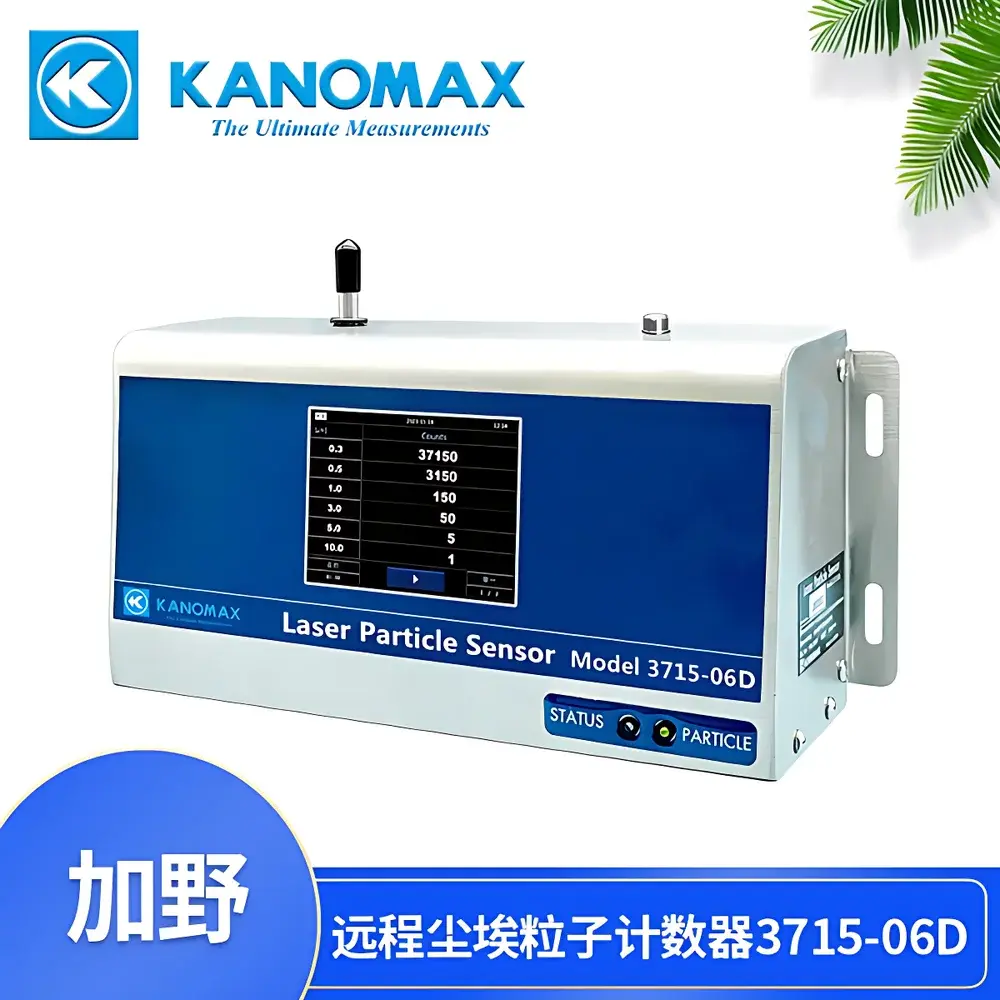
Kanomax 3715-06D Remote Particle Counter
| Brand | Kanomax |
|---|---|
| Origin | Japan |
| Model | 3715-06D |
| Flow Rate | 2.83 L/min (0.1 CFM) |
| Particle Size Channels | 0.3, 0.5, 1.0, 3.0, 5.0, 10.0 µm |
| Light Source | Long-life laser diode |
| Counting Efficiency | Compliant with ISO 21501-4 and JIS B 9921 |
| Max. Detectable Concentration | 2,000,000 counts/ft³ |
| Communication Protocols | RS-485, Modbus RTU/TCP/IP |
| Data Storage Capacity | 4,320 records |
| Power Options | DC 12–24 V, AC 100–240 V, PoE, or external DC supply |
| Operating Temperature | 10–30 °C |
| Operating Humidity | 20–85% RH (non-condensing) |
| Dimensions | 217 × 69 × 110 mm |
| Weight | 1.4 kg |
| Built-in Vacuum Pump Lifetime | 8,000 h |
| MTBF | ≥10 years |
| Warranty | 3 years |
Overview
The Kanomax 3715-06D Remote Particle Counter is a high-precision, continuous-monitoring instrument engineered for real-time airborne particulate quantification in controlled environments—including cleanrooms, pharmaceutical manufacturing suites, semiconductor fabrication facilities, and HVAC validation zones. Based on the principle of light scattering detection using a stabilized Class 1 laser diode, the device measures particles across six discrete size channels (0.3, 0.5, 1.0, 3.0, 5.0, and 10.0 µm) at a calibrated volumetric flow rate of 2.83 L/min (0.1 CFM). Its optical design and signal processing architecture comply strictly with ISO 21501-4 and JIS B 9921 standards for particle counter performance verification—ensuring traceable, repeatable, and metrologically defensible data essential for regulatory compliance and process control.
Key Features
- Integrated vacuum sampling system with 8,000-hour rated pump lifetime, eliminating dependency on external air compressors or pressurized gas sources.
- Dual-mode communication support: native RS-485 interface with configurable Modbus RTU protocol, plus optional Ethernet-based Modbus TCP/IP for seamless integration into SCADA, BMS, or centralized environmental monitoring systems (EMS).
- Onboard 4.3-inch capacitive touchscreen display enabling local configuration, real-time trend visualization, alarm status review, and manual trigger of sampling cycles.
- Multi-power architecture: compatible with PoE (IEEE 802.3af), wide-range AC input (100–240 VAC), or regulated DC input (12–24 VDC), ensuring deployment flexibility across infrastructure-constrained or explosion-proof zones.
- Embedded environmental sensor option for simultaneous temperature and relative humidity measurement—calibrated to NIST-traceable references and reported alongside particle data for contextual environmental correlation.
- Local data buffering capacity of 4,320 timestamped records (including particle counts per channel, flow rate, sensor diagnostics, and alarm flags), supporting offline auditability and gap-filling during network outages.
Sample Compatibility & Compliance
The 3715-06D is designed for ambient air and compressed gas sampling in ISO Class 5–8 cleanrooms (per ISO 14644-1), as well as non-sterile production areas requiring continuous environmental qualification. Its counting efficiency curve meets the stringent calibration requirements defined in ISO 21501-4 for optical particle counters used in GMP-regulated settings. The instrument supports 21 CFR Part 11-compliant data integrity workflows when paired with validated EMS software—enabling electronic signatures, audit trails, and role-based access control. It also satisfies EU Annex 1 (2022) recommendations for dynamic particle monitoring during aseptic processing, particularly when deployed in unidirectional airflow zones with remote telemetry.
Software & Data Management
Raw particle count data are structured in standard Modbus register maps, allowing direct ingestion into third-party platforms such as Siemens Desigo CC, Honeywell Experion, or custom Python- or LabVIEW-based acquisition systems. Kanomax provides optional PC-based configuration and reporting software (Kanomax AirCounter Suite) that supports automated report generation (PDF/CSV), statistical process control (SPC) charting, alarm log export, and historical data reconciliation. All stored records include embedded timestamps, instrument ID, firmware version, and operational status flags—enabling full forensic traceability during FDA or EMA inspection readiness reviews.
Applications
- Continuous monitoring of critical manufacturing zones in biopharmaceutical fill-finish lines and isolator environments.
- Validation and routine surveillance of HVAC filtration efficiency and room classification per ISO 14644-2.
- Particle source identification and leak detection in gloveboxes, laminar flow hoods, and transfer ports.
- Environmental baseline establishment and trending in R&D laboratories handling nanomaterials or sterile APIs.
- Integration into facility-wide EMS architectures for automated alerting, root cause analysis, and CAPA documentation linkage.
FAQ
Does the 3715-06D require annual recalibration to maintain ISO 21501-4 compliance?
Yes—Kanomax recommends annual factory calibration or accredited third-party verification using NIST-traceable polystyrene latex (PSL) reference aerosols. Calibration certificates include uncertainty budgets and correction factors per size channel.
Can the built-in pump be replaced in the field without returning the unit to service?
No—the vacuum pump is sealed and non-user-serviceable; replacement requires authorized Kanomax service center intervention to preserve pressure calibration and flow stability.
Is Wi-Fi connectivity natively supported, or does it require an external gateway?
Wi-Fi functionality is only available via the optional Wi-Fi base station accessory (sold separately); the main unit itself communicates exclusively via RS-485 or Ethernet.
What is the minimum sampling interval supported for continuous logging?
The device supports one-second real-time updates to internal memory and external hosts—configurable down to 1-second intervals for transient event capture, with averaging options applied per user-defined time windows.
How is alarm logic implemented—threshold-based, rate-of-change, or both?
Alarms are threshold-driven per size channel (0–100% of user-defined limit), with independent ON/OFF activation and latching behavior. Rate-of-change detection is not implemented in firmware but can be derived externally via EMS analytics modules.







