
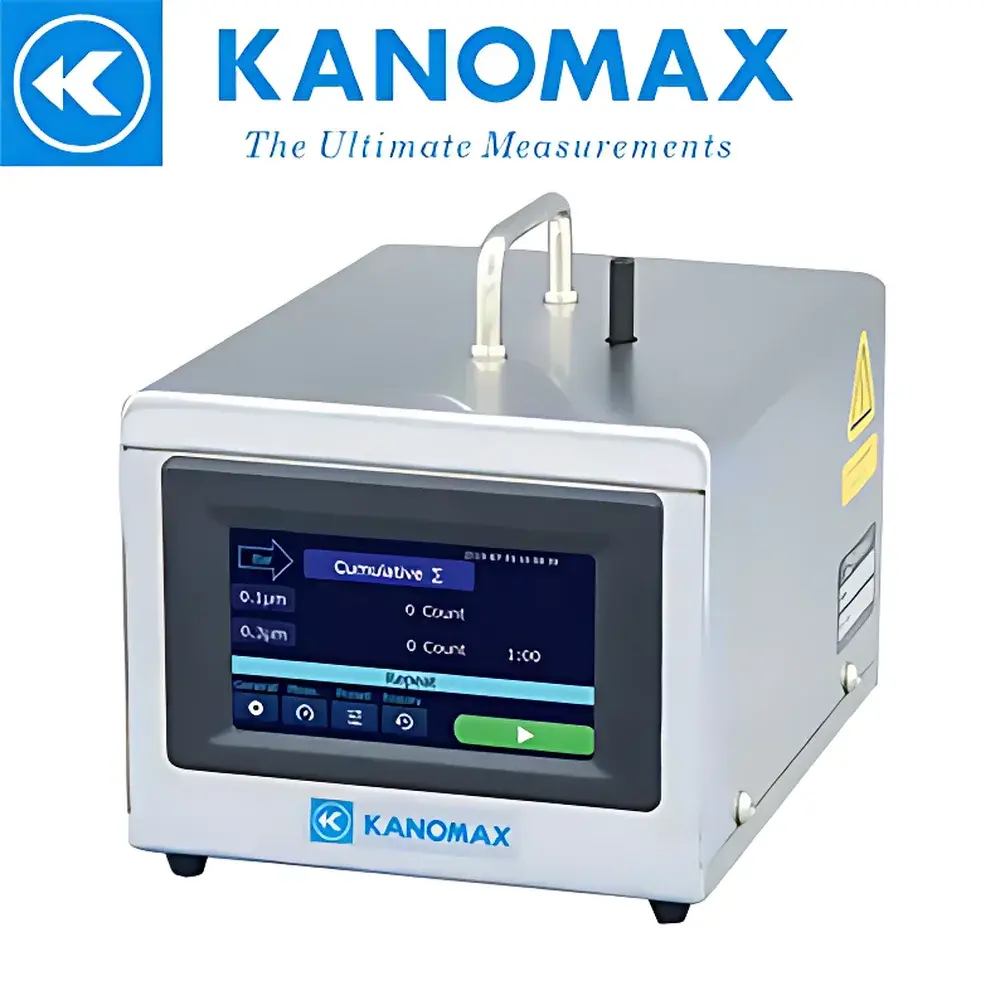
Kanomax 3950 Ultra-Compact 0.1 µm Optical Particle Counter
| Brand | Kanomax |
|---|---|
| Origin | Japan |
| Model | 3950 |
| Flow Rate | 2.83 L/min (0.1 CFM) |
| Flow Accuracy | ±5% |
| Timing Accuracy | ±1 s per 6 min |
| Repeatability | ±5% |
| Size Distribution Error | ±15% |
| Indication Error | ±30% |
| Particle Detection Principle | Light Scattering |
| Channel Sizes | 0.1 µm, 0.3 µm |
| Max Concentration | 10⁷ particles/m³ |
| Counting Efficiency | 50±20% at 0.1 µm (PSL), 100±10% at 0.15–0.2 µm (PSL) |
| Size Resolution | ≤15% (relative to 0.3 µm PSL) |
| Display | 4.3″ color TFT touchscreen |
| Communication | RS-485, Ethernet, USB (Host/Device) |
| Data Storage | 10,000 records (CSV) |
| Operating Environment | 15–35 °C, 0–85% RH (non-condensing) |
| Dimensions | 150 × 163 × 228 mm |
| Weight | 3.4 kg |
| Compliance | JIS B9921, ISO 21501-4 |
Overview
The Kanomax 3950 Ultra-Compact Optical Particle Counter is a high-precision, embedded-grade airborne particle monitoring instrument engineered for integration into semiconductor fabrication tools, miniaturized cleanroom environmental control systems, and OEM process equipment. Designed around the principle of single-particle light scattering detection, the 3950 employs a high-sensitivity laser diode and optimized optical geometry to resolve particles as small as 0.1 µm with metrologically traceable performance. Its dual-channel configuration (0.1 µm and 0.3 µm) enables real-time discrimination of ultrafine particulate contamination critical in Class 1–Class 10 clean environments. Unlike conventional benchtop particle counters, the 3950 prioritizes mechanical and electrical embeddability—achieving a footprint of only 150 × 163 × 228 mm and a mass of 3.4 kg—while maintaining full compliance with JIS B9921 and ISO 21501-4 for calibration, counting efficiency, and size resolution. The device operates at a nominal volumetric flow rate of 2.83 L/min (0.1 CFM), stabilized by an integrated low-pulsation diaphragm pump, and delivers measurement intervals programmable from 6 seconds to 99 minutes 59 seconds.
Key Features
- Ultra-compact form factor optimized for OEM integration into vacuum chambers, lithography tool enclosures, and automated wafer handling systems.
- 0.1 µm lower detection limit validated against PSL (polystyrene latex) reference standards per ISO 21501-4; counting efficiency meets 50±20% at 0.1 µm and 100±10% at 1.5×–2× the minimum detectable size.
- 4.3-inch full-color resistive touchscreen display with intuitive icon-based UI—enabling local operation without external PC dependency.
- Triple-interface communication architecture: isolated RS-485 (for daisy-chained multi-sensor networks), 10/100 Mbps Ethernet (TCP/IP, Modbus TCP), and dual-role USB (Device mode for PC data acquisition; Host mode for direct printing or USB flash logging).
- Onboard memory stores up to 10,000 measurement records in industry-standard CSV format, timestamped with internal RTC (real-time clock) synchronized to host system via NTP over Ethernet.
- Measurement modes include single-shot, repeat, continuous, differential (Δ), cumulative (∑), and ISO-compliant statistical reporting—supporting both ISO 14644-1 classification and GB/T 16292 validation protocols.
Sample Compatibility & Compliance
The Kanomax 3950 is designed exclusively for ambient or process gas sampling (e.g., nitrogen, dry air, compressed air) in non-corrosive, non-explosive environments. It is not rated for liquid-phase or aerosolized chemical solvent sampling. Its optical sensing chamber is constructed from anodized aluminum and stainless-steel wetted parts, minimizing particle adhesion and electrostatic retention. Calibration traceability follows JIS B9921 Annex B and ISO 21501-4 Clause 6, with factory certification against NIST-traceable PSL suspensions. The instrument satisfies requirements for routine monitoring under ISO 14644-1:2015 Annex D (continuous particle monitoring), and its data integrity features—including immutable timestamping, sequential record indexing, and no user-editable internal logs—support alignment with GLP/GMP documentation practices. While not FDA 21 CFR Part 11–certified out-of-the-box, audit-ready data export (CSV + metadata header) facilitates integration into validated electronic lab notebook (ELN) or MES platforms.
Software & Data Management
No proprietary software installation is required for basic operation—the 3950 functions autonomously with local display and onboard storage. For centralized deployment, Kanomax provides a Windows-compatible configuration and data retrieval utility (Kanomax PC Link v3.x) supporting batch download, time-synchronized multi-unit aggregation, and export to Excel-compatible formats. Raw CSV files contain columns for date/time, location ID (user-defined, up to 99 sites), channel-specific counts (0.1 µm, 0.3 µm), differential/cumulative flags, and instrument status codes (e.g., flow alarm, sensor fault). All communication protocols expose register-level access via Modbus TCP mapping, enabling seamless integration with SCADA, PLC, or custom Python/Node-RED middleware. Firmware updates are delivered via USB stick using signed binary packages verified by on-device cryptographic hash check.
Applications
- Semiconductor front-end process tools: real-time particle monitoring inside track systems, load locks, and etch/CVD chamber purge lines.
- Microelectronics packaging cleanrooms: localized verification of ISO Class 3–5 zones during mask aligner or wire bonder maintenance cycles.
- OEM medical device assembly: embedded particle surveillance in Class 7 isolators producing implantable sensors or microfluidic cartridges.
- Research-grade nanofabrication labs: quantifying background aerosol in glovebox-integrated atomic layer deposition (ALD) reactors.
- Pharmaceutical aseptic filling line qualification: supplemental monitoring at critical airflow junctions where traditional probe-based counters cannot be installed.
FAQ
Does the 3950 require annual recalibration?
Yes. Kanomax recommends recalibration every 12 months against certified PSL standards in an accredited laboratory to maintain compliance with ISO 21501-4. Certificate of calibration includes flow rate verification, counting efficiency testing, and size resolution assessment.
Can the 3950 operate continuously for 24/7 monitoring?
Yes. Rated for continuous duty within its specified operating range (15–35 °C, 0–85% RH non-condensing). Internal thermal management ensures stable laser output and photodetector gain over extended periods.
Is the RS-485 interface galvanically isolated?
Yes. The RS-485 port incorporates 1500 VDC isolation to prevent ground-loop interference in multi-node industrial networks.
What is the minimum resolvable particle concentration step?
The instrument reports integer counts per cubic meter; resolution is limited by Poisson statistics inherent to optical counting—not by electronic quantization. At 0.1 µm, the lower limit of quantitation (LLQ) is ~100 particles/m³ for statistically reliable differential reporting.
Does it support Modbus RTU over RS-485?
No. Only Modbus TCP over Ethernet is implemented. RS-485 uses a proprietary ASCII command protocol for basic control and status polling.
Related Products







