
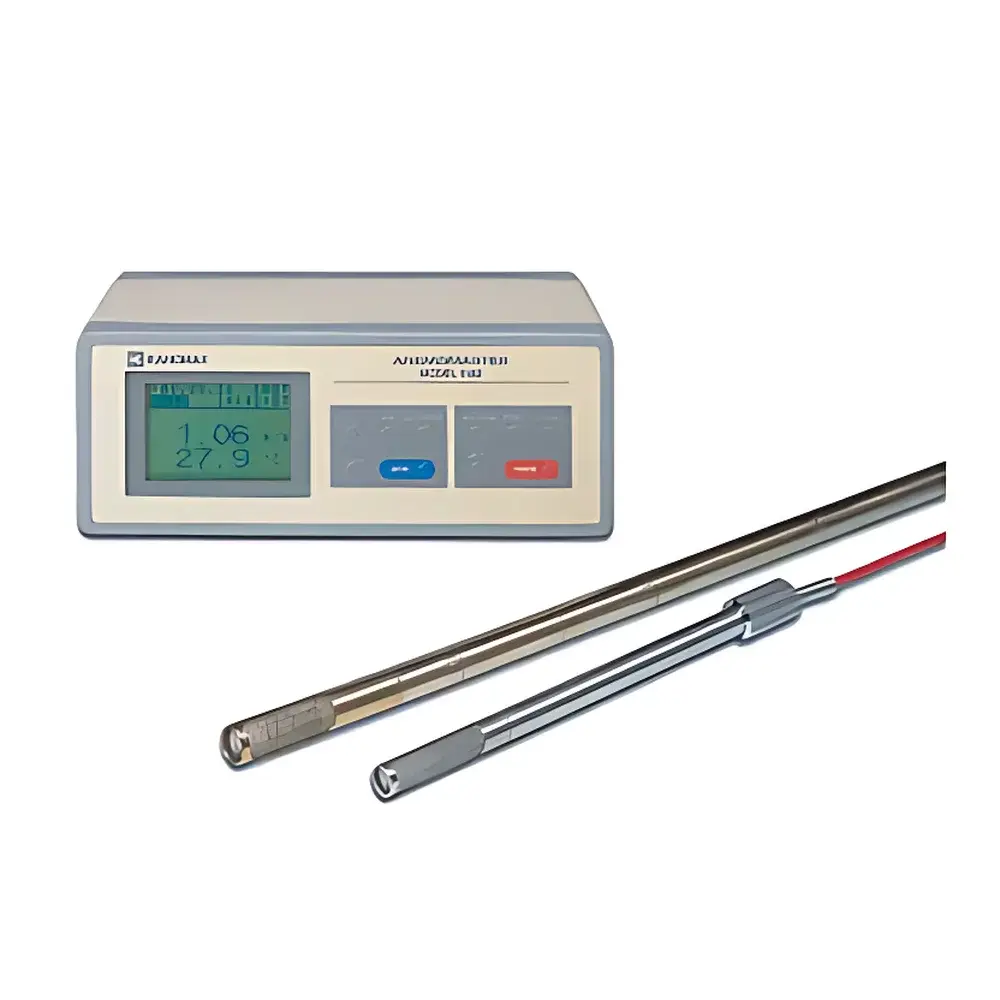
Kanomax 6162 Intelligent High-Temperature Thermal Anemometer
| Brand | Kanomax |
|---|---|
| Origin | Japan |
| Model | 6162 |
| Instrument Type | Thermal Anemometer |
| Velocity Range | 0–50.0 m/s |
| Velocity Accuracy | ±0.15 m/s (0–4.99 m/s), ±0.3 m/s (5.00–9.99 m/s), ±0.75 m/s (10.0–24.9 m/s), ±1.5 m/s (25.0–50.0 m/s) |
| Resolution | ±2% of reading |
| Operating Temperature Range | 0–500 °C |
| Operating Humidity Range | 2.0–98.0 %RH |
| Analog Output | 0–1 V |
| Data Storage Capacity | 999 records |
| Statistical Functions | Max/Min/Average |
| Probe Interchangeability | Yes |
| Compatible Multi-Channel Unit | KA12 Four-Channel Base Station |
Overview
The Kanomax 6162 Intelligent High-Temperature Thermal Anemometer is an engineered solution for continuous, real-time velocity and temperature measurement in demanding industrial environments—particularly where elevated thermal conditions preclude conventional anemometric approaches. Based on constant-temperature anemometry (CTA), the instrument maintains a heated sensing element at a fixed differential above ambient via feedback-controlled current; convective heat loss from the sensor correlates directly with local gas velocity. This principle enables stable, low-inertia response across turbulent and transient flow regimes, with minimal dependence on gas composition within standard air and inert process gases. Designed explicitly for applications up to 500 °C, the 6162 integrates a robust ceramic-sheathed probe assembly and high-temperature signal conditioning electronics, eliminating the need for external cooling jackets or purge systems typically required by lower-grade thermal sensors. Its dual-parameter output (velocity + temperature) supports direct volumetric flow calculation when cross-sectional area is entered—enabling rapid commissioning and field verification without requiring separate instrumentation.
Key Features
- High-temperature capability: Certified operation from 0 °C to 500 °C ambient exposure, with probe and electronics rated for sustained use at maximum thermal load.
- Dual-parameter measurement: Simultaneous acquisition of air velocity (0–50.0 m/s) and temperature (via integrated Pt100 RTD or thermocouple input, depending on probe variant).
- Configurable analog output: 0–1 V linear signal proportional to measured velocity, compatible with PLCs, SCADA systems, and data loggers compliant with IEC 61000-4 immunity standards.
- Onboard data logging: Internal memory stores up to 999 timestamped records, each containing velocity, temperature, and calculated volumetric flow (when area is defined).
- Statistical analysis engine: Real-time computation and display of maximum, minimum, and arithmetic mean values over user-defined sampling intervals—supporting ISO 5801 and ASHRAE 41.2-compliant duct traverse protocols.
- Modular probe architecture: Interchangeable probes—including straight, bent, and retractable variants—share common calibration coefficients and interface mechanically and electrically with the 6162 main unit.
- Multi-channel expansion: Fully compatible with the KA12 four-channel base station for synchronized multi-point monitoring in large ducts, stacks, or cleanroom supply plenums.
Sample Compatibility & Compliance
The Kanomax 6162 is validated for use with dry or moderately humid air, nitrogen, carbon dioxide, and other non-corrosive, non-condensing gases. It is not intended for use in explosive atmospheres (ATEX/IECEx zones), high-particulate streams (>10 mg/m³), or condensing vapor environments. Calibration traceability follows JIS Z 8000 and ISO/IEC 17025 requirements through Kanomax’s accredited calibration laboratory in Yokohama. The device meets EMC Directive 2014/30/EU and Low Voltage Directive 2014/35/EU. While not inherently 21 CFR Part 11 compliant, audit trails and data integrity can be maintained when used in conjunction with validated third-party software platforms supporting electronic signatures and change control.
Software & Data Management
Data export is supported via USB interface using Kanomax’s proprietary PC application (Windows 10/11 compatible), which provides graphical trend analysis, CSV export, and report generation per ISO 14644-3 Annex B conventions. Raw logged files include embedded metadata: date/time stamp, probe ID, measurement mode, and environmental RH (if humidity sensor option is installed). Firmware updates are delivered via signed binary packages with SHA-256 verification. No cloud connectivity or remote access functionality is embedded—ensuring data sovereignty and alignment with ITAR and GDPR-aligned network security policies.
Applications
- Industrial furnace and kiln exhaust characterization, including combustion efficiency audits per ASTM D6866 and EN 15403.
- Stack emission monitoring support during EPA Method 2 (velocity traverse) and ISO 9096 particulate sampling campaigns.
- Validation of HVAC system performance in pharmaceutical cleanrooms (ISO 14644-1 Class 5–8), particularly for high-temperature recirculation ducts.
- R&D testing of thermal management systems in power electronics, battery drying ovens, and aerospace component thermal cycling chambers.
- Commissioning and balancing of industrial drying tunnels, paint bake ovens, and food processing conveyors operating above 300 °C.
FAQ
What is the maximum allowable flue gas temperature for continuous probe operation?
The probe is rated for continuous exposure up to 500 °C; however, prolonged operation above 450 °C may reduce long-term calibration stability and requires quarterly verification per ISO 17025 procedures.
Can the 6162 be used in saturated steam environments?
No. Condensation will damage the thermal sensor and invalidate readings. It is suitable only for dry or sub-saturated gas streams with dew point at least 10 °C below ambient temperature.
Is probe calibration certificate included with shipment?
Yes—a NIST-traceable calibration certificate (covering velocity points at 2, 10, 25, and 45 m/s at 25 °C ambient) is supplied with each unit. High-temperature calibration (at 200 °C and 400 °C) is available as an optional service.
Does the KA12 four-channel station support synchronized sampling across all inputs?
Yes. All four channels acquire data simultaneously with <10 ms inter-channel skew, enabling phase-resolved turbulence analysis and spatial velocity gradient mapping.
How is measurement uncertainty determined across the full range?
Uncertainty is specified per ISO/IEC 17025:2017 Annex A, combining type-A (repeatability) and type-B (calibration, resolution, linearity) components. Total expanded uncertainty (k=2) is documented in the calibration report for each velocity subrange.
Related Products







