
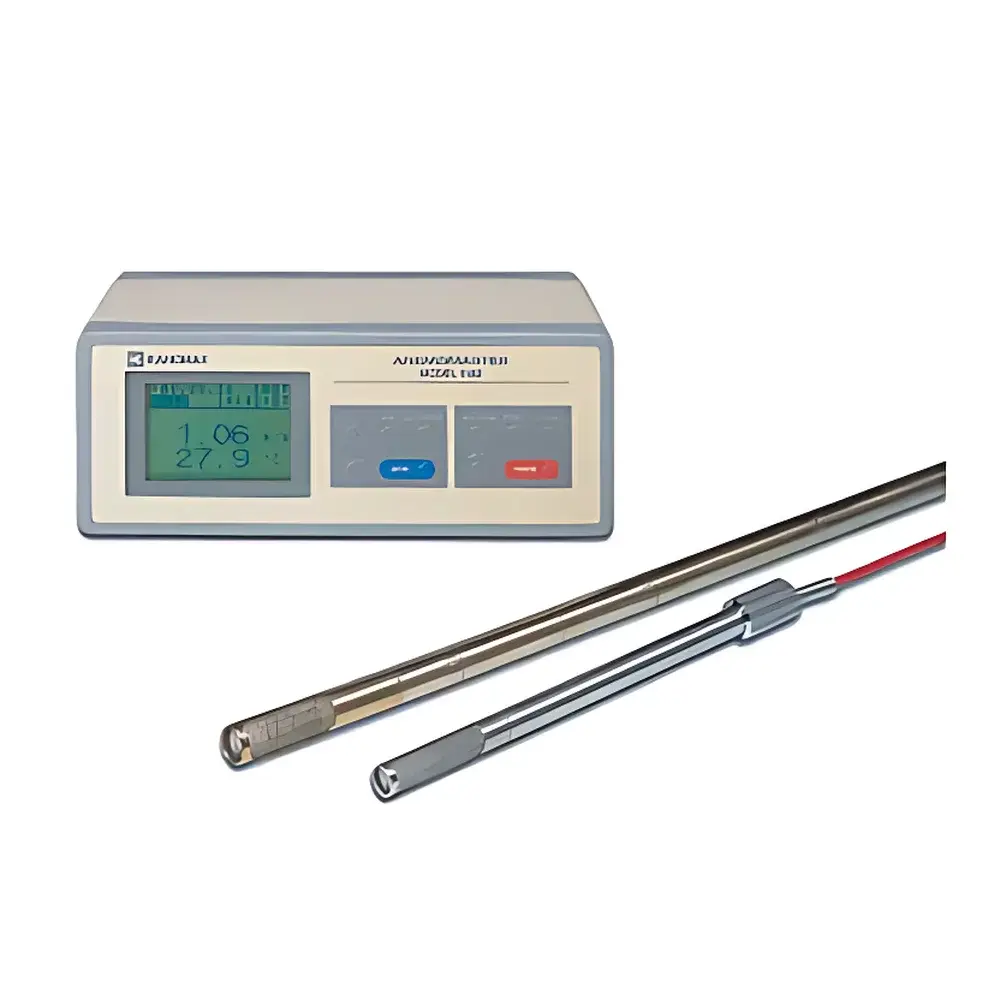
Kanomax 6162 Intelligent Medium-High Temperature Thermal Anemometer
| Brand | Kanomax |
|---|---|
| Origin | Japan |
| Model | Kanomax 6162 |
| Instrument Type | Thermal Anemometer |
| Measurement Range | 0–50.0 m/s |
| Resolution | ±2% of reading |
| Accuracy | ±0.15 m/s (0–4.99 m/s), ±0.3 m/s (5.00–9.99 m/s), ±0.75 m/s (10.0–24.9 m/s), ±1.5 m/s (25.0–50.0 m/s) |
| Operating Ambient Temperature | 0–500 °C |
| Operating Ambient Humidity | 2.0–98.0 %RH |
| Analog Output | 0–1 V |
| Data Storage Capacity | 999 sets |
| Statistical Functions | Max/Min/Average |
| Probe Interchangeability | Yes |
| Compatible Multi-Channel System | Kanomax KA12 Four-Channel Base Unit |
Overview
The Kanomax 6162 Intelligent Medium-High Temperature Thermal Anemometer is an engineered solution for continuous, real-time velocity and temperature measurement in demanding industrial airflow environments—particularly where elevated thermal conditions preclude conventional sensor operation. Based on constant-temperature anemometry (CTA), the instrument maintains a heated sensing element at a fixed differential above ambient, with convective heat loss directly correlated to local gas velocity. This principle enables stable, low-inertia response across turbulent and transient flows, without moving parts or mechanical wear. Unlike cup or vane anemometers, the 6162 delivers true vector-aligned axial velocity data, critical for duct balance, stack emission monitoring, furnace commissioning, and cleanroom HVAC validation. Its probe assembly is rated for sustained exposure up to 500 °C, making it suitable for flue gas sampling, kiln exhaust characterization, and high-temperature drying process verification—applications where standard thermal probes would thermally saturate or drift.
Key Features
- High-temperature probe capable of continuous operation from 0 °C to 500 °C ambient, with integrated Pt100 RTD for simultaneous temperature acquisition
- Wide dynamic velocity range: 0–50.0 m/s with segmented accuracy specification traceable to NIST-traceable calibration standards
- Onboard calculation engine: input cross-sectional area to derive volumetric flow rate (m³/h or CFM) in real time
- Analog output interface (0–1 V) compatible with PLCs, SCADA systems, and data loggers for integration into facility-wide monitoring networks
- Internal memory stores up to 999 sequential or triggered measurement records, each timestamped with date/time and associated temperature
- Real-time statistical processing: automatic computation and display of maximum, minimum, and arithmetic mean values over user-defined intervals
- Modular probe design supports field interchangeability; compatible with Kanomax’s KA12 four-channel base unit for synchronized multi-point profiling
Sample Compatibility & Compliance
The Kanomax 6162 is designed for use with clean, dry, non-corrosive gases—including air, nitrogen, carbon dioxide, and combustion exhaust streams with particulate loading below ISO 8573-1 Class 4. It is not intended for use in explosive atmospheres (ATEX/IECEx zones), saturated steam, or highly abrasive or chemically aggressive media (e.g., HCl, HF, or chlorine-rich flue gases). The instrument complies with IEC 61000-4 electromagnetic immunity standards and meets CE marking requirements for EMC and Low Voltage Directive conformity. While not certified to UL or CSA standards out-of-the-box, its analog output and power architecture support integration into systems compliant with FDA 21 CFR Part 11 when deployed with validated software and audit-trail-enabled data management protocols.
Software & Data Management
Data retrieval is performed via USB interface using Kanomax’s proprietary PC application (Windows-compatible), which supports export to CSV, Excel, and PDF formats. Each stored record includes velocity, temperature, timestamp, and probe ID metadata. The software enforces read-only access to historical logs unless configured with administrator privileges, supporting GLP/GMP-aligned documentation workflows. Audit trails capture user login events, configuration changes, and data export actions. For automated reporting, the application permits scheduled batch exports and configurable alarm thresholds—enabling compliance with ISO 14644-3 duct leakage testing protocols or ASTM D5482 stack velocity surveys.
Applications
- Duct and stack velocity profiling for EPA Method 2, ISO 16890, and EN 15251 ventilation assessments
- Thermal process validation in industrial ovens, annealing furnaces, and ceramic kilns
- Commissioning and balancing of high-temperature HVAC systems in semiconductor fab cleanrooms and pharmaceutical isolators
- In-situ calibration verification of fixed-mount flow sensors in power plant air preheaters and boiler secondary air ducts
- Research-grade airflow mapping in wind tunnel boundary layer studies with elevated wall temperatures
FAQ
Can the 6162 be used in wet or condensing environments?
No. While humidity tolerance extends to 98.0 %RH, the probe must remain above dew point at all times to prevent condensate formation on the sensing element, which compromises thermal transfer fidelity and may cause irreversible drift.
Is calibration certificate included with shipment?
A factory calibration report (traceable to JCSS-accredited standards) is supplied with each unit. Optional UKAS or NIST-traceable calibration certificates are available upon request prior to dispatch.
Does the KA12 four-channel base support synchronized sampling across all probes?
Yes. The KA12 unit provides hardware-triggered, sub-millisecond synchronization across up to four 6162 probes, enabling spatially resolved turbulence intensity and velocity gradient analysis.
What is the recommended recalibration interval?
Kanomax recommends annual recalibration under routine industrial use; more frequent verification is advised after exposure to thermal shock (>100 °C/min ramp rates) or mechanical impact.
Can analog output be re-ranged for custom scaling?
The 0–1 V output is fixed per velocity range (e.g., 0–50 m/s = 0–1 V); external signal conditioners or PLC scaling logic must be applied for non-linear or segmented mapping.
Related Products







