

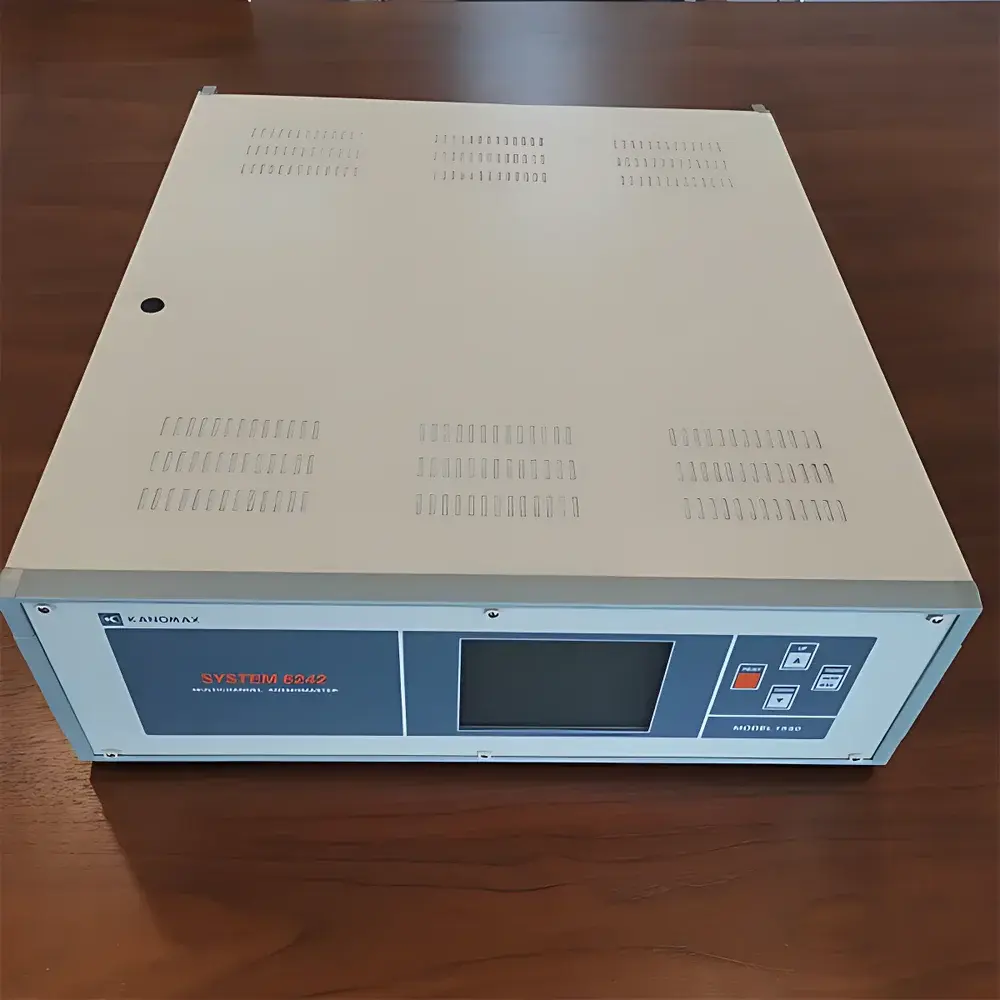
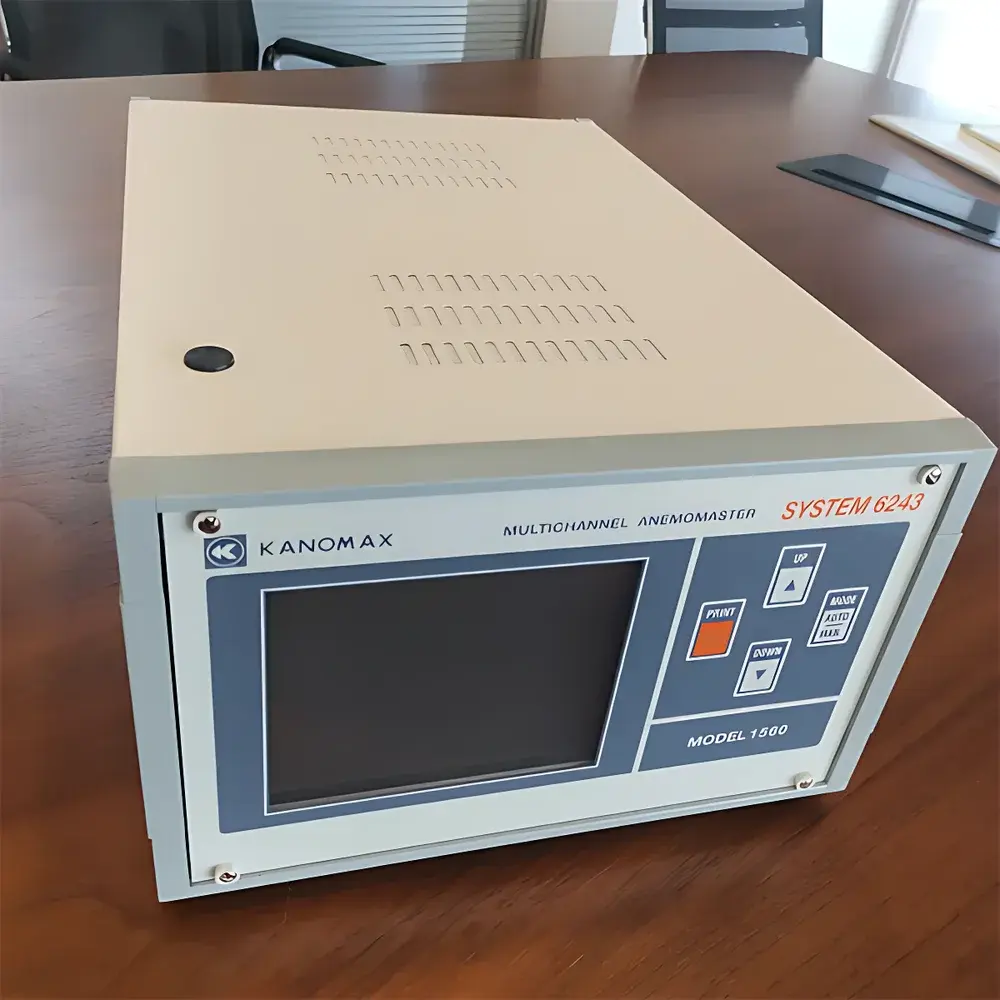
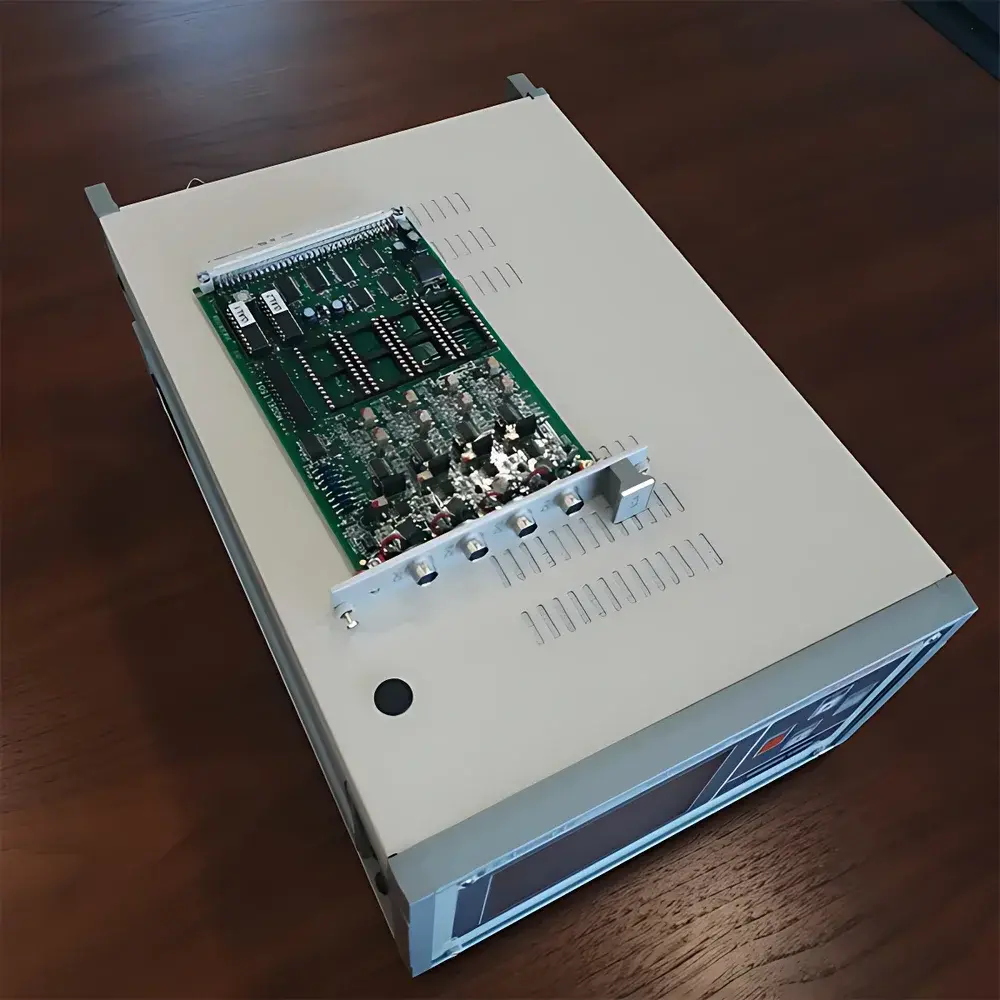
Kanomax 6242/6243 Intelligent Multi-Point Environmental Monitoring System
| Brand | Kanomax |
|---|---|
| Origin | Japan |
| Model | 6242/6243 (Base Unit Models: 1550 / 1560) |
| Instrument Type | Thermal Anemometer-Based Environmental Monitoring System |
| Resolution | 0.01 m/s (air velocity) |
| Velocity Range | Probe-Dependent (see probe specifications) |
| Accuracy | ±0.5% FS (full scale) |
| Temperature Range | 0–70 °C |
| Relative Humidity Range | 0–100% RH |
| Pressure Range | 0 to ±5 kPa |
| Pressure Accuracy | ±0.03 kPa (0–2 kPa), ±0.10 kPa (2–5 kPa) |
| Analog Output | Standard 0–5 V (optional: 0–2.5 V, 0–10 V, or 5 V) |
| Output Accuracy | ±0.5% FS |
| Communication Interface | RS-232C |
| Power Supply | AC 100–240 V, 50/60 Hz |
| Dimensions (Model 1550) | 430 × 140 × 500 mm |
| Dimensions (Model 1560) | 226 × 140 × 325 mm |
| Weight (Model 1550) | 10 kg |
| Weight (Model 1560) | 5 kg |
| Channel Scalability | Up to 320 channels via cascaded Model 1550 units (16 modules per unit) |
| Module Capacity | 16 slots (1550), 6 slots (1560) |
| Probe Compatibility | Interchangeable thermal anemometer, thermistor, capacitive humidity, and differential pressure probes |
Overview
The Kanomax 6242/6243 Intelligent Multi-Point Environmental Monitoring System is a modular, high-channel-count platform engineered for simultaneous, synchronized measurement of air velocity, temperature, relative humidity, and differential pressure across complex industrial and laboratory environments. Based on thermal anemometry principles—where convective heat transfer from a heated sensor element correlates directly with local airflow velocity—the system delivers stable, low-drift readings under variable thermal and moisture conditions. Unlike single-point handheld instruments, the 6242/6243 architecture separates signal conditioning, data acquisition, and communication into standardized hardware layers: a base unit (Model 1550 or 1560), interchangeable input modules (templates), and field-deployable probes. This modularity enables scalable deployment—from localized HVAC duct validation (6-channel Model 1560) to full-facility cleanroom monitoring (320-channel cascaded Model 1550 configurations). Designed and manufactured in Japan, the system meets stringent reliability requirements for continuous unattended operation in GMP-compliant manufacturing suites, ISO Class 5–8 cleanrooms, and environmental test chambers.
Key Features
- Modular hardware architecture supporting up to 320 simultaneous measurement channels via daisy-chained Model 1550 base units (16 module slots per unit)
- Dual base unit options: high-density Model 1550 (16-slot chassis, 10 kg) and compact Model 1560 (6-slot, 5 kg) for space-constrained installations
- Thermal anemometer probes with 0.01 m/s resolution and ±0.5% FS accuracy across velocity ranges defined by probe selection (e.g., 0–30 m/s, 0–100 m/s)
- Integrated environmental sensing: NIST-traceable thermistors (0–70 °C), capacitive RH sensors (0–100% RH), and piezoresistive differential pressure transducers (0 to ±5 kPa)
- Precision analog output (0–5 V standard; configurable 0–10 V, 0–2.5 V, or 5 V) with ±0.5% FS linearity for PLC or SCADA integration
- RS-232C serial interface compliant with EIA/TIA-232 standards for bidirectional command-and-control and real-time data streaming
- Rugged metal chassis with industrial-grade power supply (AC 100–240 V, 50/60 Hz) rated for continuous operation in ambient temperatures up to 70 °C
Sample Compatibility & Compliance
The 6242/6243 system accommodates a broad range of Kanomax-certified probes—including omnidirectional thermal anemometers for turbulent flow mapping, vane-style probes for directional duct surveys, and miniature pitot-static assemblies for confined-space applications. All probes undergo individual calibration against ISO/IEC 17025-accredited reference standards, with traceable certificates supplied per unit. The system supports compliance-critical workflows: pressure measurements align with ISO 14644-3 Annex B for cleanroom classification; temperature/humidity logging satisfies ISO 14644-2 surveillance requirements; and time-stamped raw data export enables audit-ready documentation for FDA 21 CFR Part 11 and EU Annex 11 validation protocols. No internal batteries or volatile memory are used—data integrity is preserved during power interruption via non-volatile configuration storage.
Software & Data Management
Kanomax-supplied Windows-based system software provides real-time visualization, statistical analysis (min/max/avg/std dev), trend charting, and customizable report generation (PDF/CSV/XLSX). Each channel is individually configurable for sampling interval (100 ms–3600 s), alarm thresholds, and unit conversion (m/s, ft/min, °C, °F, %RH, Pa, mmH₂O). The software implements GLP/GMP-compliant audit trails: all parameter changes, user logins, and data exports are timestamped and attributed. Raw binary data files include embedded metadata (probe ID, calibration date, module slot, firmware version) to support ICH M7 and ALCOA+ data integrity principles. Optional OPC UA server add-on enables secure interoperability with MES and LIMS platforms.
Applications
- HVAC performance verification and balancing in pharmaceutical production facilities and hospital isolation rooms
- Cleanroom airflow uniformity mapping per ISO 14644-3 and EU GMP Annex 1
- Environmental chamber qualification (IQ/OQ/PQ) for stability testing and accelerated aging studies
- Exhaust hood face velocity validation per ANSI/ASHRAE 110 and EN 14175
- Industrial process ventilation monitoring in semiconductor fab tool exhaust stacks and battery dry rooms
- Academic research in aerodynamics, indoor air quality (IAQ), and thermal comfort modeling (PMV/PPD)
FAQ
What is the maximum number of measurement points supported by a single Model 1550 base unit?
A Model 1550 supports up to 16 input modules; each module typically handles 1–4 probes depending on type, enabling up to 64 discrete measurement points per unit.
Can different probe types be mixed within one base unit?
Yes—modules are function-specific (e.g., velocity, temperature/RH, pressure), allowing concurrent use of thermal anemometers, thermistor-hygrometer combos, and differential pressure sensors on the same chassis.
Is the system compatible with modern industrial networks such as Ethernet/IP or Modbus TCP?
The native interface is RS-232C; however, third-party protocol converters (e.g., RS-232 to Modbus TCP gateways) are widely deployed in validated environments with documented equivalence testing.
How is calibration maintained across multi-unit cascaded systems?
Each probe carries its own NIST-traceable calibration certificate; base units perform automatic gain/offset compensation using stored module-specific coefficients during initialization.
Does the software support automated pass/fail evaluation against predefined acceptance criteria?
Yes—user-defined limit sets can trigger visual alerts, audible notifications, and automatic flagging of out-of-specification data points during live monitoring or post-acquisition review.
Related Products







