
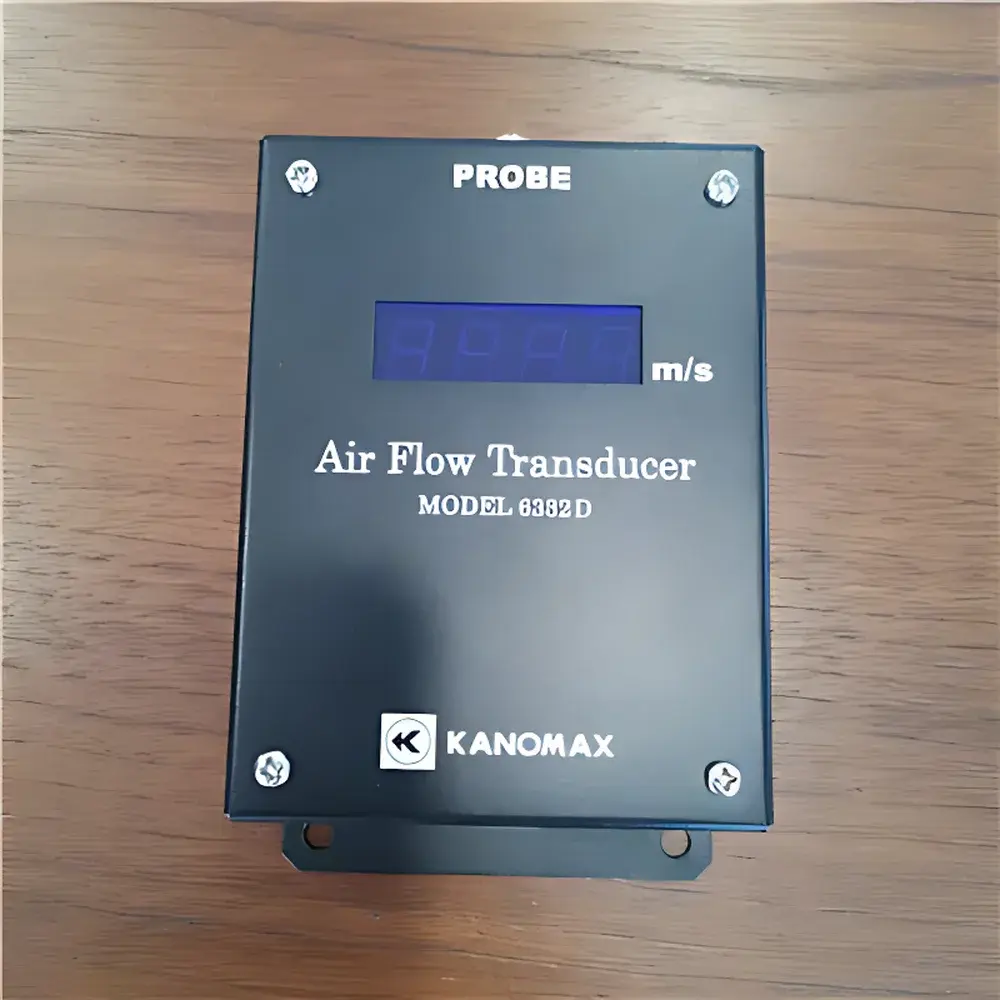
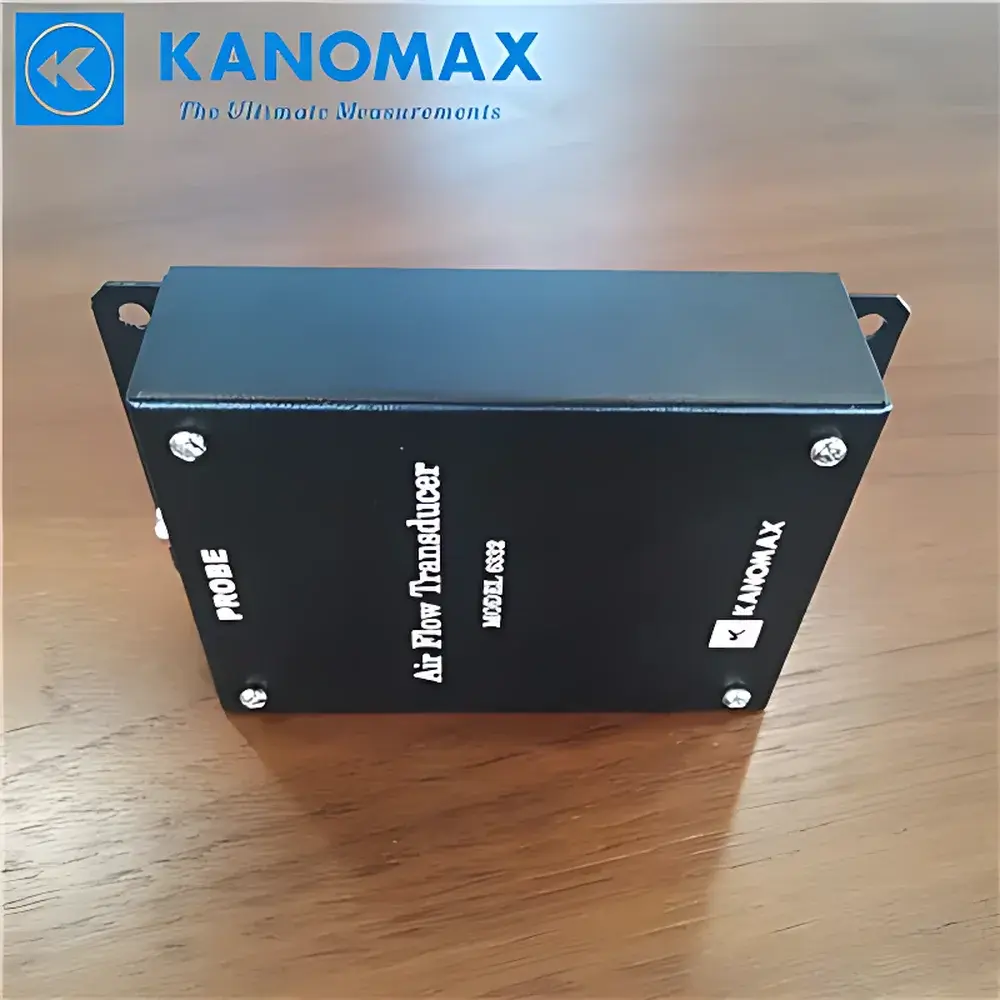
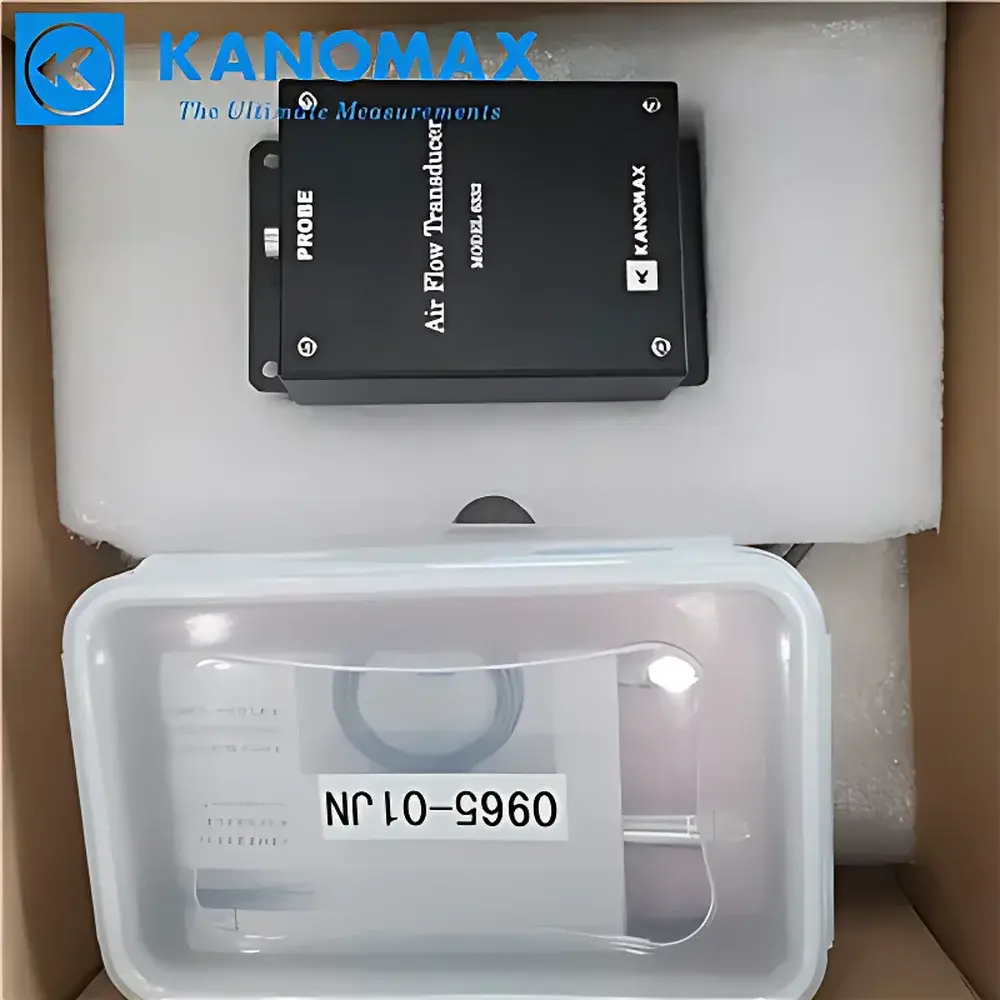
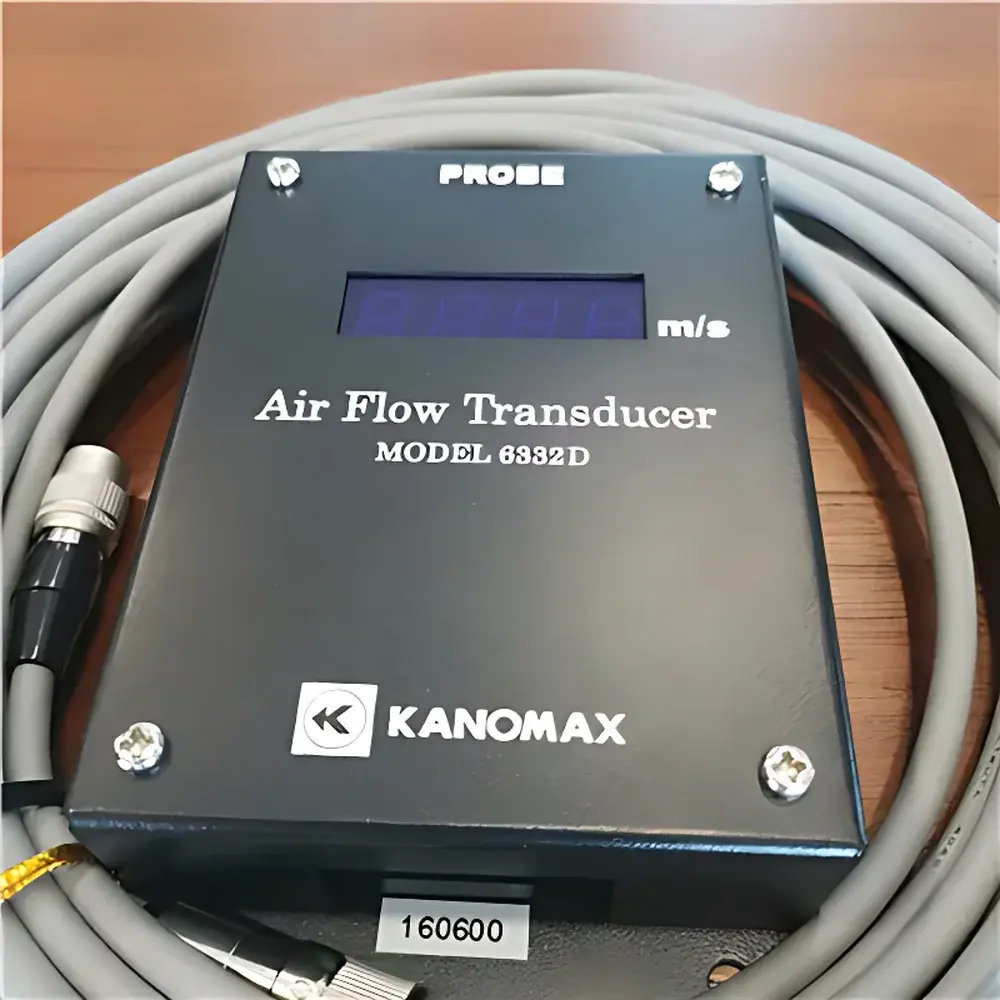
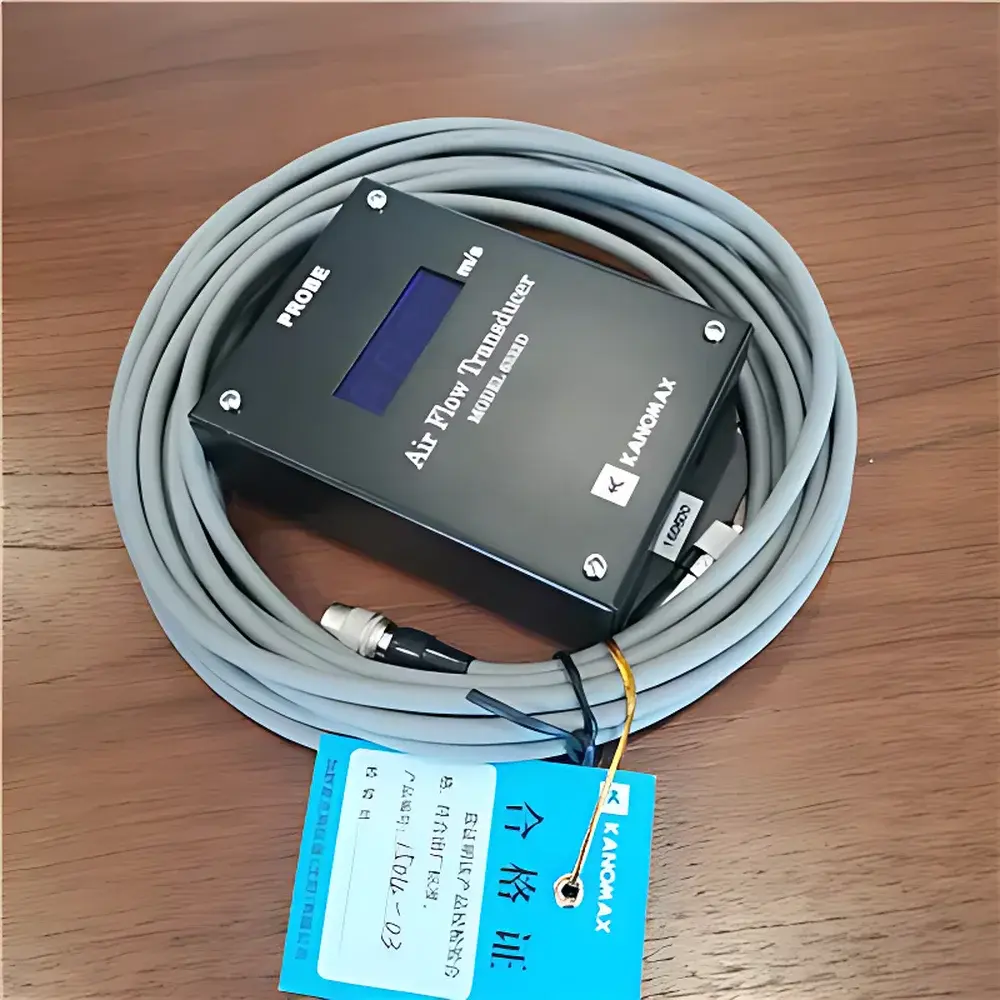
Kanomax 6332D Hot-Wire Anemometer Transmitter with Interchangeable Probe Interface
| Brand | Kanomax |
|---|---|
| Origin | Japan |
| Model | 6332D |
| Instrument Type | Hot-Wire Anemometer |
| Measurement Range | 0.1–50 m/s (9–8,400 fpm), probe-dependent |
| Accuracy | ±3% of reading ±0.1 m/s (±20 fpm) |
| Operating Temperature | 5–40 °C (41–104 °F) |
| Display | Built-in LCD |
| Output Options | Switch-selectable 0–5 V DC, 0–1 V DC, or 4–20 mA |
| Power Supply | DC 12 V ±2 V |
| Dimensions | 128 × 78 × 30 mm |
| Weight | 320 g |
| Probe Compatibility | Supports 10 interchangeable hot-wire and thermal anemometry probes |
Overview
The Kanomax 6332D is a precision-engineered hot-wire anemometer transmitter designed for continuous, real-time wind velocity monitoring in controlled and industrial environments. Based on constant-temperature anemometry (CTA) principles, the 6332D maintains a heated sensing element at a stable temperature differential relative to ambient air; changes in convective heat loss—directly proportional to airflow velocity—are converted into calibrated electrical signals. Unlike fixed-probe instruments, the 6332D features a standardized mechanical and electrical interface enabling seamless interchangeability across ten distinct probe configurations—including straight, bent, retractable, and ultra-thin variants—each optimized for specific duct geometries, cleanroom ISO classifications, HVAC commissioning protocols, or laminar flow hood validation. Its compact, DIN-rail-mountable housing integrates signal conditioning, linearization, and output switching logic without external modules, supporting deployment in both standalone and distributed monitoring architectures.
Key Features
- Modular probe interface compliant with Kanomax’s 6300-series mechanical and electrical specifications—ensures repeatable calibration traceability across all 10 compatible probes
- Triple-mode analog output selection via internal DIP switches: 0–5 V DC, 0–1 V DC, or industry-standard 4–20 mA current loop—enabling direct integration with PLCs, SCADA systems, and building management controllers
- Integrated backlit LCD display showing real-time wind speed (m/s or fpm), unit status, and probe identification—no external reader required for field verification
- Rugged aluminum-alloy enclosure rated IP54 for resistance to dust ingress and incidental moisture—suitable for laboratory, production floor, and semi-outdoor mounting
- Stable power regulation across ±2 V tolerance on 12 V DC input—minimizes drift under fluctuating supply conditions common in facility-wide instrumentation networks
- Low thermal mass sensor design enables response time <100 ms (τ₉₀), critical for capturing transient airflow events during filter integrity testing or room pressurization audits
Sample Compatibility & Compliance
The 6332D supports probe-specific measurement ranges and accuracy profiles validated per probe model—e.g., the 6332-01 straight probe (0.1–30 m/s, ±2.5% rdg) versus the 6332-07 low-velocity probe (0.05–5 m/s, ±0.05 m/s). All probes comply with JIS B 7554-1:2018 (hot-wire anemometers) and reference ASTM D1072–22 Annex A1 for airflow velocity instrument calibration methodology. The transmitter itself meets IEC 61326-1:2022 for electromagnetic compatibility in industrial environments and carries PSE certification for use in Japanese regulatory contexts. While not intrinsically safe, its 12 V DC operation allows safe deployment in non-hazardous classified zones per NEC Class I, Division 2 guidelines when installed per manufacturer wiring instructions.
Software & Data Management
The 6332D operates as a self-contained analog transducer and does not require proprietary software for basic operation. However, when integrated into multi-channel arrays—up to 16 units daisy-chained via optional synchronization cables—data streams may be logged using third-party DAQ platforms (e.g., National Instruments LabVIEW, Keysight PathWave, or open-source Python-based acquisition scripts). Analog outputs support 12-bit effective resolution when paired with compliant ADC hardware. For audit-ready applications, users are advised to document probe serial numbers, calibration dates (traceable to JCSS-accredited labs), and output configuration settings per ISO/IEC 17025:2017 clause 7.7 on measurement traceability. No onboard memory or digital communication protocols (e.g., Modbus, RS-485) are implemented—ensuring deterministic latency and eliminating firmware-related failure modes.
Applications
- HVAC system balancing and TAB (Testing, Adjusting, Balancing) per ASHRAE Guideline 1:2021
- Cleanroom airflow uniformity mapping in ISO 14644-3 Class 3–8 environments
- Pharmaceutical facility environmental monitoring per EU GMP Annex 1 (2022) requirements for unidirectional airflow verification
- Exhaust hood face velocity validation per ANSI/ASHRAE 110-2016
- Wind tunnel boundary layer profiling using arrayed 6332D units with synchronized sampling
- Industrial dryer and oven airspeed profiling where thermal stability and repeatability are critical to process yield
FAQ
Can the 6332D be used with non-Kanomax probes?
No—the mechanical coupling, thermal compensation algorithm, and calibration coefficients are uniquely matched to Kanomax’s 10 certified probe models. Third-party probes will produce non-linear or out-of-specification output.
Is NIST-traceable calibration documentation included?
Each unit ships with a factory calibration report referencing JCSS-accredited standards; full NIST-traceable certificates require separate purchase and scheduled recalibration every 12 months.
What is the maximum cable length between probe and transmitter?
For optimal signal integrity, Kanomax specifies ≤3 m for standard shielded twisted-pair cabling; longer runs require active signal buffering per application note AN-6332D-02.
Does the 6332D support digital communication protocols like Modbus RTU?
No—it is strictly an analog-output device. Digital interfacing requires external analog-to-digital conversion or integration via compatible PLC analog input modules.
How often should the sensing wire be cleaned or replaced?
Under typical indoor conditions, visual inspection and gentle cleaning with isopropyl alcohol every 6 months is sufficient; replacement intervals depend on particulate loading and are indicated by increased zero drift or reduced sensitivity beyond ±5% of full scale.







