
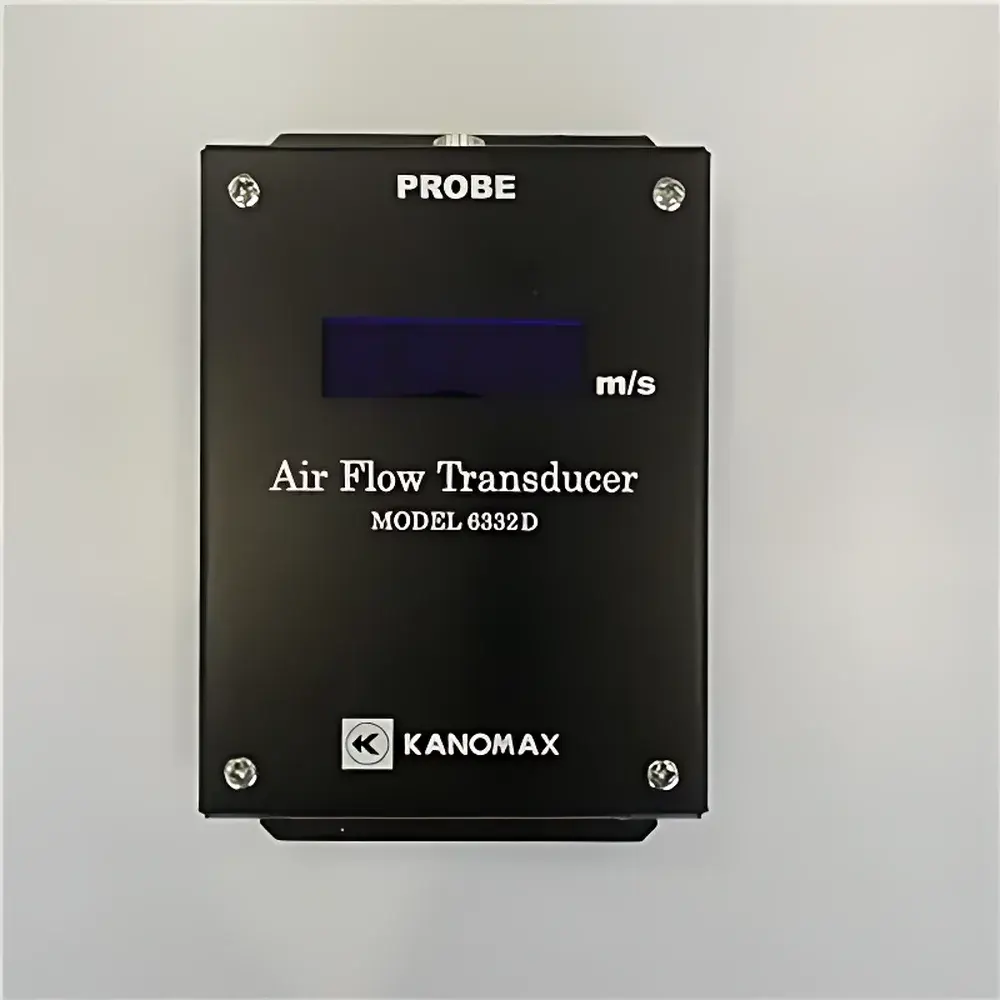
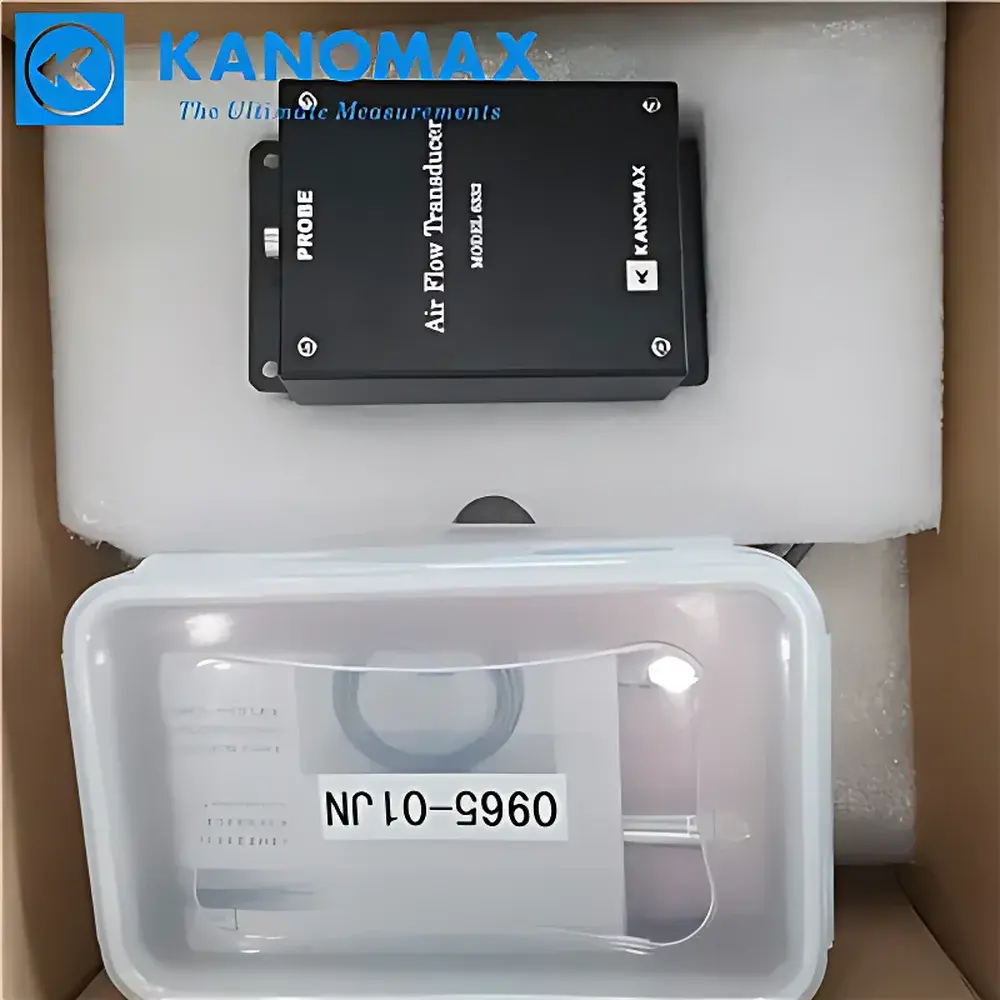
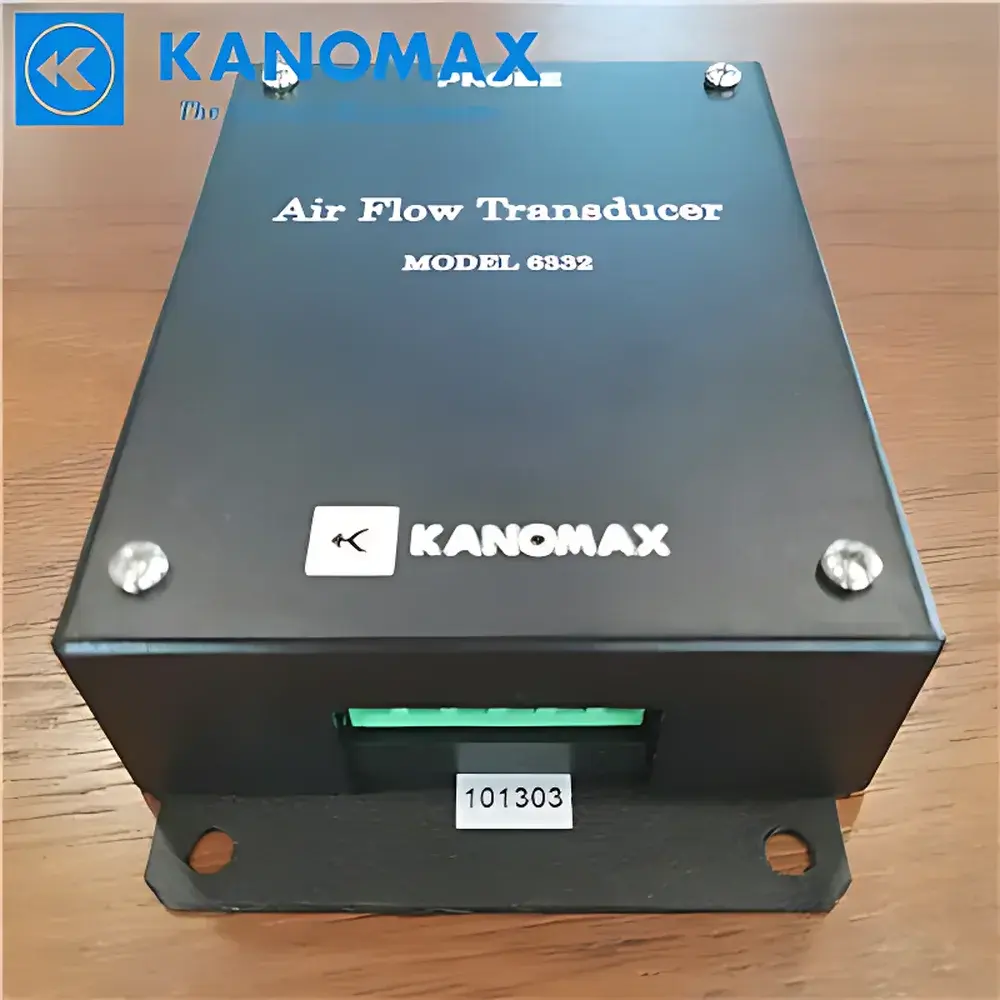
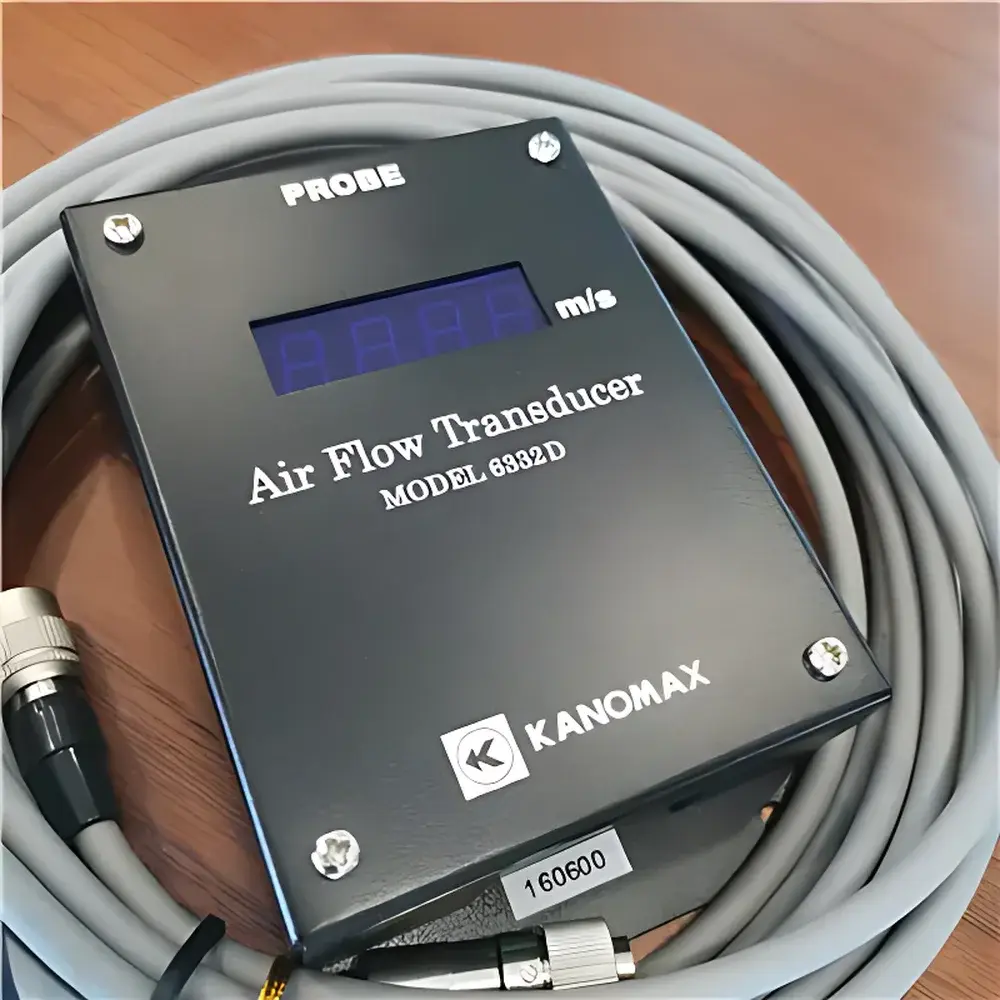
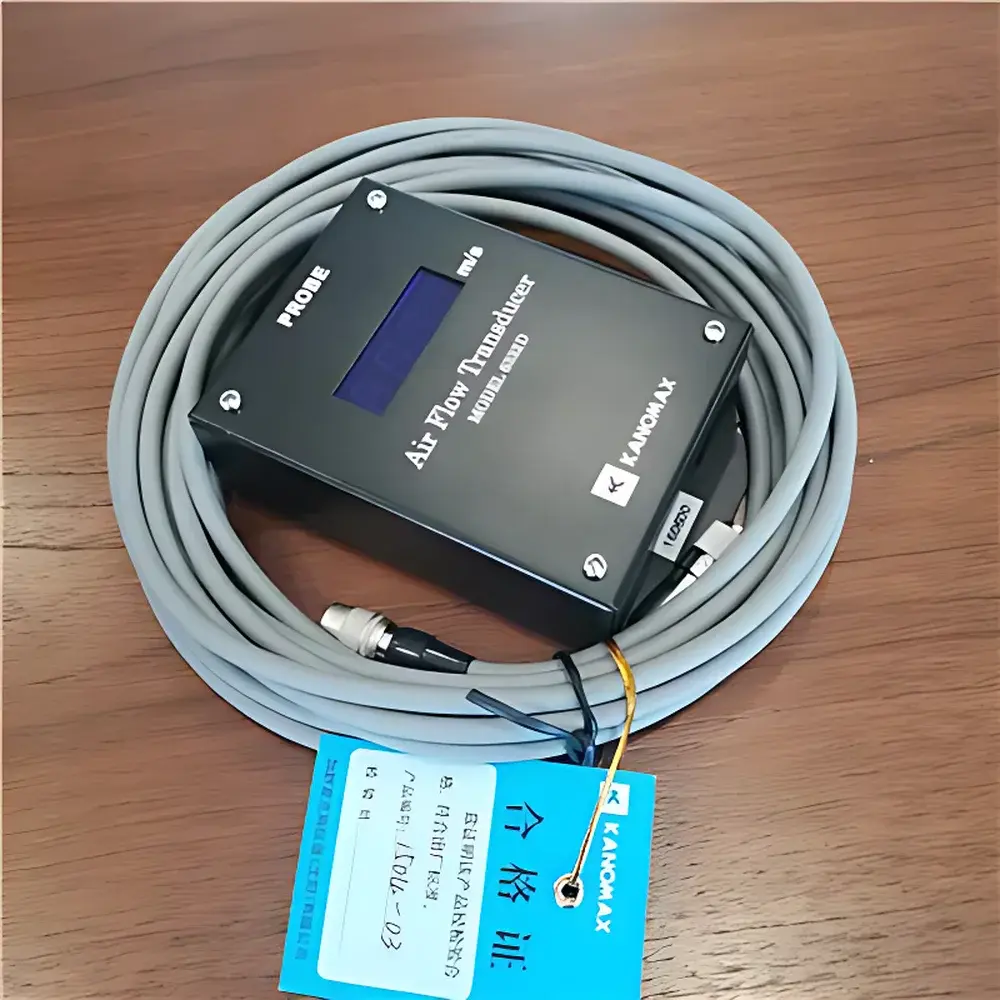
Kanomax 6332D Thermal Anemometer Transmitter with Analog Output
| Brand | Kanomax |
|---|---|
| Origin | Japan |
| Model | 6332D |
| Instrument Type | Thermal Anemometer |
| Measurement Range | 0.1–50 m/s (9–8,400 fpm), probe-dependent |
| Accuracy | ±3% of reading ±0.1 m/s (±20 fpm) |
| Operating Temperature | 5–40 °C (41–104 °F) |
| Analog Output Options | 0–5 V DC, 0–1 V DC, or 4–20 mA DC (selectable via internal DIP switch) |
| Power Supply | DC 12 V ±2 V |
| Dimensions | 128 × 78 × 30 mm |
| Weight | 320 g |
| Display | Built-in LCD (real-time wind speed readout, range dependent on connected probe) |
| Probe Compatibility | Interchangeable with 10 standardized thermal probes for the 6332 series |
Overview
The Kanomax 6332D is a precision-engineered thermal anemometer transmitter designed for continuous, real-time wind velocity monitoring in HVAC commissioning, cleanroom validation, industrial ventilation assessment, and environmental chamber characterization. Utilizing constant-temperature anemometry (CTA) principles, the device measures convective heat transfer from a heated sensor element to quantify airflow velocity with high temporal resolution and low thermal inertia. Unlike cup or vane anemometers, the 6332D delivers true vector-agnostic, omnidirectional response—critical for turbulent or low-velocity laminar flow applications where directional bias must be minimized. Its modular architecture centers on a dedicated transmitter unit that interfaces exclusively with Kanomax’s family of calibrated thermal probes, enabling traceable, NIST-traceable (via manufacturer calibration certificates) measurements across diverse duct geometries, grilles, and confined spaces.
Key Features
- Integrated backlit LCD display providing immediate, probe-specific wind speed readout without external instrumentation
- Three-field-selectable analog output modes (0–5 V DC, 0–1 V DC, or 4–20 mA DC) configured via onboard DIP switches—no software or firmware intervention required
- Rugged aluminum-alloy housing (128 × 78 × 30 mm, 320 g) rated for stable operation in ambient conditions from 5 to 40 °C and relative humidity up to 85% RH non-condensing
- Low-power DC 12 V ±2 V input with reverse-polarity protection and transient voltage suppression compliant with IEC 61000-4-5 surge immunity Level 3
- Modular probe interface supporting 10 interchangeable thermal probes—including retractable rod, telescopic wand, and ultra-thin 3 mm diameter variants—each individually calibrated and supplied with certificate of conformance
- Multi-unit daisy-chaining capability via isolated analog outputs, enabling synchronized multi-point airflow profiling in duct banks or cleanroom ceiling grids without signal degradation
Sample Compatibility & Compliance
The 6332D is compatible exclusively with Kanomax-certified thermal probes (e.g., 6331, 6333, 6335 series), each characterized over its full operational range and assigned a unique calibration curve stored in probe memory. All probes comply with ISO 16813:2006 (HVAC air velocity measurement) and meet the dimensional and thermal response requirements of ASHRAE Guideline 12-2020 for infectious aerosol control system verification. The transmitter itself carries CE marking per EMC Directive 2014/30/EU and Low Voltage Directive 2014/35/EU. While not intrinsically safe, it is suitable for use in non-hazardous environments classified under IEC 60079-0:2017 Group II, Category 3G.
Software & Data Management
The 6332D operates as a standalone analog transducer and does not require proprietary software for basic functionality. However, when integrated into SCADA, BMS, or data acquisition systems (e.g., National Instruments DAQmx, Siemens Desigo CC, or Honeywell Experion), its analog outputs support direct signal ingestion with configurable scaling (e.g., 4–20 mA mapped linearly to 0–50 m/s). For audit-ready documentation, users may pair the unit with third-party logging platforms that enforce 21 CFR Part 11-compliant electronic records—provided the host system implements user authentication, audit trails, and output signature verification. Calibration intervals are recommended annually or per ISO/IEC 17025-accredited laboratory protocols.
Applications
- HVAC system balancing and TAB (Testing, Adjusting, and Balancing) in commercial and healthcare facilities
- Cleanroom ISO Class 5–8 airflow uniformity mapping per ISO 14644-3 Annex B
- Fume hood face velocity verification per ANSI/ASHRAE 110-2016
- Industrial dryer and oven air curtain validation
- Environmental test chamber airflow homogeneity studies
- Research-grade boundary layer characterization in wind tunnels and aerodynamic test rigs
FAQ
Can the 6332D be used outdoors?
No—the operating temperature specification (5–40 °C) and lack of IP-rated enclosure restrict use to controlled indoor environments.
Is probe calibration traceable to national standards?
Yes—each probe ships with a factory calibration certificate referencing JCSS (Japan Calibration Service System) traceability; optional NIST-traceable calibration is available upon request.
What is the maximum cable length between probe and transmitter?
For optimal signal integrity with 4–20 mA output, Kanomax recommends ≤100 m using shielded twisted-pair cable (AWG 22, 100 Ω characteristic impedance).
Does the 6332D support digital communication protocols like Modbus or BACnet?
No—it is analog-output-only; digital integration requires external analog-to-Modbus converters compliant with EN 50178.
How frequently should the probe sensor be cleaned?
Inspect before each critical measurement session; clean gently with isopropyl alcohol and lint-free swab if contamination (e.g., oil mist, dust accumulation) is visible on the platinum RTD sensing element.







