
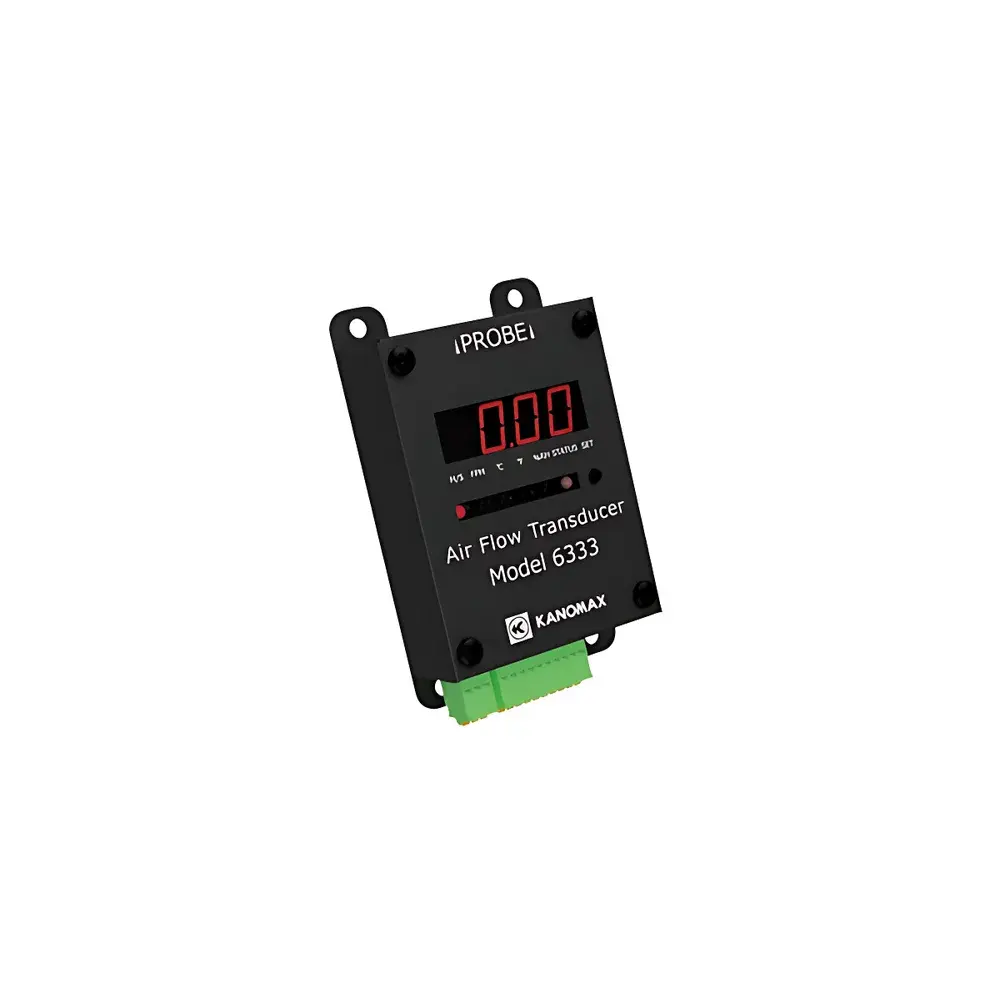
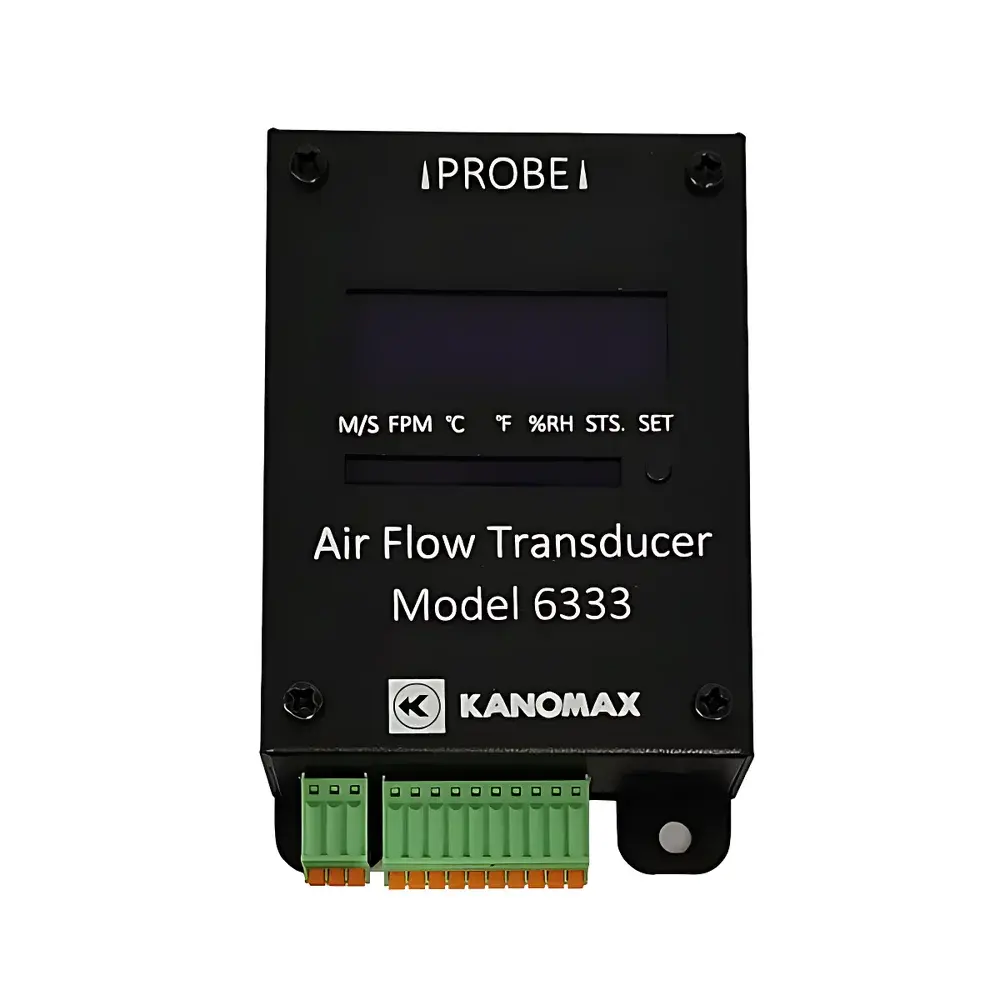
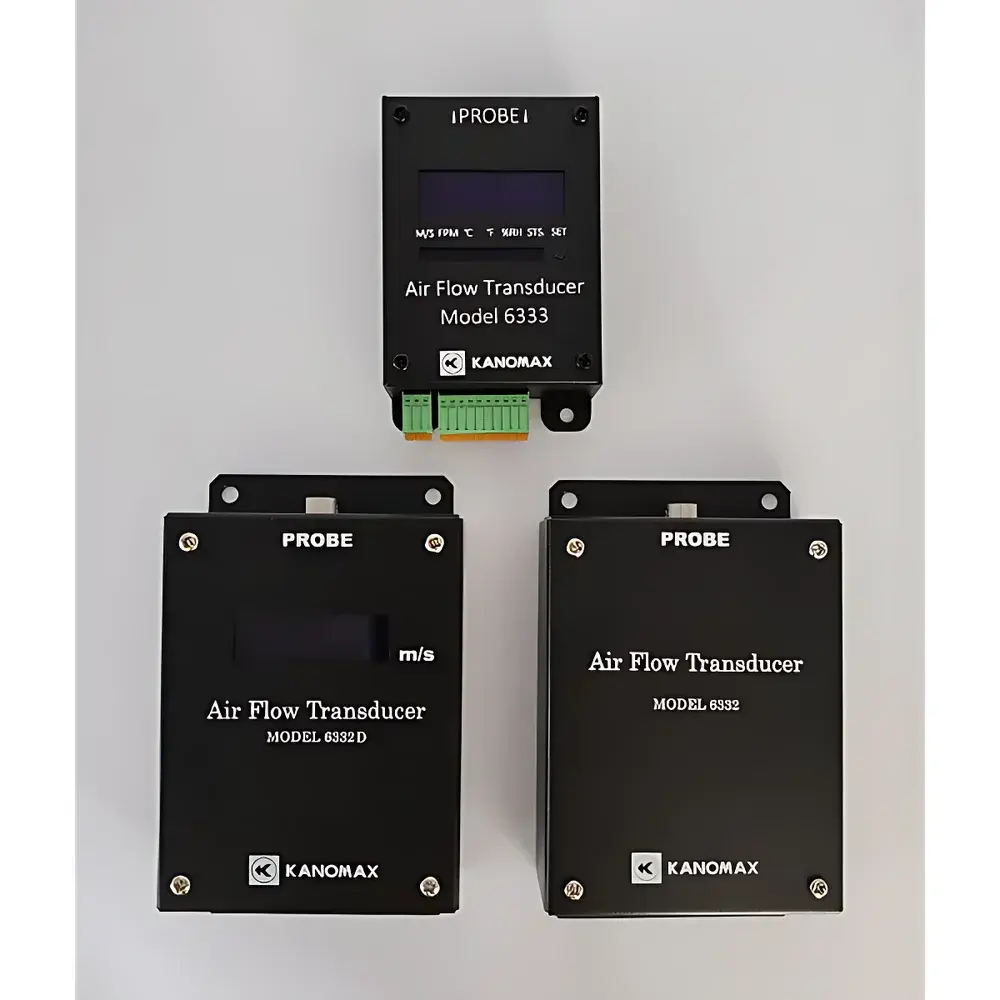
Kanomax 6333-0C Thermal Anemometer Transmitter
| Brand | Kanomax |
|---|---|
| Origin | Japan |
| Model | 6333-0C |
| Instrument Type | Thermal Anemometer |
| Resolution | 0.01 m/s (0.01–9.99 m/s), 0.1 m/s (10.0–50.0 m/s) |
| Measurement Range | 0.01–50.0 m/s |
| Accuracy | ±2% of reading or ±0.02 m/s (whichever is greater) |
| Operating Temperature | 0–60 °C |
| Operating Humidity | 2–98% RH (non-condensing) |
| Analog Output | 4–20 mA or 0–5 V (selectable via DIP switch) |
| Digital Output | RS-485 |
| Power Supply | AC 100–240 V / DC 12–24 V |
| Dimensions | 100 × 60 × 25 mm |
| Weight | 200 g |
Overview
The Kanomax 6333-0C Thermal Anemometer Transmitter is a precision-engineered environmental monitoring instrument designed for continuous, remote measurement of air velocity, temperature, and relative humidity in industrial, HVAC, cleanroom, and laboratory settings. Utilizing constant-temperature anemometry (CTA), the system measures convective heat loss from a heated sensing element to determine airflow velocity with high sensitivity down to 0.01 m/s — enabling reliable characterization of laminar flows, low-velocity ventilation ducts, and micro-environmental air movement. Unlike cup or vane anemometers, thermal sensors provide rapid response (as fast as 1 second for 90% step response at 1 m/s) and directional independence where specified — critical for validating airflow uniformity in ISO Class 5–8 cleanrooms per ISO 14644-3 and ASHRAE Standard 110. The transmitter body functions as a universal interface module, supporting interchangeable probe configurations across 15 distinct models — each optimized for specific operational constraints including temperature range (up to 120 °C), spatial access (ultra-compact probe footprints), and measurement topology (directional vs. omnidirectional).
Key Features
- Modular probe architecture: 15 interchangeable probe models (e.g., 0972-00, 0976-05, 0975-31) compatible with a single 6333-0C transmitter body — enabling field-reconfigurable measurement capability without hardware replacement.
- Ultra-low velocity detection: Minimum measurable airspeed of 0.01 m/s with resolution maintained across sub-10 m/s range, meeting requirements for ISO 14644-3 airflow uniformity testing and pharmaceutical environmental qualification (EU GMP Annex 1).
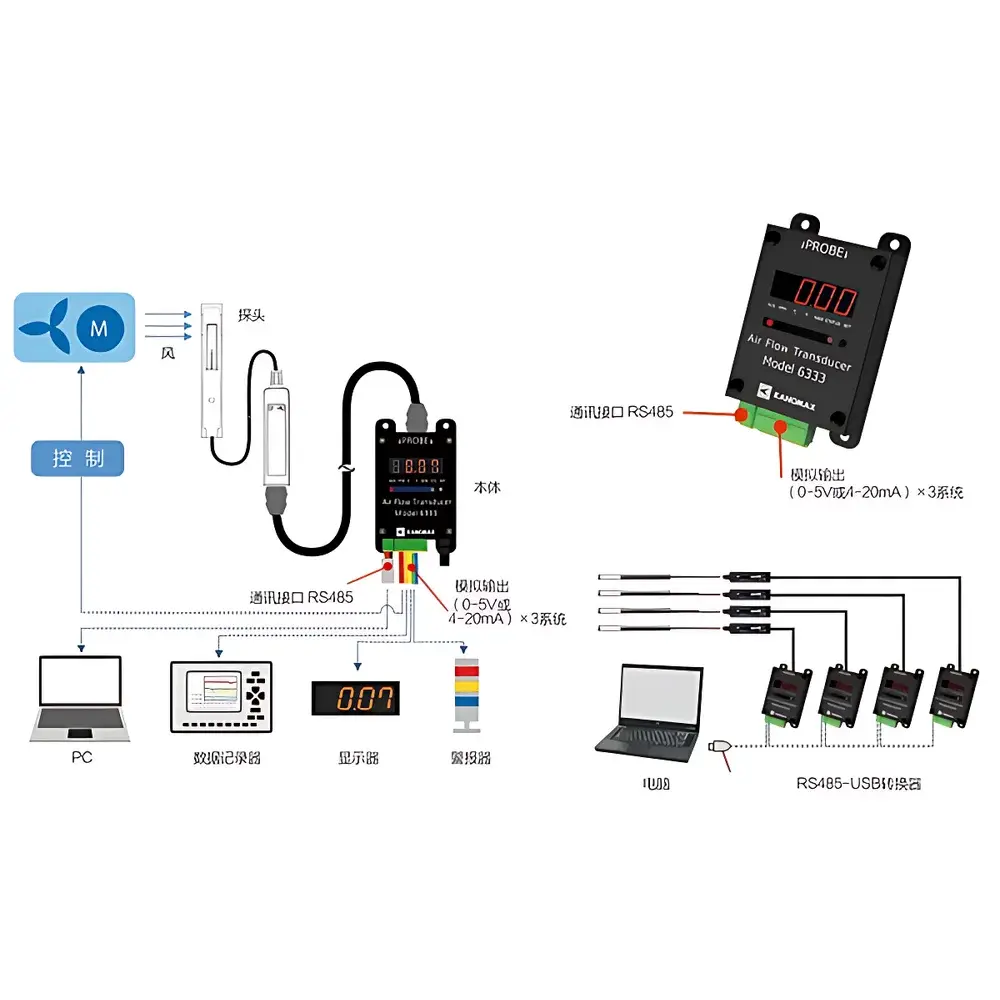
- Multi-parameter output: Simultaneous analog (4–20 mA or 0–5 V) and digital (RS-485 Modbus RTU) outputs support integration into SCADA, BMS, and PLC-based monitoring systems; configurable via front-panel DIP switches.
- Thermal compensation: All probes incorporate integrated temperature compensation algorithms to maintain velocity accuracy across operating ambient temperatures (0–60 °C base unit; probe-specific ranges up to 120 °C).
- Compact and mobile-ready design: Transmitter dimensions (100 × 60 × 25 mm) and dual power options (AC 100–240 V / DC 12–24 V) facilitate portable deployment, vehicle-mounted validation, and retrofit installation in space-constrained mechanical rooms or fume hoods.
- Robust environmental rating: IP54-rated enclosure (per IEC 60529) ensures operational reliability in non-condensing environments with humidity up to 98% RH and storage capability from −20 °C to +70 °C.
Sample Compatibility & Compliance
The 6333-0C supports diverse airflow geometries and environmental conditions through its probe family. Directional probes (e.g., 0972-00) are suitable for duct traverses requiring vector alignment per ISO 14644-3 Annex B, while omnidirectional variants (e.g., 0975-00) enable isotropic sampling in open-bay cleanrooms or biological safety cabinets. High-temperature probes (0976-05, rated to 120 °C) comply with thermal validation protocols for oven exhaust monitoring and sterilization tunnel qualification. Relative humidity measurement (5–95% RH, ±3% RH typical) adheres to ISO 14644-1 classification requirements for particle control environments. All configurations meet CE marking directives (EMC 2014/30/EU, LVD 2014/35/EU) and support GLP/GMP-compliant data integrity when used with optional software (6333-40) featuring audit-trail logging and user-access controls aligned with FDA 21 CFR Part 11 principles.
Software & Data Management
The optional Kanomax 6333-40 Windows 10-compatible software provides real-time visualization and structured data handling. It supports multilingual UI (English, Japanese, Chinese), time-synchronized multi-channel plotting (velocity, temperature, RH), and export to Excel (.xlsx) with timestamped metadata. Data acquisition modes include instantaneous value capture, moving average (1–60 s window), and statistical summary (min/max/mean/stdev). When paired with RS-485 daisy-chaining (up to four transmitters on one bus), the software enables synchronized multi-point monitoring for cross-sectional duct profiling or room airflow mapping. Raw data files retain native engineering units (m/s, °C, %RH) and probe-specific calibration coefficients — ensuring traceability for internal quality audits and regulatory submissions.
Applications
- HVAC system commissioning and TAB (Testing, Adjusting, Balancing) per ASHRAE Guideline 1
- Cleanroom airflow uniformity and velocity mapping in pharmaceutical manufacturing (EU GMP Annex 1, ISO 14644-3)
- Biological safety cabinet and fume hood face velocity verification (NSF/ANSI 49, EN 12469)
- Thermal validation of drying ovens, autoclaves, and lyophilizers using high-temperature probes
- Mobile environmental monitoring during transportation validation (cold chain, controlled ambient shipments)
- Research-grade boundary layer studies and low-Reynolds-number wind tunnel calibration
FAQ
Can the 6333-0C transmit all three parameters (air velocity, temperature, and humidity) simultaneously over analog output?
Yes — the transmitter supports configurable analog output mapping: users may assign one, two, or all three parameters to separate 4–20 mA channels (with external signal conditioning) or multiplex them into a single 0–5 V output using user-defined scaling.
Is probe interchangeability truly plug-and-play without recalibration?
Yes — all 15 probe models feature embedded calibration coefficients stored in EEPROM; the 6333-0C auto-detects probe type upon connection and applies appropriate sensor-specific algorithms and linearization tables.
Does the RS-485 interface support Modbus TCP or only Modbus RTU?
The built-in RS-485 port implements Modbus RTU protocol exclusively; TCP/IP bridging requires an external protocol converter or gateway device.
What is the maximum cable length between the transmitter and probe?
Standard Kanomax extension cables (1580 series) support lengths up to 40 m; signal integrity is maintained via shielded twisted-pair construction compliant with RS-485 electrical specifications (TIA/EIA-485-A).
How is traceable calibration documented for regulated environments?
Kanomax provides NIST-traceable calibration certificates (optional) with uncertainty budgets per ISO/IEC 17025; the 6333-40 software logs calibration events, operator ID, and date/time stamps — supporting 21 CFR Part 11 electronic record requirements when configured with password protection and audit trail enabled.
Related Products







