
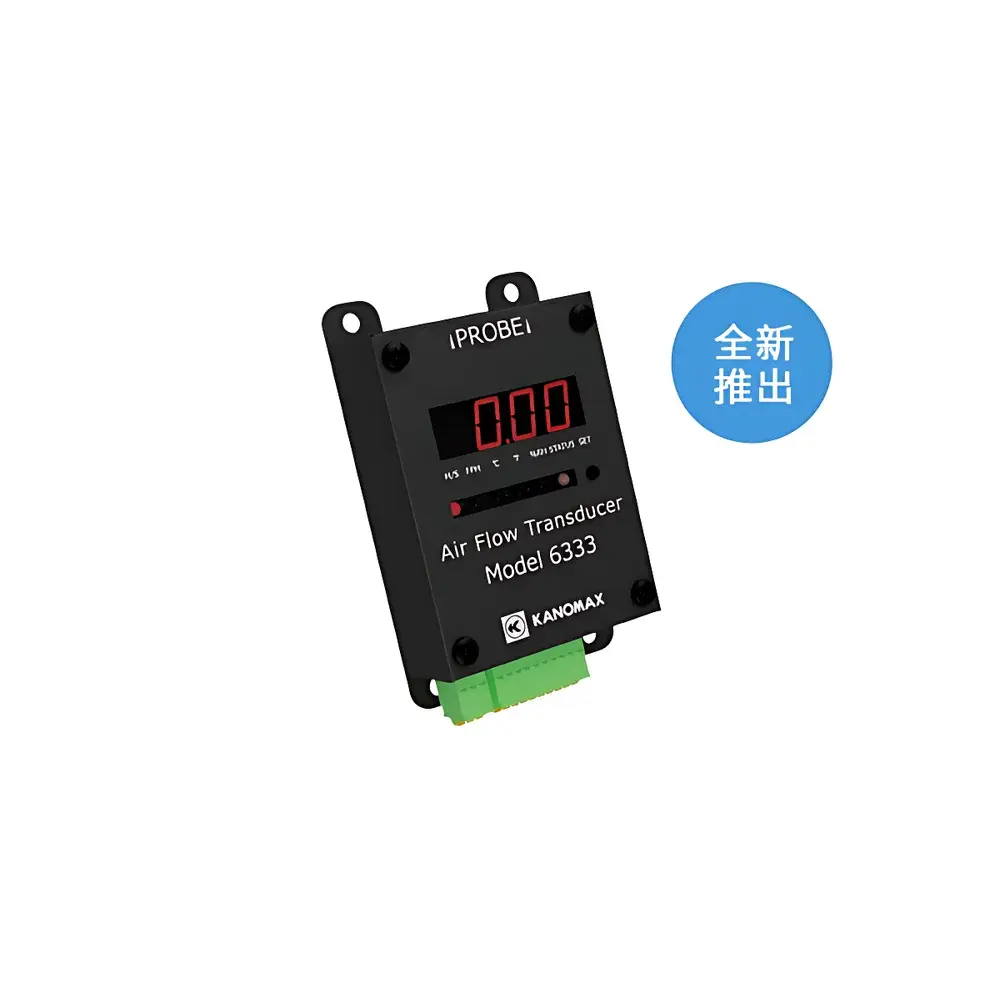
Kanomax 6333-0C Thermal Anemometer Transmitter
| Brand | Kanomax |
|---|---|
| Origin | Japan |
| Model | 6333-0C |
| Instrument Type | Thermal Anemometer |
| Resolution | 0.01 m/s (0.01–9.99 m/s), 0.1 m/s (10.0–50.0 m/s) |
| Measurement Range | 0.01–50.0 m/s (dependent on probe selection) |
| Accuracy | ±2% of reading or ±0.02 m/s (whichever is greater) |
| Operating Temperature | 0–60 °C |
| Operating Humidity | 2–98% RH (non-condensing) |
| Analog Output | 4–20 mA or 0–5 V (user-selectable via DIP switch) |
| Digital Output | RS-485 |
| Power Supply | AC 100–240 V / DC 12–24 V |
| Power Consumption | ~3 W (at DC 12 V, 10 m/s with probe 0976-03) |
| Dimensions | 100 × 60 × 25 mm (W × D × H) |
| Weight | 200 g |
Overview
The Kanomax 6333-0C Thermal Anemometer Transmitter is an industrial-grade environmental monitoring instrument engineered for high-fidelity, real-time measurement and transmission of air velocity, temperature, and relative humidity. Based on constant-temperature anemometry (CTA), the system employs a thermally sensitive hot-wire or hot-film sensor element whose heat dissipation correlates directly with local airflow—enabling precise quantification of low-velocity air movement down to 0.01 m/s. Unlike cup or vane anemometers, the 6333-0C delivers fast thermal response (≤1 s to 90% step response at 1 m/s), minimal flow disturbance, and immunity to directional bias when configured with omnidirectional probes. Its modular architecture centers on the 6333-0C transmitter unit, which serves as a universal interface for 15 interchangeable, field-swappable probes—each optimized for specific operational constraints including temperature range (up to 120 °C), spatial accessibility (ultra-compact probe footprints), and measurement geometry (directional vs. isotropic). Designed for integration into HVAC commissioning, cleanroom qualification, fume hood validation, and mobile environmental audits, the device complies with fundamental metrological principles outlined in ISO/IEC 17025 for measurement traceability and supports long-term stability under continuous operation.
Key Features
- Modular probe ecosystem: 15 certified probe variants—including directional (e.g., 0972-00), omnidirectional (e.g., 0975-00), high-temperature (up to 120 °C, e.g., 0976-05), and ultra-compact designs—interchangeable without recalibration.
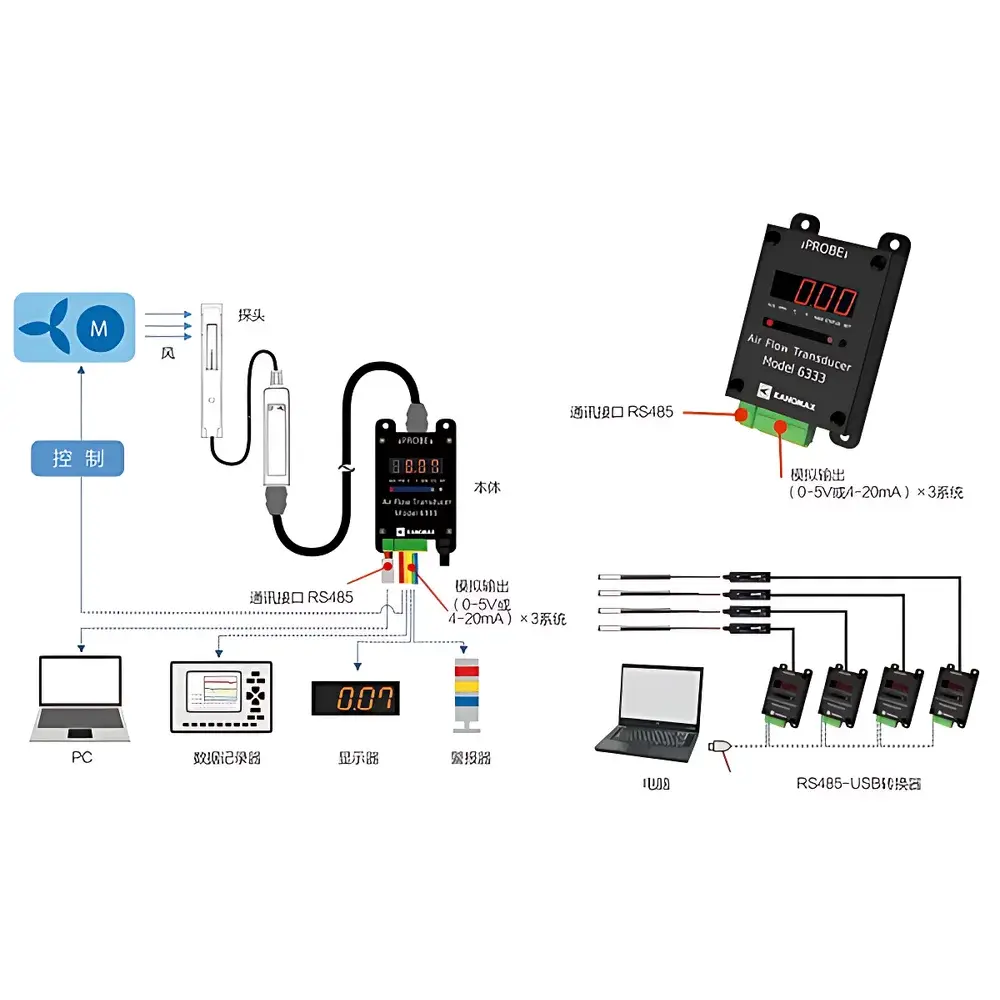
- Multi-parameter output capability: Simultaneous analog (4–20 mA or 0–5 V, user-configurable per channel) and digital (RS-485 Modbus RTU) outputs enable seamless integration with PLCs, SCADA systems, and building management platforms.
- Flexible deployment architecture: Supports up to four 6333-0C units in daisy-chained configuration for distributed multi-point monitoring; compatible with AC mains or DC power sources (12–24 V), facilitating portable, vehicle-mounted, or battery-backed applications.
- Thermal compensation across all probe types: Integrated temperature sensing corrects wind speed readings in real time, ensuring accuracy across the full operating range (0–60 °C ambient, probe-specific extended ranges).
- Robust mechanical design: IP-rated housing (per IEC 60529, typical IP54 equivalent for base unit), compact footprint (100 × 60 × 25 mm), and lightweight construction (200 g) simplify installation in confined ductwork, laminar flow hoods, or mobile test rigs.
Sample Compatibility & Compliance
The 6333-0C accommodates diverse sampling environments through its probe-flexible platform. Probes such as the 0975-31 support simultaneous measurement of air velocity (0.01–25.0 m/s), temperature (0–60 °C), and RH (5–95% RH), meeting requirements for ISO 14644-3 cleanroom air velocity mapping and ASHRAE 110 fume hood face velocity verification. High-temperature probes (e.g., 0976-05) extend applicability to exhaust ducts, drying ovens, and thermal process validation—operating reliably at up to 120 °C while maintaining ±2% wind speed accuracy. All probes are calibrated per Kanomax’s internal procedures traceable to JCSS (Japan Calibration Service System) standards. While the unit itself does not carry CE or UKCA marking for EMC or LVD, its analog/digital interfaces conform to EN 61000-6-2/6-4 immunity/emission limits when installed with appropriate shielding and grounding. For regulated environments, data integrity is preserved via timestamped output and optional audit-ready logging when paired with the 6333-40 software.
Software & Data Management
The optional Kanomax 6333-40 Windows-based software (compatible with Windows 10, 64-bit) provides full configuration, visualization, and export functionality. It supports tri-lingual UI (English, Japanese, Chinese), real-time plotting of up to three parameters simultaneously (e.g., velocity + temperature + RH), and configurable averaging intervals (1 s to 60 min). Data streams are logged in native .csv format with embedded timestamps and probe metadata, enabling direct import into Excel, MATLAB, or statistical process control (SPC) platforms. The software implements basic GLP-compliant features—including user login tracking, parameter change history, and report generation—but does not provide full 21 CFR Part 11 compliance (e.g., electronic signatures or immutable audit trails) unless deployed with third-party validated middleware. RS-485 communication uses standard Modbus RTU protocol (slave ID 1–247), permitting integration into custom LabVIEW or Python-based acquisition systems using open-source Modbus libraries.
Applications
- HVAC system commissioning and TAB (Testing, Adjusting, Balancing) per ASHRAE Guideline 1
- Cleanroom airflow uniformity and velocity profiling per ISO 14644-3 Class 5–8
- Fume hood and biosafety cabinet certification per ANSI/ASHRAE 110 and NSF/ANSI 49
- Industrial exhaust stack and duct velocity monitoring for emissions compliance
- Mobile environmental surveys (e.g., vehicle-mounted air quality assessment, agricultural ventilation studies)
- Research-grade boundary layer analysis in wind tunnels or environmental chambers
FAQ
Can the 6333-0C measure humidity independently of airflow?
Yes—when equipped with a combined probe (e.g., 0975-31), it simultaneously acquires RH, temperature, and velocity. However, RH accuracy degrades above 80% RH (±5% RH at 80–90% RH); for high-humidity applications, dedicated capacitive hygrometers are recommended.
Is probe calibration required after swapping?
No—probes are factory-matched to the 6333-0C transmitter and retain individual calibration coefficients stored in onboard EEPROM. Swapping requires no user recalibration.
What is the maximum cable length between probe and transmitter?
Standard shielded cables support up to 40 m (model 1580-35); beyond this, signal attenuation may affect resolution—consult Kanomax technical documentation for extended-run configurations.
Does the unit support Modbus TCP?
No—the digital interface is RS-485 only (Modbus RTU). Ethernet or wireless connectivity requires external protocol converters.
Can the analog output be scaled to represent multiple parameters simultaneously?
Yes—via DIP switch configuration, users can assign 4–20 mA output to any single parameter (e.g., velocity only) or use multiplexed time-division schemes (e.g., 0–5 V for velocity, 4–20 mA for temperature) per application requirements.
Related Products







