
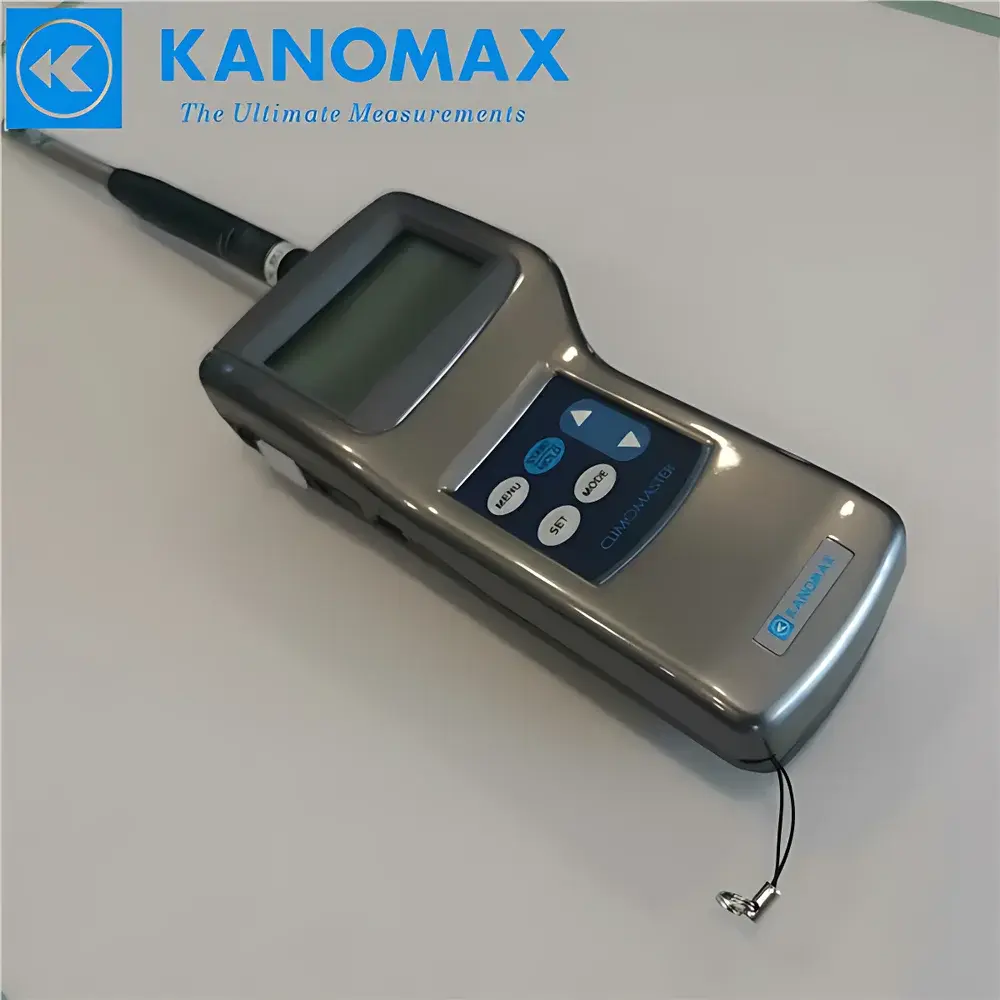
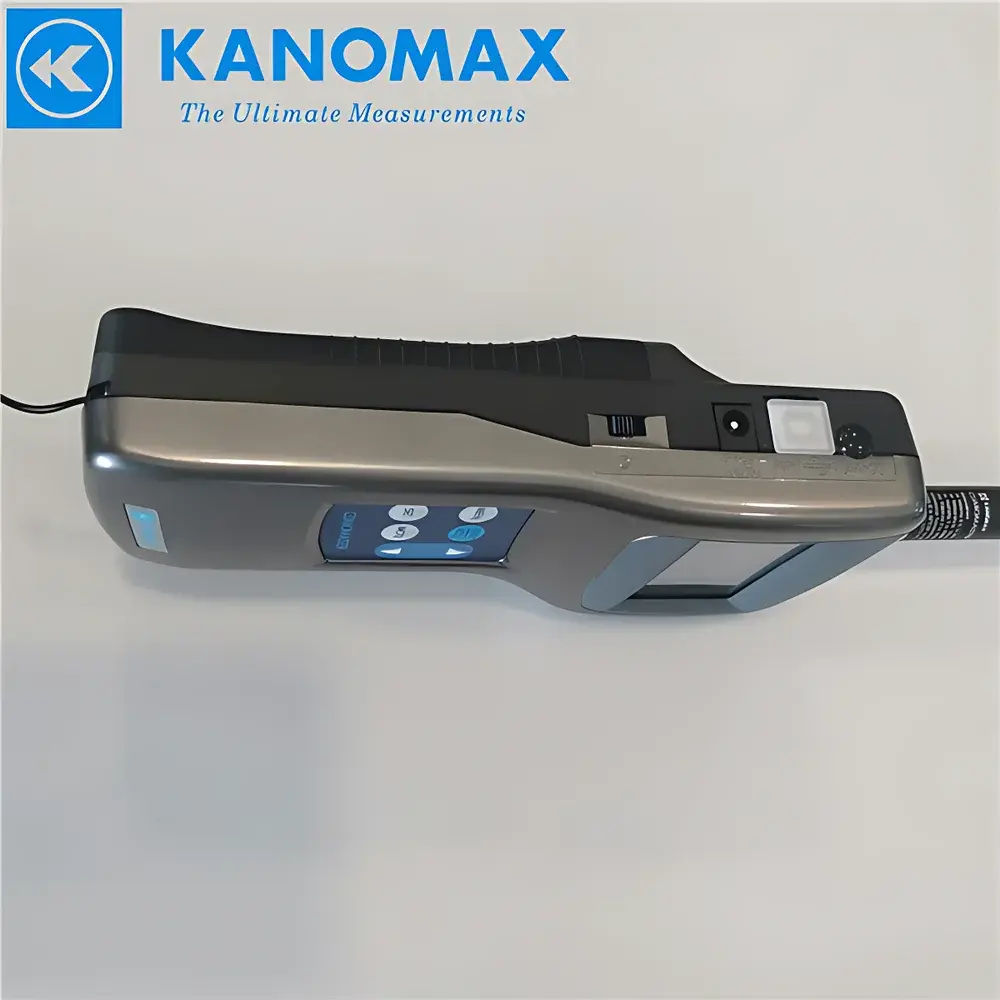
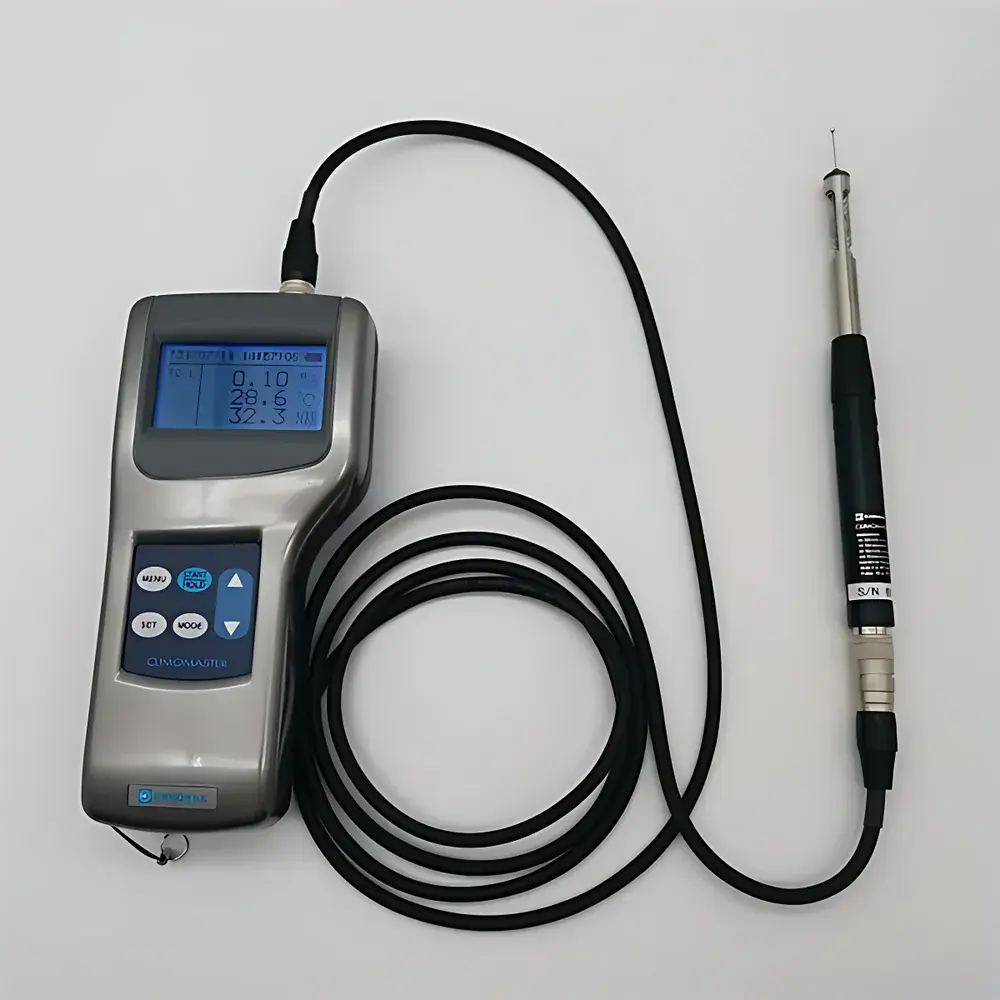
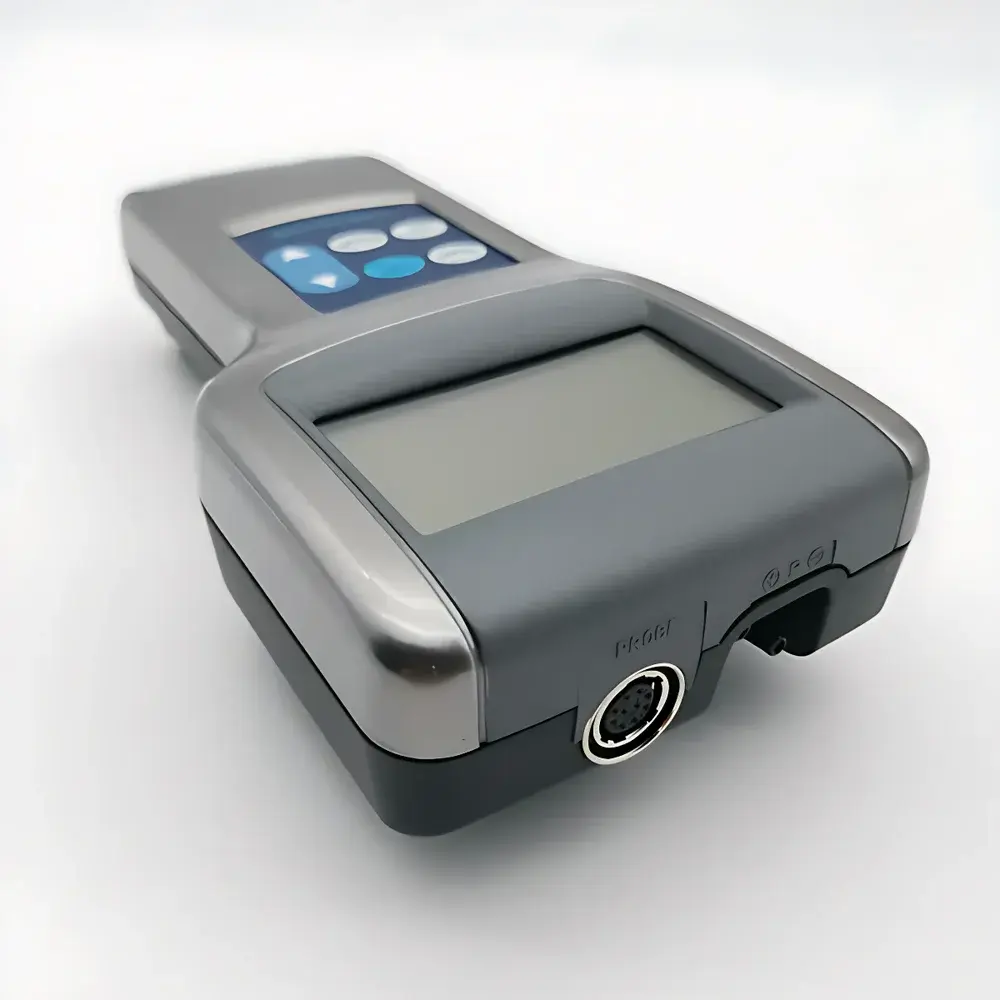
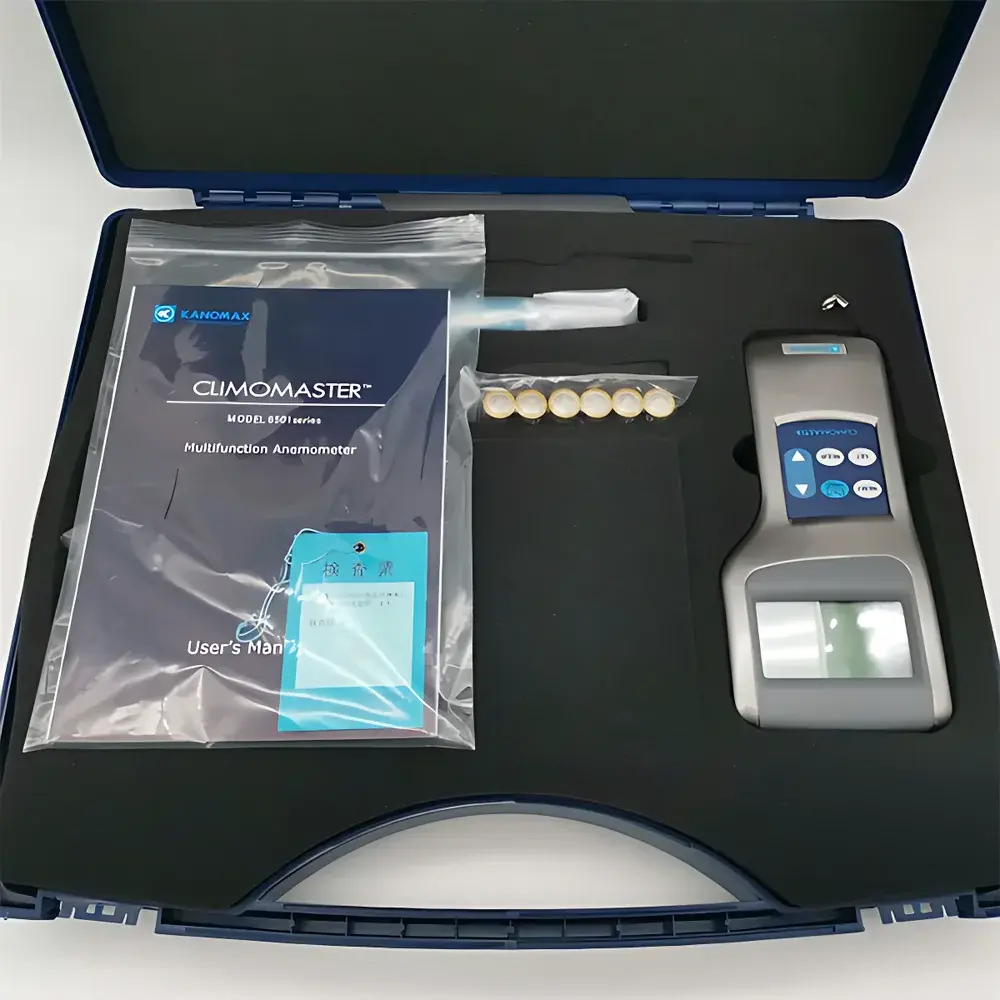
KANOMAX 65Ser Portable Thermal Anemometer
| Brand | KANOMAX |
|---|---|
| Origin | Japan |
| Instrument Type | Thermal Anemometer |
| Resolution | 0.01 m/s |
| Measurement Range | Dependent on Interchangeable Probe (e.g., 0.01–30 m/s typical for standard hot-wire probes) |
| Accuracy | ±2% of reading |
| Operating Temperature | –20 to +70 °C |
| Operating Humidity | 2.0–98.0% RH |
| Data Storage Capacity | Up to 20,000 records |
| Probe Compatibility | 8 interchangeable probe types (hot-wire, vane, pitot tube, and specialized duct/hood probes) |
| Built-in Environmental Sensors | Air velocity, volumetric flow rate, temperature, relative humidity, differential pressure |
| Real-time Calculations | Flow rate (m³/h, CFM) via user-defined duct cross-section geometry (rectangular, circular, oval) |
| Statistical Functions | Min/Max/Avg hold, live statistics |
| Data Retention | Hold function with auto-capture trigger |
| Accessories Included | 2 m probe cable, carrying case, operation manual |
Overview
The KANOMAX 65Ser Portable Thermal Anemometer is a multi-parameter environmental measurement instrument engineered for precision air velocity and volumetric flow characterization in HVAC commissioning, indoor air quality (IAQ) assessment, cleanroom validation, and industrial ventilation audits. Based on constant-temperature anemometry (CTA), the device employs a fine-wire thermal sensor whose heat dissipation correlates directly with local airflow velocity—enabling high-sensitivity, low-inertia response across turbulent and laminar regimes. Unlike cup or vane anemometers, the thermal principle delivers superior resolution at low velocities (<0.1 m/s) and eliminates mechanical inertia errors. The 65Ser integrates real-time temperature, relative humidity, and differential pressure sensing—allowing simultaneous calculation of true volumetric flow (m³/h or CFM) when the user inputs duct geometry (circular, rectangular, or oval cross-sections with dimensional parameters). Its compact, handheld form factor and battery-powered operation support field deployment without external power sources.
Key Features
- Multi-sensor fusion architecture: Simultaneous acquisition of air velocity, temperature (±0.5 °C), RH (±2% RH), and ΔP (±10 Pa typical) on a single display interface
- Modular probe system: Eight mechanically and electrically compatible probe variants—including straight and bent hot-wire probes, retractable vane probes, and pitot-static tubes—interchangeable via standardized connector without recalibration
- Real-time flow computation: Automatic volumetric flow derivation using user-entered duct dimensions and shape type; supports metric and imperial units
- On-device statistical processing: Continuous calculation of minimum, maximum, and arithmetic mean values over user-defined time intervals or sample counts
- High-capacity internal memory: Stores up to 20,000 timestamped records with full parameter sets; data export via USB interface (no proprietary software required)
- Ruggedized portable design: IP54-rated enclosure, rubberized grip, and shock-absorbing casing suitable for laboratory, facility, and outdoor field use
Sample Compatibility & Compliance
The 65Ser accommodates diverse sampling configurations through its standardized probe interface—enabling measurements in ducts ≥50 mm diameter, grilles, diffusers, fume hoods, and open ambient spaces. Probe selection determines applicable velocity range and turbulence tolerance: hot-wire probes are optimal for low-velocity laminar flows (e.g., cleanroom ISO Class 5–8 monitoring), while vane probes suit higher-velocity HVAC trunk lines. The instrument complies with JIS B 7555 (Japanese Industrial Standard for anemometers) and meets essential requirements of IEC 61000-6-3 (EMC emissions) and IEC 61000-6-2 (immunity). While not certified for safety-critical life-support systems, its measurement traceability aligns with NIST-traceable calibration protocols used in GLP-compliant environmental laboratories.
Software & Data Management
Data retrieval is accomplished via USB mass-storage mode—no driver installation required. Exported CSV files contain columns for timestamp (YYYY-MM-DD HH:MM:SS), velocity (m/s), temperature (°C), RH (%), ΔP (Pa), computed flow (m³/h), and probe ID. The format is fully compatible with Excel, MATLAB, Python pandas, and LIMS platforms. Audit trail integrity is maintained through immutable timestamps and sequential record numbering. Though the 65Ser does not implement FDA 21 CFR Part 11 electronic signature controls, its deterministic data logging behavior satisfies basic ALCOA+ principles (Attributable, Legible, Contemporaneous, Original, Accurate) for non-regulated QA/QC applications.
Applications
- HVAC system balancing and TAB (Testing, Adjusting, Balancing) per ASHRAE Guideline 1
- Cleanroom airflow uniformity mapping per ISO 14644-3 Annex B
- Fume hood face velocity verification per ANSI/ASHRAE 110
- Indoor air quality surveys under EPA IAQ Tools for Schools protocol
- Industrial exhaust stack sampling preparation (pre-screening velocity profiles)
- Academic aerodynamics education labs requiring portable, multi-parameter acquisition
FAQ
Does the 65Ser require annual recalibration?
Yes—KANOMAX recommends annual traceable recalibration against NIST-traceable standards, especially when used for compliance reporting. Field zero-checks using still-air conditions are advised before each measurement session.
Can the device measure air velocity in high-temperature ducts?
The base unit operates up to +70 °C ambient; however, high-temp probe variants (e.g., KANOMAX Model 6511HT) extend usable range to +150 °C. Standard probes are rated to +70 °C continuous exposure.
Is duct geometry input mandatory for flow calculation?
No—velocity-only mode operates independently. Duct geometry entry is optional and activates only when volumetric flow output is selected.
How is probe identification handled during interchange?
Each probe contains an embedded EEPROM chip storing calibration coefficients and type identification; the 65Ser auto-detects and loads appropriate scaling factors upon connection.
What battery life can be expected during continuous use?
With alkaline AA batteries, typical runtime is 12–15 hours under mixed sensor activation; lithium AA batteries extend this to ~20 hours and improve low-temperature performance down to –20 °C.







