
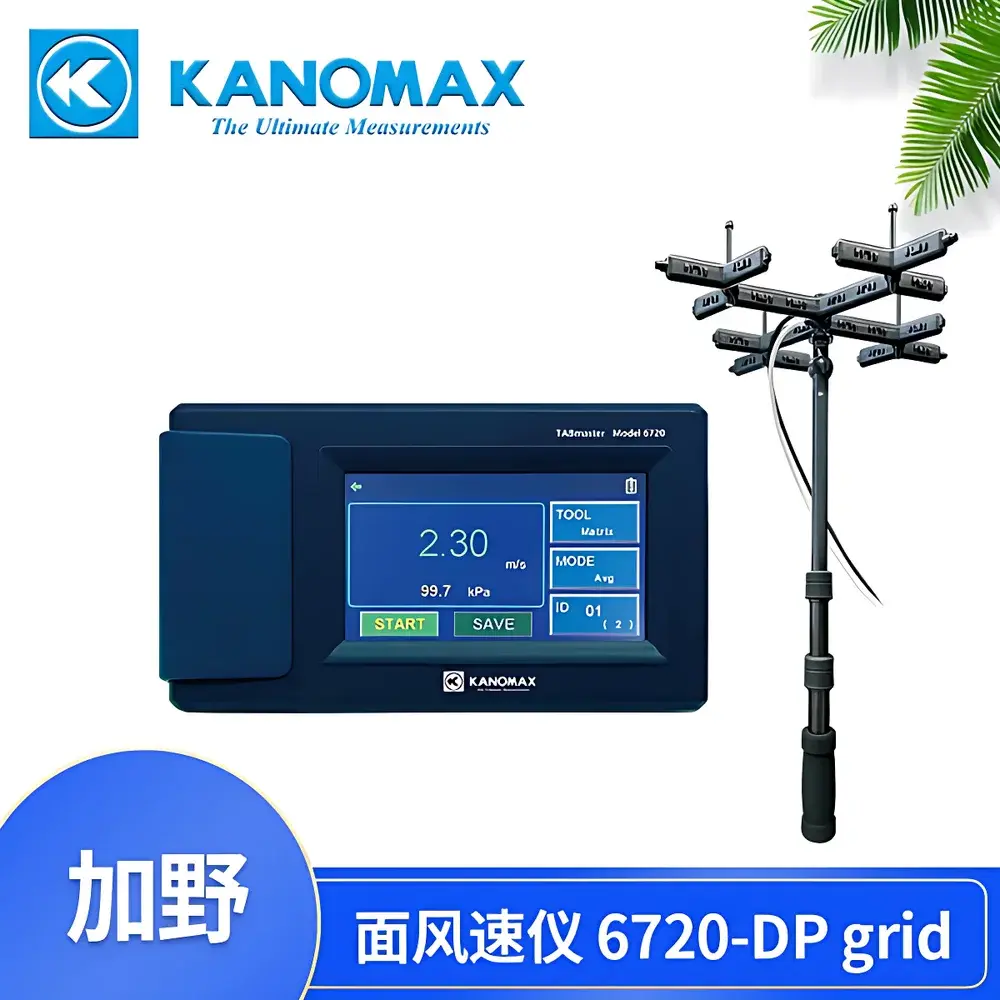
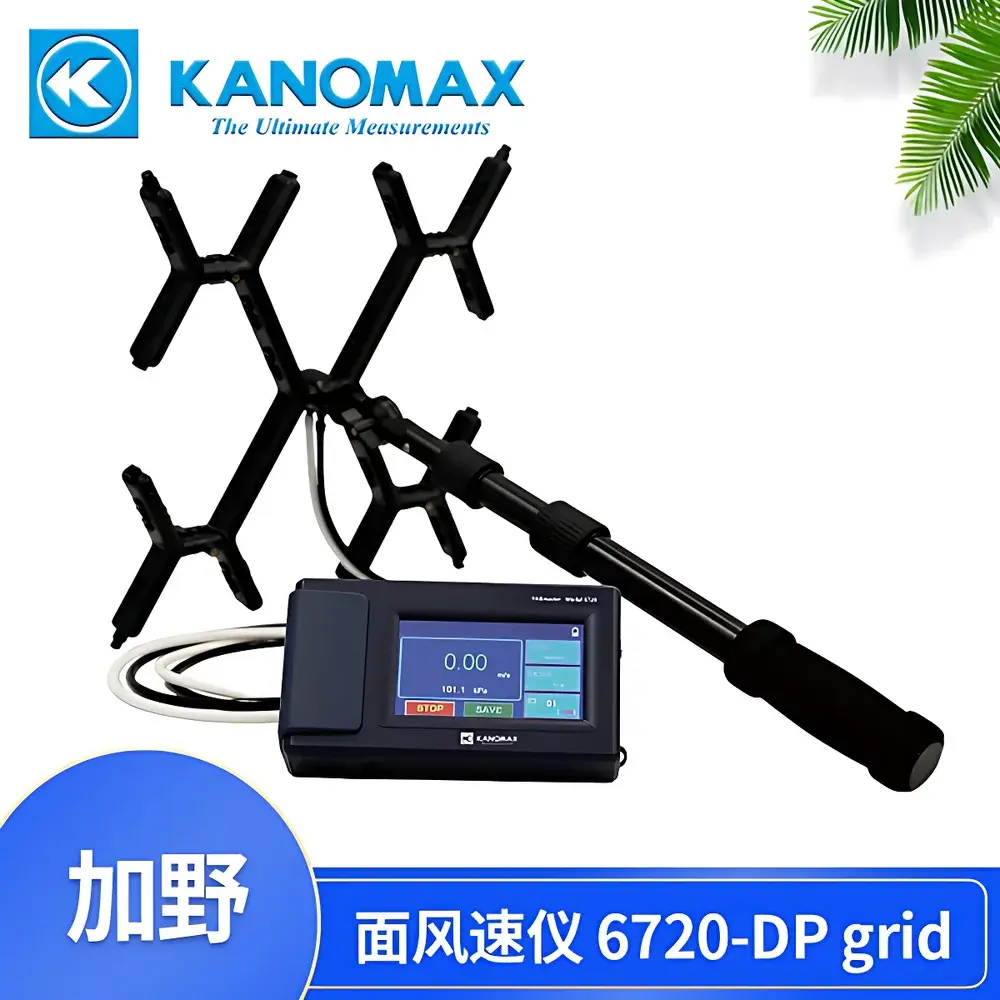
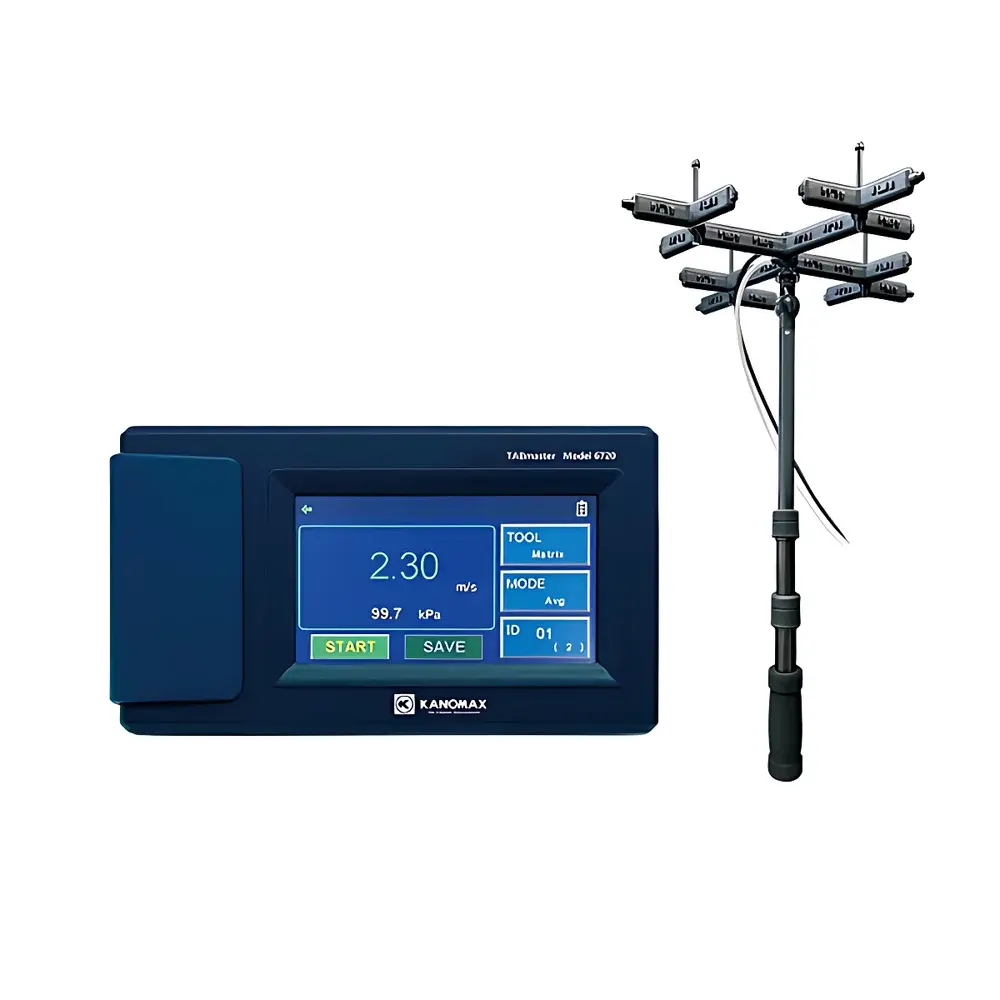
KANOMAX 6720-DP Grid Multi-Function Air Velocity & Differential Pressure Analyzer
| Brand | KANOMAX |
|---|---|
| Origin | Japan |
| Model | 6720-DP Grid |
| Instrument Type | Pitot Tube Anemometer with Grid Sensor Array |
| Velocity Range (Pitot) | 0.15–40 m/s |
| Velocity Range (Grid Sensor) | 0.15–15 m/s |
| Resolution | 0.01 m/s |
| Accuracy | ±3% of reading ±0.05 m/s (for v > 0.25 m/s) |
| Differential Pressure Range | −2500 to +2500 Pa |
| DP Resolution | 0.001 Pa |
| DP Accuracy | ±1.5% of reading ±0.25 Pa |
| Volumetric Flow Range | 40–4300 m³/h |
| Flow Accuracy | ±3% of reading ±8 m³/h (for Q > 85 m³/h) |
| Flow Resolution | 1 m³/h |
| Operating Temperature | 0–60 °C (non-condensing) |
| Operating Humidity | 0–100 %RH |
| Display | 4.3-inch full-color touchscreen |
| Data Storage | 8,000 records (internal), 10,000 records (via KANOMAX SmartApp) |
| Power | 4 × AA batteries (~14 h continuous use) or DC 5 V input |
| Weight | ~3.6 kg |
Overview
The KANOMAX 6720-DP Grid is a high-precision, multi-sensor environmental monitoring instrument engineered for comprehensive air velocity, volumetric flow, and differential pressure measurement in HVAC, cleanroom, and biosafety applications. Unlike conventional single-point anemometers, the 6720-DP Grid integrates dual sensing modalities: a calibrated pitot tube for point-source velocity profiling and a 16-point grid sensor array for spatially resolved face velocity mapping—enabling ISO 14644-3 compliant airflow uniformity assessment across ducts, fume hoods, and laminar flow cabinets. Its core measurement principle leverages Bernoulli’s equation for pitot-based dynamic pressure conversion and thermal anemometry (for grid sensors), both traceably calibrated against NIST-traceable standards. The instrument operates within a robust industrial architecture designed for field-deployable reliability, featuring IP54-rated ingress protection, low-drift electronics, and temperature-compensated transducers—critical for maintaining accuracy across ambient shifts from 0 to 60 °C.
Key Features
- 4.3-inch capacitive touchscreen interface with intuitive icon-driven navigation and real-time waveform visualization
- Dual-mode operation: seamless switching between pitot tube (0.15–40 m/s), grid sensor (0.15–15 m/s), and differential pressure (±2500 Pa) modes
- Bluetooth 5.0 wireless connectivity enabling bidirectional communication with iOS/Android devices running the official KANOMAX SmartApp
- On-device data logging (8,000 records) with timestamp, location tagging (via paired smartphone GPS), and automatic metadata capture (operator ID, test site, calibration status)
- Configurable K-factor adjustment per probe type—essential for compensating installation effects and non-ideal flow profiles per ASHRAE 111 and ISO 16813 guidelines
- Low-power design: 14-hour runtime on standard AA alkaline cells; auto-sleep mode activates after 5 minutes of inactivity
- USB-C port supporting firmware updates, bulk data export (CSV/Excel-compatible), and direct connection to PC-based analysis software
Sample Compatibility & Compliance
The 6720-DP Grid is validated for use with standardized accessories including stainless-steel pitot tubes (diameter 6 mm, L = 300 mm), modular 4×4 grid sensor arrays (100 mm pitch), and silicone differential pressure tubing sets. It meets IEC 61000-4 electromagnetic compatibility requirements and conforms to EN 61326-1 for laboratory and industrial environments. For regulated facilities, its data integrity framework supports audit-ready workflows: all stored measurements include immutable timestamps, operator identifiers, and calibration expiration dates. While not FDA 21 CFR Part 11–certified out-of-the-box, the SmartApp enables optional electronic signature integration and audit trail export—facilitating alignment with GLP and GMP documentation protocols required in pharmaceutical cleanroom commissioning (per ISO 14644-1/2) and biosafety cabinet certification (per NSF/ANSI 49).
Software & Data Management
The KANOMAX SmartApp serves as the central hub for configuration, real-time monitoring, and post-processing. It provides synchronized parameter setup—including unit selection (m/s, ft/min, m³/h, CFM), averaging interval (1–60 s), and statistical reporting (min/max/mean/cumulative). Raw datasets are exported in UTF-8 CSV format with column headers aligned to ASTM E1917 nomenclature for airflow characterization. Internal memory retains full-resolution time-series logs at user-defined intervals (1 Hz default), while the app caches up to 10,000 records with optional cloud backup via secure HTTPS endpoints. Firmware updates are delivered over-the-air with SHA-256 checksum verification to ensure cryptographic integrity.
Applications
- Biosafety cabinet face velocity mapping per NSF/ANSI 49 Section 7.3.1.1 (requires grid sensor + tripod mounting)
- HVAC system balancing and TAB (Testing, Adjusting, Balancing) per ASHRAE Guideline 1 and NEBB Procedural Standards
- Cleanroom airflow visualization and turbulence assessment in ISO Class 5–8 environments
- Fan performance testing using pitot traverse methods per AMCA 210
- Duct leakage quantification via differential pressure decay testing (EN 12599 Annex D)
- Exhaust hood containment validation and room pressure cascade verification
FAQ
What calibration standards does the 6720-DP Grid comply with?
It is factory-calibrated against NIST-traceable wind tunnel references per ISO/IEC 17025-accredited procedures; certificate includes uncertainty budgets for velocity, DP, and flow channels.
Can the grid sensor be used in high-temperature exhaust ducts?
No—the grid sensor is rated for 0–60 °C ambient; for elevated temperatures, the pitot tube (rated to 80 °C) must be used with appropriate thermal shielding.
Is USB-C data export compatible with LabVIEW or MATLAB?
Yes—CSV output follows ANSI X3.4 formatting with header rows specifying physical units and SI prefixes, enabling direct ingestion via standard import functions.
How is K-factor applied during grid measurements?
K-factor is applied per sensor element during post-processing to correct for local obstruction effects and inlet geometry deviations, per ISO 16813 Annex B guidance.
Does the device support automated pass/fail reporting for ISO 14644-3?
The SmartApp includes customizable pass/fail thresholds and generates PDF reports with annotated velocity contour maps, though final certification requires third-party validation per ISO/IEC 17025.







