
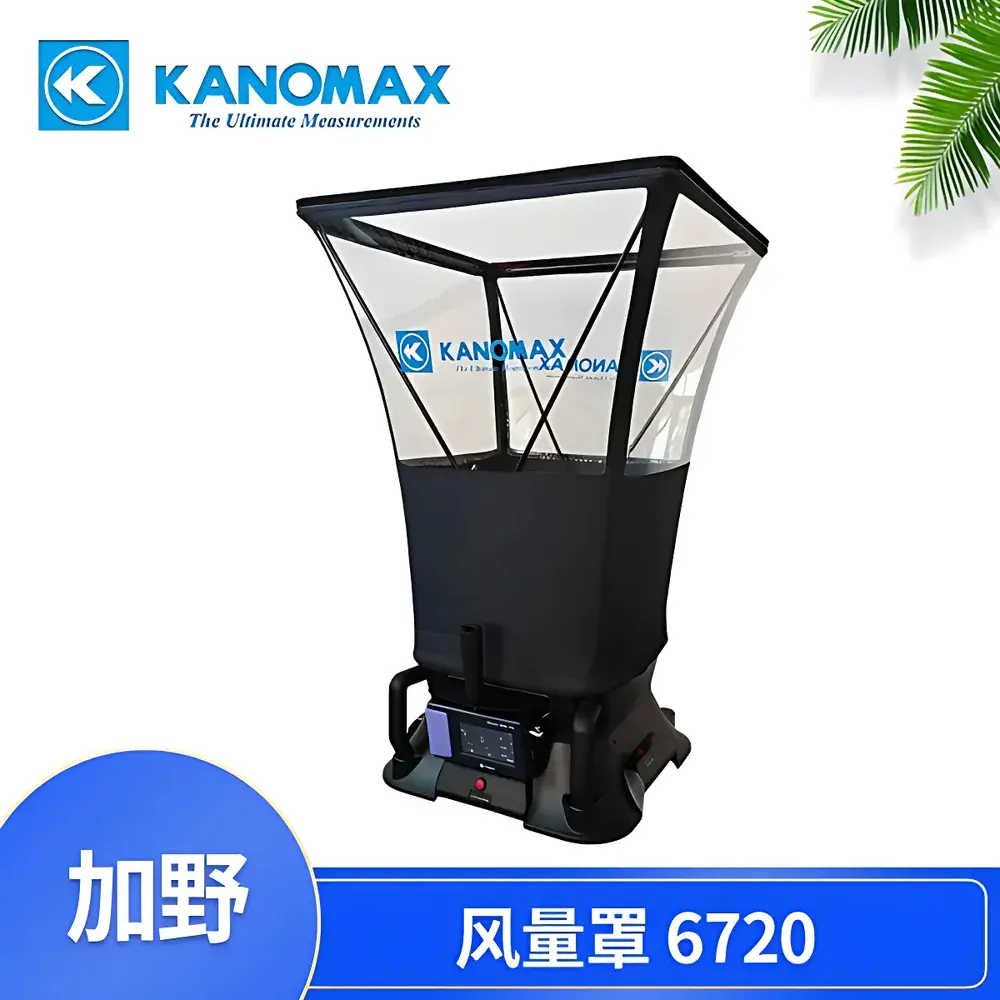
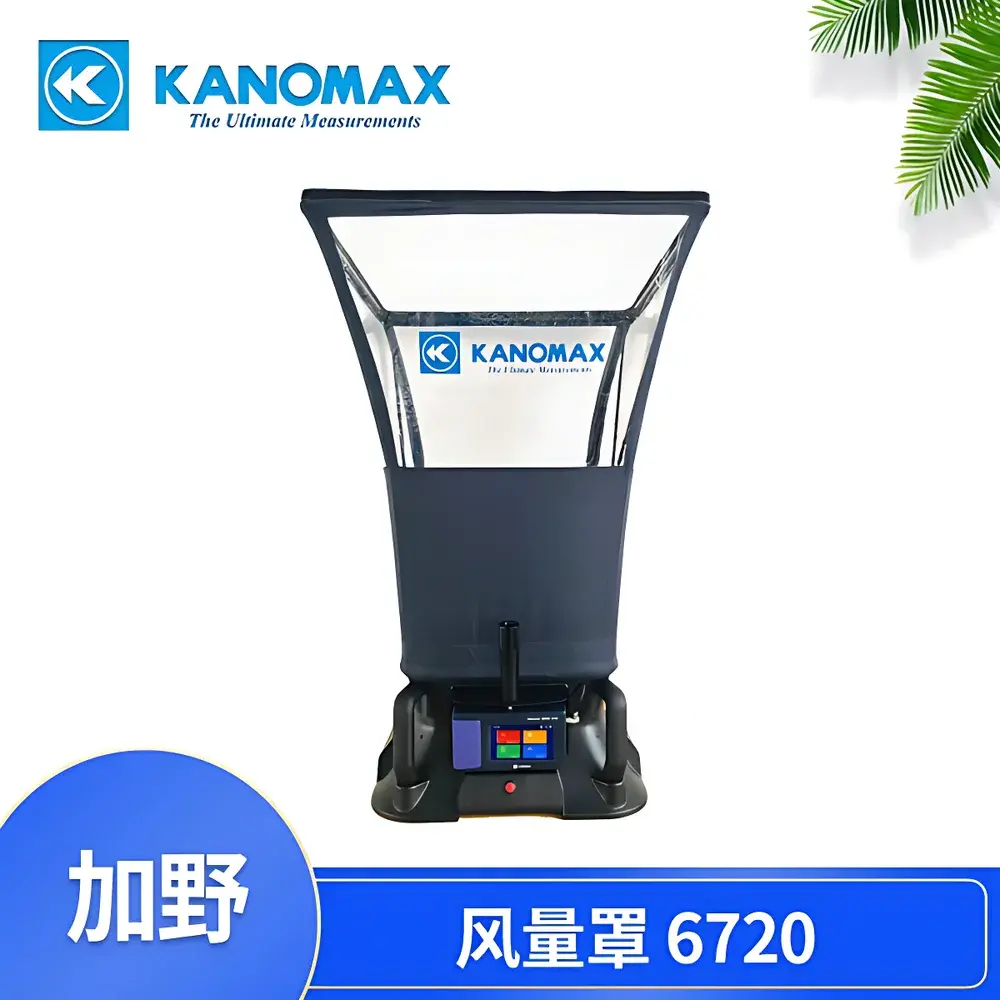
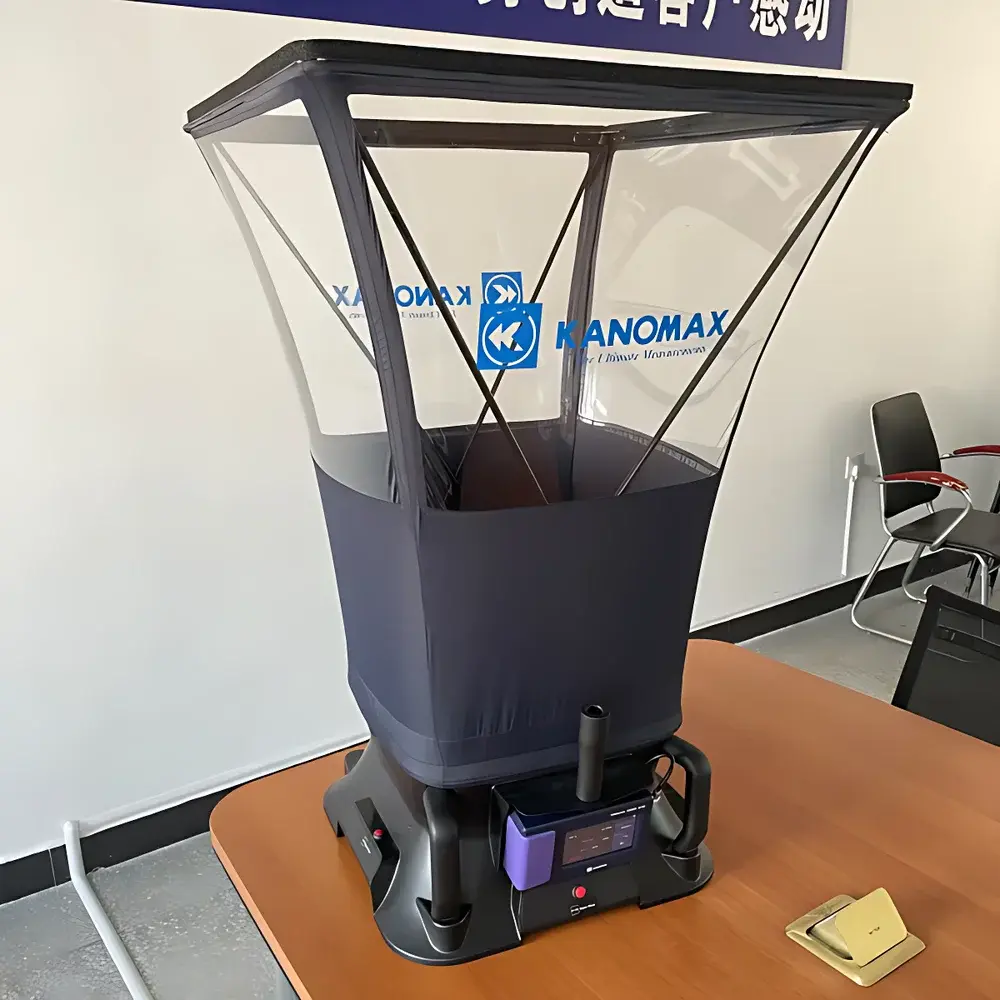
Kanomax 6720 Portable Air Flow Hood for Semiconductor Cleanroom HVAC Verification
| Brand | Kanomax |
|---|---|
| Origin | Japan |
| Model | 6720 |
| Air Flow Range | 40–4300 m³/h |
| Accuracy | ±3% of reading ±8 m³/h |
| Air Velocity Range | 0.15–40 m/s (with Pitot tube), 0.15–15 m/s (with removable velocity matrix) |
| Velocity Accuracy | ±3% of reading ±0.05 m/s |
| Differential Pressure Range | –2500 to +2500 Pa |
| DP Accuracy | ±1.5% of reading ±0.25 Pa |
| Temperature Range | 0–60 °C |
| Temp Accuracy | ±0.5 °C |
| Humidity Range | 0–100 %RH |
| RH Accuracy | ±3 %RH (10–90 %RH) |
| Operating Environment | 0–60 °C, 0–100 %RH |
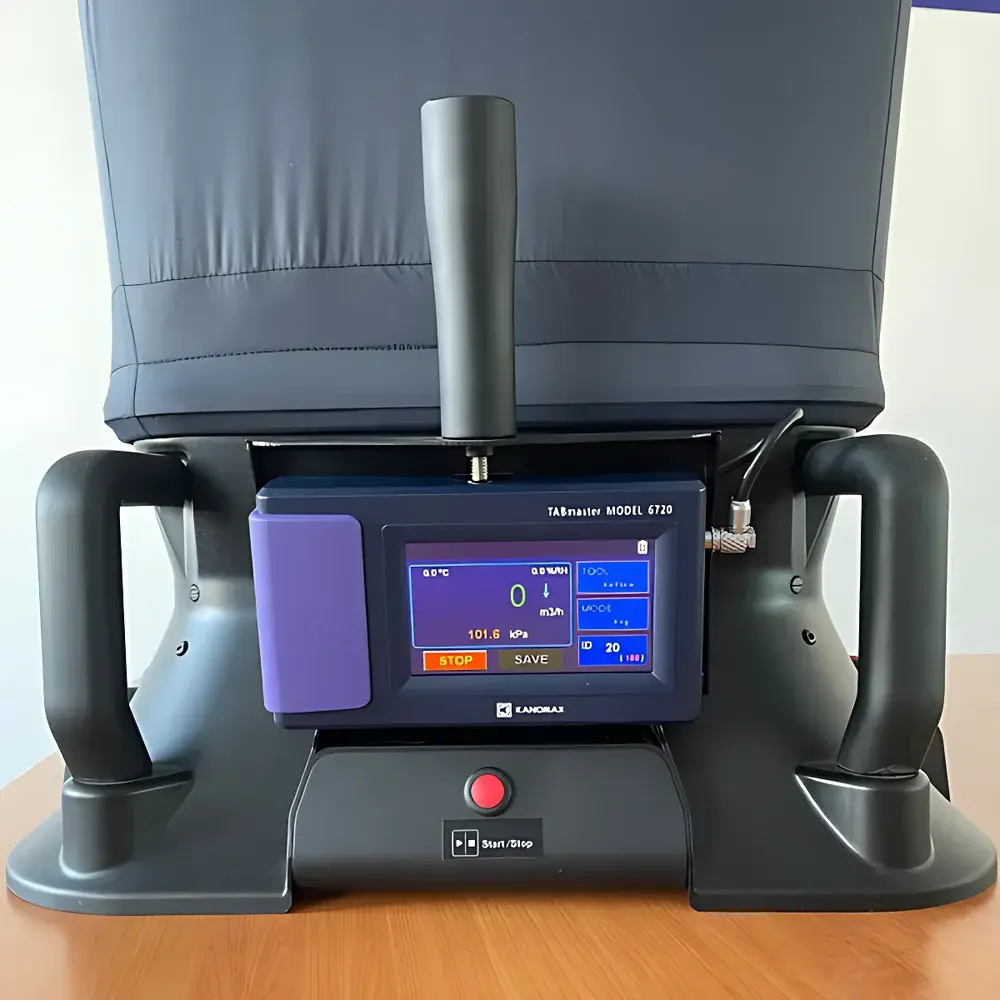
| Display | 4.3-inch full-color touchscreen LCD |
| Data Storage | 8,000 measurement sets (host), 10,000 sets (via Kanomax Mobile App) |
| Power | 4 × AA batteries (≈9 h runtime), or DC 5 V adapter |
| Weight | 3.6 kg (with standard 610×610 mm hood) |
| Standard Hood Size | 610×610 mm |
| Optional Hood Sizes | 610×1220 mm, 305×1220 mm, 500×500 mm, 915×915 mm, 915×610 mm, 800×1400 mm |
| Key Functions | Backpressure compensation, atmospheric pressure & temperature correction, supply/exhaust mode identification, real-time Bluetooth data streaming, USB data export, thermal-printer compatibility (Bluetooth/USB), 16-point differential pressure sensing grid |
Overview
The Kanomax 6720 Portable Air Flow Hood is an engineered solution for quantitative air volume verification in critical environmental control systems—particularly semiconductor cleanrooms, ISO Class 3–8 facilities, biosafety cabinets (BSCs), and HVAC commissioning workflows. It operates on the principle of integrated volumetric flow measurement using a calibrated, low-leakage hood coupled with a multi-point differential pressure sensor array and a removable velocity matrix. The instrument simultaneously captures air flow rate (m³/h), face velocity (m/s), static differential pressure (Pa), ambient temperature (°C), and relative humidity (%RH) in a single measurement cycle. Its design conforms to industry-accepted methodologies outlined in ISO 14644-3, IEST-RP-CC006.3, and ASHRAE Guideline 12–2020 for cleanroom performance testing. The 6720’s backpressure compensation algorithm dynamically corrects for resistance induced by filter loading or duct geometry—ensuring traceable, repeatable results across variable static pressure conditions encountered during fan coil unit balancing or laminar flow bench certification.
Key Features
- Simultaneous 5-parameter acquisition: air volume, face velocity, differential pressure, temperature, and humidity—displayed in real time on a 4.3-inch capacitive touchscreen
- Removable 16-point velocity matrix with uniform spatial distribution; enables precise face velocity profiling and compliance with ISO 14644-3 Annex B requirements
- Integrated backpressure compensation and atmospheric pressure/temperature correction—critical for high-accuracy volumetric reporting under non-standard barometric conditions
- True bi-directional flow detection: automatic supply/exhaust mode classification based on differential pressure polarity and airflow direction logic
- High-integrity sealing architecture: fiberglass-reinforced hood frame and low-permeability fabric skirt ensure <0.5% volumetric leakage per ANSI/ASHRAE Standard 111
- Bluetooth 5.0 module supporting dual-mode connectivity—direct pairing with iOS/Android devices for remote configuration, live data streaming, and synchronized timestamped logging
- On-device storage of up to 8,000 complete test records; expandable to 10,000 via Kanomax Mobile App with CSV/PDF export capability
- Optical transparent viewing window allows visual confirmation of hood-to-grille alignment prior to measurement—minimizing positional error and operator-induced uncertainty
Sample Compatibility & Compliance
The 6720 is validated for use with a broad spectrum of terminal airflow devices found in microelectronics manufacturing environments—including HEPA-filtered ceiling modules, FFUs (fan filter units), VAV boxes with terminal diffusers, and biological safety cabinet exhaust plenums. Its modular hood system supports rapid reconfiguration: six optional hood sizes (from 305×1220 mm to 915×915 mm) accommodate rectangular, square, and irregularly shaped supply/exhaust openings without requiring custom tooling. All measurements adhere to traceable calibration protocols aligned with NIST-traceable standards. The instrument meets electromagnetic compatibility (EMC) requirements per IEC 61326-1:2020 and carries CE marking for conformity with EU Directive 2014/30/EU. For regulated pharmaceutical or medical device cleanrooms, the 6720 supports audit-ready documentation when used with Kanomax’s GLP-compliant software suite (optional), enabling electronic signatures, user access controls, and 21 CFR Part 11–compliant audit trails.
Software & Data Management
Data collection and post-processing are managed through two complementary platforms: the embedded firmware interface and the Kanomax Mobile Application (iOS/Android). The onboard OS provides intuitive touch navigation for test setup, K-factor adjustment, unit selection (SI/imperial), and immediate review of min/max/avg/cumulative values. All stored records include metadata: date/time stamp, operator ID, hood size, ambient conditions, and measurement mode. Via Bluetooth, the app enables remote parameter configuration, live graphing of transient flow profiles, batch export to cloud storage (Google Drive, Dropbox), and direct thermal printing using certified Bluetooth printers (e.g., Zebra ZQ520). USB-C data transfer supports mass export to desktop analysis tools such as Excel or MATLAB. Firmware updates are delivered over-the-air (OTA) to maintain alignment with evolving ISO/IEC 17025 laboratory accreditation criteria.
Applications
The Kanomax 6720 serves as a primary verification tool across multiple mission-critical workflows: HVAC system commissioning and TAB (Testing, Adjusting, Balancing) in semiconductor fabs; annual recertification of ISO 14644-1 classified cleanrooms; routine validation of laminar flow hoods and biosafety cabinets per NSF/ANSI 49; airflow uniformity mapping in wafer fabrication tool exhaust canopies; and differential pressure decay testing for room integrity assurance. Its ability to resolve low-flow conditions (down to 40 m³/h) while maintaining accuracy at high-volume exhaust points (up to 4300 m³/h) makes it uniquely suited for both sub-micron particle control zones and high-capacity chemical fume extraction systems. Field engineers routinely deploy the 6720 alongside particle counters and SMPS systems to correlate airflow stability with particulate concentration trends during qualification studies.
FAQ
Does the 6720 require annual recalibration?
Yes—Kanomax recommends traceable recalibration every 12 months against NIST-certified reference standards, particularly when used in GMP-regulated environments.
Can the 6720 measure airflow in ducts with turbulent or swirling inlet profiles?
It is not designed for in-duct measurement; it must be placed directly over terminal outlets or inlets. For duct applications, Kanomax recommends the 6501 Series hot-wire anemometer with traverse rods.
Is the Bluetooth communication encrypted?
Data transmission uses AES-128 encryption; pairing requires manual confirmation on both host and mobile device to prevent unauthorized access.
What is the uncertainty contribution of backpressure compensation under high-resistance HEPA filters?
At 2000 Pa static pressure drop, the combined uncertainty remains within ±4.2% of reading (k=2), as verified per ISO/IEC 17025 accredited test reports.
Are firmware updates backward-compatible with legacy data formats?
Yes—all versions preserve native .kmd binary file structure and support forward migration to CSV/JSON exports without loss of metadata or calibration flags.







