
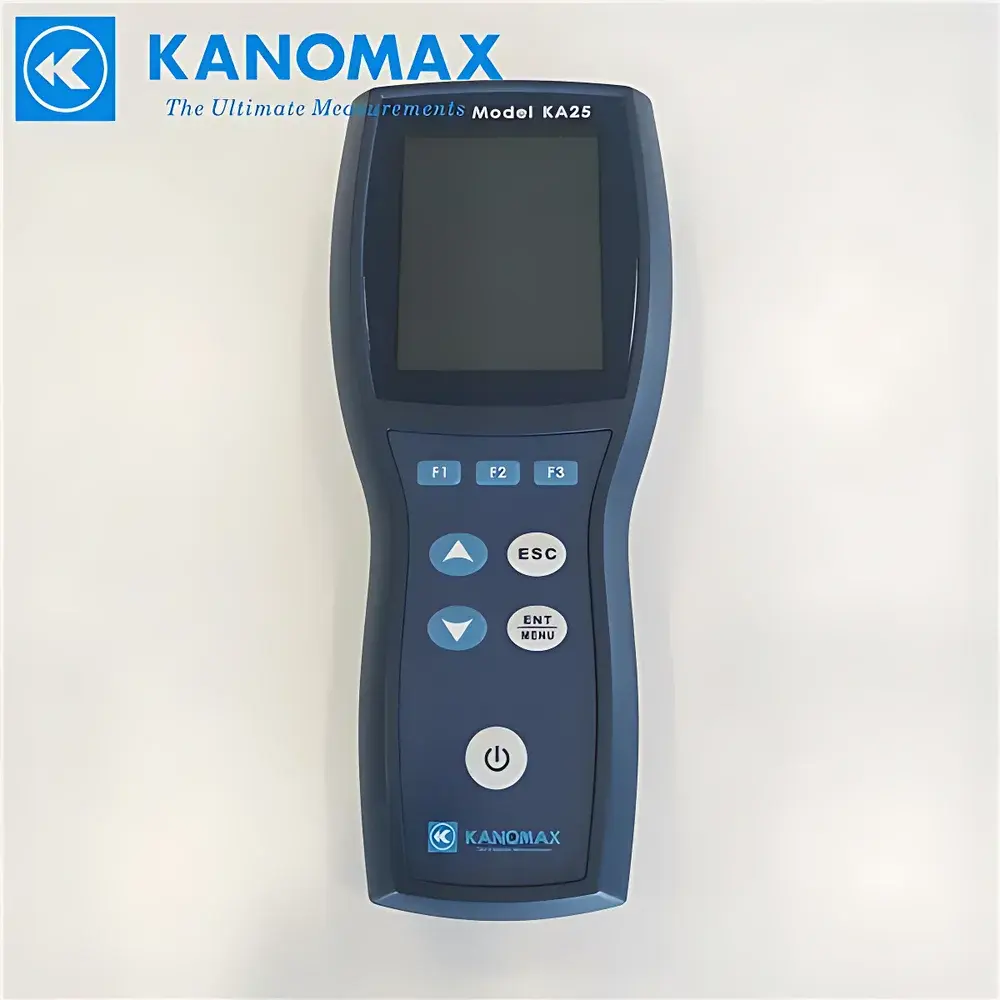
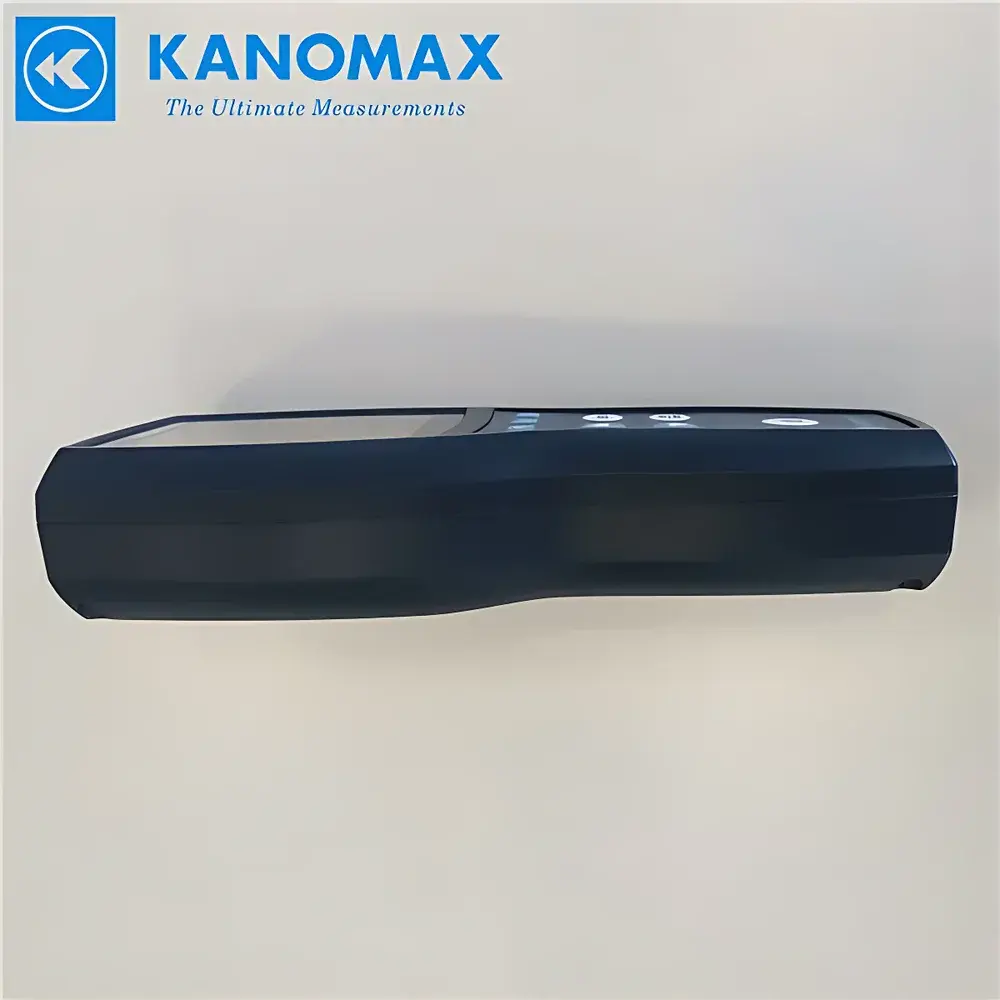
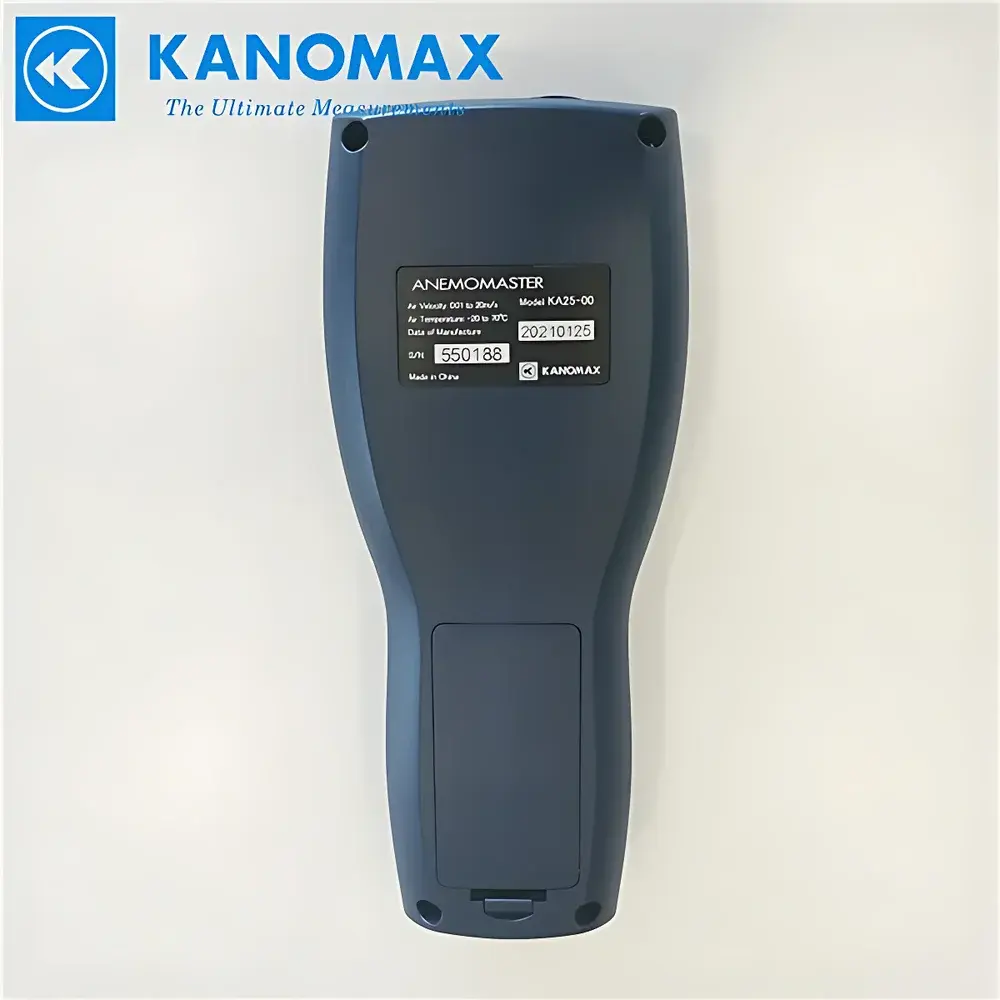
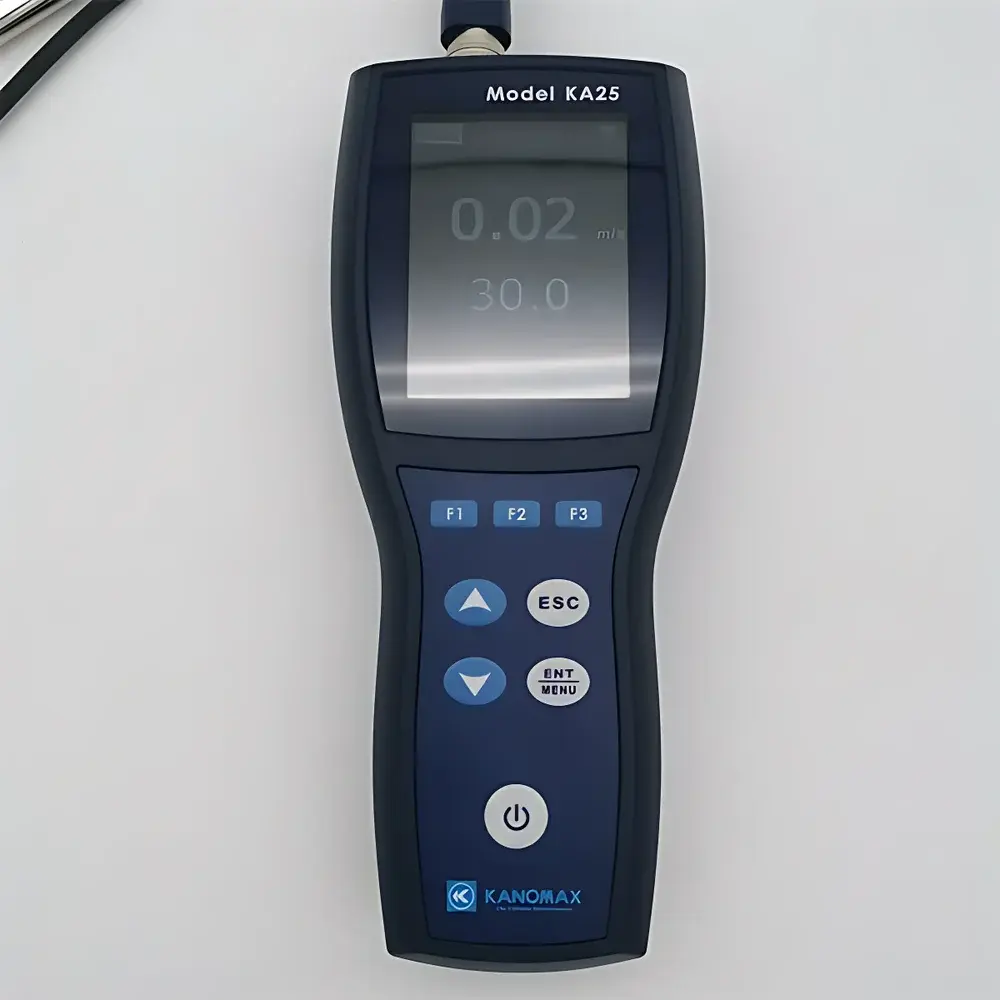
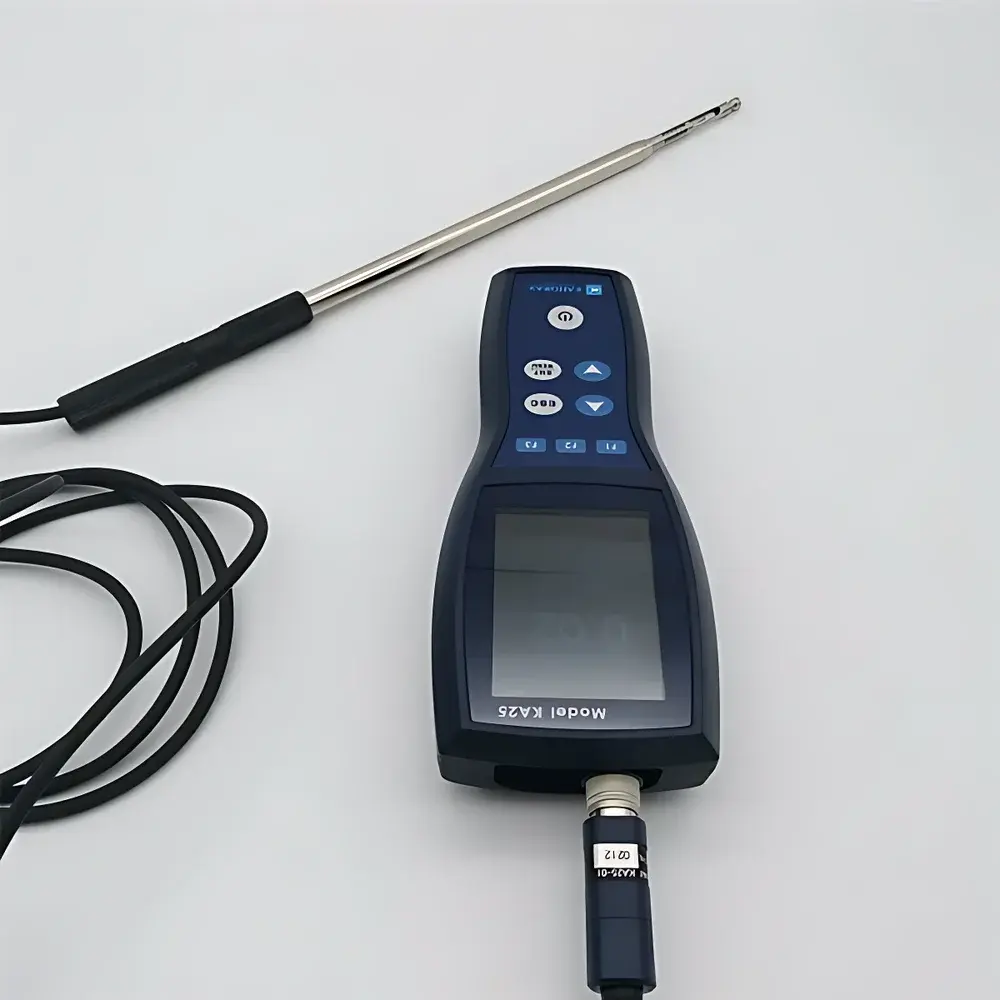
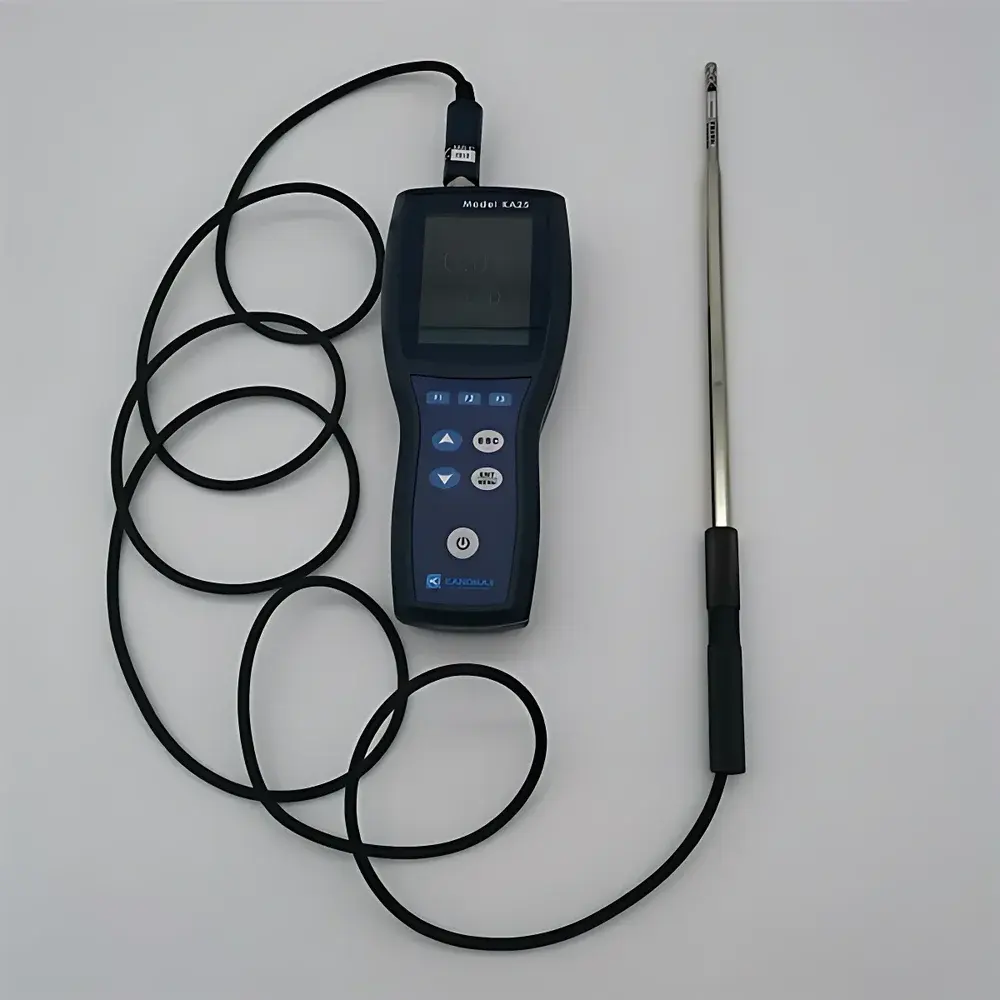
Kanomax KA25 Hot-Wire Anemometer with Air Flow Calculation
| Brand | Kanomax |
|---|---|
| Origin | Japan |
| Model | KA25 |
| Instrument Type | Hot-Wire Anemometer |
| Resolution | 0.01 m/s |
| Measurement Range | 0.01–20.0 m/s |
| Accuracy | ±(3% of reading + 0.03 m/s) |
| Operating Temperature | −20–70 °C |
| Operating Humidity | 2–98% RH |
| Temperature Accuracy | ±0.5 °C (at v > 0.5 m/s) |
| Temperature Resolution | 0.1 °C |
| Response Time (Wind Speed) | ~1 s (90%, at 1 m/s) |
| Response Time (Temperature) | ~30 s (90%, at 1 m/s) |
| Pipe Shape Compatibility | Rectangular & Circular |
| Dimension Input Range | 0.1–255.0 cm |
| Air Flow Display | Up to 1 m³/h |
| Data Hold Function | Yes |
| Time Constant Settings | 1 s / 5 s / 10 s / 20 s |
| Statistical Functions | Min / Avg / Max |
| Auto Power-Off | 3 / 5 / 10 min |
| Display | 3-level backlight LCD |
| Power Supply | 4 × AA alkaline batteries |
| Battery Life | ~15 h (1 m/s, 20 °C) |
| Body Dimensions | 200 × 85 × 40 mm |
| Probe Dimensions | Ø6 mm (sensor) / Ø14 mm (handle) × 294–1060 mm (telescoping & flexible) |
| Cable Length | 2000 mm |
| Body Operating Temp. | 5–40 °C |
| Probe Operating Temp. | −20–70 °C |
| Storage Temp. | −20–60 °C |
| Weight | ~220 g (without batteries) |
| Standard Accessories | Instrument body, telescoping/flexible probe, protective carrying case, quick-start manual, batteries |
Overview
The Kanomax KA25 is a portable, handheld hot-wire anemometer engineered for precise, real-time measurement of air velocity and ambient temperature in HVAC, cleanroom, industrial ventilation, and environmental monitoring applications. Based on constant-temperature anemometry (CTA), the KA25 employs a thermally sensitive platinum wire sensor whose cooling rate correlates directly with local airflow velocity—enabling high-resolution detection down to 0.01 m/s across a robust 0.01–20.0 m/s range. Unlike cup or vane anemometers, the hot-wire principle ensures minimal flow disturbance and rapid dynamic response (~1 s for 90% velocity step response at 1 m/s), making it suitable for turbulent or low-velocity environments where spatial and temporal fidelity are critical. Integrated temperature sensing (−20–70 °C, ±0.5 °C accuracy above 0.5 m/s) enables simultaneous thermal profiling, while built-in geometric input functionality allows direct calculation of volumetric air flow (m³/h) for rectangular or circular ducts—eliminating manual computation and reducing operator error.
Key Features
- Telescoping and flexible probe design (Ø6 mm sensor tip, Ø14 mm handle, 294–1060 mm extended length) for access to confined, irregular, or elevated ductwork without compromising sensor alignment.
- Adjustable time constant (1 s / 5 s / 10 s / 20 s) to optimize signal stability versus responsiveness depending on turbulence intensity and averaging requirements.
- On-device statistical analysis: real-time display of minimum, maximum, and average values over user-defined sampling intervals—essential for ISO 14644-3 compliance testing and HVAC commissioning reports.
- Three-level backlight LCD with intuitive icon-based interface; supports data hold, auto power-off (configurable at 3/5/10 min), and battery-level indication.
- Rugged, lightweight housing (220 g,不含 batteries) with IP54-rated probe and body sealing—suitable for field use in non-hazardous industrial environments with humidity up to 98% RH.
- Calibration traceability aligned with JIS B 7553 and NIST-traceable reference standards; factory calibration certificate included.
Sample Compatibility & Compliance
The KA25 is validated for use with clean, dry air—free of particulates, oil mist, or condensable vapors—to preserve sensor integrity and measurement repeatability. It is not intended for corrosive, explosive, or high-dust environments without optional filtration or protective housings. The instrument meets electromagnetic compatibility (EMC) requirements per IEC 61326-1 (industrial environment) and safety standards per IEC 61010-1 (CAT II, pollution degree 2). While not inherently 21 CFR Part 11 compliant, its audit-ready data logging (when paired with optional PC software and external storage) supports GLP/GMP-aligned workflows when combined with documented SOPs, user access controls, and electronic signature protocols.
Software & Data Management
Although the KA25 operates as a standalone field instrument, raw measurements—including timestamped velocity, temperature, and calculated air flow—can be exported via optional RS-232 or USB interface using Kanomax’s proprietary KA-Link software (v3.2+). This application enables batch export to CSV or Excel, generation of summary statistics, trend visualization, and PDF report drafting compliant with ISO/IEC 17025 documentation requirements. All stored data retains metadata such as probe ID, user ID (if configured), measurement duration, and time constant setting—facilitating traceability during third-party audits.
Applications
- HVAC system balancing and commissioning per ASHRAE Guideline 12 and ISO 11855.
- Cleanroom airflow uniformity and velocity mapping (ISO 14644-3 Class 5–8).
- Exhaust hood face velocity verification (NIOSH/OSHA guidelines).
- Industrial process ventilation surveys, including fume extraction and drying tunnel profiling.
- Academic and research laboratory airflow characterization in wind tunnels, environmental chambers, and aerodynamic studies.
- Energy audit support through quantitative assessment of infiltration/exfiltration rates and duct leakage estimation.
FAQ
What types of duct geometries does the KA25 support for air flow calculation?
It supports both rectangular and circular cross-sections; users manually enter width, height (for rectangles) or diameter (for circles) in centimeters (0.1–255.0 cm range).
Can the KA25 measure in hazardous or high-particulate environments?
No—it is designed for clean air only. Exposure to dust, oil aerosols, or corrosive gases may damage the hot-wire sensor and invalidate calibration.
Is the probe interchangeable with other Kanomax models?
Yes—the KA25 probe uses Kanomax’s standardized connector interface and is compatible with KA32 and KA41 series instruments for cross-platform flexibility.
Does the KA25 meet international calibration standards?
Yes—factory calibration follows JIS B 7553 and is traceable to NIST standards; optional annual recalibration services are available with ISO/IEC 17025-accredited certificates.
How is measurement uncertainty quantified for velocity readings?
Total uncertainty is specified as ±(3% of reading + 0.03 m/s) under standard conditions (23 °C, 50% RH, stable laminar flow); this includes contributions from linearity, repeatability, and temperature compensation error.
Related Products







