
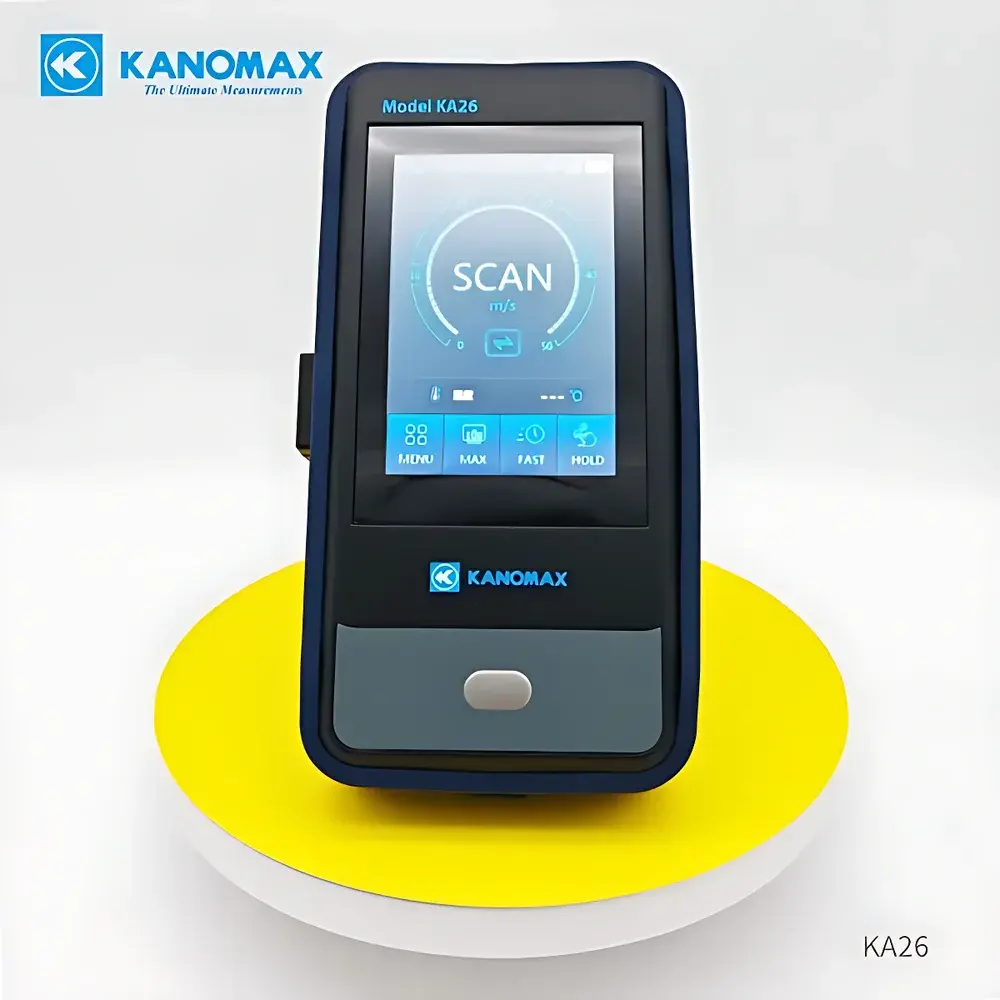
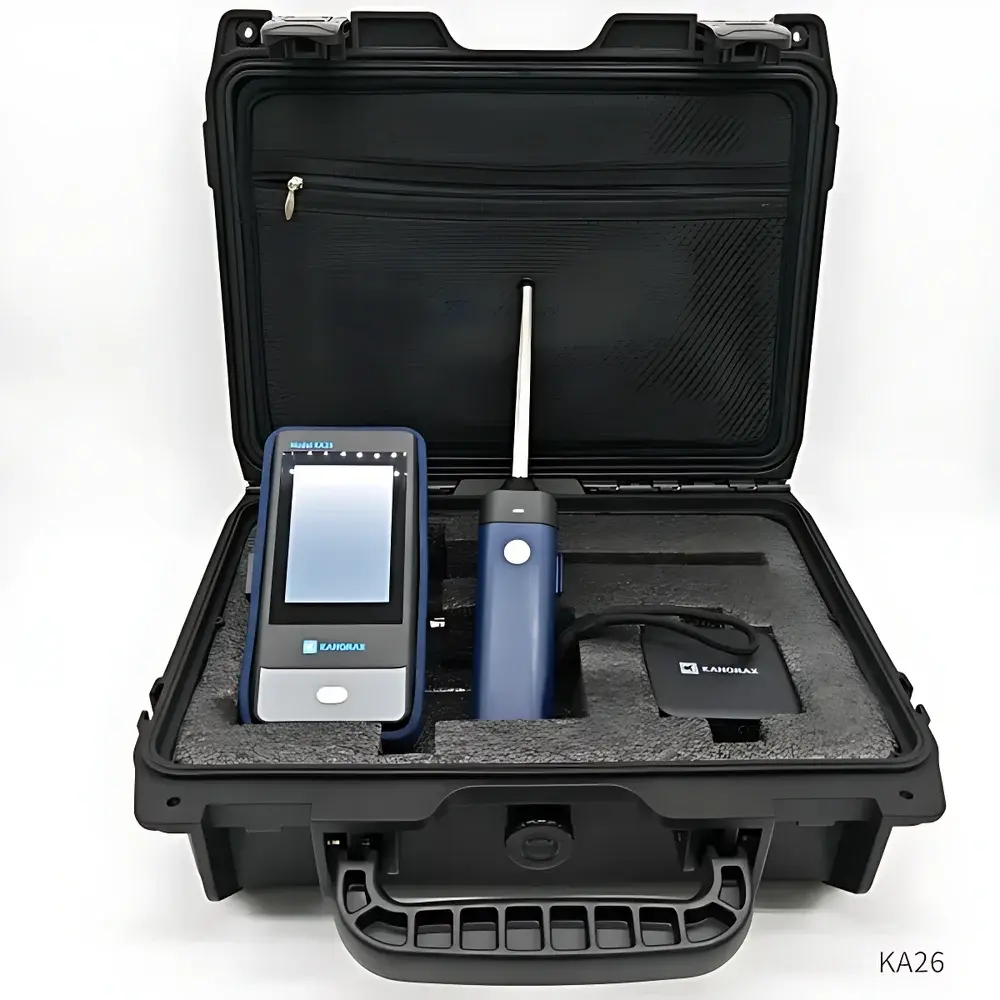
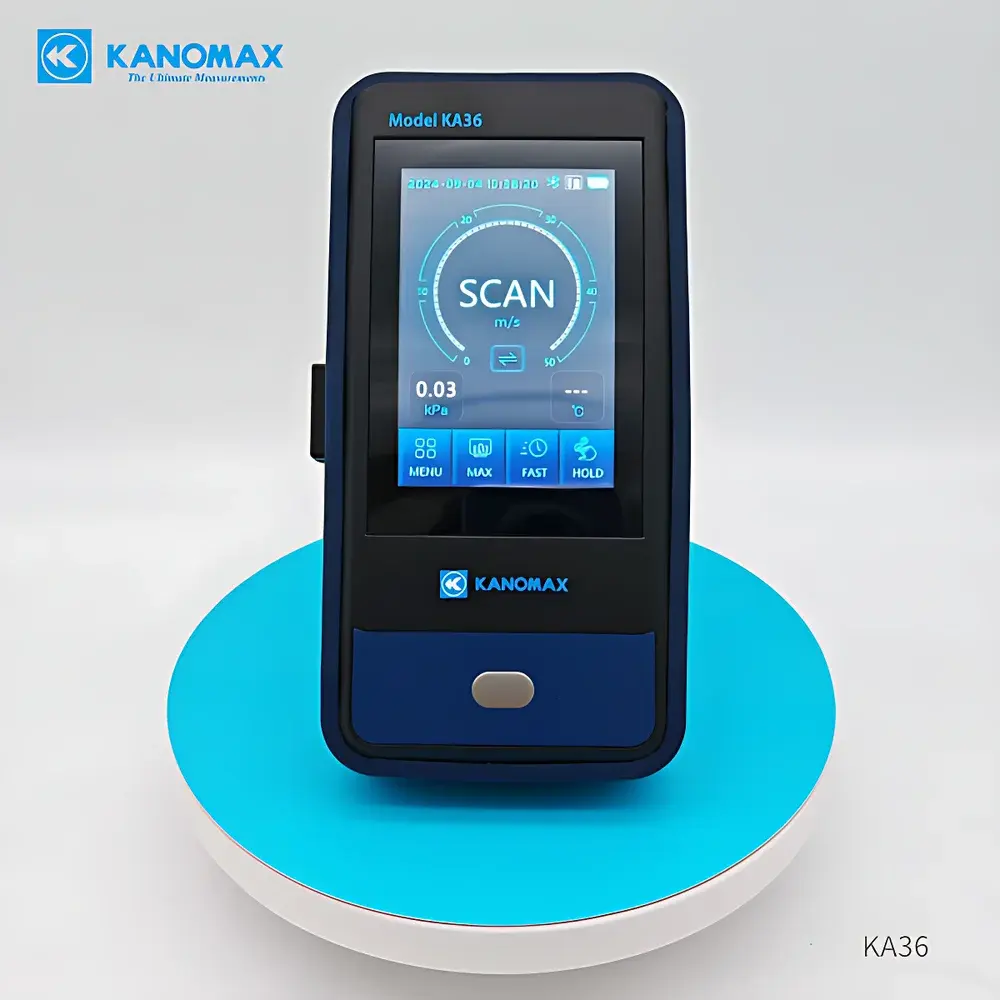
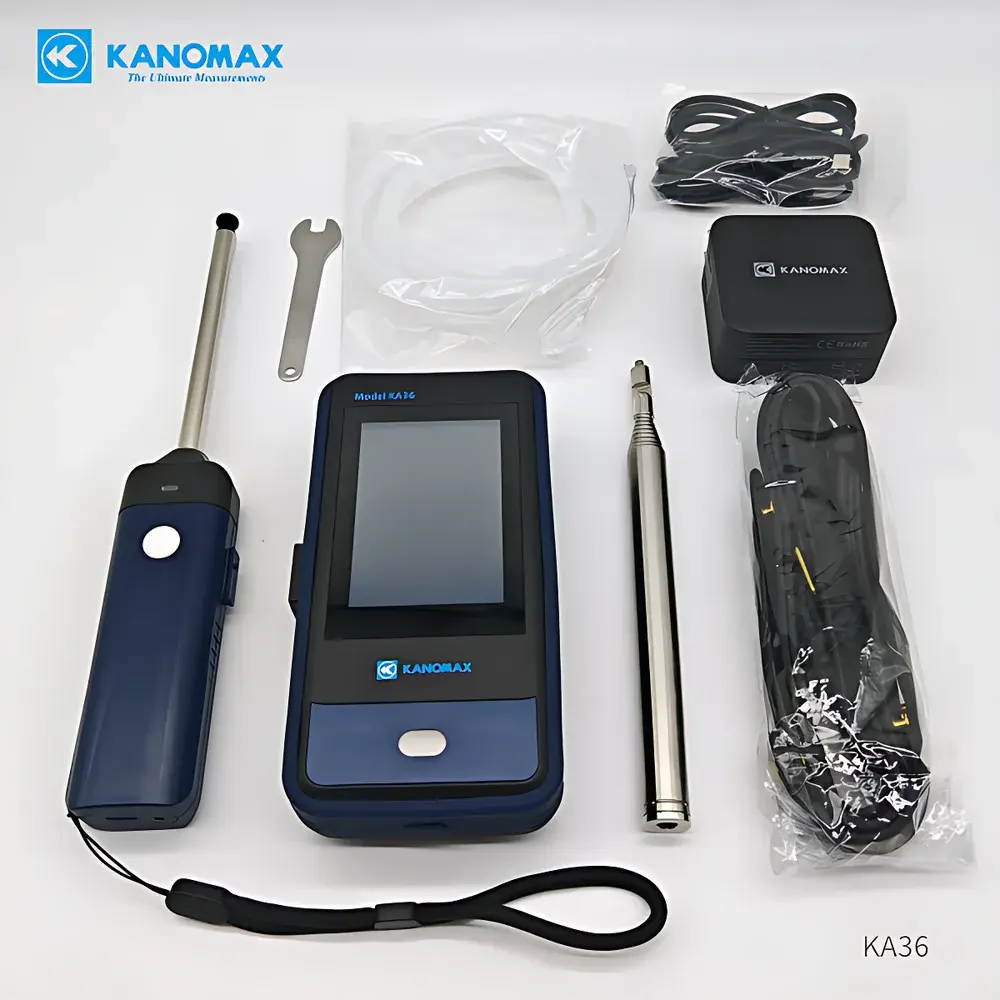
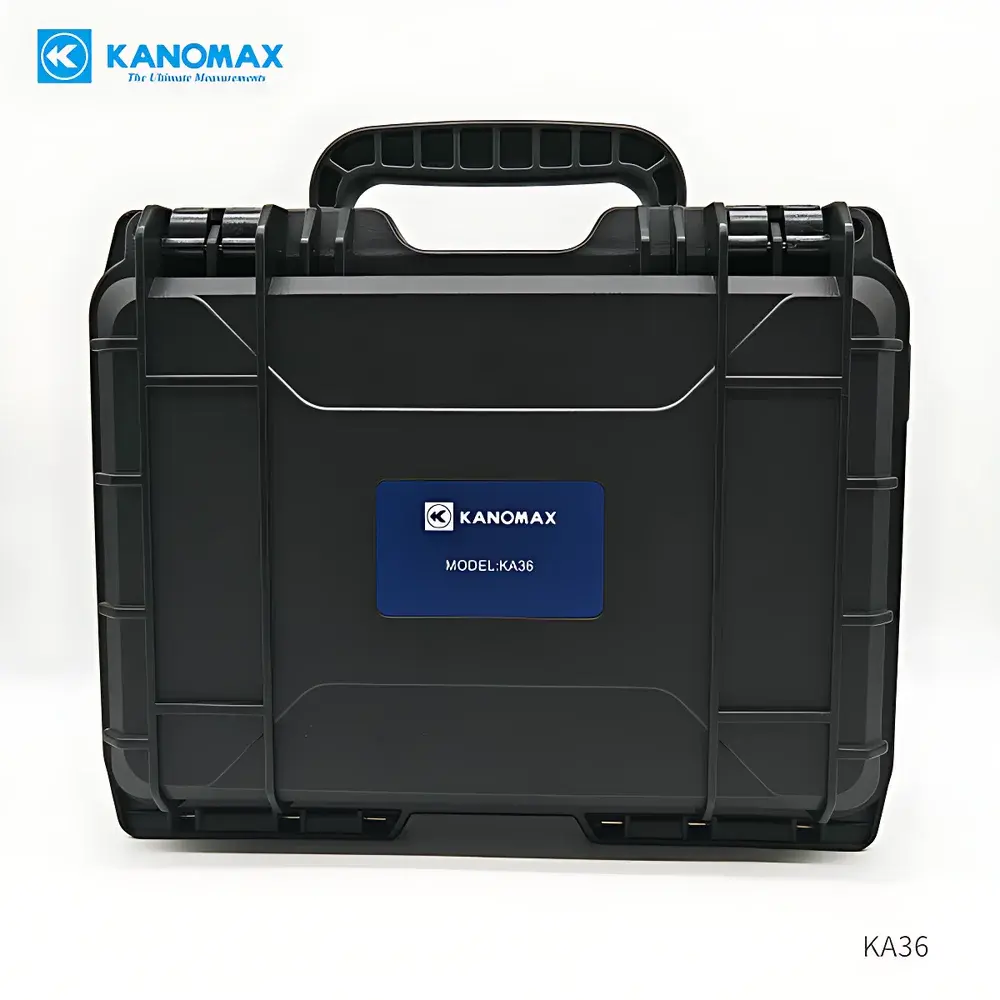
KANOMAX KA26/KA36 Hot-Wire Anemometer
| Brand | KANOMAX |
|---|---|
| Origin | Japan |
| Model | KA26 / KA36 |
| Instrument Type | Hot-Wire Anemometer |
| Velocity Range | 0.00–50.0 m/s |
| Velocity Resolution | 0.01 m/s (0.00–9.99 m/s), 0.1 m/s (10.0–50.0 m/s) |
| Temperature Range | −20.0–100.0 °C |
| Temperature Resolution | 0.1 °C |
| Pressure Range | −5.00 to +5.00 kPa |
| Pressure Resolution | 0.01 kPa |
| Velocity Accuracy | ±3% of reading or ±0.015 m/s, whichever is greater |
| Temperature Accuracy | ±0.3 °C (0.0–60.0 °C), ±0.5 °C (−20.0–0.0 °C and 60.0–100.0 °C) |
| Pressure Accuracy | ±0.1 kPa |
| Response Time (Velocity) | ~1 s |
| Response Time (Temperature) | ~30 s |
| Response Time (Pressure) | ~1 s |
| Display | 3.5-inch resistive touch LCD |
| Data Storage | 5,000 records |
| Communication | Bluetooth 5.0, USB-C |
| Power | Rechargeable Li-ion battery (≈10 h @ 5 m/s, 20 °C), AC adapter (USB-C) |
| Operating Environment (Body) | 5–40 °C |
| Operating Environment (Probe) | −20–100 °C |
| Storage Temperature | −30–60 °C |
| Dimensions (Body) | 160 × 80 × 32 mm |
| Probe Dimensions | Φ10 mm sensor tip |
| handle | 40 × 27 × 125 mm |
| extendable length | 260–330 mm (up to 1240 mm with extension rod) |
| Weight | ≈600 g |
Overview
The KANOMAX KA26 and KA36 are precision-engineered hot-wire anemometers designed for high-fidelity velocity, temperature, and differential pressure measurements in demanding environmental and industrial applications. Based on constant-temperature anemometry (CTA), these instruments utilize a fine platinum-coated tungsten wire heated to a stable temperature above ambient. As airflow passes over the sensor, convective heat loss is measured and converted into velocity via calibrated thermal transfer models—ensuring high linearity and repeatability across the full 0.00–50.0 m/s range. Unlike cup or vane anemometers, hot-wire technology provides superior low-velocity sensitivity (<0.1 m/s), rapid dynamic response (~1 s), and minimal flow disturbance—critical for laminar flow characterization in cleanrooms, HVAC commissioning, and ISO 14644-3 compliant airflow verification. The dual-model platform offers configurability: KA26 focuses on core air velocity and temperature measurement, while KA36 adds integrated differential pressure sensing (±5.00 kPa) for duct static pressure and filter resistance evaluation—enabling comprehensive air system diagnostics per ASHRAE Standard 111 and ISO 16813.
Key Features
- 3.5-inch resistive touch LCD with dual-view display: simultaneous numeric readout and real-time analog bar graph for intuitive trend monitoring and transient behavior assessment.
- Bluetooth 5.0 wireless communication eliminates probe-to-body cabling—enabling unobstructed access to remote ducts, ceiling diffusers, and ISO Class 5–8 cleanroom supply grilles without signal degradation or mechanical strain.
- Modular, interchangeable probe design with flexible extension rod (max. 1240 mm); no auxiliary fixtures required for hard-to-reach locations such as high-bay exhaust stacks or under-floor plenums.
- Real-time limit alarm function: user-definable upper/lower thresholds trigger visual highlighting and audible alerts when velocity, temperature, or pressure exceeds setpoints—supporting immediate intervention during GMP-critical airflow validation (e.g., FDA 21 CFR Part 11-compliant audit trails via optional software).
- On-device statistical processing: automatic calculation and display of minimum, maximum, and arithmetic mean values over user-defined sampling intervals—essential for EN 13779 and ISO 14644-1 compliance reporting.
- Ergonomic form factor: integrated desktop stand and chest-mount strap; compact body (160 × 80 × 32 mm) and lightweight construction (≈600 g) facilitate extended handheld operation and field mobility.
Sample Compatibility & Compliance
The KA26/KA36 is validated for use in clean, non-corrosive, particle-free airstreams—making it suitable for pharmaceutical Grade A–D environments, semiconductor fab tool intakes, and laboratory fume hood face velocity surveys. It complies with key international standards including ISO 7726 (ergonomics of thermal environments), ISO 14644-3 (cleanroom testing methods), and ASHRAE Guideline 12–2020 (for infection control in HVAC systems). While not intrinsically rated for hazardous locations, its probe operating range (−20–100 °C) and body rating (5–40 °C) support deployment in controlled manufacturing spaces, environmental chambers, and outdoor ventilation assessments where ambient conditions remain within specification. Calibration traceability follows JIS Z 8015 and NIST-traceable reference standards; routine recalibration is recommended annually or after 200 hours of cumulative use per ISO/IEC 17025 guidelines.
Software & Data Management
Data acquisition and post-processing are supported via KANOMAX’s proprietary PC application (compatible with Windows 10/11), which enables secure export of time-stamped datasets (.csv, .xlsx) with metadata tagging (operator ID, location, test protocol). The software supports configurable report templates aligned with EU GMP Annex 1 and FDA Aseptic Processing guidance—incorporating digital signature fields, version-controlled calibration certificates, and audit-log generation for 21 CFR Part 11 compliance. Bluetooth pairing allows live streaming to mobile devices for on-the-fly annotation and geotagged documentation. All 5,000 onboard records retain timestamp, sensor ID, and environmental context—eliminating transcription errors during QA review cycles.
Applications
- Cleanroom certification: supply air velocity mapping per ISO 14644-1, uniformity checks at critical workstations, and recovery time validation.
- HVAC performance verification: duct traverse surveys, filter bank pressure drop analysis (KA36), coil face velocity profiling, and room air change rate calculation.
- Indoor Air Quality (IAQ) investigations: thermal comfort assessment (operative temperature + air velocity), draft risk evaluation (ASHRAE 55), and ventilation effectiveness auditing.
- Pharmaceutical facility qualification: Grade A laminar flow hoods, isolator glove port velocity, and RABS barrier integrity testing.
- Research & development: wind tunnel boundary layer studies, fan performance curves, and thermal management validation in electronics enclosures.
FAQ
What distinguishes the KA26 from the KA36 model?
The KA36 integrates a differential pressure sensor (±5.00 kPa) alongside velocity and temperature measurement capabilities, enabling simultaneous duct static pressure and filter resistance evaluation—whereas the KA26 is optimized for velocity/temperature-only applications.
Can the instrument measure in corrosive or high-humidity environments?
No. The hot-wire sensor is sensitive to condensation, oil mist, and particulate contamination; use is restricted to clean, dry air streams per manufacturer specifications. For humid or contaminated environments, consider KANOMAX’s pitot-static or thermal mass flow alternatives.
Is the device suitable for ISO 14644-3 cleanroom certification?
Yes—when operated within its specified accuracy limits and calibrated against traceable standards, the KA26/KA36 meets the instrumentation requirements for airflow velocity and temperature testing outlined in ISO 14644-3 Annex B.
How is data integrity maintained during Bluetooth transmission?
All Bluetooth sessions employ AES-128 encryption; data packets include CRC-32 checksums and sequence numbering to ensure lossless, tamper-evident transfer—consistent with ALCOA+ data governance principles.
What is the recommended recalibration interval?
Annual calibration is advised, or after 200 hours of operational use—whichever occurs first—to maintain metrological confidence per ISO/IEC 17025 Clause 7.7.







