
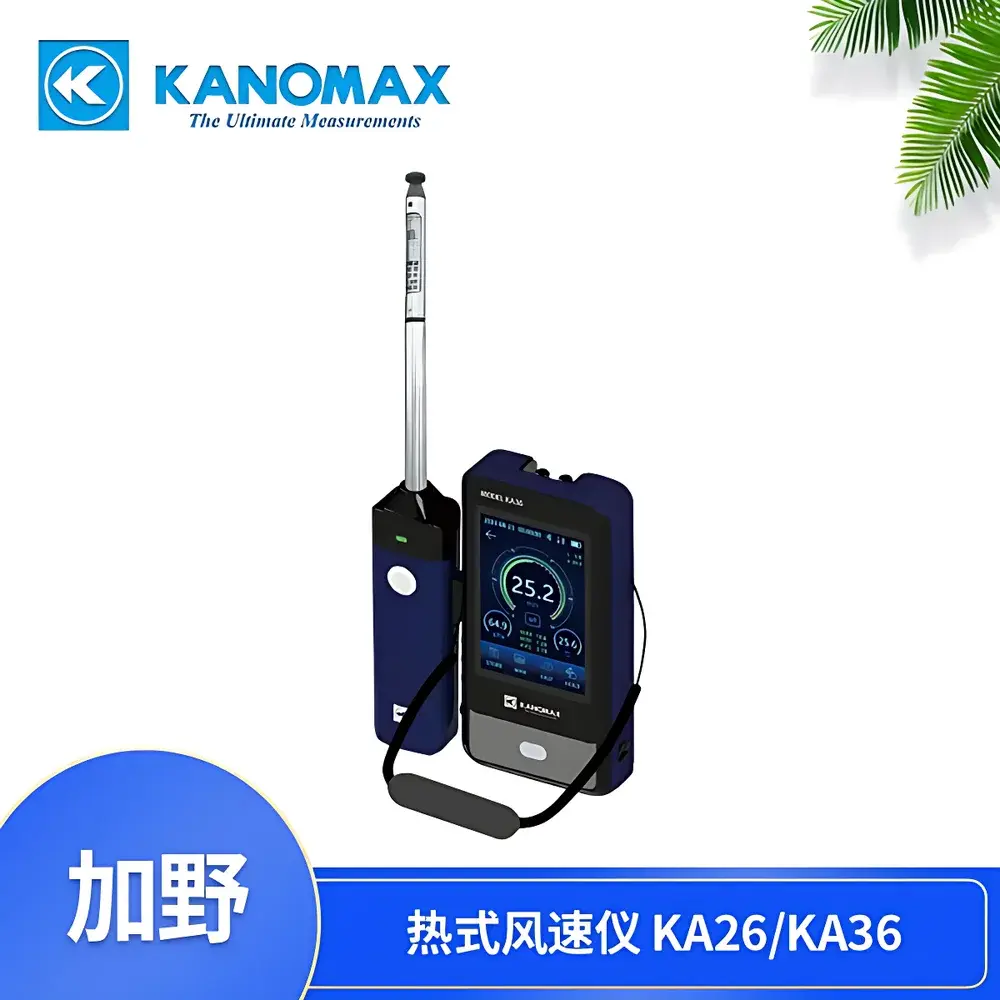
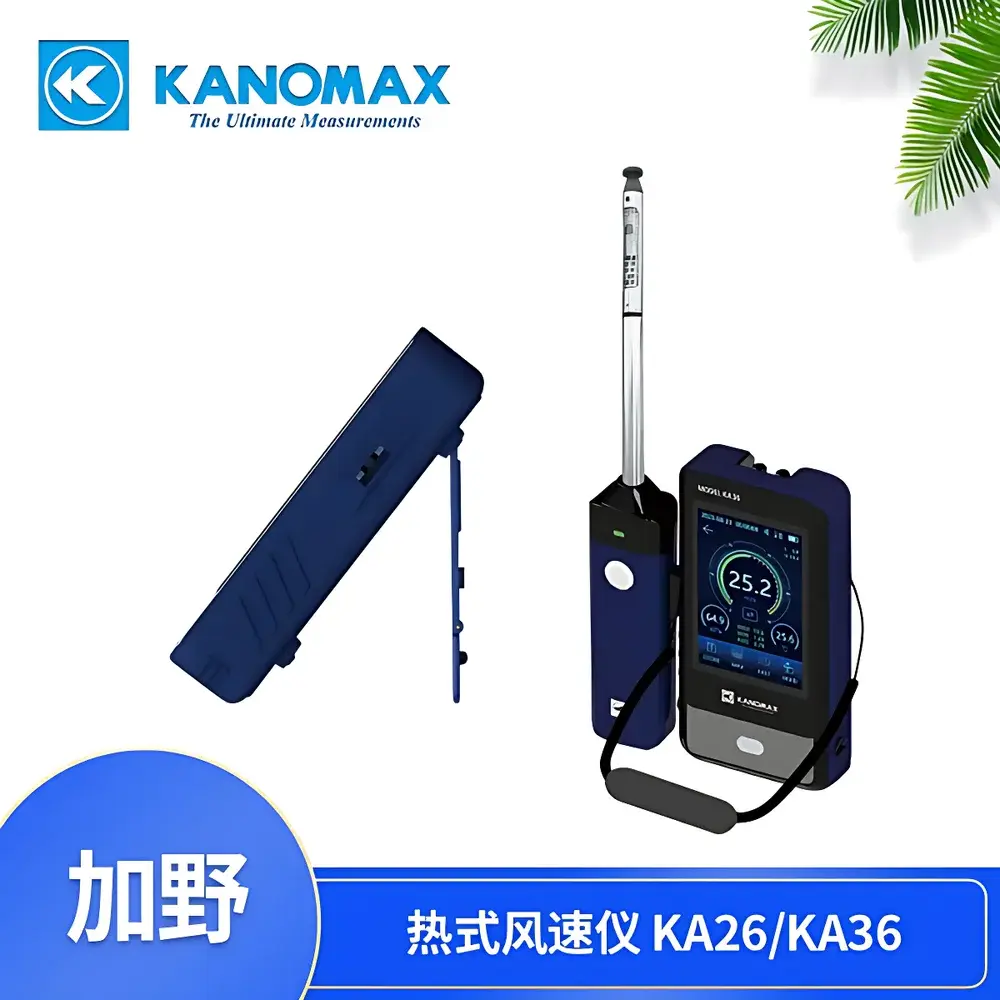
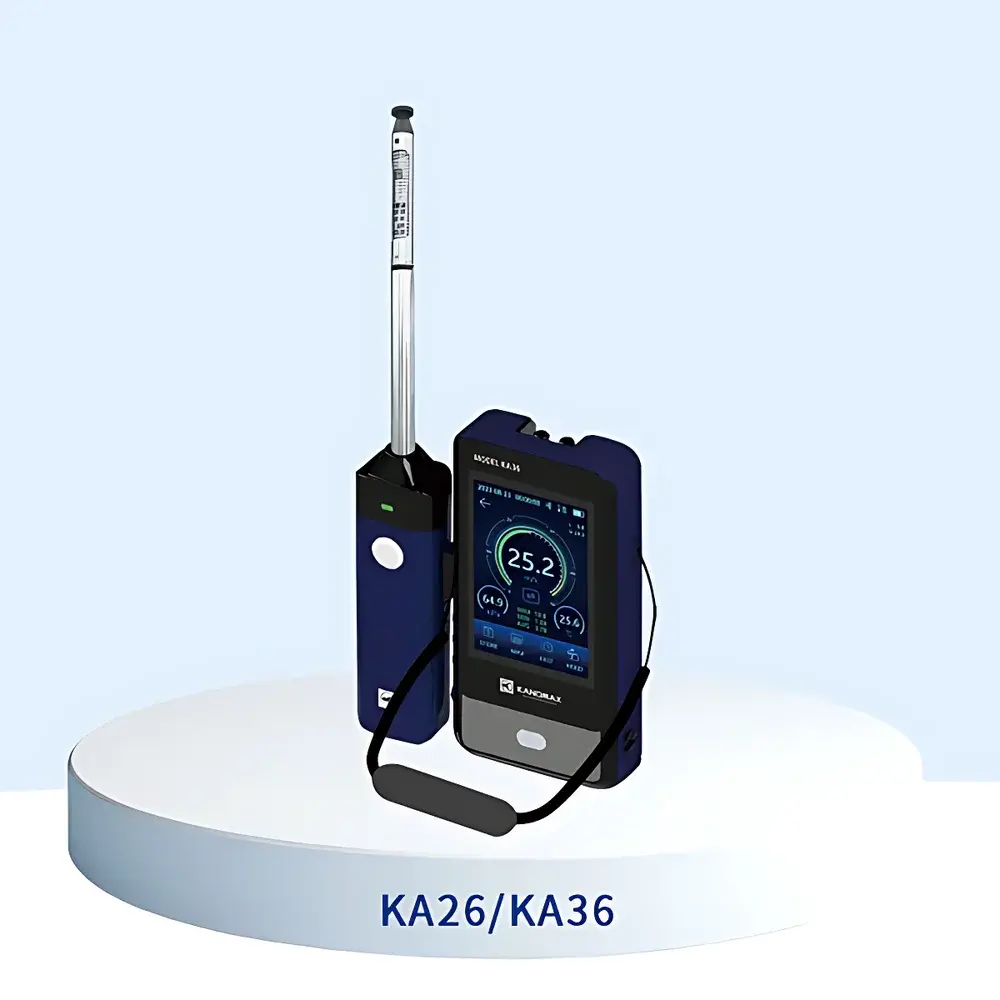
Kanomax KA26 Thermal Anemometer
| Brand | Kanomax |
|---|---|
| Origin | Japan |
| Model | KA26 |
| Instrument Type | Thermal Anemometer |
| Velocity Range | 0.00–50.0 m/s |
| Velocity Resolution | 0.1 m/s (0.01 m/s in 0.00–9.99 m/s range) |
| Accuracy | ±3% of reading or ±0.015 m/s, whichever is greater |
| Temperature Range | −20.0–100.0 °C |
| Temperature Resolution | 0.1 °C |
| Temperature Accuracy | ±0.3 °C (−20.0–0.00 °C and 60.0–100.0 °C: ±0.5 °C) |
| Pressure Range | 0.00 to ±5.00 kPa |
| Pressure Resolution | 0.01 kPa |
| Pressure Accuracy | ±0.1 kPa |
| Response Time (Velocity) | ~1 s |
| Response Time (Temperature) | ~30 s |
| Response Time (Pressure) | ~1 s |
| Display | 3.5-inch resistive touchscreen |
| Data Storage | 5,000 records |
| Communication | Bluetooth 5.0, USB-C |
| Battery Life | Approx. 10 h (at 5 m/s, 20 °C) |
| Operating Environment (Unit) | 5–40 °C |
| Operating Environment (Probe) | −20–100 °C |
| Storage Temperature | −30–60 °C |
| Dimensions (Unit) | 160 × 80 × 32 mm |
| Probe Dimensions | Φ10 mm sensor |
| handle | 40 × 27 × 125 mm |
| extendable length | 260–330 mm |
| Weight | ~600 g |
| Probe Extension Capability | Up to 1240 mm with included extension rod |
| Compliance | Designed for industrial hygiene, HVAC commissioning, and cleanroom monitoring per ISO 14644-3, ASHRAE 110, and ANSI/ASHRAE Standard 111 |
Overview
The Kanomax KA26 Thermal Anemometer is a portable, multi-parameter environmental measurement instrument engineered for precision air velocity, temperature, and differential pressure quantification in demanding field and laboratory applications. Utilizing constant-temperature anemometry (CTA), the KA26 employs a heated thermistor sensor whose thermal dissipation correlates directly with local airflow velocity—enabling stable, low-inertia response across its full 0.00–50.0 m/s range. Unlike cup or vane anemometers, this thermal principle delivers high reproducibility at low velocities (<1 m/s) and maintains linearity up to turbulent flow regimes encountered in ductwork, fume hoods, and cleanroom supply diffusers. Its integrated tri-sensor architecture allows simultaneous acquisition of velocity, ambient temperature (−20.0–100.0 °C), and static/differential pressure (±5.00 kPa), eliminating sequential instrument switching and reducing measurement uncertainty in time-sensitive commissioning workflows.
Key Features
- 3.5-inch resistive touchscreen display supporting dual-view visualization: numeric readouts paired with real-time analog bar graphs for intuitive trend assessment.
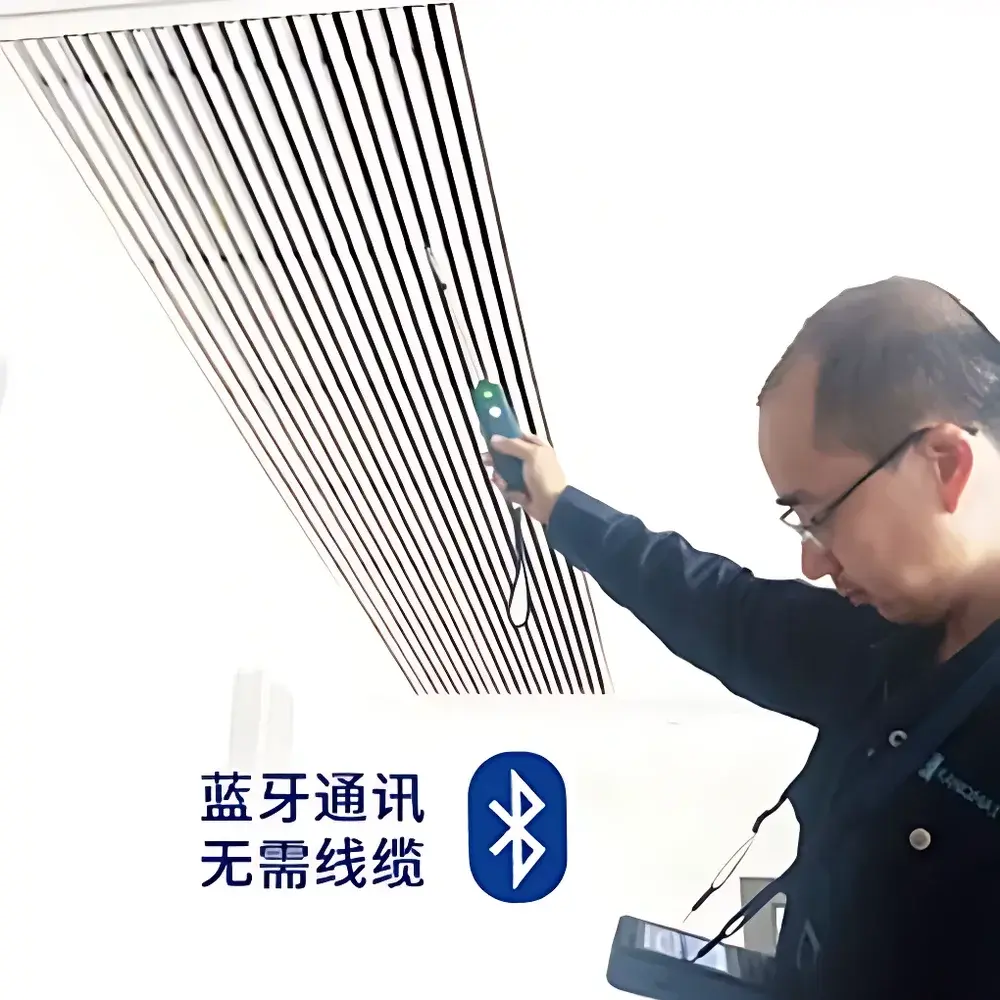
- Bluetooth 5.0 wireless communication between probe and main unit—eliminating cable constraints during duct traverses, ceiling-mounted outlet testing, or confined-space ventilation surveys.
- Modular, interchangeable probe design with flexible extension rod (extends up to 1240 mm); no auxiliary fixtures required for remote or elevated sampling points.
- Configurable limit-based alarm system: user-defined thresholds trigger visual highlighting and audible alerts when measured values exceed preset bounds—critical for HVAC balancing and ISO 14644-1 compliance verification.
- On-device statistical processing: automatic calculation and logging of minimum, maximum, and arithmetic mean values over user-defined intervals—supporting ASHRAE Guideline 12 and ISO 16814 reporting requirements.
- Integrated status indicators for battery level, Bluetooth connection strength, signal integrity, and data-hold activation—enhancing operational transparency in multi-user environments.
- Ergonomic form factor (160 × 80 × 32 mm, ~600 g) with built-in kickstand and lanyard mount—optimized for hands-free desktop operation or chest-mounted mobility during extended walk-through audits.
Sample Compatibility & Compliance
The KA26 is validated for use with clean, dry air—making it suitable for non-corrosive, particle-free environments typical of HVAC system commissioning, pharmaceutical cleanrooms (ISO Class 5–8), laboratory fume hood certification (per ASHRAE 110), and indoor air quality (IAQ) assessments under ANSI/ASHRAE Standard 62.1. Its probe operating temperature range (−20–100 °C) accommodates both chilled-water coil discharge measurements and high-temperature exhaust duct evaluations. While not intrinsically safe, the device complies with IEC 61000-4 electromagnetic immunity standards and meets CE marking requirements for portable measuring instruments. Data integrity protocols—including timestamped logging, non-volatile memory storage (5,000 records), and USB-C export—align with GLP documentation expectations for facility qualification reports.
Software & Data Management
Data acquisition and post-processing are supported via Kanomax’s proprietary PC software (compatible with Windows 10/11), which enables batch download, CSV export, graphical trend analysis, and PDF report generation—including customizable headers, calibration traceability fields, and pass/fail annotations per user-defined limits. All stored records retain native timestamps, sensor ID metadata, and measurement mode flags (e.g., “hold,” “average,” “peak”). The USB-C interface supports both power delivery and bidirectional data transfer, while Bluetooth pairing preserves configuration settings across sessions. Though the KA26 does not implement FDA 21 CFR Part 11 electronic signature controls, its audit-ready log structure—including immutable record sequencing and absence of editable internal timestamps—facilitates retrospective validation in GxP-regulated facilities when paired with procedural SOPs.
Applications
- HVAC system commissioning and TAB (Testing, Adjusting, Balancing) per NEBB and AABC standards.
- Cleanroom airflow uniformity mapping and ISO 14644-3 classification studies.
- Fume hood face velocity verification and containment performance evaluation (ASHRAE 110).
- Industrial ventilation surveying—including local exhaust systems, dust collection ducts, and spray booth air curtains.
- Indoor environmental quality (IEQ) investigations supporting LEED IEQ Credit 2 and WELL Building Standard W07.
- Research-grade airflow profiling in aerodynamic test rigs, wind tunnel boundary layer characterization, and thermal management validation for electronics enclosures.
FAQ
What is the recommended calibration interval for the KA26?
Kanomax recommends annual recalibration against NIST-traceable standards; however, frequency should be risk-assessed based on usage intensity, environmental exposure, and regulatory context (e.g., quarterly for GMP cleanroom applications).
Can the KA26 measure mass flow rate?
No—the KA26 outputs volumetric velocity only. Mass flow derivation requires additional inputs (air density, cross-sectional area, humidity compensation), which must be calculated externally using recorded temperature, pressure, and relative humidity data.
Is the probe compatible with the KA36 model?
Yes—KA26 and KA36 share identical probe interfaces and mechanical specifications, enabling cross-model interchangeability of sensors, extension rods, and pressure tubing accessories.
Does the device support real-time data streaming to a SCADA or BMS platform?
Not natively—the KA26 lacks Modbus, BACnet, or OPC UA protocols. Real-time integration requires third-party Bluetooth-to-MQTT gateways or custom middleware bridging its CSV export workflow.
How is traceability maintained during field use?
Each unit ships with a factory calibration certificate listing serial-numbered sensor offsets, reference standard IDs, and environmental conditions at time of calibration—satisfying ISO/IEC 17025 clause 7.7 documentation requirements when retained as part of site-specific equipment records.







