
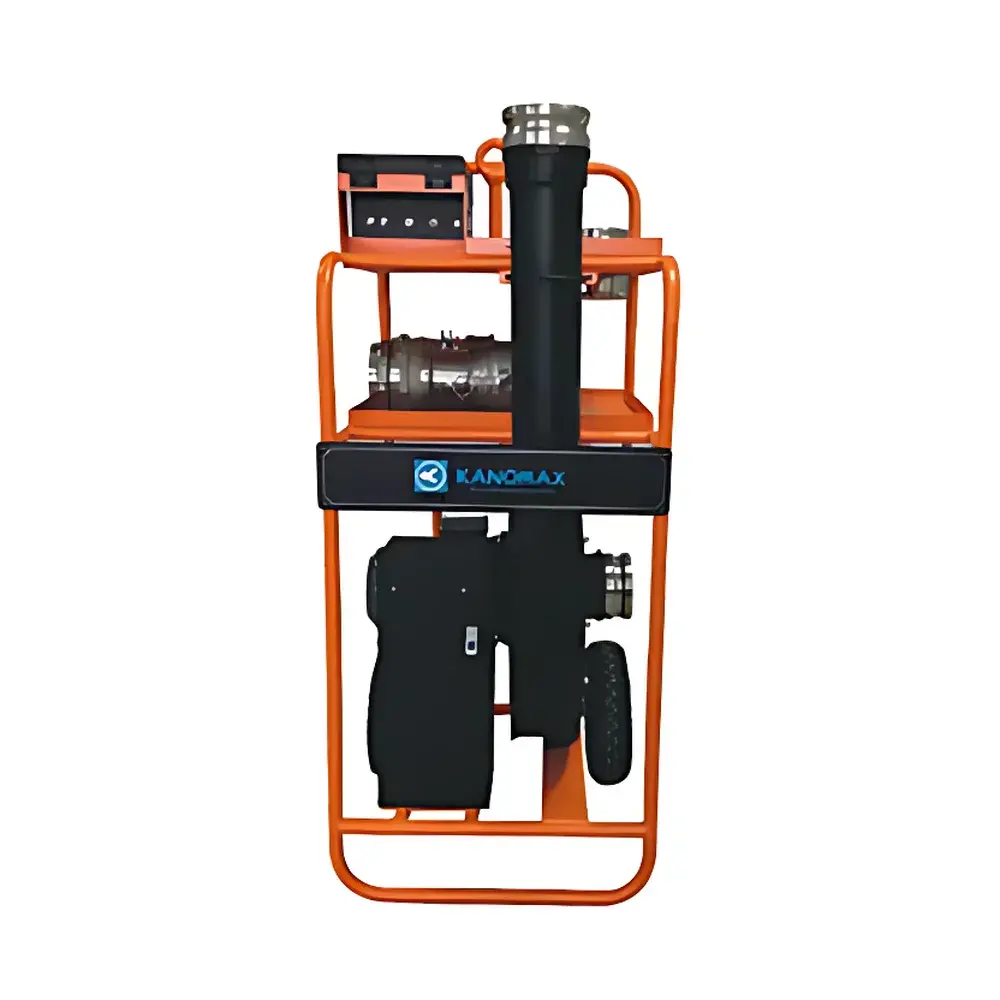
Kanomax KAN-1000 Positive & Negative Pressure Duct Leakage Testing System
| Brand | Kanomax |
|---|---|
| Origin | Japan |
| Model | KAN-1000 |
| Compliance Standards | EN 1507:2006, EN 12237:2002, Eurovent 2/2, DW/143, SMACNA Duct Construction Standards, GB 50243–2002 |
| Pressure Range | ±5000 Pa (adjustable) |
| Flow Measurement Range | 0.1–3000 m³/h (dependent on duct size and test configuration) |
| Data Storage | 1000 test records |
| Display | 4.7-inch capacitive touchscreen LCD |
| Environmental Operating Range | 0–40 °C, 10–90 % RH (non-condensing) |
| Interface | USB port for data export |
| Power Supply | Rechargeable Li-ion battery (≥8 h continuous operation) |
| Certifications | CE, RoHS, ISO 9001-manufactured design |
Overview
The Kanomax KAN-1000 Positive & Negative Pressure Duct Leakage Testing System is a portable, field-deployable instrumentation platform engineered for quantitative assessment of air leakage performance in HVAC ductwork under controlled pressurization conditions. Based on the principle of constant-pressure differential testing—where a calibrated fan induces either positive or negative pressure relative to ambient conditions—the system measures volumetric airflow required to maintain a specified test pressure across the duct section under evaluation. This methodology aligns with internationally recognized duct airtightness protocols including EN 1507, EN 12237, and SMACNA’s HVAC Air Duct Leakage Test Manual. The KAN-1000 delivers traceable, repeatable results suitable for commissioning verification, energy code compliance (e.g., ASHRAE 90.1, IECC), and post-installation quality assurance in commercial, institutional, and industrial ventilation systems.
Key Features
- Simultaneous positive and negative pressure testing modes, configurable via intuitive touchscreen interface
- Dual-sensor architecture: high-accuracy differential pressure transducer (±0.5 Pa resolution) paired with thermal anemometer-based flow sensor (0.1–3000 m³/h range, NIST-traceable calibration)
- Real-time display of critical parameters: leakage airflow (m³/h), test pressure (Pa), ambient temperature (°C), and barometric pressure (hPa)
- Onboard data logging with timestamped storage of up to 1000 complete test records, including pressure vs. time curves and pass/fail status per standard-defined thresholds
- 4.7-inch capacitive touchscreen LCD with multi-language support (English, Japanese, Chinese, Spanish), optimized for gloved operation and low-light environments
- Modular fan assembly with quick-connect duct couplings and integrated flow straighteners to minimize turbulence-induced measurement uncertainty
- Rechargeable lithium-ion battery pack supporting ≥8 hours of continuous field use; optional AC adapter for benchtop operation
Sample Compatibility & Compliance
The KAN-1000 is validated for use with rigid and flexible rectangular, round, and oval duct systems ranging from 100 mm to 2000 mm in equivalent diameter. It accommodates both supply and return air networks, including insulated and non-insulated configurations. All measurement algorithms and pass/fail logic are implemented in accordance with the acceptance criteria defined in EN 1507:2006 (metallic ducts), EN 12237:2002 (flexible ducts), Eurovent 2/2 (European classification), DW/143 (UK ductwork specification), SMACNA HVAC Air Duct Leakage Test Manual (U.S. practice), and GB 50243–2002 (Chinese HVAC construction standard). Device firmware includes selectable standard profiles with preloaded leakage class limits (e.g., Class A, B, C per EN 1507), enabling immediate compliance determination without manual calculation.
Software & Data Management
Test data are exportable via USB mass storage mode to standard CSV or Excel-compatible formats for integration into building commissioning reports, energy modeling workflows, or QA/QC documentation. No proprietary software installation is required—files open directly in common spreadsheet applications. Each record contains full metrological metadata: date/time stamp, operator ID (user-definable), duct identifier, test pressure setpoint, measured leakage rate, environmental conditions, and pass/fail flag. While the KAN-1000 does not implement FDA 21 CFR Part 11 electronic signature functionality (as it is not intended for regulated pharmaceutical or biotech cleanroom validation), its audit-ready data structure supports GLP-aligned documentation practices in third-party commissioning and energy auditing contexts.
Applications
- Pre-commissioning and post-construction duct leakage verification per ASHRAE Guideline 0 and ISO 16813
- Energy code compliance testing for LEED v4.1 EA Prerequisite: Minimum Energy Performance and IECC Chapter 16
- Troubleshooting excessive fan energy consumption attributable to undetected duct leakage
- Validation of duct sealing interventions during retrocommissioning projects
- Technical due diligence assessments in facility acquisition or portfolio benchmarking
- Training and certification programs for HVAC technicians and TAB (Testing, Adjusting, Balancing) professionals
FAQ
Does the KAN-1000 require annual recalibration?
Yes. Kanomax recommends annual recalibration of both the differential pressure sensor and flow transducer at an ISO/IEC 17025-accredited laboratory using NIST-traceable standards.
Can the KAN-1000 be used for smoke testing or tracer gas methods?
No. The KAN-1000 is designed exclusively for quantitative pressure-based leakage quantification—not qualitative leak location. It may be used in conjunction with smoke tubes or ultrasonic detectors for pinpointing leakage sites after quantitative failure is identified.
Is the device compatible with Building Management Systems (BMS)?
Not natively. The KAN-1000 operates as a standalone field instrument. However, exported CSV data can be imported into BMS trend databases or CMMS platforms via manual upload or automated scripting.
What maintenance is required between tests?
Routine inspection of fan inlet filters, seal integrity of coupling gaskets, and touchscreen cleanliness is recommended. No user-serviceable internal components require periodic replacement under normal operating conditions.
Does the KAN-1000 meet ISO 5801 requirements for fan performance testing?
No. ISO 5801 applies to laboratory-grade fan characterization. The KAN-1000 complies with ISO 2533 (acoustics) and ISO 5167-derived flow measurement principles adapted for field duct testing, not fan aerodynamic certification.
Related Products







