
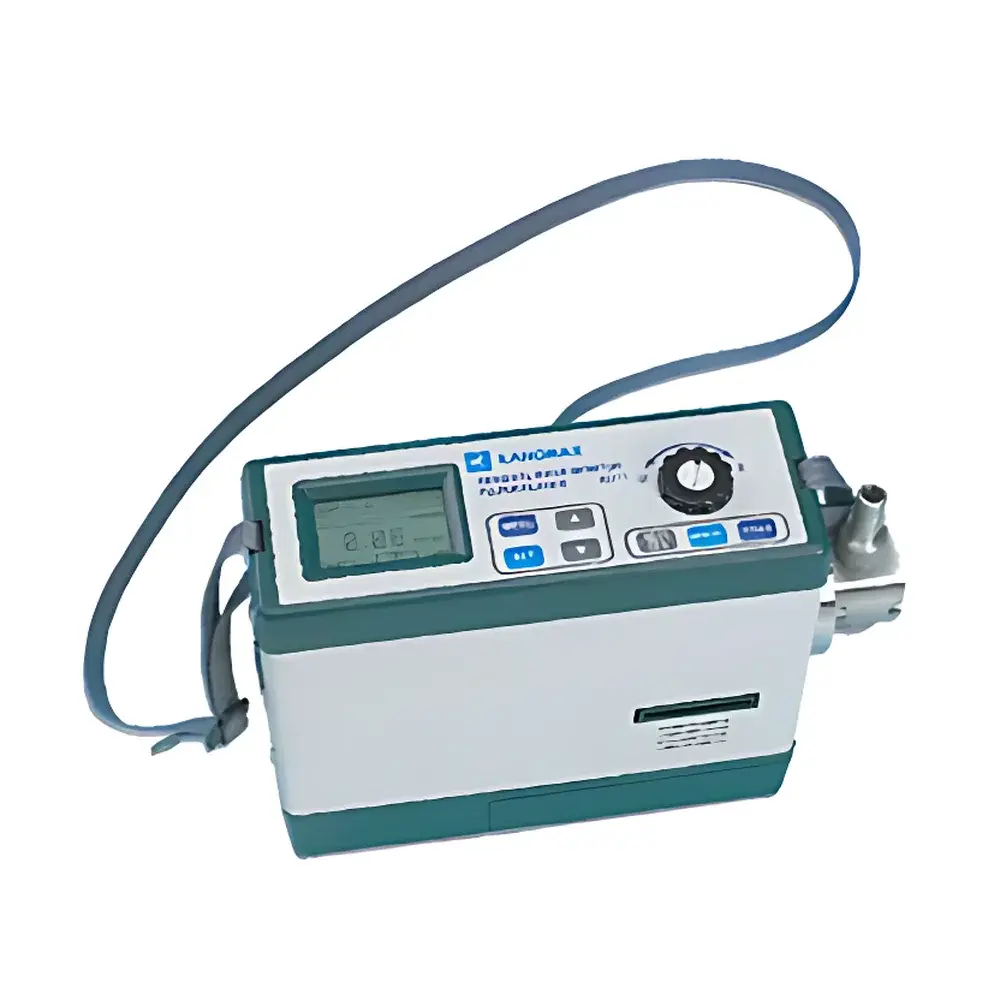
KANOMAX KD11 PM2.5 Dust Monitor
| Brand | KANOMAX |
|---|---|
| Origin | Japan |
| Manufacturer Type | Authorized Distributor |
| Product Origin | Imported |
| Model | KD11 |
| Operating Principle | Tapered Element Oscillating Microbalance (TEOM™-style microgravimetric method) |
| Safety Rating | Non-explosion-proof |
| Measurement Range | 0.01–10.00 mg/m³ |
| Resolution | 0.01 mg/m³ |
| Accuracy | ±10% of reading |
| Relative Error | ≤ ±2% |
| Data Storage Capacity | 500 records |
| Communication Interface | RS-232C |
| Sampling Duration Options | Fixed modes (24 s, 120 s) or user-defined (10–3600 s) |
| Maintenance Alert | Automatic crystal contamination warning |
Overview
The KANOMAX KD11 PM2.5 Dust Monitor is a precision microgravimetric particulate mass concentration analyzer engineered for real-time, continuous measurement of airborne PM₂.₅ and PM₁₀ mass concentrations in ambient air, indoor environments, and occupational settings. It employs the tapered element oscillating microbalance (TEOM) principle—specifically, a temperature-controlled quartz crystal microbalance (QCM) operating at a resonant frequency sensitive to mass loading. As airborne particles deposit onto the oscillating crystal surface, the resulting frequency shift is linearly correlated to accumulated mass, enabling direct, filterless, real-time gravimetric quantification without reliance on optical proxies or calibration transfer functions. This physical measurement approach ensures traceability to SI mass units and eliminates humidity- and particle-refractive-index-dependent biases common in optical scattering instruments. The KD11 is designed for field-deployable operation under stable laboratory or controlled environmental monitoring conditions—not for hazardous or explosive atmospheres.
Key Features
- Real-time gravimetric measurement of PM₂.₅ and PM₁₀ mass concentrations with no filter replacement required during sampling
- High-resolution detection down to 0.01 mg/m³ across a dynamic range spanning 0.01–10.00 mg/m³
- Onboard data logger storing up to 500 timestamped measurement records with sampling duration metadata
- Configurable sampling intervals: factory presets (24 s and 120 s) plus fully programmable duration from 10 to 3600 seconds
- Automated crystal contamination alert system triggered when deposited mass exceeds pre-set threshold—reducing risk of measurement drift and ensuring data integrity
- RS-232C serial interface compliant with EIA/TIA-232 standards, enabling bidirectional communication with host PCs for configuration, data retrieval, and firmware updates
- Integrated thermal management stabilizing crystal temperature to minimize thermal drift effects on resonance frequency
- Tool-free, solvent-compatible crystal cleaning procedure supporting routine maintenance in accordance with ISO 10175-2 and EN 481 guidance for personal dust sampling instrumentation
Sample Compatibility & Compliance
The KD11 is validated for use with ambient air, office air, cleanroom perimeter zones, and general industrial indoor environments where non-explosive, non-corrosive aerosols are present. It complies with Japanese Industrial Standards JIS B 7922-1 (2019) for particulate matter monitors and aligns with the measurement principles referenced in ISO 25358:2021 (Air quality — Gravimetric determination of PM₁₀ and PM₂.₅ mass concentration). While not certified to US EPA EQPM or EU MCERTS requirements for regulatory stack monitoring, its microgravimetric methodology supports method validation under ISO/IEC 17025-accredited laboratories for workplace exposure assessment per OSHA Method ID-235 and NIOSH Method 0600. The instrument meets CE marking requirements for electromagnetic compatibility (EN 61326-1) and safety (EN 61010-1).
Software & Data Management
KANOMAX provides dedicated Windows-based communication software compatible with Windows 10/11 (64-bit), supporting ASCII protocol over RS-232C. The software enables full remote control—including start/stop command issuance, sampling duration reconfiguration, and real-time data streaming visualization. All downloaded datasets include UTC timestamps, sampling duration, measured concentration, and status flags (e.g., “Crystal Alert Active”). Export formats include CSV and plain-text log files suitable for import into LIMS platforms or statistical analysis tools such as R, Python (pandas), or JMP. Audit trails are maintained locally on the host PC; while the KD11 itself does not implement FDA 21 CFR Part 11 electronic signature controls, its data output structure supports integration into GLP/GMP-compliant workflows when paired with validated third-party data acquisition systems.
Applications
- Ambient air quality monitoring in urban and suburban locations for epidemiological and public health studies
- Indoor air quality (IAQ) assessment in schools, hospitals, and office buildings per ASHRAE Standard 62.1
- Occupational hygiene surveys for respirable dust exposure evaluation in construction, manufacturing, and material handling facilities
- Validation and cross-checking of optical particle counters (OPCs) and beta attenuation monitors (BAMs) in reference measurement campaigns
- Research-grade time-series analysis of PM₂.₅ diurnal patterns, source apportionment modeling input, and filtration efficiency testing
- Educational laboratory use for teaching aerosol science, environmental metrology, and gravimetric measurement fundamentals
FAQ
Does the KD11 require filter media or consumables during normal operation?
No—the KD11 operates on a filterless microgravimetric principle using a reusable quartz crystal sensor. Only periodic crystal cleaning with isopropyl alcohol is required.
Can the KD11 measure PM₁.₀ or ultrafine particles (<0.1 µm)?
No—it is configured with an inertial impactor cut-point optimized for PM₂.₅ and PM₁₀ separation per ISO 7708:1995 specifications. It does not resolve sub-100 nm particles.
Is the accuracy specification (±10%) valid across the entire measurement range?
Yes—the stated accuracy applies to all readings within 0.01–10.00 mg/m³ when operated per KANOMAX calibration and environmental guidelines (20–30 °C, <80% RH, low-vibration environment).
How is traceability maintained for calibration?
KANOMAX provides factory calibration against NIST-traceable reference aerosols (e.g., Arizona Test Dust, A1 Ultrafine). End users may perform verification checks using calibrated gravimetric reference filters in parallel sampling configurations.
What maintenance intervals are recommended?
Crystal cleaning is advised after each 50 hours of cumulative sampling or upon activation of the contamination alert—whichever occurs first. Annual recalibration by an authorized KANOMAX service center is recommended for metrological continuity.







