
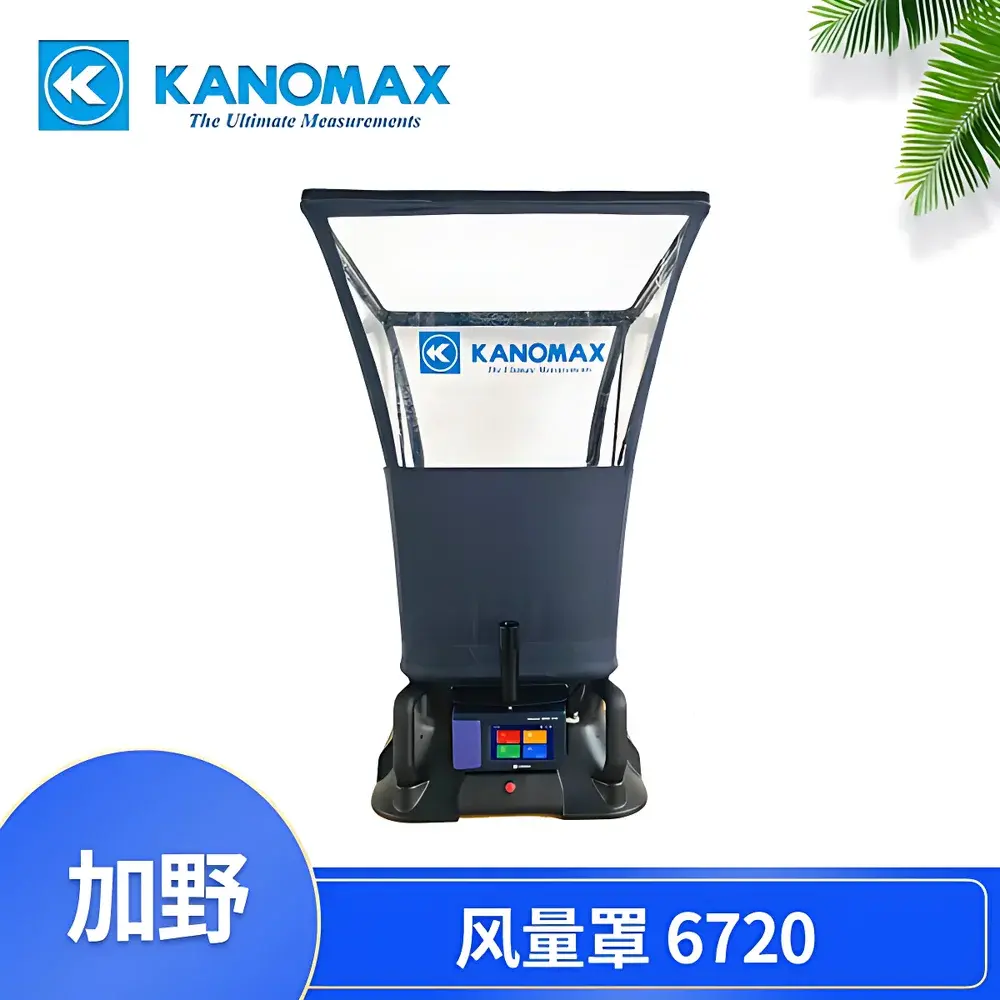
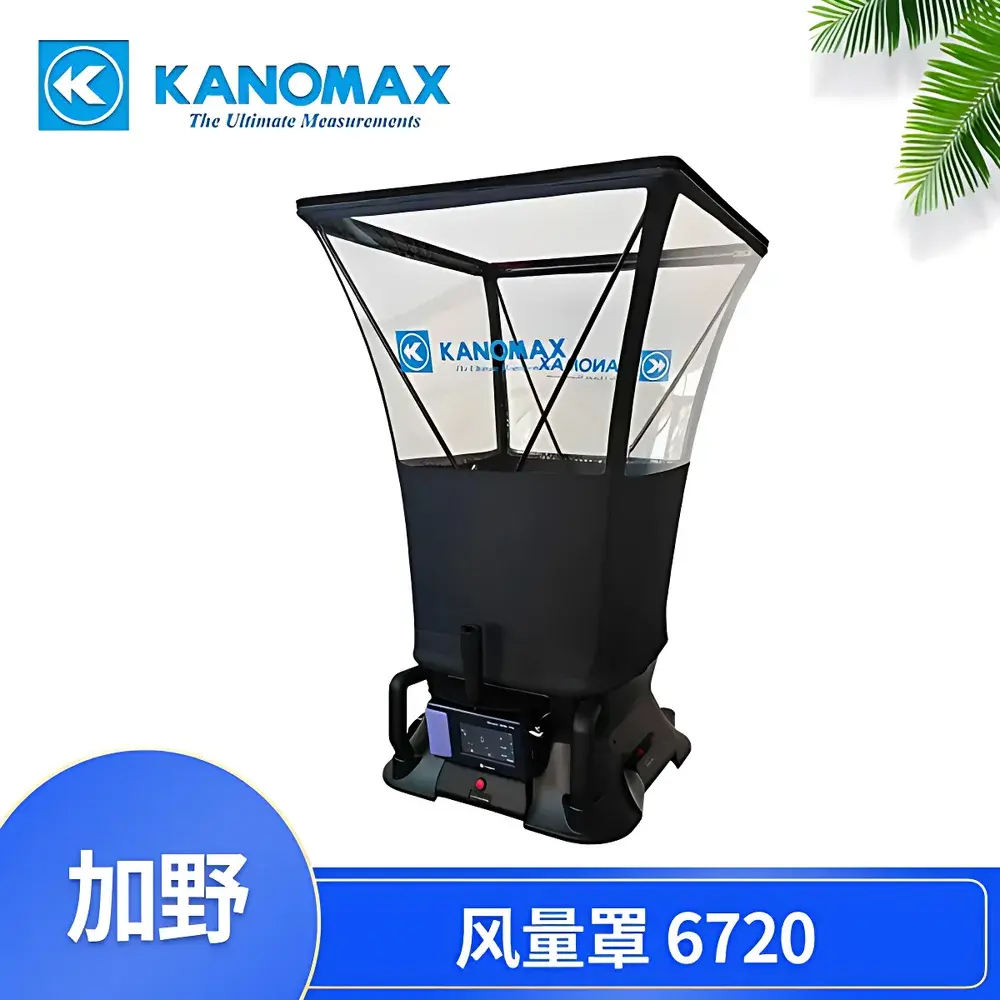
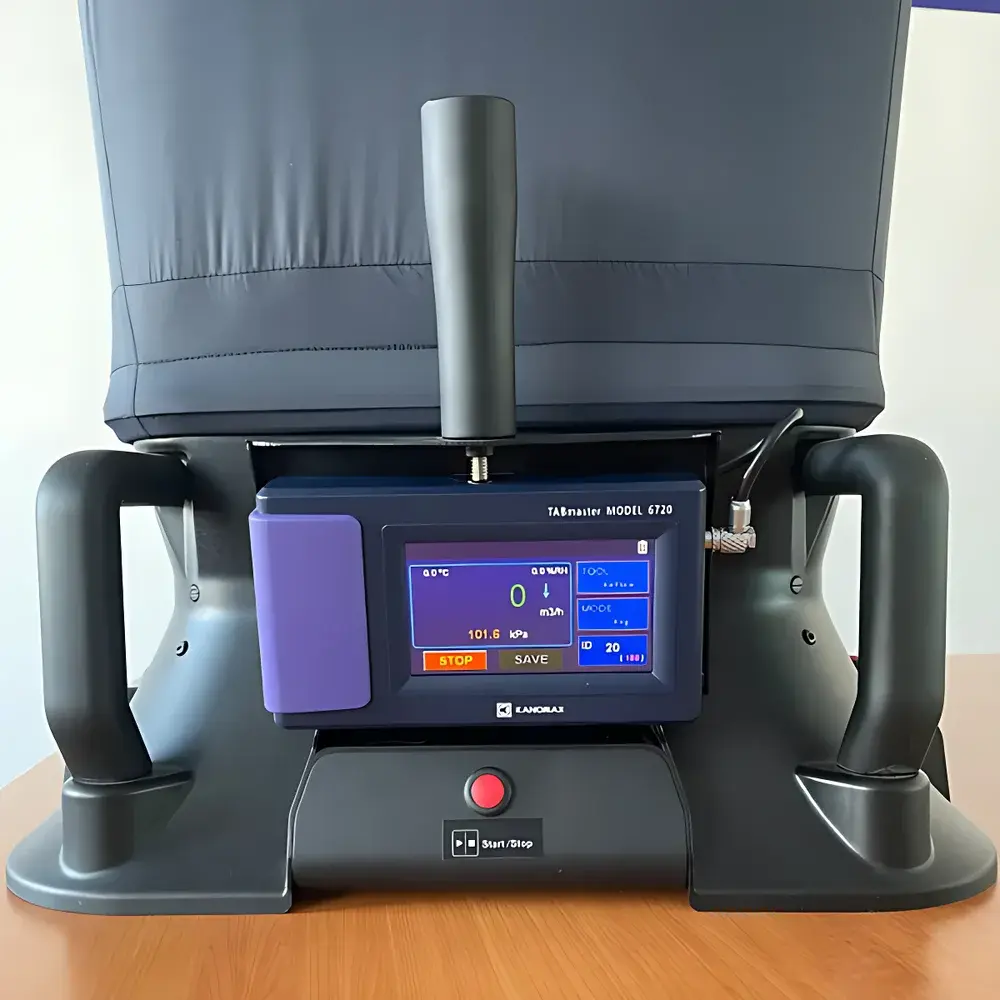
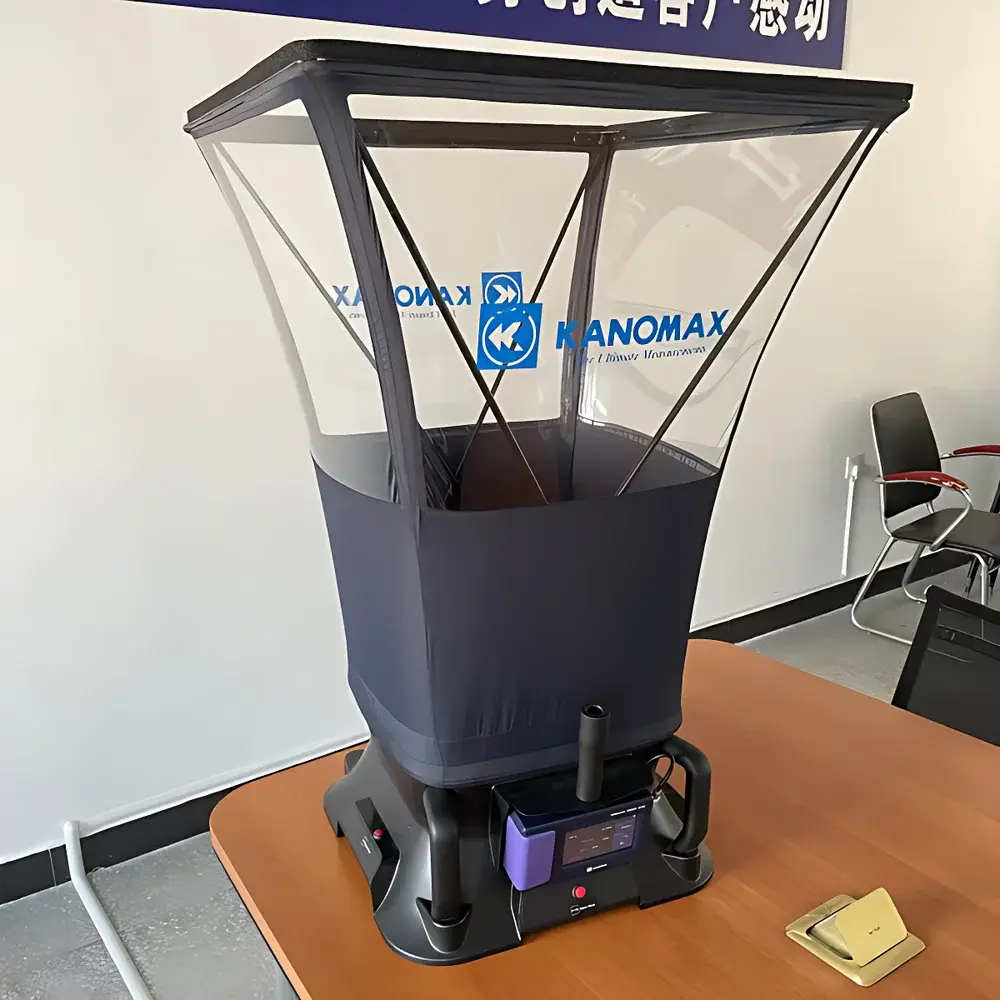
Kanomax Model 6720 Air Flow Hood
| Key | Brand: Kanomax |
|---|---|
| Origin | Japan |
| Model | 6720 |
| Airflow Range | 40–4300 m³/h |
| Accuracy | ±3% of reading ±8 m³/h |
| Air Velocity Range (with Pitot tube) | 0.15–40 m/s |
| Air Velocity Range (with velocity matrix) | 0.15–15 m/s |
| Velocity Accuracy | ±3% of reading ±0.05 m/s |
| Differential Pressure Range | −2500 to +2500 Pa |
| DP Accuracy | ±1.5% of reading ±0.25 Pa |
| Temperature Range | 0–60 °C |
| Temp Accuracy | ±0.5 °C |
| Humidity Range | 0–100 %RH |
| RH Accuracy | ±3 %RH (10–90 %RH) |
| Operating Environment | 0–60 °C, 0–100 %RH |
| Display | 4.3-inch full-color touchscreen LCD |
| Data Storage | 8,000 measurements (host), 10,000 (via Kanomax Mobile App) |
| Power | 4 × AA batteries (≈9 h), or DC 5 V adapter |
| Weight | 3.6 kg |
| Standard Hood Size | 610 × 610 mm |
| Optional Hood Sizes | 610×1220 mm, 305×1220 mm, 500×500 mm, 915×915 mm, 915×610 mm, 800×1400 mm |
| Key Functions | Backpressure compensation, airflow direction detection (supply/exhaust), barometric pressure correction, real-time Bluetooth data transmission, USB export, on-device clock & battery indicator |
Overview
The Kanomax Model 6720 Air Flow Hood is a precision-engineered handheld instrument designed for quantitative volumetric airflow measurement in HVAC systems, cleanrooms, biosafety cabinets, and ventilation ductwork. It operates on the principle of integrated velocity-area integration: airflow is captured by a rigid, airtight hood placed over an outlet or inlet, and the internal velocity matrix—comprising 16 calibrated sensing points—measures local air velocities across the cross-section. Simultaneously, the unit acquires ambient temperature, relative humidity, and differential pressure to apply real-time atmospheric corrections. Its dual-sensor architecture supports interchangeable measurement modes: with the detachable velocity matrix for low-to-moderate velocity applications (0.15–15 m/s), or with an optional Pitot tube for high-velocity ducts (up to 40 m/s). The instrument’s wide dynamic range (40–4300 m³/h) and built-in backpressure compensation ensure traceable, repeatable results even under non-ideal static pressure conditions—critical for ASHRAE 111, ISO 14644-3, and EU GMP Annex 1 compliance verification.
Key Features
- 4.3-inch full-color capacitive touchscreen interface with intuitive icon-based navigation and multilingual support (English, Japanese, Chinese, Spanish, French)
- Integrated 16-point velocity matrix with uniform pressure tap distribution and automatic backpressure compensation algorithm
- Simultaneous real-time acquisition of airflow volume (m³/h), face velocity (m/s), temperature (°C), relative humidity (%RH), and differential pressure (Pa)
- On-device calculation of maximum, minimum, average, and cumulative values per test sequence; timestamped logging with user-defined test IDs
- Bluetooth 4.2 LE connectivity enabling bidirectional communication with iOS/Android devices running the official Kanomax Mobile App
- Direct thermal printing via Bluetooth-enabled portable printers (e.g., Zebra ZQ520, Star SM-L200) without intermediate PC software
- Transparent front viewing window for visual confirmation of hood-to-grille alignment and seal integrity during measurement
- Modular design: velocity matrix and main housing are mechanically separable—enabling use as a standalone differential pressure meter or face velocity probe when paired with optional accessories
Sample Compatibility & Compliance
The Model 6720 accommodates a broad spectrum of HVAC terminal devices—including VAV boxes, diffusers, grilles, HEPA filter banks, laminar flow hoods, and biological safety cabinets—through its six standard and custom-configurable hood sizes (610×610 mm base; optional up to 800×1400 mm). Its sealed construction and glass-fiber support frame minimize flex-induced leakage, maintaining measurement integrity across variable mounting geometries. The instrument meets IEC 61000-4 electromagnetic compatibility requirements and is certified for CE marking. While not intrinsically rated for hazardous locations, it complies with ISO/IEC 17025 calibration traceability frameworks when used with NIST-traceable reference standards. Data integrity aligns with FDA 21 CFR Part 11 principles through secure audit trails in the Kanomax Mobile App (user authentication, electronic signatures, immutable logs), supporting GLP and GMP validation protocols in pharmaceutical and medical device manufacturing environments.
Software & Data Management
Data handling is optimized for both field efficiency and laboratory-grade documentation. The embedded memory stores 8,000 complete test records with metadata (date/time, location tag, operator ID, hood size, K-factor setting). Via USB-C or Bluetooth, datasets export in CSV or PDF format—with configurable units (CFM/LFM/m³/h), K-factor adjustment per application, and selectable averaging intervals. The Kanomax Mobile App extends functionality: remote parameter configuration, live graphing of temporal airflow trends, batch export to cloud storage (Google Drive, Dropbox), and generation of compliant test reports featuring header fields for QA review and signature blocks. All stored data include embedded environmental context (T, RH, Patm) to support post-hoc uncertainty analysis per ISO/IEC Guide 98-3 (GUM).
Applications
- HVAC commissioning and balancing per ASHRAE Guideline 1 and TAB (Testing, Adjusting, Balancing) standards
- Cleanroom certification (ISO 14644-3 Class 5–8), including unidirectional airflow uniformity and total supply/exhaust volume verification
- Biosafety cabinet (BSC) performance testing: inflow velocity, downflow velocity, and exhaust volume per NSF/ANSI 49
- Pharmaceutical facility qualification: air change rate validation in Grade A/B/C/D rooms per EU GMP Annex 1
- Energy audits and retro-commissioning—quantifying actual vs. design airflow to identify duct leakage, damper misalignment, or fan degradation
- Educational and research laboratories requiring portable, multi-parameter environmental profiling capability
FAQ
What hood sizes are included with the Model 6720, and how are custom sizes validated?
The standard package includes one 610 × 610 mm hood. Optional sizes—including 610×1220 mm, 305×1220 mm, and 915×915 mm—are factory-calibrated using NIST-traceable wind tunnel data. Each hood carries a unique K-factor stored in firmware; users select the corresponding size in the menu to auto-apply correction.
Does the instrument support differential pressure measurement without the hood attached?
Yes. When the velocity matrix is detached and connected via the included pressure tubing, the Model 6720 functions as a standalone differential pressure meter with ±2500 Pa range and 0.25 Pa resolution.
How is backpressure compensation implemented during high-resistance exhaust testing?
A dedicated internal pressure sensor continuously monitors static pressure upstream of the matrix. The firmware applies a dynamic correction curve derived from empirical hood resistance characterization, ensuring volumetric accuracy remains within ±3% ±8 m³/h even at static pressures exceeding 150 Pa.
Can historical data be exported in formats compatible with LIMS or CMMS platforms?
Yes. CSV exports contain all raw and calculated parameters with ISO 8601 timestamps and SI units. Custom column mapping is supported via the Kanomax Desktop Utility (Windows/macOS), enabling direct ingestion into LabWare LIMS, IBM Maximo, or similar enterprise systems.
Is firmware update capability available, and how is it performed?
Firmware updates are distributed quarterly via Kanomax Technical Support and installed via USB-connected PC using the Kanomax Configuration Tool—no internet connection required on the instrument itself. Each release includes enhanced K-factor tables, bug fixes, and expanded language packs.







