
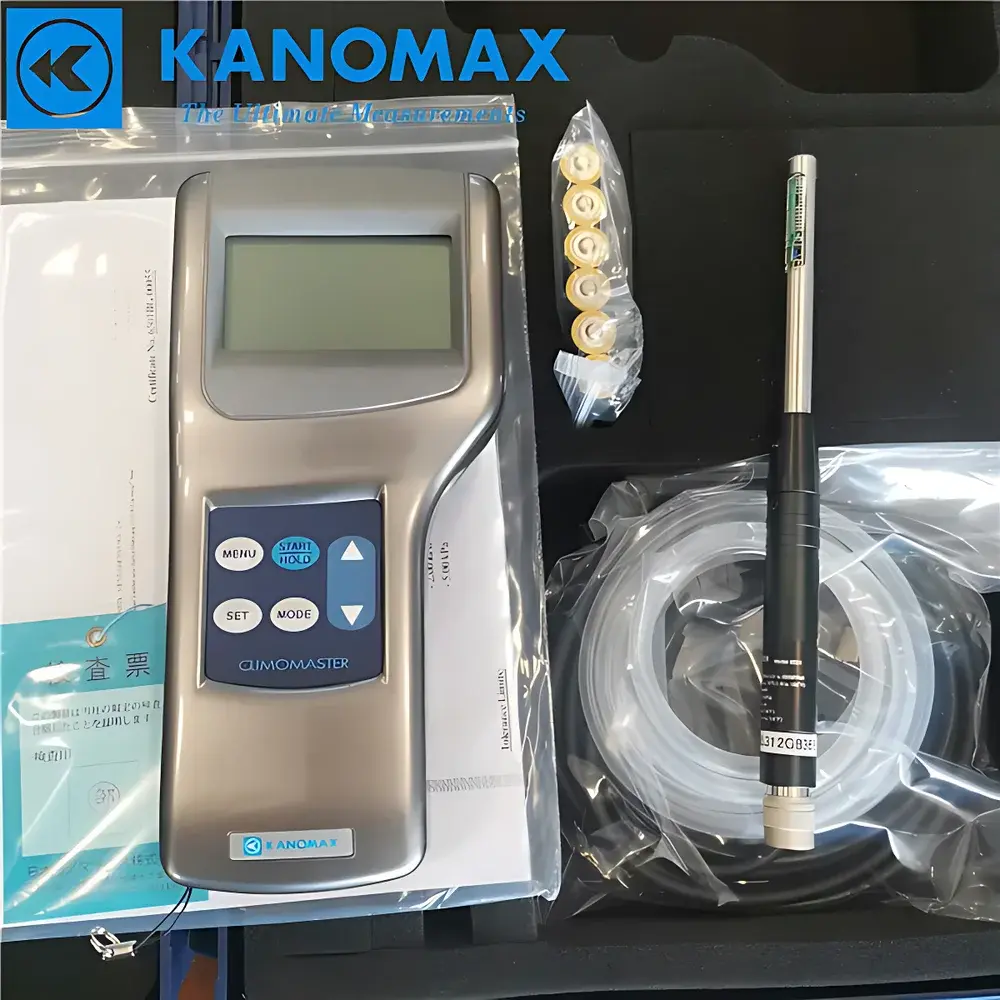
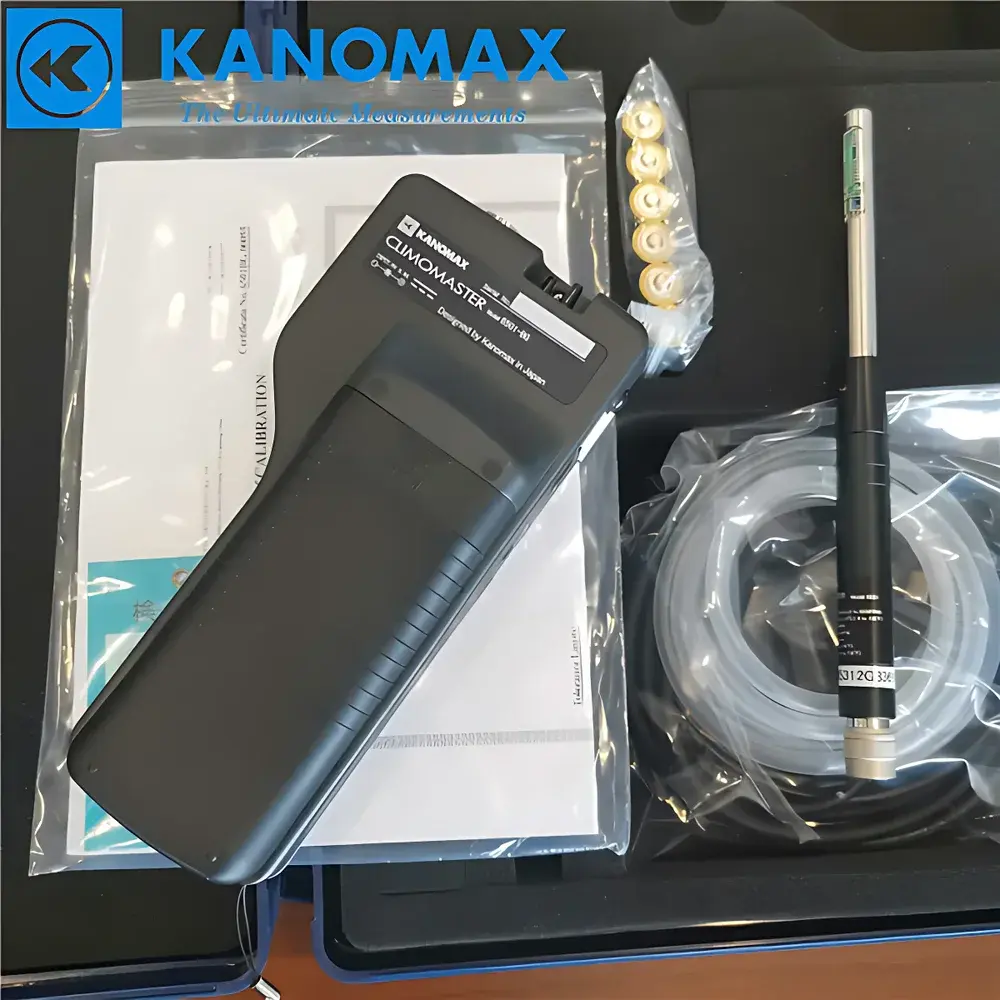
KANOMAX Multi-Function Anemometer & Environmental Air Flow Meter
| Brand | KANOMAX |
|---|---|
| Origin | Japan |
| Instrument Type | Thermal Anemometer |
| Resolution | 0.01 m/s |
| Measurement Range | Dependent on Interchangeable Probe Model |
| Accuracy | ±2% of Reading |
| Operating Temperature | −20 to +70 °C |
| Operating Humidity | 2.0–98.0% RH |
| Data Storage Capacity | Up to 20,000 Records |
| Probe Compatibility | 8 Standard KANOMAX Thermal Probes (e.g., KA3200, KA3300, KA3400 Series) |
| Built-in Calculations | Volumetric Air Flow (m³/h, CFM), Average/Min/Max Statistics, Hold Function |
| Input Parameters | Custom Duct Geometry (Rectangular, Circular, Oval) with Dimension Entry |
Overview
The KANOMAX Multi-Function Anemometer & Environmental Air Flow Meter is a precision-engineered handheld instrument designed for comprehensive airflow and ambient environmental parameter assessment in HVAC commissioning, cleanroom validation, industrial ventilation audits, and indoor air quality (IAQ) investigations. Based on constant-temperature anemometry (CTA), the system utilizes calibrated hot-wire or hot-film sensor elements housed in interchangeable probes to measure true mass-based air velocity with high temporal response and low flow sensitivity. Unlike cup or vane anemometers, thermal sensing enables accurate low-velocity measurement (<0.1 m/s) without mechanical inertia limitations. The device integrates real-time acquisition of air velocity, temperature, relative humidity, and differential pressure — all synchronized and displayed simultaneously on a high-contrast backlit LCD. Its core function extends beyond point measurement: by accepting user-defined duct cross-sectional geometry (rectangular, circular, or oval) and dimensions, it computes volumetric airflow (m³/h or CFM) directly, eliminating manual calculation errors and streamlining duct traverse protocols per ISO 16813 and ASHRAE Guideline 12.
Key Features
- Simultaneous real-time measurement and display of air velocity, dry-bulb temperature, relative humidity, and differential pressure
- Eight standardized KANOMAX thermal probe options (e.g., KA3200 straight probe, KA3300 bent probe, KA3400 multi-point array) with plug-and-play interface and automatic probe recognition
- Duct geometry-aware airflow calculation engine supporting rectangular, circular, and oval cross-sections with metric/imperial unit input
- On-device statistical processing: arithmetic mean, minimum, maximum, and standard deviation over user-defined sample intervals
- Hold function for freezing transient readings during field inspections or tight-access measurements
- Rugged IP54-rated housing with ergonomic grip, integrated tilt stand, and replaceable lithium-ion battery (≥12 hours continuous operation)
- Calibration traceability to JCSS (Japanese Calibration Service System) standards; factory calibration certificate included
Sample Compatibility & Compliance
The instrument supports direct measurement in non-corrosive, non-condensing air streams across laboratory fume hoods, supply/exhaust ducts, cleanroom diffusers, and occupied zone breathing-height surveys. It complies with key international performance and safety requirements including IEC 61000-4 (EMC immunity), JIS B 7551 (anemometer accuracy specifications), and ISO 7726 (ergonomics of thermal environments). For regulated environments—such as pharmaceutical manufacturing facilities operating under EU GMP Annex 1 or FDA 21 CFR Part 211—the device meets prerequisite criteria for qualification-ready instrumentation when used with documented probe-specific calibration certificates and validated measurement procedures. While not inherently 21 CFR Part 11 compliant as a standalone data logger, its exported CSV files support integration into validated LIMS or electronic lab notebook (ELN) systems with appropriate audit trail controls.
Software & Data Management
Data export is performed via USB-C connection to Windows-based PCs using KANOMAX’s proprietary PC Link software (v3.2+), which provides time-stamped record viewing, customizable report generation (PDF/CSV), and graphical trend analysis. The software supports batch import of multiple measurement sessions, duct profile mapping, and automated compliance checks against predefined velocity or airflow thresholds. All stored records include metadata: date/time stamp, probe ID, operator ID (user-input field), ambient conditions, and geometric input parameters. Internal memory retains up to 20,000 full records with timestamp and channel values; overwrite protection prevents accidental deletion of untransferred data. Firmware updates are delivered through the same software interface and maintain backward compatibility with historical calibration coefficients.
Applications
- HVAC system balancing and TAB (Testing, Adjusting, Balancing) per NEBB and AABC standards
- Cleanroom ISO 14644-3 airflow uniformity and velocity mapping (including laminar flow verification at HEPA filter outlets)
- Occupational health assessments: local exhaust ventilation (LEV) hood face velocity verification per OSHA Technical Manual Section III: Chapter 6
- Indoor air quality baseline studies incorporating thermal comfort indices (e.g., PMV/PPD calculations)
- Validation of air handling unit (AHU) performance and filter integrity testing support
- Educational laboratory use for fluid mechanics and environmental engineering coursework
FAQ
Does this instrument meet ISO 14644-3 requirements for cleanroom airflow mapping?
Yes — when used with appropriate KANOMAX traceable probes (e.g., KA3400 multi-point array) and following prescribed grid spacing and dwell time protocols, it fulfills velocity measurement accuracy and repeatability criteria outlined in Clause 8.2.
Can I perform automatic duct traverse calculations without external software?
Yes — all geometry-based volumetric flow computations occur onboard; no PC connection is required for real-time CFM/m³/h output.
Is NIST-traceable calibration available for individual probes?
KANOMAX offers optional JCSS-accredited calibration services with NIST-traceable reference standards; certificates include uncertainty budgets per ISO/IEC 17025.
What is the maximum cable length supported between probe and main unit?
Standard probe cables are 2 m; extended 5 m and 10 m variants are available as accessories with verified signal integrity up to 10 Hz bandwidth.
How is measurement uncertainty quantified for combined parameters like airflow?
Total uncertainty incorporates probe velocity error (±2% of reading), dimensional input tolerance (user-defined), temperature/humidity drift compensation, and duct geometry assumption error — typical expanded uncertainty (k=2) is ±3.5% for rectangular ducts under controlled conditions.







