
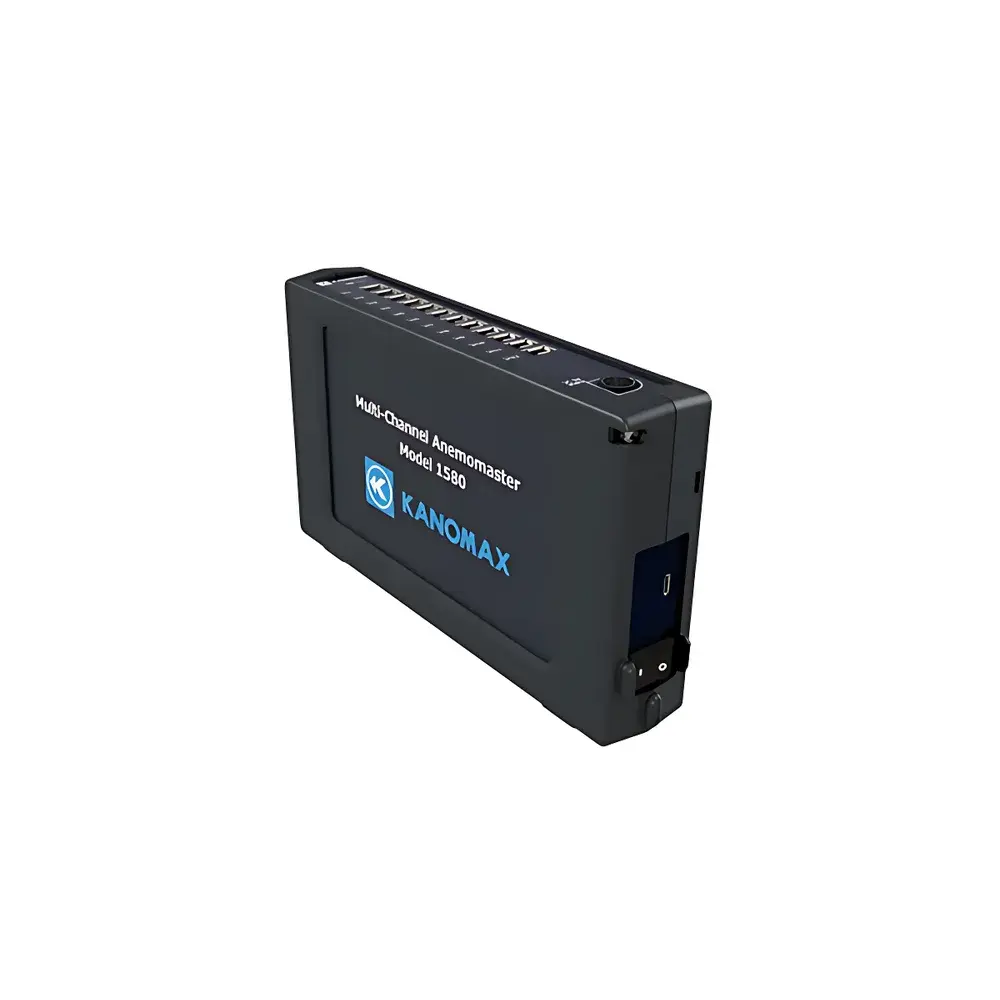
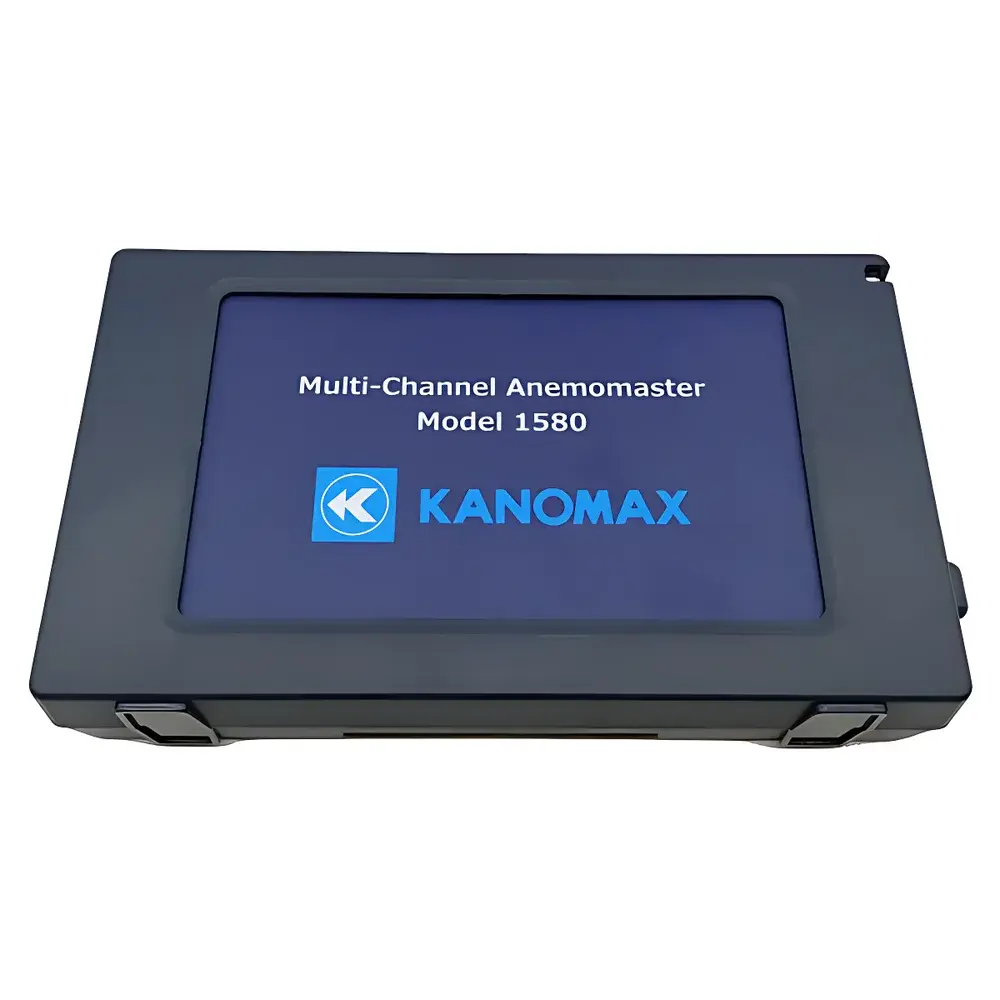
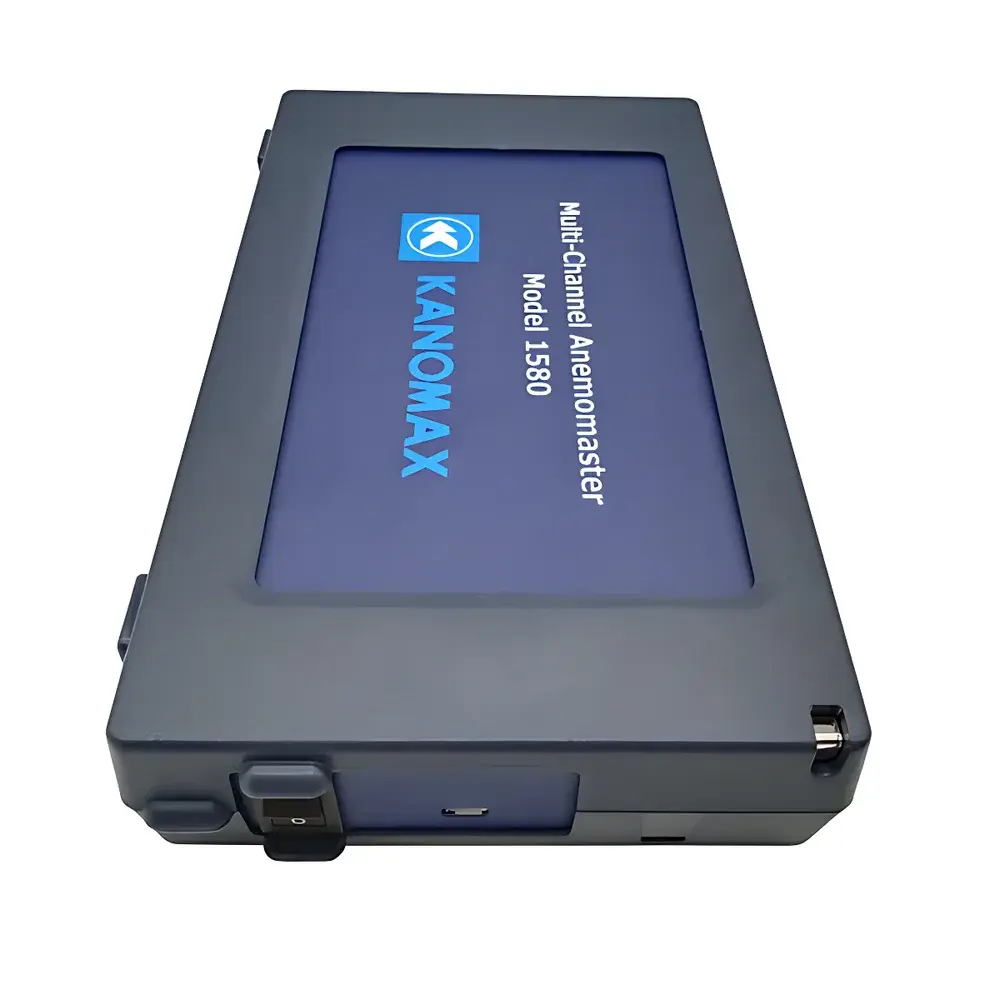
KANOMAX Multi-Point Environmental Monitoring System Model 1580-0C
| Brand | KANOMAX |
|---|---|
| Origin | Liaoning, China |
| Model | 1580-0C |
| Instrument Type | Thermal Anemometer |
| Resolution | 0.01 m/s |
| Measurement Range | 0.01–50.0 m/s |
| Accuracy | ±2% of reading or ±0.02 m/s (whichever is greater) |
| Operating Temperature | 5–40 °C |
| Operating Humidity | 0–85% RH (non-condensing) |
| Weight | 0.6 kg |
| Dimensions | 220 × 130 × 40 mm (W × D × H) |
| Power Supply | AC 100–240 V / DC 12–24 V |
| Communication | USB Micro-B, RS-485 serial interface |
Overview
The KANOMAX Multi-Point Environmental Monitoring System Model 1580-0C is a compact, modular, 12-channel data acquisition platform engineered for simultaneous, high-fidelity measurement of air velocity, temperature, and relative humidity across distributed locations. Built upon thermal anemometry principles—where convective heat transfer from a heated sensor element correlates directly with local airflow velocity—the system delivers traceable, low-range sensitivity down to 0.01 m/s, making it suitable for HVAC commissioning, cleanroom qualification, laminar flow validation, and environmental chamber mapping. Its architecture supports real-time synchronization of up to 12 independent probes—each individually calibrated and temperature-compensated—enabling spatially resolved profiling without channel crosstalk or timing drift. The system’s lightweight chassis (0.6 kg), dual power flexibility (AC/DC), and plug-and-play connectivity support both stationary lab deployment and mobile applications including vehicle-mounted duct surveys and field-based ventilation audits.
Key Features
- 12-channel synchronized acquisition with hot-wire and hot-film probe compatibility
- Modular probe ecosystem: 15 interchangeable probe models—including directional and omnidirectional variants—with operating ranges spanning 0.01–50.0 m/s and temperature tolerances up to 120 °C
- Industry-leading miniaturized probe form factor (e.g., Model 0976-03/04/07), enabling installation in confined geometries such as micro-diffusers, filter housings, and semiconductor tool inlets
- Integrated temperature compensation across all velocity probes ensures stability under ambient thermal gradients (5–40 °C operational range)
- Dual communication interface: USB Micro-B for direct PC connection and RS-485 serial bus for daisy-chained multi-unit expansion
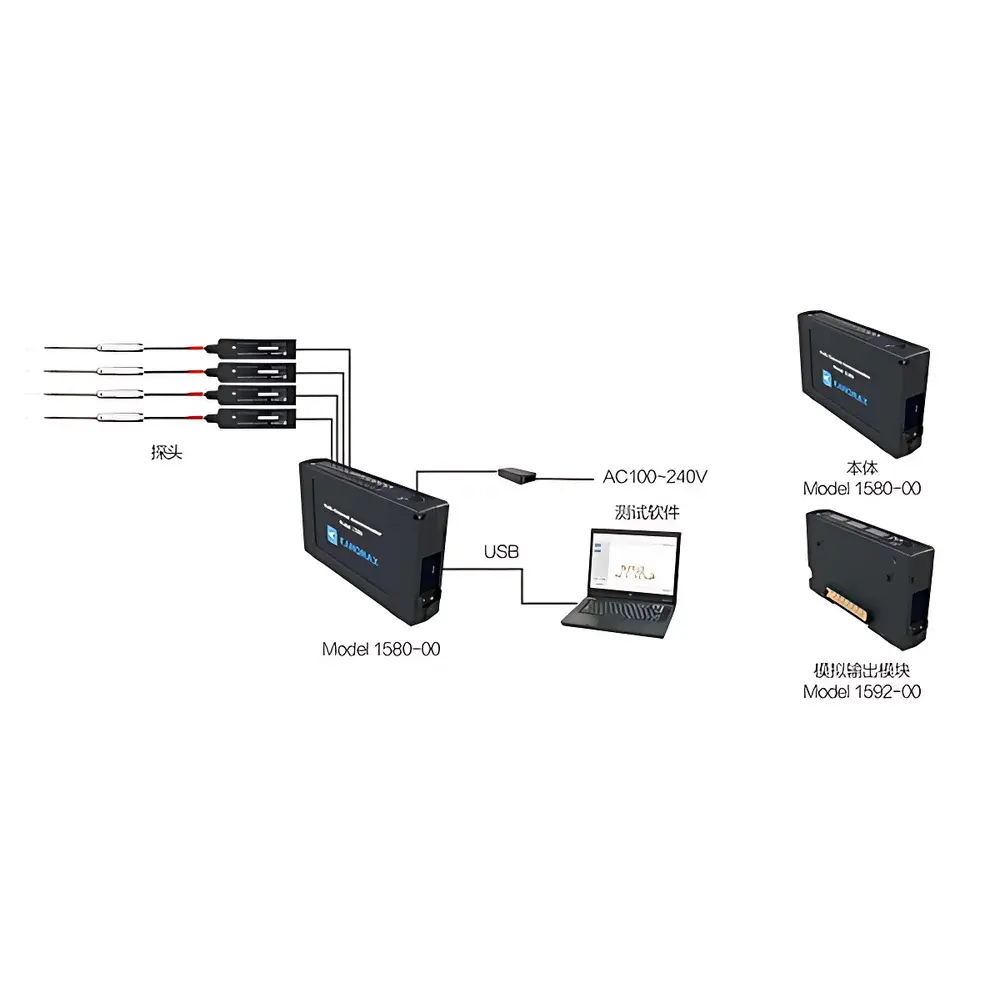
- Configurable analog output via optional Model 1592-0C module (12-channel per unit), supporting 0–5 V (1 kΩ load) or 4–20 mA (250 Ω load) per channel with user-defined scaling
- Scalable architecture: Up to 12 Model 1592-0C modules may be connected to a single Model 1580-0C host, enabling up to 144 velocity, 72 velocity+temperature, or 36 velocity+temperature+RH channels
Sample Compatibility & Compliance
The Model 1580-0C accommodates heterogeneous probe configurations within a single acquisition cycle—e.g., mixing high-sensitivity low-velocity probes (0975-00, response time ≤3 s at 1 m/s) with high-temperature variants (0976-13/14/17, rated to 120 °C) and combined velocity/temperature/humidity probes (0975-31). All probes conform to ISO 7726:2001 (Ergonomics of the thermal environment – Instruments for measuring physical quantities) for air velocity instrumentation accuracy and response characteristics. While not certified to IEC 61000-6-3 (EMC emission) or UL 61010-1 out-of-the-box, the system meets CE marking requirements for electromagnetic compatibility when used with supplied AC adapters and shielded cabling. Data integrity aligns with GLP/GMP documentation practices through timestamped metadata embedding, probe-specific calibration ID logging, and audit-ready export formats.
Software & Data Management
KANOMAX-supplied Windows 10-compatible software provides native bilingual (English/Japanese) and trilingual (Chinese optional) UI support. It enables real-time visualization of all active channels via synchronized time-series plots, statistical overlays (min/mean/max), and dynamic threshold alarms. Each probe’s serial number, calibration date, and configuration parameters (e.g., velocity range, temperature offset, RH compensation curve) are stored in the system database and automatically applied during session initialization. Raw data streams are logged at user-selectable intervals (100 ms–60 s) and exported natively to CSV or Excel (.xlsx) with embedded metadata headers. The software supports automated report generation compliant with ISO 14644-3 Annex B (cleanroom airflow uniformity testing) and ASHRAE Guideline 12-2020 (HVAC infection control verification protocols).
Applications
- HVAC system balancing and duct traverse validation per ANSI/ASHRAE Standard 111
- Cleanroom ISO Class 5–8 airflow uniformity mapping and turbulence assessment
- Pharmaceutical facility environmental monitoring (Grade A/B/C/D zones) per EU GMP Annex 1
- Automotive cabin airflow characterization and thermal comfort studies
- Validation of fume hood face velocity, biosafety cabinet inflow, and laminar flow workstations
- Environmental chamber temperature/velocity/humidity correlation analysis
- Research-grade boundary layer investigations in wind tunnels and aerodynamic test rigs
FAQ
What is the maximum number of probes supported per Model 1580-0C unit?
A single Model 1580-0C host supports up to 12 probes simultaneously via its integrated 12-channel input bay.
Can the system operate continuously in environments above 40 °C?
The host unit is rated for 5–40 °C operation; however, high-temperature probe models (e.g., 0976-13/14/17) extend measurement capability to 120 °C ambient—provided the host remains within its specified thermal envelope via remote mounting or thermal shielding.
Is FDA 21 CFR Part 11 compliance supported?
The software includes electronic signature prompts, user access levels, and audit trail logging (session start/end, parameter changes, export events); full Part 11 compliance requires site-specific validation protocol execution and integration with enterprise identity management systems.
How is probe calibration traceability maintained?
Each probe carries a unique serial number linked to its NIST-traceable calibration certificate; calibration coefficients and expiration dates are embedded in firmware and imported automatically into the software upon probe connection.
Does the system support third-party SCADA or PLC integration?
Yes—via the RS-485 serial interface using Modbus RTU protocol (addressable slave mode), enabling direct integration with industrial automation platforms without intermediary gateways.







