
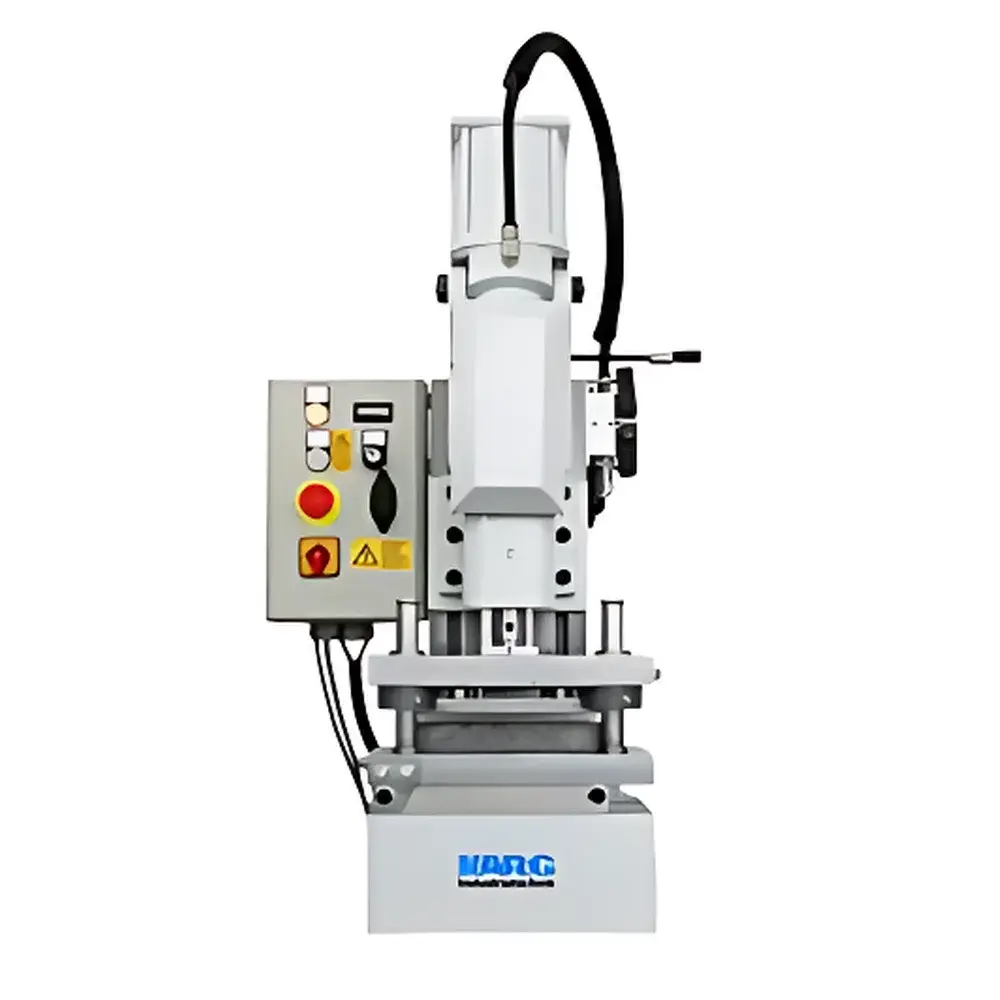
Karg MPS 75 / MPS 150 Manual Notched Specimen Punching Machine
| Brand | Karg |
|---|---|
| Origin | Germany |
| Model | MPS 75 / MPS 150 |
| Max Punching Force | 7,500 N (MPS 75) / 15,000 N (MPS 150) |
| Max Stroke | 40 mm |
| Table Dimensions | 250 × 150 mm |
| Weight | 50 kg |
| Footprint (W×D) | 250 × 240 mm (MPS 75) / 250 × 300 mm (MPS 150) |
| Operation | Lever-Actuated or Pneumatic Option Available |
| Compliance | Configurable for ISO 179, ISO 180, ASTM D6110, ASTM D5041, ISO 13802 Notch Geometries |
Overview
The Karg MPS 75 and MPS 150 are precision-engineered manual notched specimen punching machines designed for repeatable, standardized sample preparation in mechanical testing laboratories. These instruments operate on a robust lever-based mechanical advantage principle—optionally upgradable to pneumatic actuation—to deliver consistent, high-force punching without reliance on electrical power or complex control systems. Engineered for compliance with international material testing standards—including ISO 179 (Charpy impact), ISO 180 (Izod impact), ASTM D6110 (tensile impact), ASTM D5041 (notched tensile strength), and ISO 13802 (reference specimen geometry)—the MPS series enables laboratories to produce geometrically accurate notches in thermoplastics, elastomers, composites, and semi-rigid polymer sheets. Each unit features a rigid cast-iron frame, precision-ground table surface, and modular die-mounting interface compatible with standardized DIN/ISO/ASTM cutting dies—ensuring traceability, inter-laboratory comparability, and full alignment with GLP and ISO/IEC 17025 quality management requirements.
Key Features
- Lever-actuated mechanical design ensures high reproducibility and eliminates variability introduced by operator fatigue or inconsistent hand force
- Modular die interface accepts interchangeable notching dies—available with or without ejector pins—for standardized geometries per ISO 179-1, ISO 180-1, ASTM D6110 Type A/B/C, and custom specifications
- Two force-class variants: MPS 75 delivers up to 7,500 N nominal punching force; MPS 150 extends capability to 15,000 N for thicker or higher-modulus specimens (e.g., fiber-reinforced thermoplastics)
- Maximum stroke of 40 mm accommodates multi-layer stacks and thick-section materials while maintaining die alignment and shear integrity
- Stable 250 × 150 mm anodized aluminum table with T-slot configuration enables secure clamping of fixtures, alignment jigs, or auxiliary guides
- Compact footprint (250 × 240 mm for MPS 75; 250 × 300 mm for MPS 150) and 50 kg mass ensure benchtop stability without floor anchoring
- Pneumatic upgrade option available for high-throughput environments—integrated with standard industrial air supply (4–6 bar) and equipped with pressure-regulated foot pedal control
Sample Compatibility & Compliance
The MPS series is validated for use with soft to semi-rigid polymeric materials including ABS, PC, PP, PE, PVC, PMMA, and rubber compounds—typically in sheet form ranging from 1 mm to 12 mm thickness. Notch geometry fidelity is maintained across material hardness values from Shore A 30 to Shore D 85. All standard dies comply with dimensional tolerances specified in ISO 2818 (machining of test specimens) and ISO 13802 (reference dimensions for notched bars). Die sets are supplied with calibration certificates referencing traceable metrology (e.g., certified CMM measurement reports), supporting audit readiness under ISO/IEC 17025 Clause 6.4 and FDA 21 CFR Part 11 when paired with documented SOPs and equipment logs.
Software & Data Management
As a fully mechanical, non-electronic instrument, the MPS 75/MPS 150 requires no embedded firmware, drivers, or proprietary software. This architecture eliminates cybersecurity concerns, firmware obsolescence, and validation overhead associated with computer-controlled systems. All operational parameters—including punch force, stroke depth, die type, and specimen batch ID—are recorded manually in laboratory notebooks or integrated into LIMS via structured templates. For labs implementing electronic records, the device supports integration through external digital loggers (e.g., barcode-scanned die IDs, timestamped photo documentation, or connected load-cell verification units—sold separately). Full traceability is achieved using Karg’s optional Die Identification Kit, which assigns unique engraved serial numbers to each die set aligned with internal asset management protocols.
Applications
- Preparation of notched specimens for Charpy and Izod impact testing per ISO 179-1/ISO 180-1
- Generation of ASTM D5041-compliant notched tensile bars for fracture toughness evaluation
- Routine quality control in polymer compounding and extrusion facilities requiring rapid, in-line specimen conditioning
- Academic research labs conducting comparative mechanical property studies across polymer families
- Third-party testing laboratories accredited to ISO/IEC 17025 seeking low-maintenance, standards-aligned sample prep instrumentation
- Regulatory submission support for medical device polymer characterization (e.g., ISO 10993-12 extractables testing where notched extraction vessels are required)
FAQ
Can the MPS 75/MPS 150 be used with non-standard or custom notch geometries?
Yes—Karg offers custom die design and manufacturing services based on client-provided CAD drawings or physical master samples, subject to minimum order quantities and dimensional feasibility review.
Is die calibration required before first use?
Each die set ships with a dimensional verification report; annual recalibration is recommended and supported by Karg-certified metrology partners in EMEA, North America, and APAC regions.
Does the machine require electrical power or compressed air by default?
No—the base configuration is purely mechanical and lever-operated; pneumatic actuation is an optional field-upgrade kit.
What maintenance is required for long-term accuracy?
Monthly inspection of lever pivot wear, quarterly lubrication of guide rails with ISO VG 68 mineral oil, and annual torque verification of die-mounting screws per Karg Technical Bulletin TB-MPS-02.
Are replacement parts and dies available globally?
Yes—Karg maintains a centralized spare parts warehouse in Stuttgart, with standard dies and consumables stocked by authorized distributors in over 42 countries; lead time for custom dies averages 6–8 weeks.



