
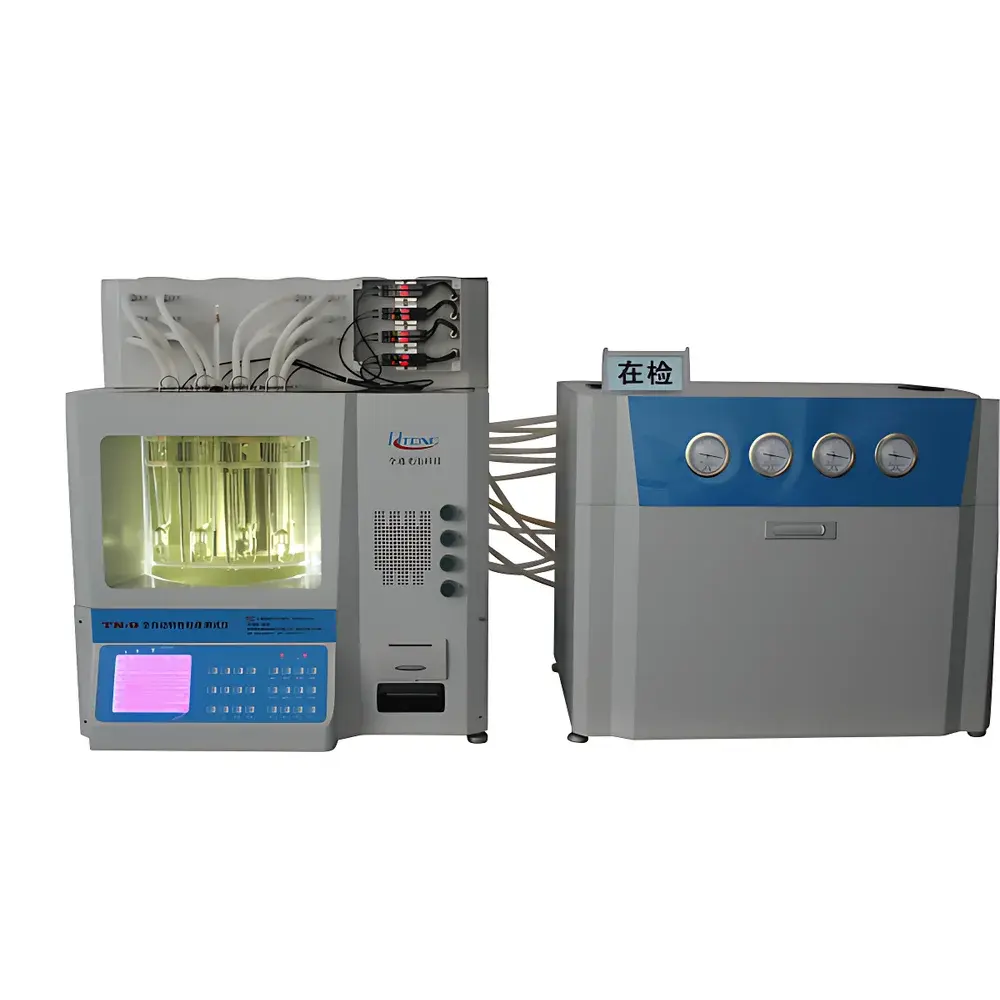
Karrie EKN-9 Automated Intrinsic Viscosity Tester for PET Chips
| Brand | Karrie |
|---|---|
| Model | EKN-9 |
| Application | Intrinsic Viscosity Measurement of Polyethylene Terephthalate (PET) Chips |
| Measurement Principle | Capillary Viscometry (Ubbelohde-type) |
| Temperature Control Range | 0–120 °C |
| Temperature Stability | ±0.01 °C |
| Timing Resolution | 0.01 s (max 999.99 s) |
| Capillary Diameter | 0.88 mm (standard), optional 0.53 mm |
| Intrinsic Viscosity Range | 0.1–4.0 dL/g |
| Repeatability | ≤±0.004 dL/g |
| Reproducibility | ≤±0.007 dL/g |
| Sample Units | 4 independent test cells |
| Compliance | GB/T 17931–2003, JJG 155–1991 |
| Interface | RS-232 |
| Power | 2000 W |
| Dimensions (Upper Frame) | 704 × 589 × 825 mm |
| Weight | 150 kg |
Overview
The Karrie EKN-9 Automated Intrinsic Viscosity Tester is a dedicated capillary viscometer engineered for precise, high-throughput intrinsic viscosity (IV) determination of polyethylene terephthalate (PET) chips—specifically bottle-grade and fiber-grade materials. It implements Ubbelohde-type capillary viscometry in strict accordance with GB/T 17931–2003, the Chinese national standard equivalent to ISO 1628-5 for PET solution viscosity measurement. The instrument operates on dilute solution principle: PET samples are dissolved in phenol/1,1,2,2-tetrachloroethane (or alternative solvent systems per ASTM D4603), and flow time through a calibrated capillary under gravity is measured at tightly controlled temperature. Intrinsic viscosity is calculated via the Huggins or Schulz–Blaschke equation using efflux times, concentration, and instrument-specific calibration constants. Unlike manual or semi-automated systems, the EKN-9 eliminates operator-dependent variables—including thermal drift during equilibration, inconsistent meniscus detection, and mechanical handling errors—by integrating microprocessor-controlled thermostatic regulation, optical fiber-based meniscus sensing, and fully sequenced fluidic actuation.
Key Features
- Four independent Ubbelohde capillary test units operating simultaneously or individually, enabling parallel analysis of up to four PET chip samples per cycle without cross-contamination.
- High-stability temperature control system with ±0.01 °C accuracy across 0–120 °C range; utilizes non-volatile memory for permanent storage of temperature compensation coefficients, eliminating repeated recalibration.
- Fiber-optic meniscus detection system replacing legacy photodiode sensors—achieving sub-20 ms timing repeatability over five consecutive runs (≤0.02 s deviation).
- Integrated vacuum-assisted cleaning and hot-air drying subsystem: precisely metered solvent delivery, programmable rinse cycles, and uniform thermal drying prevent capillary clogging and residue carryover.
- Dual-frame mechanical architecture isolates the vacuum pump from the measurement module, minimizing vibration-induced timing noise and ensuring long-term stability of efflux time acquisition.
- Onboard data management: stores up to 800 complete test records including raw efflux times, calculated IV values, polymer average molecular weight (via Mark–Houwink relationship), and processing metadata (temperature setpoint, dwell time, solvent batch ID).
- RS-232 serial interface compliant with standard SCPI command syntax, supporting bidirectional communication with LIMS or laboratory PCs for automated data export, remote parameter configuration, and audit-trail generation.
Sample Compatibility & Compliance
The EKN-9 is validated exclusively for PET-based synthetic polymers dissolved in high-boiling-point solvents compatible with Ubbelohde geometry—primarily phenol/1,1,2,2-tetrachloroethane (60/40 w/w) per GB/T 17931–2003. It accommodates standard capillary dimensions (0.88 mm nominal bore; optional 0.53 mm for higher-viscosity solutions) certified to JJG 155–1991 metrological specifications. While optimized for bottle-grade PET chips (typical IV range: 0.5–1.5 dL/g), the system supports extended range testing (0.1–4.0 dL/g) relevant to recycled PET feedstock or specialty copolymer formulations. All temperature, timing, and fluidic operations meet traceability requirements for GLP-compliant laboratories; optional PC-based software provides electronic signatures, user access logs, and 21 CFR Part 11–ready audit trails when deployed with validated configurations.
Software & Data Management
The embedded firmware implements deterministic real-time scheduling for all critical operations: temperature stabilization monitoring, solvent aspiration sequencing, meniscus transit timing, and post-test conditioning. Raw efflux time data are stored with timestamp, sensor status flags, and environmental parameters (ambient pressure, humidity). Optional Windows-based host software enables full method definition—including solvent selection, concentration input, Mark–Houwink constants (K = 7.2 × 10⁻³, a = 0.69 for PET in phenol/TCE), and pass/fail criteria. Export formats include CSV, PDF reports with embedded calibration certificates, and XML-compatible structured logs suitable for integration into enterprise quality management systems (QMS). All stored parameters—including temperature setpoints, rinse/dry cycle counts, and error thresholds—are retained after power loss via EEPROM-backed memory.
Applications
- Quality control of PET resin batches prior to bottle preform extrusion, ensuring consistency in melt strength and stretch-blow molding performance.
- In-process monitoring during solid-state polymerization (SSP) lines to track molecular weight build-up and optimize residence time.
- Technical service support for PET recyclers evaluating IV degradation after multiple extrusion passes or thermal history exposure.
- R&D laboratories developing PET copolymers (e.g., PTT, PEN) requiring comparative IV assessment under standardized dissolution protocols.
- Contract testing labs serving packaging OEMs needing ISO/IEC 17025–accredited IV reporting with full uncertainty budgeting (Type A/B components derived from repeatability/reproducibility studies).
FAQ
Does the EKN-9 comply with international standards beyond GB/T 17931?
Yes—the capillary geometry, timing methodology, and temperature control specifications align with ISO 1628-5 and ASTM D4603. Validation documentation includes cross-referenced uncertainty budgets traceable to NIM (China National Institute of Metrology) certified reference materials.
Can the instrument be used for polymers other than PET?
It is specifically designed and factory-validated for PET. Use with other polymers (e.g., nylon, polycarbonate) requires full revalidation of solvent compatibility, capillary calibration, and Mark–Houwink parameters—and is not covered under warranty or regulatory support.
What maintenance intervals are recommended for sustained accuracy?
Capillaries require quarterly verification against NIST-traceable calibration fluids; temperature sensors should be checked annually using a certified PRT reference probe; optical path alignment is verified during each preventive maintenance visit (recommended every 12 months).
Is remote diagnostics supported?
The RS-232 interface allows basic status polling and error code retrieval. Full remote troubleshooting requires optional Ethernet-to-serial gateway hardware and licensed diagnostic software modules.
How is data integrity ensured during power interruption?
All operational parameters, calibration coefficients, and test records are written to non-volatile memory before each step completes. Unfinished tests auto-resume from last stable state upon reboot, preserving intermediate timing data and solvent usage logs.





