
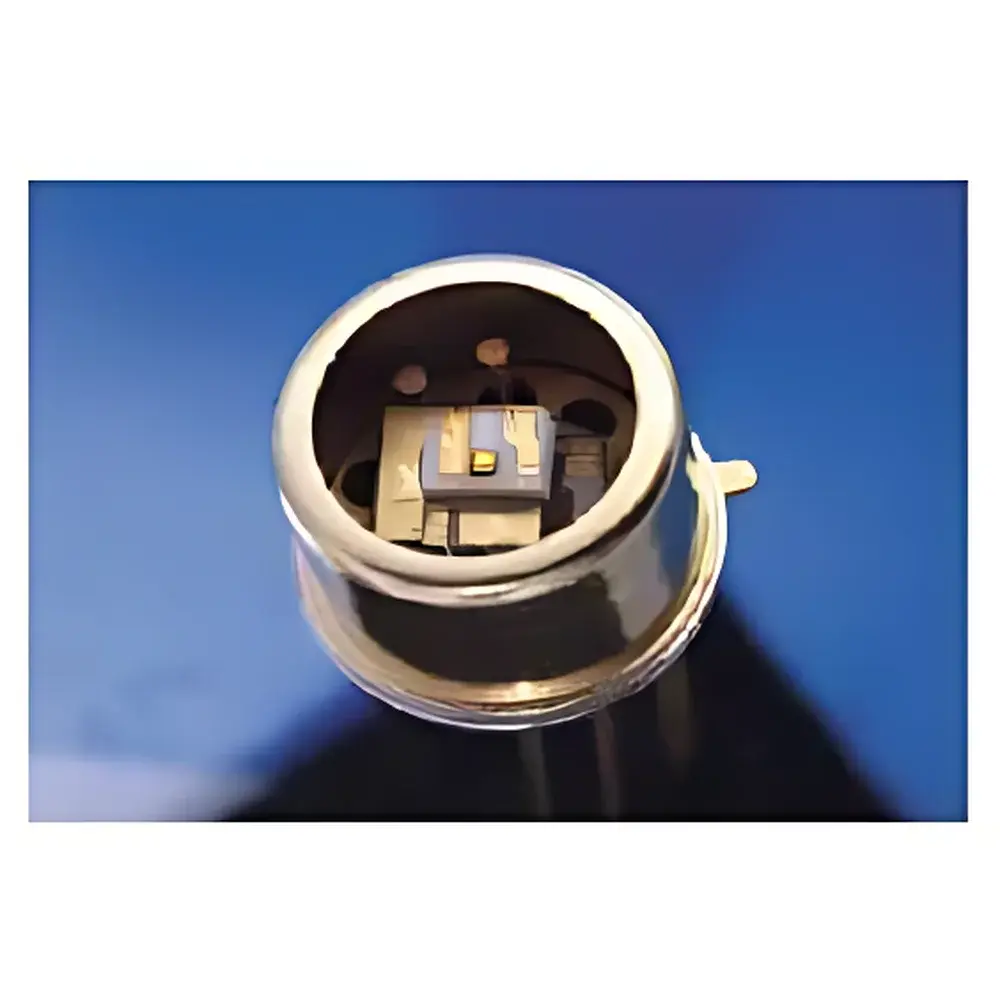
VCSEL Laser Diode Module – 795 nm, Single-Mode, TEC-Stabilized, TO-5 Package
| Origin | USA |
|---|---|
| Manufacturer Type | Authorized Distributor |
| Origin Category | Imported |
| Model | 795 VCSEL |
| Pricing | Available Upon Request |
| Wavelength Options | 759, 763, 780, 795, 808, 810, 840, 850, 852, 860, 945, 948, 980 nm |
| Output Power Options | 5, 6, 12, 24, 100 mW |
| Operating Temperature Range | 0–50 °C (uncooled) |
| TEC-controlled range | −10 to +70 °C |
| Mode | Single-mode & multimode variants available |
| Package Types | TO-5 can (with integrated TEC and thermistor), TO-46, TO-56, SMD, E2000, SMA, bare die |
Overview
The VCSEL Laser Diode Module – 795 nm is a high-stability, single-mode vertical-cavity surface-emitting laser designed for precision gas sensing applications requiring narrow-linewidth, wavelength-tunable near-infrared (NIR) sources. Unlike edge-emitting lasers, VCSELs employ a monolithic resonant cavity formed by distributed Bragg reflectors (DBRs) above and below the active quantum well region, enabling low threshold current (< 1 mA typical), high wall-plug efficiency, circular beam profile, and intrinsic wavelength stability. This 795 nm variant operates within the oxygen A-band absorption region and is widely deployed in tunable diode laser absorption spectroscopy (TDLAS) systems for trace gas detection—including O2, H2O, CO, CH4, and NH3. The module integrates a thermoelectric cooler (TEC), NTC thermistor, and hermetic TO-5 package to maintain wavelength accuracy better than ±0.01 nm over extended operational periods—critical for compliance with ISO 14064-1 (greenhouse gas quantification) and ASTM D6522 (ambient air monitoring) protocols.
Key Features
- Single-mode emission at 795 nm with spectral linewidth < 10 MHz (FWHM), optimized for high-resolution TDLAS
- Integrated TEC and 10 kΩ NTC thermistor enabling closed-loop temperature control (±0.02 °C stability) and precise wavelength tuning via current/temperature co-sweep
- Low threshold current (typically 0.8–1.2 mA) and power consumption (< 1.5 W at 100 mW output), suitable for battery-powered field instruments
- Hermetically sealed TO-5 package with gold-plated copper base, anti-reflection coated window, and built-in guard ring for electrostatic discharge (ESD) protection (IEC 61000-4-2 Level 4 compliant)
- Multiple packaging options including fiber-pigtailed E2000 and SMA connectors for direct integration into optical gas cells or multipass absorption cells
- Full characterization data provided per device: L-I-V curves, spectral maps, mode-hop-free tuning ranges, and thermal transient response up to 10 kHz modulation bandwidth
Sample Compatibility & Compliance
This VCSEL module is engineered for compatibility with standard 10–20 cm path-length Herriott-type or White-cell gas cells, as well as miniature photonic integrated circuits (PICs) using silicon nitride or silica-on-silicon waveguides. It meets RoHS 3 (2015/863/EU) and REACH SVHC requirements. For regulated environments—including EPA Method TO-14A-compliant ambient air analyzers and FDA-cleared medical breath analyzers—the device supports audit-ready documentation packages aligned with ISO 9001:2015 manufacturing controls and GLP-compliant calibration traceability to NIST SRM 2034 (laser wavelength standards). All units undergo 100% burn-in testing at 50 °C for 240 hours prior to shipment.
Software & Data Management
Each module ships with a vendor-agnostic ASCII-based configuration file (.cfg) containing calibrated lookup tables for wavelength vs. drive current (at fixed TEC setpoints) and wavelength vs. TEC temperature (at fixed bias current). These tables are directly importable into LabVIEW, MATLAB, Python (via PyVISA), or custom C++ instrument control frameworks. Optional firmware-enabled digital control interface (I²C or SPI) supports real-time feedback of thermistor resistance, TEC voltage/current, and photodiode monitor output—enabling full 21 CFR Part 11-compliant electronic records when paired with validated data acquisition software. Firmware revision history and calibration certificate serial numbers are embedded in on-device EEPROM.
Applications
- Tunable Diode Laser Absorption Spectroscopy (TDLAS) for industrial stack emissions monitoring (EPA PS-15, EN 15267-3)
- Medical breath analysis systems targeting NO (nitric oxide) biomarkers at 795 nm for asthma management
- High-precision oxygen concentration measurement in combustion control and inerting systems
- Multi-gas sensor platforms leveraging wavelength-division multiplexing (WDM) with adjacent VCSELs (e.g., 780 nm + 795 nm + 852 nm)
- Calibration sources for NIR spectrophotometers and FTIR reference modules (NIST-traceable line positions)
- Free-space optical communications in secure short-range links (IEEE 802.15.7r1)
FAQ
What is the maximum modulation bandwidth supported by this VCSEL?
The 795 nm single-mode VCSEL achieves > 8 GHz small-signal modulation bandwidth under optimized RF impedance matching; practical system-level bandwidth is typically limited by driver electronics and thermal response—recommended for DC–500 MHz analog current modulation or digital NRZ/OOK up to 2.5 Gbps.
Is wavelength calibration traceable to NIST standards?
Yes. Each unit includes a Certificate of Calibration referencing NIST Standard Reference Material 2034, with uncertainty ±0.003 nm (k = 2) measured using a High-Finesse WS7 wavemeter traceable to NIST.
Can this VCSEL operate in pulsed mode for time-resolved spectroscopy?
Yes. With appropriate current pulsing circuitry (rise/fall time 50,000 hours at 25 °C case temperature.
Are custom wavelengths outside the listed options available?
Custom wavelengths between 750 nm and 1000 nm are available under NRE-supported development contracts, subject to epitaxial wafer qualification and minimum order quantities of 500 units.
Does the TO-5 package include a monitor photodiode?
Yes. All TO-5 variants integrate a rear-facet PIN photodiode with responsivity ≥ 0.7 A/W at 795 nm, calibrated to ±3% absolute accuracy, enabling real-time power stabilization loops.



