
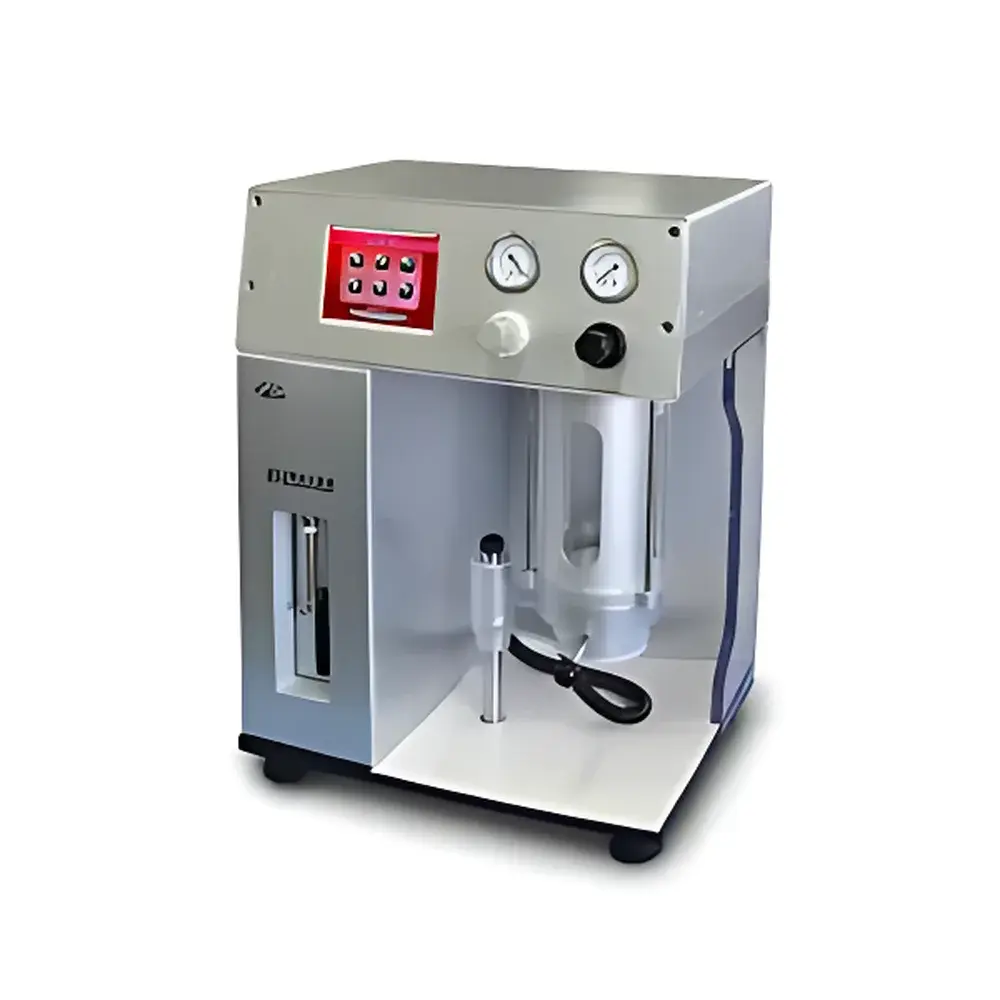
Karrie KT-2A Desktop Optical Particle Counter
| Brand | Karrie |
|---|---|
| Model | KT-2A |
| Instrument Type | Optical Particle Counter (Light Obscuration Principle) |
| Origin | Guangdong, China |
| Particle Size Range | 1–400 µm |
| Sensitivity | 1 µm (per ISO 4402) or 4 µm(c) (per GB/T 18854 & ISO 11171) |
| Detection Channels | Up to 9900 user-definable size bins |
| Sample Volume | 0.2–100 mL (±0.5% accuracy) |
| Flow Rate | 5–80 mL/min |
| Max Viscosity | 650 cSt |
| Max Vacuum | 0.08 MPa |
| Max Pressure | 1 MPa |
| Temperature Range | 0–80 °C (sample) |
| Resolution | <10% (per GB/T 18854-2002 & ISO 11171) |
| Coincidence Limit | 12,000 particles/mL (5% coincidence error) |
| Repeatability | RSD < 2% |
| Accuracy | ±10% |
| Compliance Standards | GB/T 18854-2002, ISO 11171:1999, ISO 4406, NAS 1638, SAE AS749D, GJB 420A/B, GB/T 14039 |
| Display | 5.6″ color TFT touchscreen |
| Data Output | On-screen display, thermal printer, RS232 interface |
| Power Supply | 100–245 VAC, 49–62 Hz |
Overview
The Karrie KT-2A Desktop Optical Particle Counter is a precision-engineered instrument designed for quantitative analysis of insoluble particulate contamination in liquid media using the light obscuration (LO) principle—also known as the optical blockage or photometric shadowing method. In this technique, particles suspended in a liquid stream pass through a focused laser beam; each particle generates a transient reduction in transmitted light intensity proportional to its cross-sectional area. The magnitude and frequency of these pulses are converted into particle size distribution and concentration data in real time. The KT-2A complies fully with GB/T 18854-2002 (equivalent to ISO 11171:1999), ensuring metrological traceability to internationally recognized calibration protocols using certified reference materials such as NIST-traceable latex spheres, ACFTD, ISO MTD, and ROST standards. Its architecture supports rigorous quality control workflows in regulated environments where particle contamination directly impacts system reliability—particularly in hydraulic, lubrication, and dielectric fluid applications across aerospace, power generation, marine, and heavy industrial sectors.
Key Features
- High-fidelity light obscuration detection enabled by a stable semiconductor laser source and optimized flow cell geometry, delivering sub-micron sensitivity (1 µm per ISO 4402; 4 µm(c) per ISO 11171).
- Precision syringe-based sampling system ensures constant volumetric delivery with ≤±0.5% volume accuracy across 0.2–100 mL ranges, minimizing aspiration-induced variability.
- Dual-mode sample chamber supporting both vacuum-assisted degassing (up to 0.08 MPa) and positive-pressure forcing (up to 1 MPa), enabling reliable analysis of viscous fluids up to 650 cSt and volatile or air-saturated samples.
- Configurable detection channels: up to 9900 programmable size bins within the 1–400 µm range, allowing granular resolution for custom particle classification schemes beyond standard binning.
- Multi-standard compliance engine with embedded grading tables for ISO 4406, NAS 1638, SAE AS749D, GJB 420A/B, and GB/T 14039—plus two user-defined channel sets for proprietary specifications.
- Integrated thermal printer with Chinese character support (via built-in input method), enabling on-site generation of auditable, timestamped reports compliant with internal QA documentation requirements.
- Four independent calibration curve storage slots (latex sphere, ACFTD, ISO MTD, ROST), facilitating rapid switching between calibration matrices without manual recalibration or software reconfiguration.
- Robust data management architecture featuring local non-volatile memory for ≥10,000 test records, full audit trail logging, and RS232 serial communication for integration into LIMS or centralized QC databases.
Sample Compatibility & Compliance
The KT-2A is validated for use with a broad spectrum of industrially relevant liquids, including mineral- and synthetic-based hydraulic oils, turbine oils, transformer (insulating) oils, gear oils, engine oils, aviation kerosene (Jet A-1), water-glycol and phosphate ester fire-resistant fluids, polymer solutions, and organic solvents. It accommodates temperature-controlled sampling from 0 °C to 80 °C and tolerates ambient operating conditions from 0 °C to 60 °C. All measurement procedures align with ISO/IEC 17025 principles for testing laboratories, and raw data output—including pulse histograms, cumulative counts, and differential distributions—supports GLP/GMP-compliant review. The instrument’s firmware enforces strict adherence to ISO 11171’s flow rate stability, sensor alignment, and coincidence correction algorithms, ensuring results are defensible during regulatory audits (e.g., FAA AC 20-152B, MIL-STD-1246C, or IEC 60296 Annex D).
Software & Data Management
Data acquisition, visualization, and reporting are managed via an embedded real-time OS with a responsive 5.6″ capacitive touchscreen interface. The system logs every test with metadata including date/time stamp, operator ID (optional), sample ID, viscosity-adjusted flow rate, calibration curve ID, and environmental parameters. Export formats include CSV and proprietary binary archives compatible with Karrie’s PC-based analysis suite (supplied separately), which provides advanced statistical tools—such as trend analysis over time, batch comparison heatmaps, and ISO cleanliness code mapping. RS232 connectivity enables remote command execution (e.g., start/stop, parameter recall) and automated report push to network drives or enterprise SQL databases. Audit trails record all configuration changes, calibration events, and user logins—meeting FDA 21 CFR Part 11 requirements when deployed with appropriate access controls and electronic signature protocols.
Applications
The KT-2A serves as a primary tool for condition monitoring and contamination control in mission-critical fluid systems. In aerospace maintenance facilities, it verifies hydraulic fluid cleanliness prior to aircraft acceptance per SAE AS4059F. Power utilities employ it for routine transformer oil assessment against IEC 60429 and IEEE C57.104 thresholds. Marine engine OEMs use its high-viscosity capability to screen cylinder lubricants under ASTM D7619. In pharmaceutical manufacturing, it supports USP and particulate matter testing for non-aqueous injectables and ophthalmic solutions when paired with appropriate filtration and dilution protocols. Its modular design also supports R&D applications requiring high-resolution particle profiling—such as catalyst slurry characterization, nanomaterial dispersion stability studies, or wear debris morphology correlation in tribology research.
FAQ
What calibration standards are supported, and how often must recalibration be performed?
The KT-2A stores four factory-certified calibration curves (NIST-traceable latex spheres, ACFTD, ISO MTD, ROST) and supports user-generated curves. Annual recalibration against ISO 11171 reference materials is recommended; interim verification using control samples is advised before each analytical session.
Can the KT-2A analyze aqueous samples such as coolant or deionized water?
Yes—provided the sample is pre-filtered to remove macroscopic debris and degassed to minimize bubble interference. For ultrapure water applications, optional low-conductivity tubing and inert wetted materials are available.
Is the instrument suitable for Good Manufacturing Practice (GMP) environments?
When configured with password-protected user roles, electronic signatures, and full audit trail export, the KT-2A meets core GMP data integrity requirements per Annex 11 and ALCOA+ principles.
How does the system handle particle coincidence at high concentrations?
The KT-2A applies dynamic coincidence correction based on pulse width and amplitude deconvolution, validated up to 12,000 particles/mL at 5% error threshold per GB/T 18854-2002.
Does the device support external automation or PLC integration?
RS232 command protocol documentation is provided for integration with SCADA systems or automated sampling stations; analog I/O modules (0–10 V / 4–20 mA) are available as optional accessories.
Related Products



