
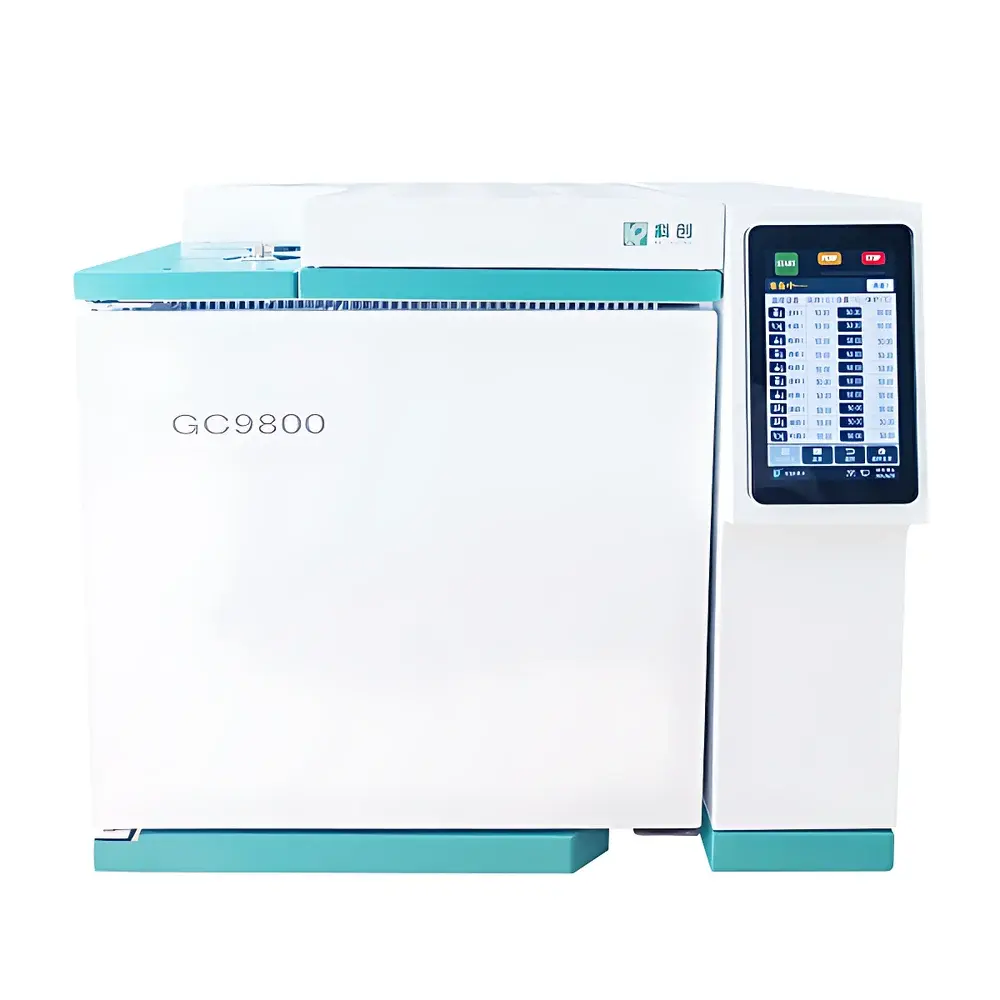
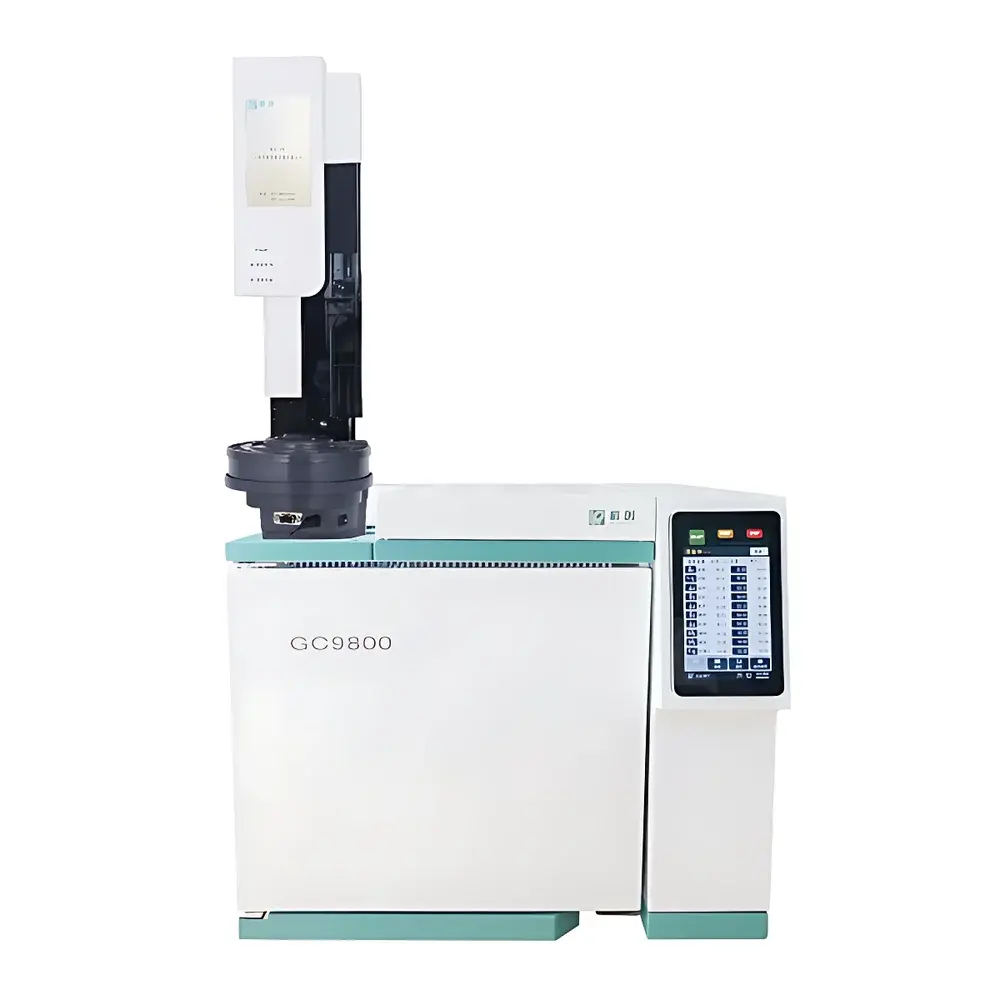
Ke Chuang GC9800N Gas Chromatograph for Baijiu (Chinese Liquor) Analysis
| Brand | Ke Chuang |
|---|---|
| Origin | Shanghai, China |
| Manufacturer Type | OEM Manufacturer |
| Instrument Type | Laboratory Gas Chromatograph |
| Models | GC2002, GC9800N, GC9800G |
| Price Range | USD 5,600–7,200 (FOB Shanghai) |
| Temperature Control Range | Ambient + 8 °C to 400 °C |
| Ramp Rate | 0.1–40 °C/min |
| Cooling Rate | 400 °C → 50 °C in ≤4 min |
| Carrier Gas Flow Range | 0–100 mL/min |
| Carrier Gas Pressure Range | 0–250 kPa |
| Injector Max Temp | 300 °C |
| Injector Pressure Setpoint Range | 0–250 kPa |
| Injector Total Flow Setpoint Range | 0–1200 mL/min |
| Detector Options | TCD, FID, ECD, FPD |
| Column Oven Programmable Stages | Up to 16 (expandable to unlimited) |
| EPC/EFC Precision | ±0.001 psi (pressure), ±0.001 mL/min (flow) |
| Retention Time RSD | <0.008% |
| Peak Area RSD | <1.0% |
| Dimensions (W×D×H) | 530 × 570 × 506 mm |
| Weight | ≤50 kg |
| Power | 220 V ±10%, 50 Hz ±5%, ≤3000 W |
Overview
The Ke Chuang GC9800N Gas Chromatograph is a dedicated analytical platform engineered for high-precision volatile compound profiling in baijiu — traditional Chinese distilled spirit. It operates on the fundamental principle of gas-phase separation, where sample vapors are partitioned between a mobile phase (inert carrier gas) and a stationary phase (capillary column) under precisely controlled thermal and flow conditions. The system delivers reproducible retention times and quantitative accuracy essential for congener analysis, including esters (e.g., ethyl acetate, ethyl hexanoate), alcohols (isoamyl alcohol, propanol), aldehydes (acetaldehyde), and fusel oils. Designed for routine QC/QA in distilleries, regulatory compliance laboratories, and research institutes, the GC9800N meets core requirements for method validation per ISO/IEC 17025 and supports alignment with Chinese National Standard GB/T 10345–2007 (Method for Analysis of Baijiu) and GB 5009.48–2016 (Determination of Ethanol and Volatile Substances in Alcoholic Beverages).
Key Features
- Advanced dual-column oven architecture with independent temperature control — enabling simultaneous or sequential analysis using different stationary phases (e.g., polar DB-WAX for esters; non-polar HP-5 for higher alcohols).
- Integrated Electronic Pressure and Flow Control (EPC/EFC) system with ±0.001 psi pressure resolution and ±0.001 mL/min flow resolution — ensuring unmatched retention time stability and method transferability across instruments.
- 10-channel independent temperature control system, including two programmable column ovens, injector ports, detector blocks, and auxiliary zones — all calibrated to ±0.1 °C accuracy with 0.01 °C display resolution.
- 7-inch capacitive touchscreen interface with embedded chromatogram display and real-time baseline monitoring — eliminating dependency on external PCs during method setup or troubleshooting.
- RJ45 Ethernet interface supporting TCP/IP-based remote operation; one workstation can manage up to 253 units — facilitating centralized lab supervision, audit-ready data logging, and integration into LIMS environments.
- Modular detector configuration: factory-calibrated TCD (detection limit ≥6000 mV·mL/mg), FID (≤3.0×10⁻¹² g/s for n-hexadecane), ECD (≤10 fg/mL for γ-HCH), and FPD (≤1.0 pg/s P, ≤10.0 pg/s S) — each with wide-dynamic-range amplifiers to prevent solvent peak saturation.
- Automatic back-flush and oven-cooling via motorized rear door — achieving 400 °C → 50 °C in ≤4 minutes — significantly reducing cycle time for high-throughput baijiu batch screening.
Sample Compatibility & Compliance
The GC9800N accommodates liquid injection (split/splitless), headspace sampling (compatible with autosamplers such as Ke Chuang HS-900), and solid-phase microextraction (SPME) workflows. Sample introduction is optimized for aqueous ethanol matrices (typically 40–65% v/v), with inert, deactivated inlet liners and gold-plated septa minimizing active site adsorption. All hardware materials comply with USP Class VI biocompatibility standards. The instrument satisfies critical regulatory prerequisites for food and beverage testing labs, including traceability of calibration events, electronic signature support (via optional 21 CFR Part 11-compliant software module), and GLP-aligned audit trails. Temperature ramp profiles and EPC setpoints are fully parameterizable and exportable as CSV or XML for SOP documentation and inter-lab method harmonization.
Software & Data Management
Chromatographic data acquisition and processing are handled by Ke Chuang’s GC-Studio 3.0 software — a Windows-based platform featuring full instrument reverse control, multi-detector signal routing, and customizable reporting templates aligned with GB/T 10345–2007 reporting formats. Users may define time-programmed detector switching (e.g., FID for early eluters, ECD for chlorinated contaminants), integrate peak areas using Gaussian or valley-to-valley algorithms, and apply internal standard correction (e.g., using 2-ethylhexanoic acid or tert-butanol). Raw data files (.kcd) are stored with embedded metadata (operator ID, method name, audit timestamp), and all processing steps are logged with user-initiated annotations. Optional database modules support SQL Server integration for long-term archiving and cross-sample statistical analysis (ANOVA, PCA) of congener fingerprints across baijiu aroma types (Sauce, Strong, Light, Rice).
Applications
- Quantitative determination of 20+ key flavor congeners in baijiu according to GB/T 10345–2007 and ISO 20985:2019 (Sensory analysis — Methodology for establishing sensory profiles of alcoholic beverages).
- Detection of trace methanol (≤0.04 g/L limit per GB 2757–2012) and ethyl carbamate (urethane) using ECD- or MS-coupled methods.
- Authenticity verification via volatile marker ratios (e.g., ethyl lactate/ethyl acetate, isoamyl alcohol/ethanol) to identify adulteration or geographical origin.
- Process monitoring of fermentation and aging stages through time-series congener profiling.
- Stability testing under accelerated storage conditions (e.g., 40 °C/75% RH) to assess ester hydrolysis kinetics.
FAQ
Is the GC9800N compliant with FDA 21 CFR Part 11 for electronic records and signatures?
Yes — when configured with the optional GxP Edition software package, the system provides role-based access control, electronic signatures with biometric or token-based authentication, and immutable audit trails meeting ALCOA+ principles.
Can the GC9800N be coupled with a mass spectrometer?
Yes — the instrument features a standardized GC-MS interface port (standard 1/8″ Swagelok fitting) and supports transfer line temperature control up to 350 °C. It is compatible with third-party quadrupole and TOF-MS systems.
What column dimensions and phases are recommended for baijiu analysis?
Typical configurations include 30 m × 0.32 mm × 0.25 µm DB-WAX (for esters/aldehydes) and 30 m × 0.25 mm × 0.25 µm HP-5ms (for higher alcohols and fatty acids); temperature programming starts at 40 °C (hold 2 min), ramps at 5 °C/min to 220 °C, then holds for 5 min.
Does the system support unattended overnight operation?
Yes — with the optional 10-position autosampler (HS-900 or AS-900 series) and scheduled shutdown/restart logic, the GC9800N executes fully automated sequences including leak checks, column conditioning, and calibration verification runs.
How is method transfer validated between GC9800N units?
Retention time RSD <0.008% and peak area RSD <1.0% (n=6) across identical methods and columns ensure robust inter-instrument reproducibility; EPC calibration certificates and column lot traceability are provided with each shipment.






