
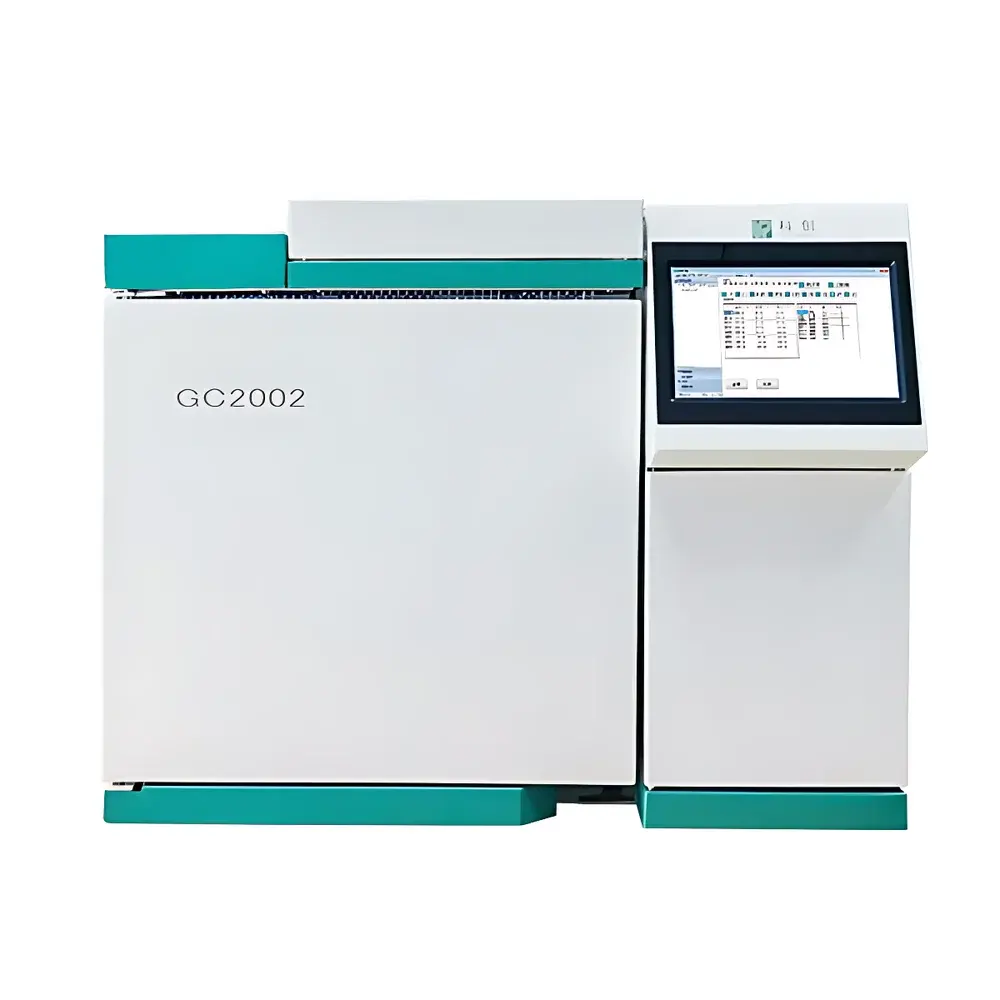
Kechuang GC2002 / GC9800 Laboratory Gas Chromatograph for VOC and Moisture Analysis in Coatings
| Brand | Kechuang |
|---|---|
| Origin | Shanghai, China |
| Manufacturer Type | Direct Manufacturer |
| Instrument Type | Benchtop Laboratory Gas Chromatograph |
| Application Focus | VOC and Water Content Quantification in Paints, Coatings, and Related Polymer Formulations |
| Temperature Control Range | Ambient + 8 °C to 400 °C |
| Oven Ramp Rate | 0.1–40 °C/min |
| Oven Cool-down | 400 °C → 50 °C in ≤4 min |
| Carrier Gas Flow Control Range | 0–100 mL/min (N₂, He, H₂) |
| Carrier Gas Pressure Control Range | 0–250 kPa |
| Injector Maximum Operating Temperature | 300 °C |
| Injector Pressure Setting Range | 0–250 kPa |
| Injector Total Flow Setting Range | 0–1200 mL/min |
Overview
The Kechuang GC2002 and GC9800 are dedicated benchtop gas chromatographs engineered for precise, reproducible quantification of volatile organic compounds (VOCs) and residual moisture in liquid and semi-solid coating formulations—including architectural paints, automotive basecoats, industrial primers, and waterborne emulsions. These instruments operate on the principle of capillary gas chromatography with flame ionization detection (FID) or thermal conductivity detection (TCD), enabling separation and measurement of low-boiling solvents (e.g., toluene, xylene, ethyl acetate, isopropanol) and water vapor based on retention time and peak area calibration. Designed specifically for compliance-driven quality control laboratories, the systems support standardized test methods such as ISO 11890-2, ASTM D6886, and GB/T 23985–2009 for VOC content determination, while also accommodating modified headspace-GC protocols for trace moisture analysis per ASTM E2018 and ISO 15512.
Key Features
- Programmable dual-zone oven with high-stability temperature control (±0.1 °C) across a wide operating range (ambient + 8 °C to 400 °C), ensuring optimal resolution for both early-eluting VOCs and higher-boiling resin components.
- Rapid thermal cycling capability—cool-down from 400 °C to 50 °C in ≤4 minutes—enables high-throughput batch analysis of coating samples without compromising column integrity or baseline stability.
- Electronic pressure control (EPC) and electronic flow control (EFC) modules provide independent, digitally regulated carrier gas delivery (0–100 mL/min) and injector total flow (0–1200 mL/min), supporting method transfer between split/splitless and headspace injection modes.
- High-temperature programmable split/splitless injector (up to 300 °C) with pressure-tuned inlet operation (0–250 kPa), compatible with large-volume liquid injection, purge-and-trap interfaces, and automated headspace samplers.
- Modular detector architecture allows field-installation of FID (detection limit < 1 pg C/s), TCD (for universal detection including H₂O), or optional PID for aromatic-specific screening—configurable per application requirements.
- Robust mechanical design with vibration-damped optical bench and sealed electronics enclosure ensures long-term operational reliability in shared QC laboratory environments.
Sample Compatibility & Compliance
The GC2002/GC9800 systems accommodate direct liquid injection (via syringe or autosampler), static/dynamic headspace sampling, and thermal desorption for solid or viscous coating matrices. Sample introduction is optimized for aqueous, solvent-based, and high-solids formulations using inert deactivated liners and low-bleed capillary columns (e.g., DB-VRX, Stabilwax, or PLOT Q). All hardware and firmware comply with essential requirements of ISO/IEC 17025:2017 for testing laboratories, and support full audit trail generation when operated with validated chromatography data systems (CDS). Method validation documentation—including specificity, linearity (R² ≥ 0.999), LOD/LOQ, precision (RSD < 3%), and recovery (95–105%)—is provided for VOC and moisture assays per ICH Q2(R2) guidelines.
Software & Data Management
Kechuang’s proprietary GC Navigator™ software provides intuitive method development, real-time chromatogram visualization, and integrated calibration curve management. The platform supports 21 CFR Part 11-compliant user access control, electronic signatures, and immutable audit trails for all acquisition, processing, and reporting events. Raw data files (.raw) are stored in open-format directories and exportable to LIMS via ASTM E1384 or HL7 messaging. Optional integration with third-party CDS (e.g., OpenLab CDS, Chromeleon) is available through standard instrument control protocols (SCPI over LAN/RS-232).
Applications
- Quantitative VOC profiling in regulatory submissions (EU REACH, US EPA Method 24, China GB 18581–2020)
- Batch release testing of solvent residue limits in automotive refinish coatings
- Moisture content verification in powder coating feedstocks and UV-curable resins
- Stability-indicating assay for hydrolytic degradation products in alkyd and acrylic dispersions
- Raw material qualification of monomers, plasticizers, and coalescing agents
- Failure analysis of blistering, cratering, or poor film formation linked to residual volatiles
FAQ
Can this system analyze water content in 100% solids coatings without derivatization?
Yes—using static headspace-GC with TCD detection and external calibration against certified water-in-solvent standards, achieving typical quantitation limits of 50–200 ppm depending on matrix viscosity and headspace equilibration parameters.
Is method transfer supported between GC2002 and GC9800 platforms?
Yes—both models share identical pneumatic architecture, temperature programming logic, and detector signal processing firmware; validated methods require only minor retention time adjustment due to column oven geometry differences.
Does the system meet GLP requirements for contract testing laboratories?
When deployed with GC Navigator™ in “audit mode” and paired with qualified hardware (e.g., NIST-traceable temperature calibrators, certified gas standards), the platform satisfies core GLP principles outlined in OECD Series on Principles of Good Laboratory Practice.
What column types are recommended for simultaneous VOC and moisture analysis?
A fused-silica PLOT Q column (30 m × 0.53 mm, 40 µm) provides baseline separation of C₁–C₆ hydrocarbons, chlorinated solvents, and water under isothermal conditions at 40 °C, with FID/TCD dual detection capability.
Is remote monitoring and troubleshooting supported?
Yes—integrated Ethernet port enables secure remote access via SSH or VNC for diagnostics, method updates, and real-time status monitoring, subject to local network security policy approval.



