
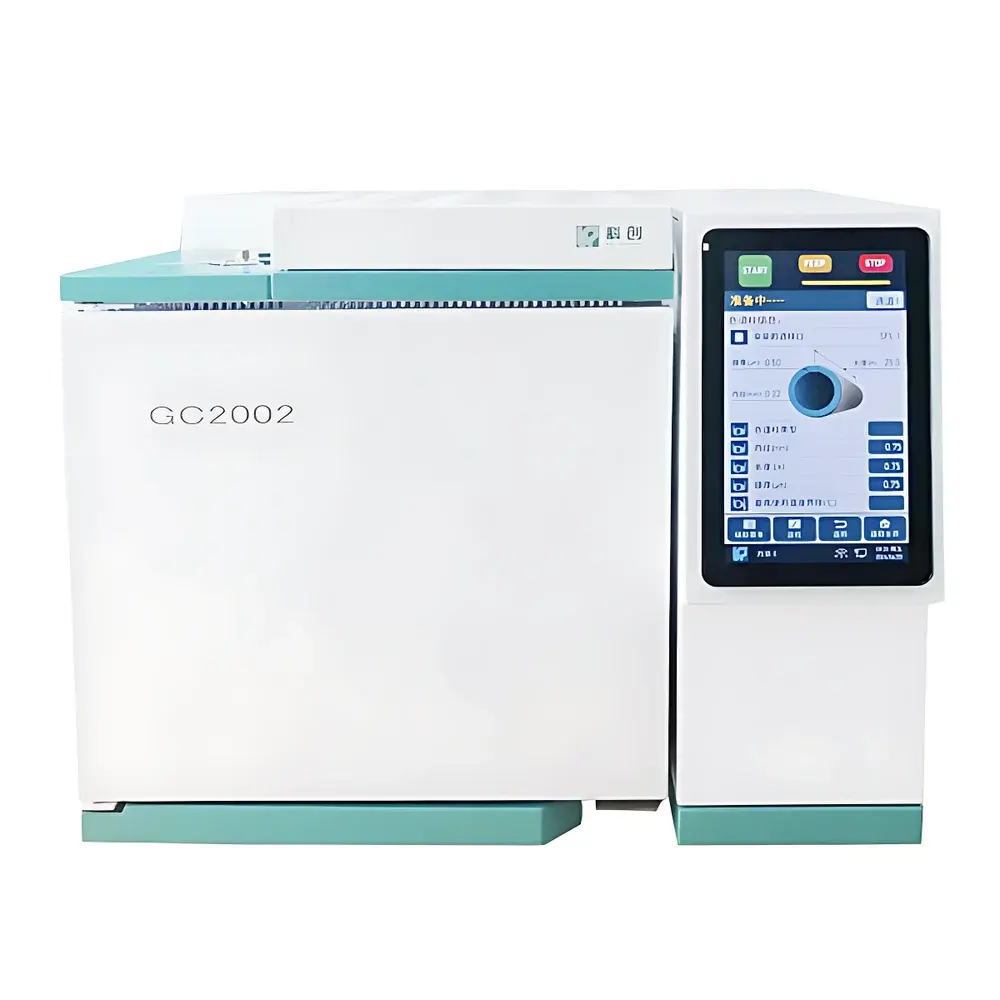
Kechuang GC2002 Network-Enabled Gas Chromatograph for High-Purity Food-Grade CO₂ and Specialty Gas Analysis
| Brand | Kechuang |
|---|---|
| Origin | Shanghai, China |
| Manufacturer Type | OEM Manufacturer |
| Product Category | Domestic |
| Model | GC2002 |
| Detection Targets | Trace Impurity Analysis in High-Purity Gases (He, H₂, N₂, CO₂, etc.) |
| Temperature Control Precision | ±0.01 °C |
| EPC/EFC Pressure Accuracy | 0.001 psi |
| EPC/EFC Flow Accuracy | 0.001 mL/min |
| Column Oven Cooling Time | ≤5 min (350 °C → 50 °C) |
| Max Programmed Temperature Ramps | 16 stages (extendable to unlimited) |
| Detector Options | TCD, FID, ECD, FPD |
| Data Interface | RJ45 Ethernet (TCP/IP), Embedded Chromatography Workstation |
| Remote Control Capacity | Up to 253 units per workstation |
Overview
The Kechuang GC2002 is a network-enabled, high-stability gas chromatograph engineered for trace impurity analysis in food-grade carbon dioxide and other high-purity specialty gases—including helium, hydrogen, nitrogen, and argon. Designed to meet stringent purity specifications required by beverage carbonation, pharmaceutical inerting, semiconductor process gases, and cryogenic applications, the system employs classical gas-phase separation principles based on differential partitioning of analytes between a mobile gas phase (carrier gas) and a stationary phase coated inside fused-silica capillary or packed columns. Its dual independently programmable column ovens support complex multi-step temperature programs, enabling precise retention time control for co-eluting low-concentration impurities such as hydrocarbons, oxygen, moisture-derived species (e.g., CO, CH₄), and permanent gases. The instrument complies with ISO 8573-5 for compressed air purity testing and supports method development aligned with ASTM D1945 (analysis of natural gas), ASTM D1946 (analysis of reformed gas), and ISO 6142 (gas mixture preparation and verification).
Key Features
- Dual independent column oven modules, each supporting up to 16 programmable temperature ramps (extendable to unlimited via firmware update), with temperature stability of ±0.01 °C and cooling from 350 °C to 50 °C in ≤5 minutes using auto-controlled rear door ventilation.
- Integrated electronic pressure and flow control (EPC/EFC) system with 24-channel capability; pressure control resolution of 0.001 psi and flow resolution of 0.001 mL/min; supports constant-pressure, constant-flow, and 8-stage programmed pressure/flow ramping modes.
- 10-inch industrial-grade capacitive touchscreen interface with embedded real-time baseline monitoring, spectral visualization, and direct instrument reverse control—eliminating dependency on external PC during routine operation.
- RJ45 Ethernet interface compliant with TCP/IP v4/v6; embedded chromatography workstation firmware enables centralized remote supervision, data acquisition, and configuration management across up to 253 instruments on a single LAN segment.
- Modular detector architecture supporting simultaneous installation of TCD, FID, ECD, and FPD—each with factory-calibrated wide-dynamic-range amplifiers to prevent solvent peak saturation and ensure linear response over 10⁴–10⁷ concentration ranges.
- Comprehensive self-diagnostic suite with real-time fault logging, thermal runaway protection (automatic heater cutoff if any zone exceeds setpoint by >5 °C), and ambient temperature compensation (≤0.1 °C column oven drift per 10 °C ambient shift).
Sample Compatibility & Compliance
The GC2002 accommodates gaseous samples delivered via stainless-steel or electropolished passivated tubing, compatible with standard CGA/ISO gas cylinder fittings and pressure regulators. It accepts sample introduction via split/splitless injectors, gas-tight syringes, or automated valve-based sampling loops (optional). For food-grade CO₂ analysis, the system meets ISO 22000 prerequisite program requirements for gas purity verification and supports validation protocols required under FDA 21 CFR Part 11 when paired with audit-trail-enabled chromatography data systems (CDS). All hardware components contacting sample streams are passivated or constructed from 316L stainless steel, minimizing catalytic decomposition and adsorption artifacts. Optional hydrogen leak detection and variable-frequency column oven cooling motors further enhance operational safety and throughput in regulated environments.
Software & Data Management
The embedded GC2002 workstation provides full method definition, sequence scheduling, peak integration, calibration curve generation (linear, quadratic, or multi-point non-linear), and report export in PDF, CSV, and XML formats. It supports user-defined metadata tagging (e.g., batch ID, operator, instrument ID) and integrates seamlessly with LIMS platforms via HL7 or ASTM E1384-compliant interfaces. Audit trails record all parameter changes, data deletions, and user logins with timestamps and IP addresses. When deployed in GLP/GMP laboratories, the system can be configured to enforce electronic signatures, role-based access control (RBAC), and 21 CFR Part 11-compliant electronic records—provided the host CDS environment satisfies predicate rule requirements for software validation and change control.
Applications
- Quantification of trace hydrocarbons (<100 ppb) and permanent gases (O₂, CO, CH₄, N₂O) in beverage-grade CO₂ per ISO 22000 Annex A and Coca-Cola/PEPSICO supplier specifications.
- Residual solvent screening in pharmaceutical excipient-grade nitrogen and argon used in lyophilization and blanketing processes.
- Verification of ultra-high-purity helium (≥99.9995%) for semiconductor etch and deposition tools, detecting ppm-level air contaminants.
- Monitoring of hydrogen purity (≥99.999%) for fuel cell feedstock, with detection of CO, CO₂, and total hydrocarbon content.
- Environmental chamber purge gas certification where background VOCs must remain below detection limits defined in ISO 16000-6.
FAQ
Does the GC2002 support regulatory-compliant data integrity practices?
Yes—when operated with validated third-party CDS software, it fulfills ALCOA+ principles (Attributable, Legible, Contemporaneous, Original, Accurate) and supports 21 CFR Part 11 requirements including electronic signatures, audit trails, and role-based permissions.
Can multiple detectors operate simultaneously on a single analysis run?
Yes—the workstation allows time-programmed signal routing, enabling concurrent acquisition from two or more detectors on the same chromatographic run, with independent integration parameters per channel.
Is the column oven lighting integrated for maintenance purposes?
Yes—a built-in LED illumination module facilitates visual inspection and physical installation of columns without external lighting sources.
What carrier gases are supported by the EPC/EFC system?
The system supports N₂, H₂, He, and Ar with automatic gas-type selection and optimized flow/pressure algorithms for each.
How is instrument calibration verified across extended operation?
The system includes internal reference channels for continuous baseline offset correction and supports scheduled automated calibration checks using certified gas standards traceable to NIST or BIPM.







