
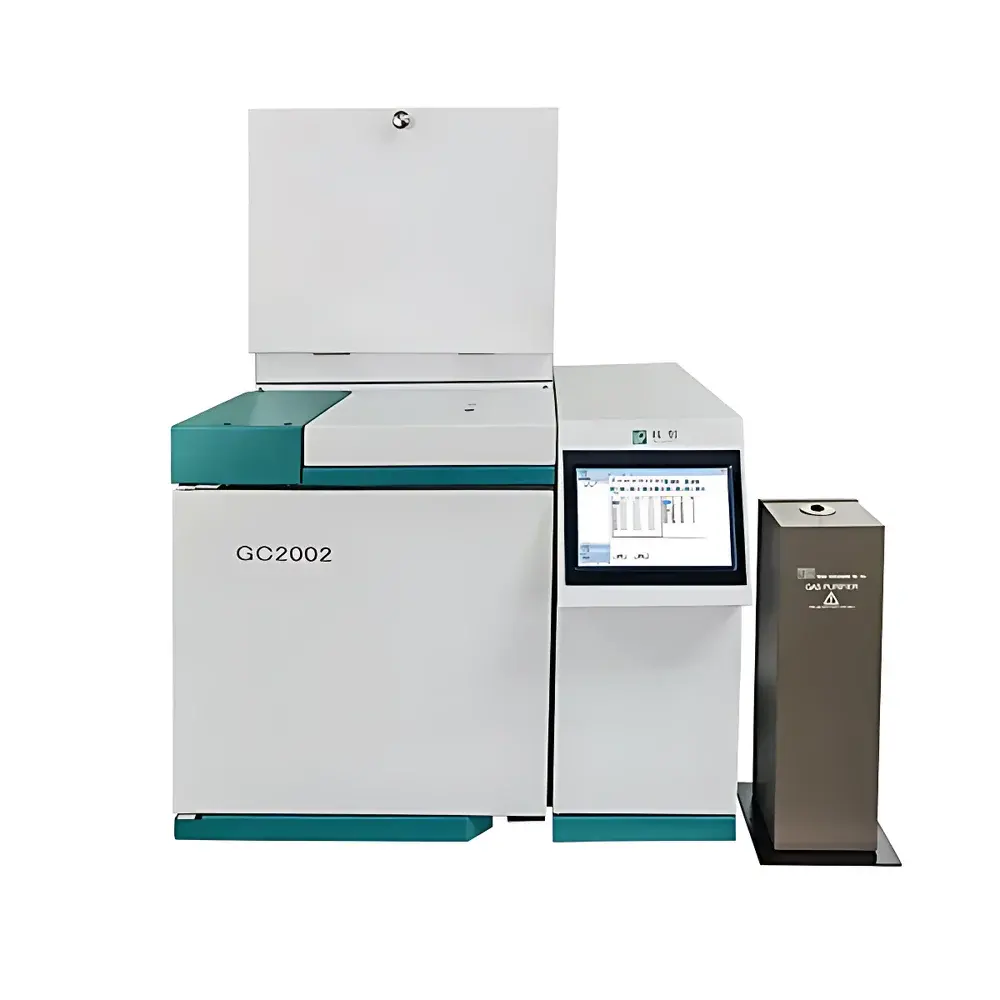
KeChuang GC2002N/PDHID High-Purity and Ultra-High-Purity Carbon Dioxide Impurity Analyzer Gas Chromatograph
| Brand | KeChuang |
|---|---|
| Origin | Shanghai, China |
| Manufacturer Type | Direct Manufacturer |
| Regional Classification | Domestic (China) |
| Model | GC2002N/PDHID |
| Instrument Type | Laboratory Gas Chromatograph |
| Application Field | Dedicated to High-Purity Gas Analysis |
| Oven Temperature Range | 0–400 °C |
| Maximum Ramp Rate | 40 °C/min |
| Cooling Time (from 400 °C to 50 °C) | ≤4 min |
| Carrier Gas Flow Range & Control | 0–500 mL/min |
| Carrier Gas Pressure Range & Control | 0–0.4 MPa |
| Injector Maximum Operating Temperature | 300 °C |
| Injector Pressure Setting Range | 0–0.4 MPa |
| Injector Total Flow Setting Range | 0–500 mL/min |
Overview
The KeChuang GC2002N/PDHID is a purpose-built laboratory gas chromatograph engineered for trace-level impurity analysis in high-purity (≥99.999%) and ultra-high-purity (≥99.9999%) carbon dioxide streams. It integrates a pulsed discharge helium ionization detector (PDHID), a highly sensitive and universally responsive detector capable of detecting permanent gases (H₂, O₂, N₂, CO, CH₄, etc.) at sub-ppb to low-ppb levels without chemical derivatization or catalytic conversion. Unlike thermal conductivity detectors (TCD) or flame ionization detectors (FID), the PDHID delivers consistent response factors across diverse molecular species—including noble gases—making it uniquely suited for comprehensive impurity profiling in electronic-grade, semiconductor-grade, and laser-grade CO₂. The system employs dual-column configuration with molecular sieve 5A and PoraPLOT Q columns for optimal separation of light gases and hydrocarbons, while its fully programmable oven and precision pneumatic control ensure reproducible retention times and quantitative stability across extended analytical sequences.
Key Features
- PDHID detector with helium carrier gas: Provides universal detection sensitivity for H₂, O₂, N₂, CO, CH₄, CO₂, and other inert/combustible gases at detection limits typically <10 ppb (v/v) under optimized conditions.
- High-temperature oven (0–400 °C) with rapid thermal ramping (up to 40 °C/min) and accelerated cooling (≤4 min from 400 °C to 50 °C), enabling short cycle times and high sample throughput in QC environments.
- Dual independent pressure and flow control modules for carrier, make-up, and detector gases—ensuring long-term baseline stability and minimal drift during multi-hour analyses.
- Programmable split/splitless injector with temperature range up to 300 °C and pressure/flow settings fully integrated into method parameters (0–0.4 MPa, 0–500 mL/min).
- Robust, modular architecture designed for continuous operation in ISO 17025-accredited laboratories; all critical hardware components are field-serviceable without recalibration.
Sample Compatibility & Compliance
The GC2002N/PDHID is validated for direct injection of gaseous samples with CO₂ matrix concentrations ranging from 99.99% to 99.99999%. It meets analytical requirements defined in ASTM D7607–22 (Standard Test Method for Trace Impurities in High-Purity Gases by Gas Chromatography) and aligns with IEC 60068-2-52 (corrosion resistance testing for electronics-grade gases). The system supports GLP-compliant workflows through audit-trail-enabled software (see Software & Data Management). All wetted parts—including stainless-steel tubing, valves, and injector liners—are electropolished and passivated to minimize adsorption and memory effects for reactive analytes such as O₂ and CO. Calibration protocols follow ISO/IEC 17025:2017 Annex A.2 guidelines for calibration gas traceability to NIST SRMs or equivalent national metrology institute standards.
Software & Data Management
The instrument is operated via KeChuang ChromaLab v3.2, a Windows-based chromatography data system (CDS) compliant with FDA 21 CFR Part 11 requirements. The software provides full electronic signature support, user role-based access control, automated method validation reports, and secure audit trails covering all acquisition, processing, and reporting events. Peak integration uses adaptive baseline algorithms optimized for low-amplitude PDHID signals; quantitation employs internal standard or external standard calibration curves with linear/nonlinear regression options. Raw data files (.kcd) are stored in vendor-neutral formats compatible with third-party LIMS platforms via ASTM E1394 or HL7 ADT interfaces. All calibration and performance verification records—including daily system suitability tests (SST)—are archived with time-stamped metadata and digital signatures.
Applications
- Quality control of CO₂ used in semiconductor photolithography, laser cutting, and food-grade packaging.
- Verification of purity specifications per SEMI F63–22 (Specification for Electronic Grade Carbon Dioxide) and GB/T 23938–2009 (Chinese national standard for high-purity CO₂).
- Monitoring trace impurities (e.g., H₂O, O₂, N₂, CO, CH₄, C₂H₂, C₂H₄) in CO₂ feedstocks for supercritical fluid extraction (SFE) and carbon capture utilization and storage (CCUS) processes.
- Supporting failure analysis in CO₂-based fire suppression systems where O₂ ingress or hydrocarbon contamination may compromise efficacy.
- Research applications involving isotopic CO₂ tracing, where co-eluting impurities must be resolved prior to IRMS coupling.
FAQ
What detection limits can be achieved for H₂ and CO in CO₂ using the PDHID configuration?
Typical method detection limits (MDLs) are 5–8 ppb for H₂ and 3–6 ppb for CO under standard operating conditions (1 mL gas loop, 30 m column, He carrier at 30 mL/min). MDLs are method-dependent and require formal validation per ISO 11843–7.
Is the system compatible with hydrogen carrier gas for enhanced separation speed?
No—PDHID operation requires helium as the discharge and carrier gas. Hydrogen is incompatible due to plasma instability and safety risks in the pulsed discharge chamber.
Can the GC2002N/PDHID be integrated into an automated gas sampling network?
Yes—equipped with RS-232, Ethernet, and optional 0–10 V analog outputs, it supports integration with multiplexed gas sampling valves (e.g., VICI Valco 12-port) and central SCADA systems via Modbus TCP.
Does the system meet regulatory requirements for pharmaceutical excipient grade CO₂ testing?
It satisfies USP , Ph. Eur. 2.2.45, and JP 17 general chapters for residual solvent and impurity analysis when configured with appropriate columns, calibration standards, and validated methods.
What maintenance intervals are recommended for PDHID lamp lifetime and column performance?
PDHID lamps exhibit >2,000 hours of stable operation under routine use; column lifetime exceeds 12 months when protected by guard columns and operated within specified temperature and flow limits. Preventive maintenance is scheduled every 90 days per KeChuang’s PM checklist.




