
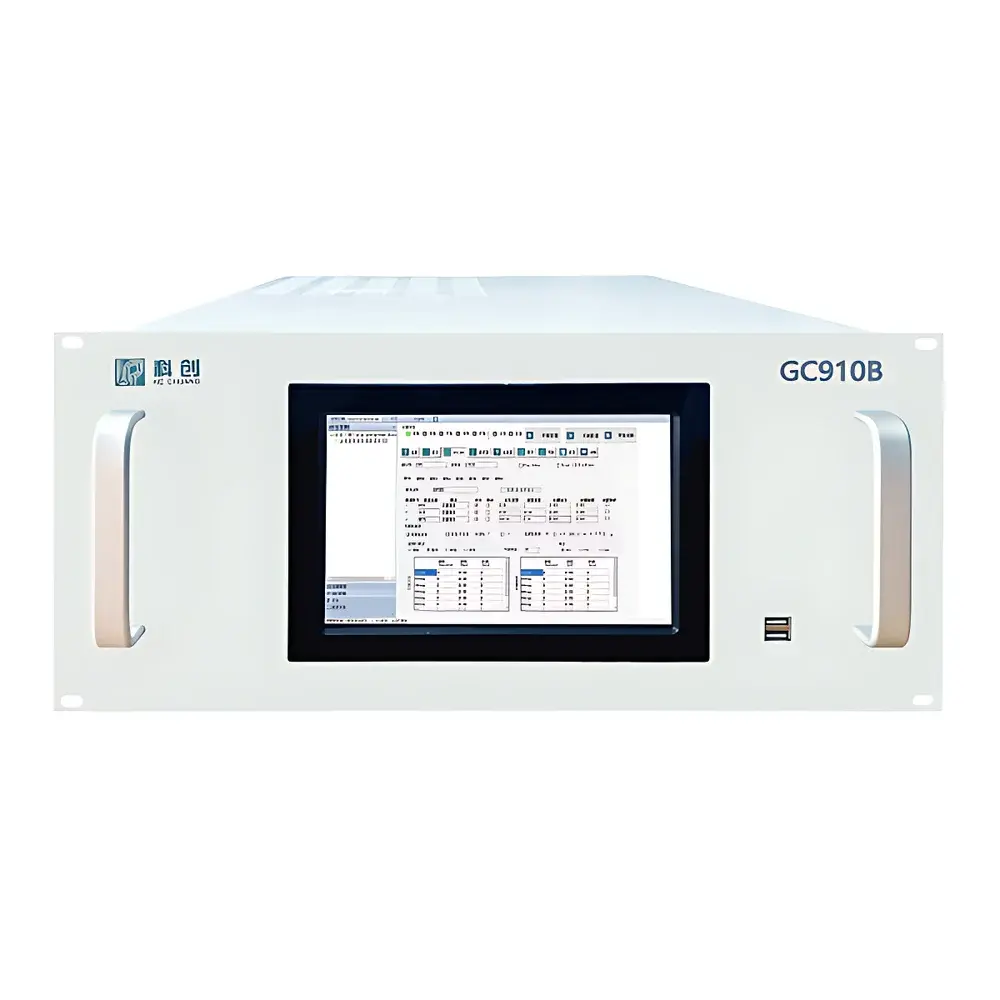
Kechuang GC910B Mobile-Mounted Dissolved Gas Analysis (DGA) Gas Chromatograph for Transformer Oil
| Brand | Kechuang |
|---|---|
| Origin | Shanghai, China |
| Manufacturer Type | OEM Manufacturer |
| Product Category | Domestic |
| Model | GC910B |
| Instrument Type | Laboratory Gas Chromatograph |
| Application Field | Power Industry–Specific DGA |
| Oven Temperature Range | Ambient + 8 °C to 400 °C |
| Ramp Rate | 0.1–40 °C/min |
| Cool-Down Rate | 400 °C to 50 °C in ≤4 min |
| Carrier Gas Flow Range & Control | 0–100 mL/min |
| Carrier Gas Pressure Range & Control | 0–250 kPa |
| Injector Max Operating Temperature | 300 °C |
| Injector Pressure Setting Range | 0–250 kPa |
| Injector Total Flow Setting Range | 0–1200 mL/min |
Overview
The Kechuang GC910B is a purpose-built, mobile-mounted gas chromatograph engineered for dissolved gas analysis (DGA) of insulating oils used in power transformers and high-voltage switchgear. It implements classical packed- or capillary-column gas chromatography with dual-column oven architecture, enabling simultaneous or sequential analysis of key fault gases—H₂, CH₄, C₂H₆, C₂H₄, C₂H₂, CO, and CO₂—per IEC 60567, ASTM D3612, and DL/T 703 standards. Its compact, ruggedized chassis supports deployment in utility vehicle labs, substation mobile units, and field service vehicles without compromising analytical integrity. The system operates on the principle of differential partitioning of gaseous analytes between a mobile phase (carrier gas) and stationary phase (column packing), followed by selective detection using thermally stable, high-sensitivity detectors. All thermal zones—including dual independently programmable ovens—are stabilized via PID-controlled heating elements with real-time digital feedback, ensuring retention time stability and inter-laboratory reproducibility required for trending-based condition monitoring.
Key Features
- Dual independent column ovens, each programmable from ambient + 8 °C to 400 °C with ±0.01 °C temperature stability and ramp rates adjustable from 0.1 to 40 °C/min.
- Integrated electronic pressure/flow control (EPC/EFC) system with 0.001 psi pressure resolution and 0.001 mL/min flow resolution; supports constant-pressure, constant-flow, and multi-step program pressure/flow profiles (up to 8 stages).
- 8-inch industrial-grade resistive touchscreen interface with embedded chromatographic data acquisition, real-time baseline visualization, and full instrument reverse control—no external hardware required.
- RJ45 Ethernet interface enabling native TCP/IP communication; single workstation can manage up to 253 GC910B units simultaneously, supporting centralized remote monitoring, firmware updates, and audit-log synchronization across regional utility networks.
- Automatic post-run oven cooling: 350 °C → 50 °C in ≤3.5 min via motorized rear door actuation and integrated axial fans.
- Eight user-programmable external event timers for automated valve switching, detector polarity reversal, or multi-cycle unattended operation—essential for continuous DGA screening protocols.
- Self-diagnostic firmware with real-time fault logging (e.g., heater open-circuit, sensor drift, EPC valve stall), coupled with redundant overtemperature protection across all heated zones.
Sample Compatibility & Compliance
The GC910B is validated for headspace analysis of degassed transformer oil samples extracted via vacuum extraction or mechanical shaking per ASTM D3612 Method A/B/C. It accepts standard 1/16″ stainless-steel or fused-silica capillary columns (e.g., Porapak Q, Hayesep D, or custom DGA-packed columns) and accommodates both manual and autosampler-integrated injection. Detector configurations include TCD (for H₂, O₂, N₂, CO, CO₂), FID (for hydrocarbons), and optionally ECD or FPD for trace halogenated or sulfur compounds. The system complies with IEC 60567 Ed. 3 (2019) for DGA reporting, supports GLP-compliant data archiving, and meets essential requirements of ISO/IEC 17025 for testing laboratories. Its electrical design conforms to IEC 61000-6-3 (EMC) and IEC 61010-1 (safety), with CE marking documentation available upon request.
Software & Data Management
The embedded chromatography workstation provides full bidirectional instrument control, method development, peak integration (with customizable baseline algorithms), and report generation compliant with IEEE C57.104 and DL/T 722 guidelines. Raw data files (.cdf or .ch) retain full metadata—including detector voltage traces, EPC setpoints, oven ramp logs, and calibration history—for forensic traceability. Audit trails record all user actions (login/logout, method edits, result approvals) with timestamp and operator ID, satisfying FDA 21 CFR Part 11 requirements when deployed in regulated utility QA environments. Data export supports CSV, PDF, and XML formats; integration with SCADA or CMMS platforms is achievable via OPC UA or RESTful API extensions.
Applications
- On-site dissolved gas analysis for predictive maintenance of oil-immersed power transformers, reactors, and tap changers.
- Diagnostic interpretation using Duval triangles, Rogers ratios, and IEC 60599 fault coding schemes.
- Verification of oil reclamation efficacy after vacuum dehydration or adsorption treatment.
- Baseline profiling of new insulating oil prior to commissioning.
- Root-cause investigation of incipient faults (partial discharge, thermal degradation, arcing) through gas evolution kinetics.
- Regulatory compliance testing for grid operators under national transmission codes (e.g., China’s DL/T 722, India’s CEA Regulations).
FAQ
Is the GC910B certified for use in explosion-hazardous areas?
No—the GC910B is designed for indoor or vehicle-mounted laboratory environments classified as non-hazardous (Zone 2/Class I, Division 2). For Class I, Division 1 applications, an intrinsically safe external sample introduction module must be integrated separately.
Can the system perform fully automated unattended analysis overnight?
Yes—using the 8-event timer function and compatible autosampler (e.g., Kechuang AS-910), the GC910B supports up to 99 consecutive runs with programmable column conditioning, detector tuning, and data auto-save.
What carrier gases are supported, and how is gas purity managed?
N₂, H₂, He, and Ar are supported via EPC-configurable gas selection. Users must supply ≥99.999% pure carrier gas with appropriate filtration (hydrocarbon, moisture, oxygen traps); internal gas lines are passivated stainless steel.
Does the software support LIMS integration?
Yes—via HL7 or ASTM E1384-compliant interfaces; custom middleware is available for Siemens Desigo, GE Digital Predix, or Schneider EcoStruxure deployments.
What is the typical calibration frequency for DGA applications?
Per IEC 60567, initial calibration with certified gas standards is required before first use; subsequent recalibration is recommended every 30 days or after 50 injections, whichever occurs sooner.
Related Products





