
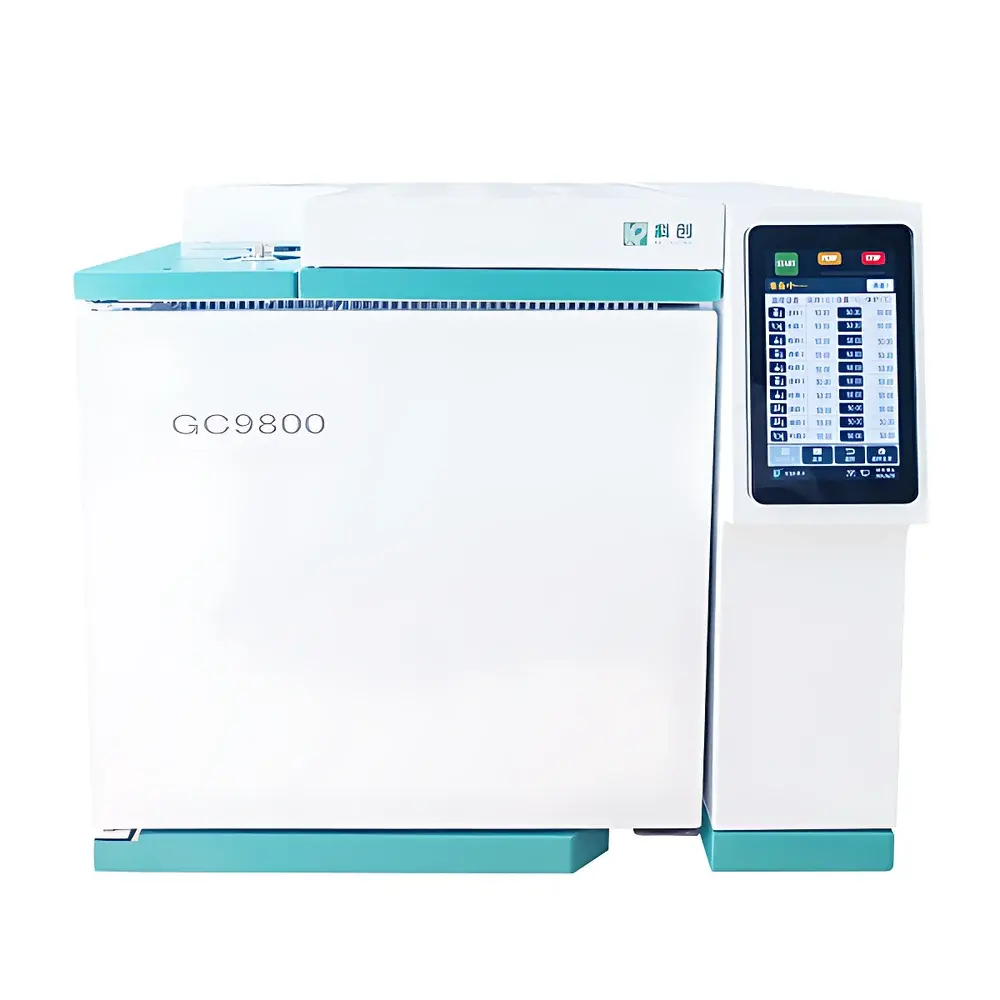
Kechuang GC9800 Gas Chromatograph for Residual Organic Solvent Analysis in Packaging Materials
| Brand | Kechuang |
|---|---|
| Origin | Shanghai, China |
| Manufacturer Type | Direct Manufacturer |
| Regional Category | Domestic (China) |
| Model | GC9800 |
| Price | USD 5,600 (approx.) |
Overview
The Kechuang GC9800 Gas Chromatograph is a high-precision, laboratory-grade analytical system engineered for the quantitative determination of residual organic solvents—such as benzene, toluene, ethyl acetate, isopropanol, and xylene—in flexible packaging films, laminates, and pharmaceutical blister materials. It operates on the fundamental principle of gas–solid or gas–liquid partition chromatography, where volatile analytes are separated based on differential partitioning between a mobile phase (carrier gas) and a stationary phase (capillary column), followed by selective detection. Designed specifically to meet regulatory requirements for packaging safety—including ISO 10993-18, ASTM F2475, and Chinese Pharmacopoeia (ChP) Volume IV Section 9011—the GC9800 delivers robust performance for routine QC/QA labs conducting residual solvent testing per ICH Q3C guidelines. Its dual-column oven architecture, ultra-stable temperature control (±0.01 °C), and integrated electronic pressure/flow control (EPC/EFC) ensure exceptional retention time reproducibility (<0.008% RSD) and peak area precision (<1.0% RSD), critical for compliance-driven reporting.
Key Features
- Dual independently programmable column ovens, each supporting up to 16 heating ramps (expandable to unlimited steps), with rapid cooling capability (≤5 min from 350 °C to 50 °C) via motorized back-door actuation.
- 10-channel precision temperature control system, including dual oven zones, injector ports, detector bodies, and auxiliary modules—all calibrated to ±0.1% accuracy and displayed with 0.01 °C resolution.
- Integrated EPC/EFC system with 24-channel independent control capability; pressure accuracy: ±0.001 psi; flow accuracy: ±0.001 mL/min; supports N2, H2, He, and Ar carrier gases.
- 7-inch industrial-grade capacitive touchscreen interface with real-time baseline monitoring, chromatogram display, and full instrument reverse control—eliminating dependency on external PCs during method execution.
- RJ45 Ethernet interface enabling digital signal transmission, centralized multi-instrument management (up to 253 units per network segment), remote diagnostics, firmware updates, and audit-ready data streaming to LIMS or ELN systems.
- Modular detector architecture accommodating TCD, FID, ECD, and FPD configurations; all detectors feature wide-dynamic-range amplifiers to prevent solvent peak saturation and ensure linear response across 104–107 concentration ranges.
- Onboard fault self-diagnosis with real-time error logging, over-temperature cut-off protection per channel, and automatic thermal shutdown if any zone exceeds user-defined limits.
Sample Compatibility & Compliance
The GC9800 is validated for headspace analysis of residual solvents in polyethylene (PE), polypropylene (PP), polyester (PET), aluminum foil composites, and PVC-based packaging substrates. Sample introduction is compatible with standard 20 mL headspace vials and automated headspace samplers (e.g., Agilent 7697A or Thermo TriPlus HS). Method development aligns with USP , EP 2.4.24, and ChP General Chapter 9011. All hardware and firmware support GLP/GMP-compliant operation: audit trails for method changes, user access levels, electronic signatures, and data integrity features compliant with FDA 21 CFR Part 11 when used with validated chromatography data systems (CDS).
Software & Data Management
The embedded chromatography workstation provides full bidirectional instrument control, method building, sequence scheduling, integration parameter optimization, and report generation. It supports customizable acquisition time programs for multiple detectors within a single data channel—enabling simultaneous FID/ECD signal switching without hardware reconfiguration. Raw data files (.cdf or .dx) are stored with metadata tags (operator ID, injection time, method version, calibration status). Networked deployment allows centralized data archiving, cross-lab method sharing, and hierarchical supervision—ideal for contract testing laboratories operating under ISO/IEC 17025 accreditation.
Applications
- Quantification of Class 2 and Class 3 residual solvents in pharmaceutical primary packaging per ICH Q3C.
- Migration testing of printing ink solvents (e.g., MEK, cyclohexanone) into food-contact packaging under EU Regulation (EC) No. 1935/2004.
- QC release testing of sterile barrier systems used in medical device packaging.
- Validation of solvent removal efficiency in gravure and flexographic printing processes.
- Environmental monitoring of VOC emissions from packaging production lines.
FAQ
Does the GC9800 support compliance with FDA 21 CFR Part 11?
Yes—when operated with validated third-party CDS software (e.g., Chromeleon, OpenLab CDS) and configured with role-based user accounts, electronic signatures, and immutable audit trails.
Can the instrument be upgraded to include mass spectrometric detection?
Yes—the built-in GC-MS interface port supports direct coupling to quadrupole or single-quadrupole mass spectrometers for structural confirmation and trace-level identification.
What is the maximum number of independent EPC channels supported?
The system supports up to 24 independently controlled EPC/EFC channels, enabling complex multi-valve, multi-column, or multidetector configurations.
Is ambient temperature compensation active during column oven operation?
Yes—the thermal management system compensates for ambient fluctuations of up to ±10 °C, maintaining column temperature stability within ±0.1 °C.
What is the minimum detectable concentration for ECD detection of chlorinated pesticides?
Under optimized conditions using a 63Ni source and capillary column, the ECD achieves ≤10 fg/mL detection limit for γ-HCH (lindane), meeting EPA Method 8081B sensitivity requirements.




