
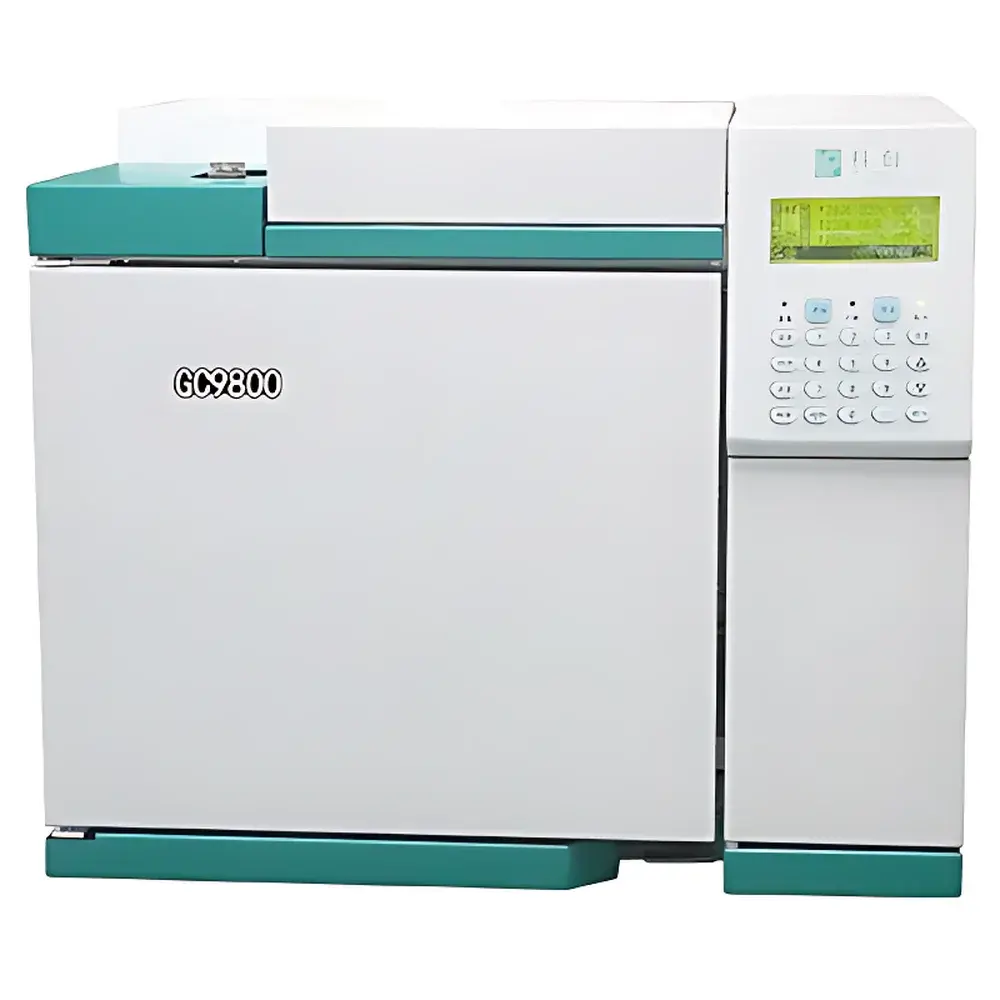
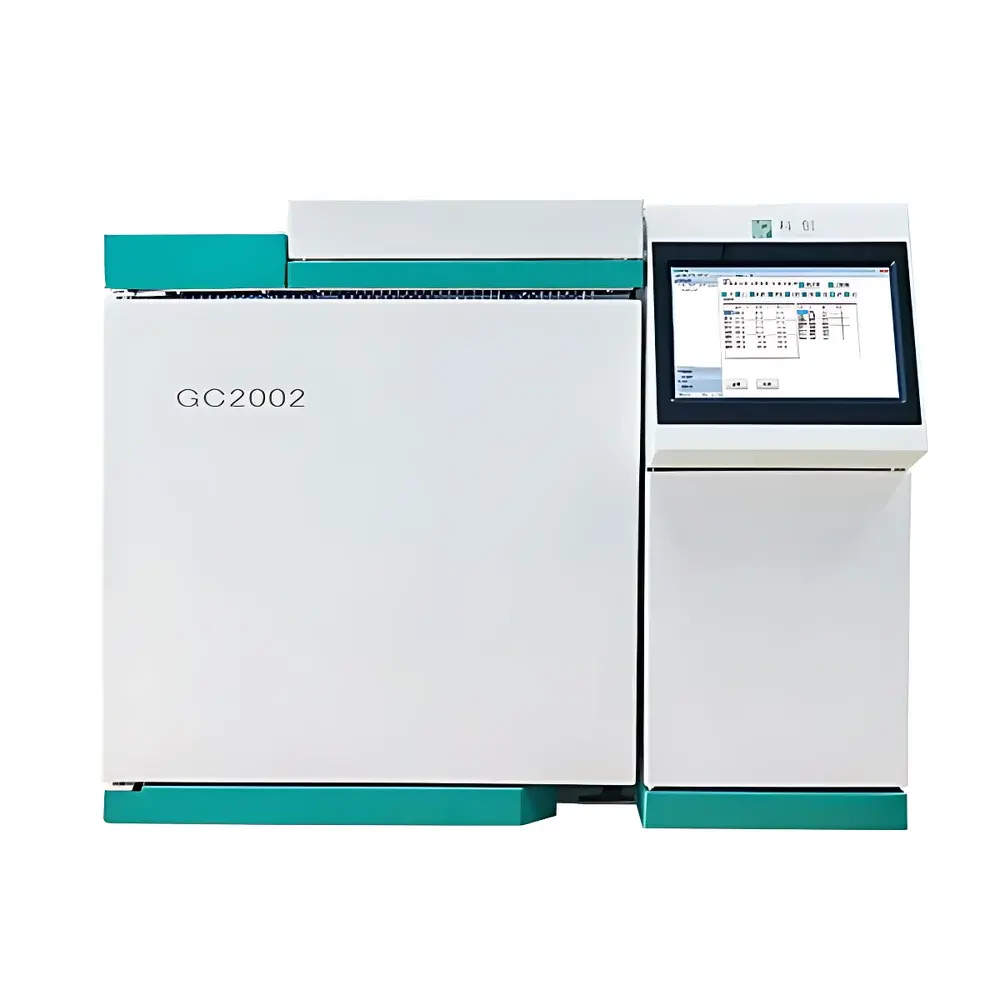
Kechuang GC9800 High-Purity Carbon Dioxide Analysis System with Dual-Detector Gas Chromatograph (TCD/FID + Ni Methanizer)
| Brand | Kechuang |
|---|---|
| Origin | Shanghai, China |
| Manufacturer Type | OEM Manufacturer |
| Region Category | Domestic (China) |
| Model | GC9800 (N₂/CO₂/THC Configuration) |
| Detection Targets | Trace Impurities in High-Purity Gases (He, H₂, N₂, CO₂, CH₄, CO, O₂, Total Hydrocarbons) |
| Detectors | TCD (TC-1H) + FID + Ni Catalyst Methanizer |
| Temperature Range | 8 °C above ambient to 400 °C |
| Temperature Control Accuracy | ±0.5% |
| Max. Programmed Ramps | 8 steps |
| Ramp Rate | 0–39 °C/min (0.1 °C/min increment) |
| TCD LOD | H₂ ≤ 0.5 ppm, O₂ ≤ 1 ppm, N₂ ≤ 3 ppm |
| FID LOD | CO 0.1–0.2 ppm, THC ≤ 2 ppm (Ar carrier) |
| Linear Range | FID 10⁷, TCD 10⁵ |
| Baseline Noise | FID ≤ 1×10⁻¹³ A, TCD ≤ 10 µV |
| Baseline Drift | FID ≤ 5×10⁻¹³ A/30 min, TCD ≤ 60 µV/30 min |
| Stabilization Time | FID ≤ 1 h, TCD ≤ 2 h |
Overview
The Kechuang GC9800 High-Purity Carbon Dioxide Analysis System is a dedicated gas chromatograph engineered for trace-level impurity profiling in ultra-high-purity (UHP) industrial gases—particularly CO₂ used in semiconductor fabrication, pharmaceutical inerting, laser media, and food-grade applications. It employs dual-detector architecture (thermal conductivity detector, TCD; and flame ionization detector, FID) coupled with a nickel-catalyzed methanizer to convert CO and CO₂ into methane for enhanced hydrocarbon and carbon oxide detection sensitivity. The system operates on the fundamental principle of gas-phase separation via capillary or packed column chromatography, followed by selective, quantitative detection based on thermal or ionization response. Its design conforms to analytical requirements defined in ISO 8573-5 (compressed air purity), ASTM D1946 (analysis of reformed gas), and IEC 60567 (dissolved gas analysis in insulating oils), supporting laboratories requiring compliance-ready data generation under GLP and internal QA/QC protocols.
Key Features
- Full microprocessor-based control architecture with embedded Ethernet (10/100 Mbps) interface enabling remote instrument supervision, firmware updates, and diagnostic support over LAN or internet—compatible with centralized lab management systems.
- Six independent temperature zones—including oven, injector, detectors, and methanizer—with precision control (±0.5%) across a range from 8 °C above ambient to 400 °C; supports up to 8-step programmable ramping at 0.1 °C/min resolution.
- Integrated column oven with automatic back-flush door and near-ambient cooling capability (down to +8 °C), ensuring reproducible retention time stability for low-boiling analytes such as H₂, O₂, and N₂.
- Dual-detector configuration: high-sensitivity TCD (TC-1H) optimized for permanent gases (H₂, O₂, N₂, CO₂), and FID with sub-ppm detection limits for CO and total hydrocarbons (THC); Ni methanizer enables CO/CO₂ conversion prior to FID detection.
- Self-diagnostic firmware with real-time fault logging—identifies sensor anomalies, heater failures, or temperature deviations—and activates hardware-level thermal cutoff if any zone exceeds user-defined safety thresholds.
- Built-in chromatographic data system (CDS) with native networked signal output; raw analog/digital signals transmitted directly via Ethernet without external DAQ hardware.
Sample Compatibility & Compliance
The GC9800 accepts gaseous samples via automated or manual gas-tight valves (e.g., 6-port or 10-port Valco-type), compatible with standard 1/8″ or 1/16″ stainless steel or fused silica transfer lines. It supports both helium and argon carrier gases, with validated methods for CO₂ matrix analysis containing trace H₂ (≥0.5 ppm), O₂ (≥1 ppm), N₂ (≥3 ppm), CO (≥0.1 ppm), CH₄ (≥0.02 ppm), and THC (≥2 ppm). Method validation documentation aligns with ISO/IEC 17025 requirements for calibration traceability, repeatability (RSD < 2.5% for peak area at 10× LOD), and intermediate precision. The system supports audit trails and electronic signatures per FDA 21 CFR Part 11 when deployed with compliant third-party CDS software.
Software & Data Management
Data acquisition and processing are handled through the embedded workstation, which provides real-time chromatogram visualization, peak integration (tangent skim, valley-to-valley, exponential skimming), retention time locking, and customizable report templates. All chromatographic parameters—including method files, sequence logs, calibration curves, and audit entries—are stored locally in encrypted binary format and accessible via HTTP or FTP over the integrated Ethernet port. Raw data export is supported in ASCII (.csv) and industry-standard .cdf formats for post-processing in third-party tools (e.g., OpenLab CDS, Chromeleon). Remote access allows supervisors to review run status, validate integration parameters, and approve reports without physical presence—facilitating multi-site quality oversight.
Applications
- Quality release testing of electronic-grade CO₂ for semiconductor etching and chamber purging processes.
- Verification of CO₂ purity in pharmaceutical packaging environments where residual O₂ or H₂ may catalyze oxidation of active ingredients.
- Monitoring of CO₂ streams in biogas upgrading facilities to quantify removal efficiency of H₂S, siloxanes, and hydrocarbons.
- Trace oxygen and moisture co-analysis in high-purity nitrogen or argon supply lines feeding GC carrier gas systems.
- Environmental emission monitoring of combustion-derived CO and THC in flue gas recirculation loops (when configured with appropriate sampling conditioning).
FAQ
What carrier gases are compatible with the GC9800 for CO₂ impurity analysis?
Helium and argon are validated carriers; hydrogen is not recommended due to safety constraints with the Ni methanizer and FID operation.
Can the system quantify CO₂ itself—not just impurities—in a CO₂-rich sample?
Yes—the TCD channel provides direct, linear quantification of CO₂ concentration using external standard calibration; typical dynamic range spans 99.99% to 99.9999% purity (1–100 ppmv impurity level).
Is the Ni methanizer permanently installed or field-replaceable?
It is a modular, thermally insulated reactor cartridge mounted in a dedicated temperature-controlled zone, designed for routine replacement after ~12 months of continuous operation or upon catalytic deactivation.
Does the GC9800 support unattended overnight operation?
Yes—equipped with full sequence scheduling, auto-shutdown logic, and watchdog timers; all temperature zones and detector statuses are monitored continuously during extended runs.
How is calibration traceability maintained for regulatory submissions?
Certified reference gas mixtures (NIST-traceable or equivalent) are used for initial calibration; calibration verification checks are logged automatically before each analytical batch, with metadata archived alongside chromatograms.







