
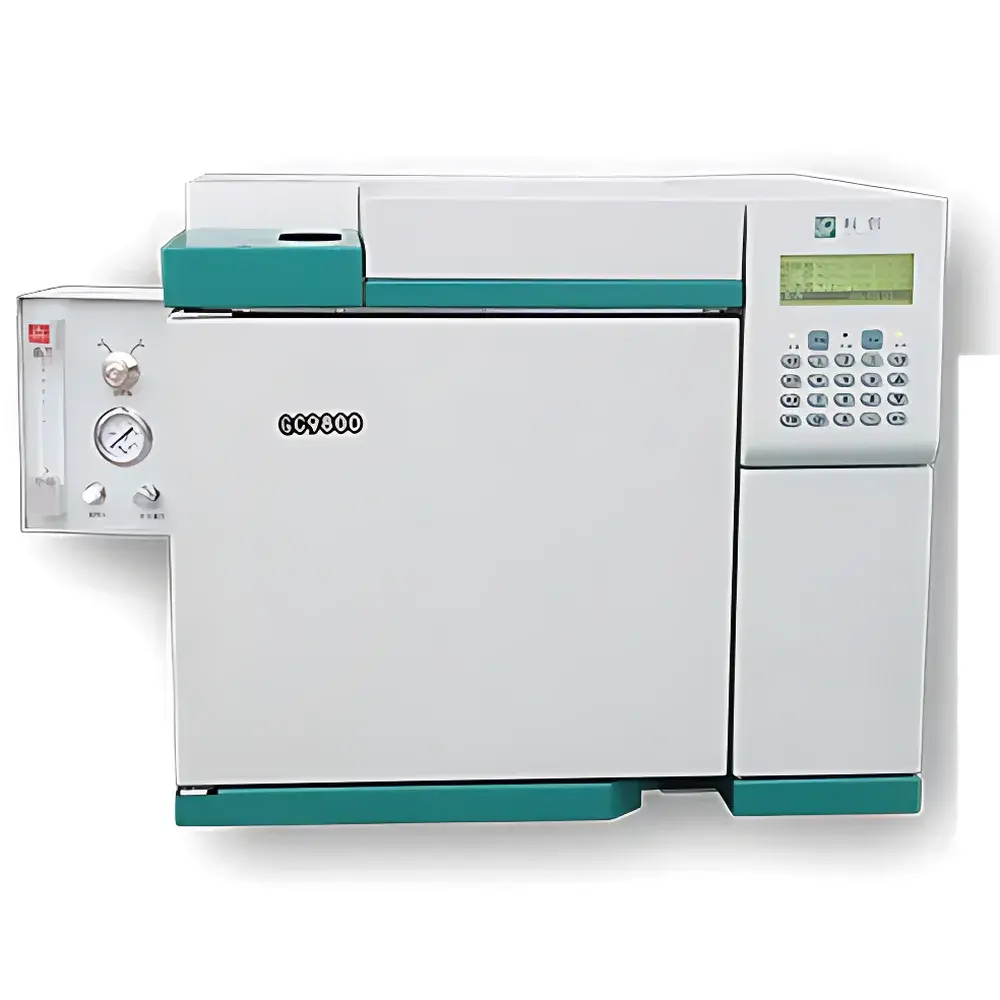
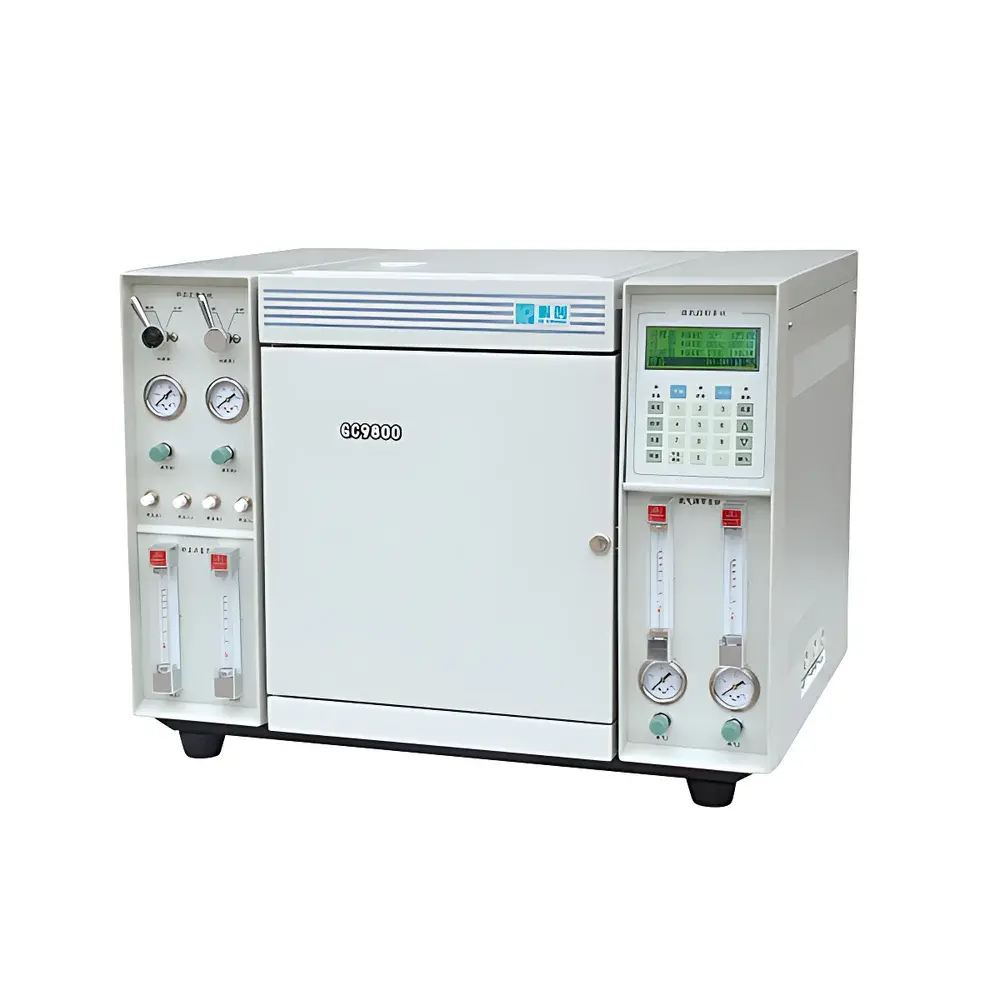
Kechuang GC9800 High-Purity Gas Analysis Gas Chromatograph
| Brand | Kechuang |
|---|---|
| Origin | Shanghai, China |
| Manufacturer Type | Direct Manufacturer |
| Instrument Type | Laboratory Gas Chromatograph |
| Application | Dedicated to High-Purity Gas Analysis |
| Oven Temperature Range | 8 °C above ambient to 400 °C |
| Oven Ramp Rate | 0.1–40 °C/min |
| Oven Cool-Down | 400 °C to 50 °C in ≤4 min |
| Carrier Gas Flow Control Range | 0–100 mL/min |
| Carrier Gas Pressure Control Range | 0–250 kPa |
| Injector Maximum Operating Temperature | 300 °C |
| Injector Pressure Setting Range | 0–250 kPa |
| Injector Total Flow Setting Range | 0–1200 mL/min |
| Detector | TC-1H Thermal Conductivity Detector (TCD) |
| TCD Sensitivity | ≥5000–10000 mV·mL/mg (benzene) |
| Baseline Noise | ≤0.01 mV |
| Baseline Drift | ≤0.1 mV/30 min |
| Linear Dynamic Range | 10⁵ |
| Minimum Detectable Concentration | H₂: 0.5 ppm, O₂: 1.5 ppm, N₂: 2 ppm |
| Temperature Control Accuracy | ±0.5% of setpoint |
| Programmable Temperature Steps | 8 |
| Temperature Program Reproducibility | ≤1% |
Overview
The Kechuang GC9800 High-Purity Gas Analysis Gas Chromatograph is a dedicated laboratory-scale gas chromatography system engineered for trace-level impurity profiling in ultra-high-purity (UHP) industrial gases—including hydrogen, nitrogen, oxygen, argon, helium, and synthetic air. It operates on the fundamental principle of differential partitioning between a mobile phase (inert carrier gas) and a stationary phase (capillary or packed column), enabling precise separation and quantification of permanent gases and low-boiling volatiles. The instrument integrates a high-sensitivity thermal conductivity detector (TC-1H TCD), optimized gas sampling manifold, and thermally stabilized column oven with near-ambient capability (≥8 °C above ambient), ensuring robust retention time reproducibility and baseline stability essential for compliance-driven gas purity certification. Designed for ISO 8573-1, SEMI F57, ASTM D1946, and IEC 60376 applications, the GC9800 supports routine verification of gas specifications down to sub-ppm levels in semiconductor fabrication, pharmaceutical inerting, and high-energy physics environments.
Key Features
- Eight-step programmable temperature control with ramp rates adjustable from 0.1 to 40 °C/min in 0.1 °C increments; oven cools from 400 °C to 50 °C in ≤4 minutes via motorized rear door actuation.
- Dual independent pressure and flow control for carrier gas (0–250 kPa / 0–100 mL/min) and injector total flow (0–1200 mL/min), supporting both constant-pressure and constant-flow operational modes.
- TC-1H thermal conductivity detector with ≥5000–10000 mV·mL/mg sensitivity (benzene), baseline noise ≤0.01 mV, drift ≤0.1 mV/30 min, and linear dynamic range of 10⁵—enabling accurate quantitation across four orders of magnitude without detector reconfiguration.
- Microprocessor-based embedded control architecture with six independently regulated temperature zones (oven, up to three injectors, up to two detectors) and four time-programmable event channels for valve switching, detector polarity reversal, or signal attenuation.
- 10/100BASE-T Ethernet interface compliant with TCP/IP v4, enabling remote instrument monitoring, method deployment, and real-time data streaming to centralized LIMS or ELN platforms without proprietary middleware.
- Self-diagnostic firmware with fault logging and automatic thermal cutoff: any zone exceeding user-defined temperature limits triggers immediate heater shutdown and audible/visual alarm, satisfying functional safety requirements per IEC 61508 SIL-1.
Sample Compatibility & Compliance
The GC9800 accommodates standard stainless-steel or fused-silica capillary columns (up to 60 m length, 0.53 mm ID) and packed columns (1/8″ OD, 2–4 m) compatible with molecular sieve 5A, Porapak Q, Hayesep D, and alumina PLOT phases. Its gas sampling system accepts direct connection to high-pressure gas cylinders (via pressure-reducing regulators), loop injection (0.25–5 mL), or online process taps using heated sample lines (optional). The system meets design and performance criteria referenced in ISO/IEC 17025 for testing laboratories, supports audit-ready electronic records per FDA 21 CFR Part 11 (when paired with validated workstation software), and facilitates GLP-compliant reporting through timestamped method parameters, raw chromatograms, and calibration history export.
Software & Data Management
The integrated GC workstation provides native Ethernet-based acquisition and processing without external DAQ hardware. It supports simultaneous control of up to 253 instruments per subnet, multi-user role-based access (administrator, analyst, reviewer), and automated peak integration using iterative tangent-skimming and valley-to-valley algorithms. All method files, sequence tables, calibration curves, and audit trails are stored in encrypted SQLite databases with SHA-256 checksums. Raw data export complies with ASTM E1947 (Chromatographic Data Exchange Format) and includes metadata headers conforming to netCDF-4 conventions for long-term archival interoperability.
Applications
- Quantitative analysis of residual O₂, N₂, CH₄, CO, CO₂, and H₂O in electronic-grade H₂ and He used in CVD/PVD tool purging.
- Verification of ISO 8573-1 Class 1–2 compressed air purity in cleanroom HVAC systems and medical breathing gas production.
- Trace hydrocarbon impurity screening in SF₆ insulating gas for high-voltage switchgear maintenance.
- Residual solvent profiling in cryogenic liquid nitrogen and argon deliveries per ASTM D7257.
- Validation of purge gas integrity during pharmaceutical lyophilization cycle qualification (ICH Q5C).
FAQ
What detection limits does the GC9800 achieve for common impurities in hydrogen?
The TC-1H TCD achieves 0.5 ppm for H₂ impurities (e.g., O₂, N₂, CH₄) under optimized conditions using a 1 mL gas loop, 5A molecular sieve column, and helium carrier at 30 mL/min.
Is the system compliant with 21 CFR Part 11 for regulated pharmaceutical use?
Yes—when deployed with the validated GCWorkstation v3.2+ and configured with electronic signatures, audit trail logging, and secure user authentication, it satisfies predicate rule requirements for electronic records and signatures.
Can the GC9800 operate unattended for extended sequences?
Yes—the embedded scheduler supports overnight and weekend runs with auto-shutdown, leak-check routines, and email/SNMP alerts upon completion or fault condition.
Does the column oven support isothermal operation at near-ambient temperatures?
Yes—temperature control is stable to within ±0.5% from 8 °C above ambient, enabling reliable separation of CO/CO₂/O₂/N₂ at 35 °C without cryogenic cooling.
What column configurations are recommended for UHP argon analysis?
A 3 m × 1/8″ SS column packed with 50/80 mesh Molecular Sieve 5A (60 Å) at 60 °C oven temperature, 25 mL/min He carrier, and 100 °C injector yields baseline resolution of Ar, O₂, N₂, CH₄, and CO in <8 min.




