
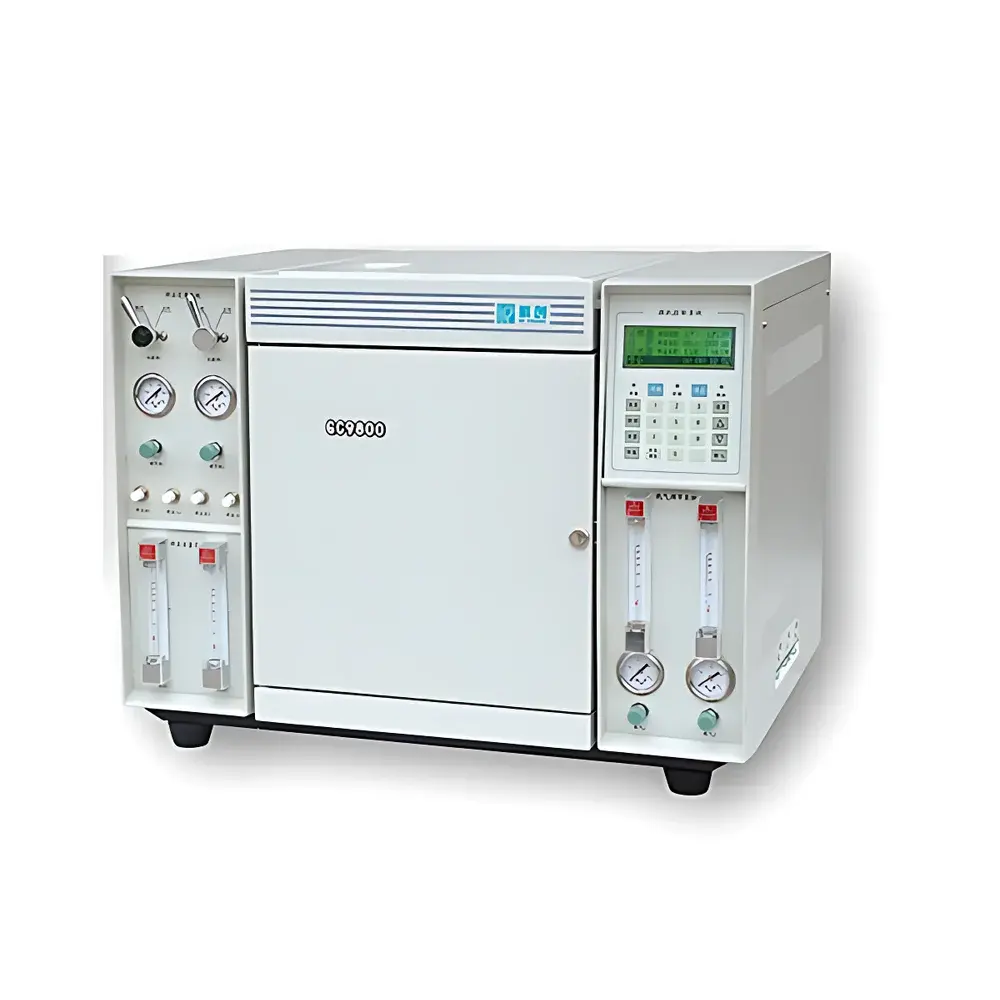
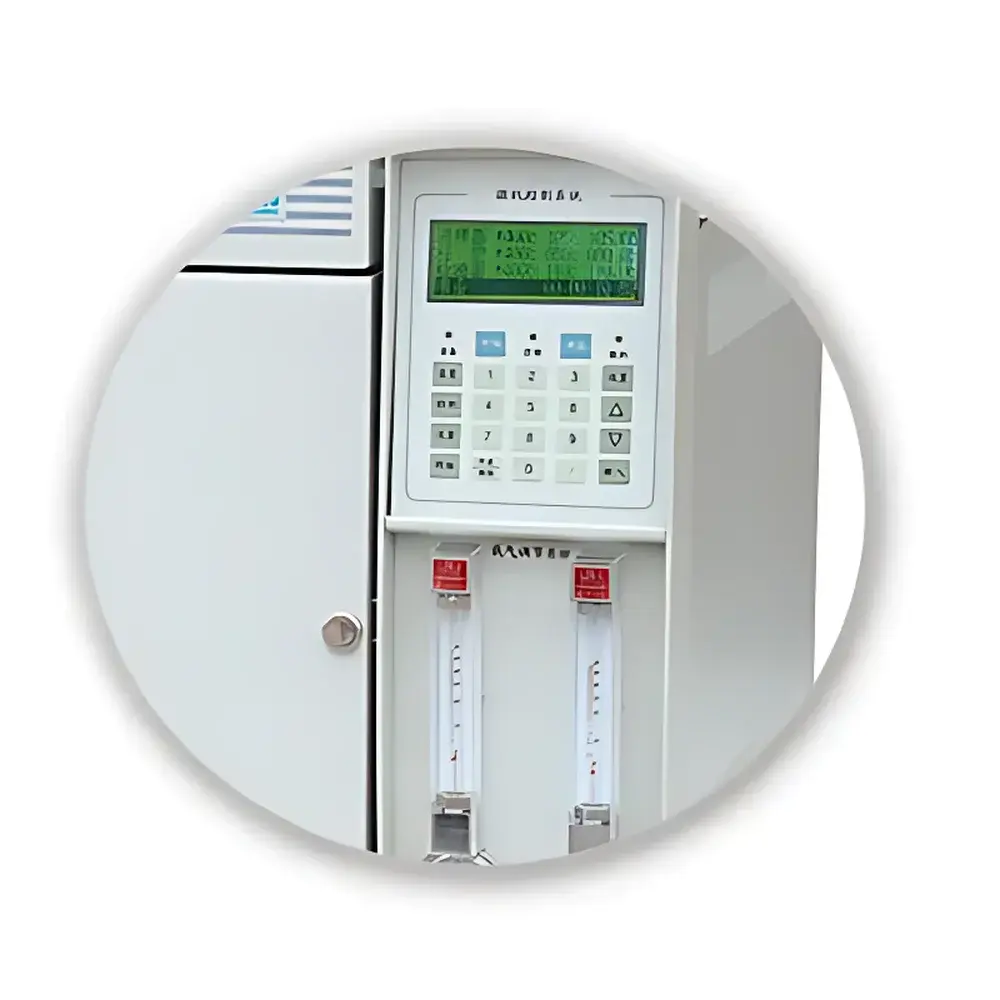
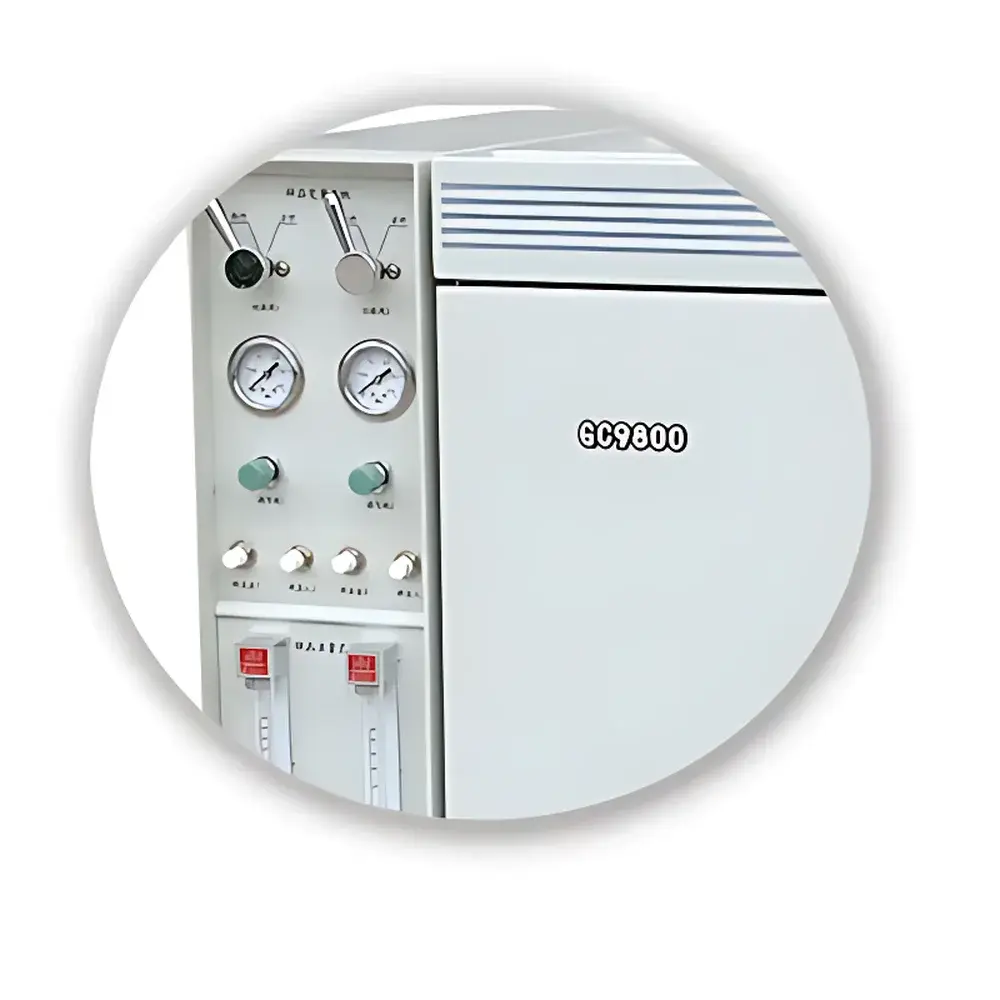
Kechuang GC9800 High-Purity Special Gas Analysis System
| Brand | Kechuang |
|---|---|
| Origin | Shanghai, China |
| Manufacturer Type | Direct Manufacturer |
| Region Category | Domestic (China) |
| Model | GC9800 High-Purity Gas Analyzer |
| Detection Targets | Trace impurity analysis in high-purity gases (He, H₂, N₂, CO₂, CH₄, O₂, CO, NH₃, Ar, etc.) |
| Detector | TC-1H Thermal Conductivity Detector (TCD) |
| TCD Sensitivity | ≥5000–10000 mV·mL/mg (benzene) |
| Baseline Noise | ≤0.01 mV |
| Baseline Drift | ≤0.1 mV/30 min |
| Linear Range | 10⁵ |
| Oven Temperature Range | 8°C above ambient to 400°C |
| Temperature Control Accuracy | ±0.5% |
| Programmable Temperature Ramping | 8-step |
| Ramp Rate | 0–39°C/min (0.1°C/min increment) |
| Ramp Reproducibility | ≤1% |
| Communication Interface | 10/100M Ethernet |
| Remote Control Capacity | Up to 253 units per workstation |
| Column Oven | Large-volume oven with automatic rear-door opening |
| Near-Ambient Operation | Enabled down to ambient +8°C |
| Self-Diagnostic System | Real-time fault localization and type identification |
| Over-Temperature Protection | Independent thermal cutoff for all six temperature zones |
Overview
The Kechuang GC9800 High-Purity Special Gas Analysis System is a dedicated gas chromatograph engineered for trace-level impurity quantification in ultra-high-purity (UHP) industrial and electronic-grade gases—including helium, hydrogen, nitrogen, argon, ammonia, carbon dioxide, methane, oxygen, and carbon monoxide. Built upon classical thermal conductivity detection (TCD) principles, the GC9800 leverages differential thermal conductivity between carrier gas and analyte molecules to deliver robust, non-destructive, and inherently stable detection—ideal for routine QC/QA in semiconductor fabrication, photovoltaic manufacturing, and high-purity gas production facilities. Its architecture adheres to fundamental chromatographic requirements: precise carrier gas flow control, thermally stable column environments, reproducible injection, and linear detector response across five orders of magnitude. Unlike flame ionization or mass spectrometric alternatives, the TCD-based GC9800 requires no hydrogen or air supply, eliminates combustion-related safety hazards, and ensures long-term baseline stability under continuous 24/7 operation—critical for unattended monitoring in cleanroom-adjacent labs or central utility rooms.
Key Features
- Six independent temperature-controlled zones—including oven, injector(s), detector, and auxiliary modules—with ±0.5% accuracy and programmable ramping up to 400°C.
- Eight-stage oven temperature programming with ramp rates adjustable in 0.1°C/min increments and reproducibility ≤1%, enabling optimized separation of closely eluting species (e.g., O₂/N₂/CH₄ in Ar matrix).
- Large-volume column oven with automatic rear-door opening for rapid cooling and near-ambient operation (as low as ambient +8°C), minimizing thermal stress on sensitive capillary or packed columns.
- Integrated 10/100M Ethernet interface supporting TCP/IP communication, allowing centralized remote control, real-time data streaming, and firmware updates without local console access.
- Network-capable architecture: a single workstation can concurrently manage up to 253 GC9800 units—facilitating fleet-wide deployment across multi-site gas production plants or regional calibration laboratories.
- Comprehensive self-diagnostic system that identifies fault location (e.g., “Injector Zone 2 heater open circuit”) and severity level, reducing mean time to repair (MTTR) and supporting predictive maintenance planning.
- Dual-layer over-temperature protection: hardware-level thermal cutoff plus software-enforced interlock, ensuring immediate shutdown if any zone exceeds user-defined limits—fully compliant with IEC 61010-1 safety requirements.
Sample Compatibility & Compliance
The GC9800 is validated for analysis of gaseous samples with purity levels ≥99.999% (5N) and impurity concentrations ranging from sub-ppm (v/v) to low-ppm levels. It accommodates both stainless-steel and fused-silica capillary columns, as well as packed columns (e.g., molecular sieve 5A, Porapak Q), configured for specific gas matrices—such as NH₃-in-N₂ or CO-in-He applications. The system supports standardized gas sampling protocols per ASTM D1946 (Analysis of Gases by Gas Chromatography), ISO 8573-5 (Compressed Air — Part 5: Determination of Oil Vapor and Organic Solvent Content), and SEMI F57 (Specification for Electronic Grade Gases). All hardware and firmware components are designed to meet electromagnetic compatibility (EMC) standards EN 61326-1 and safety standard EN 61010-1. Data integrity features—including audit trail logging, user authentication, and electronic signature support—align with GLP and GMP expectations, and may be extended to satisfy FDA 21 CFR Part 11 requirements when deployed with validated third-party LIMS integration.
Software & Data Management
The GC9800 operates with an embedded chromatographic data system (CDS) accessible via standard web browser or dedicated Windows client. Raw analog signals are digitized at 20-bit resolution and transmitted over Ethernet as native .CDF or .CSV files—eliminating proprietary file lock-in. The software provides full method development tools: peak integration with customizable baselines, retention time locking, multi-point calibration curve generation (linear, quadratic, or polynomial), and automatic impurity quantitation against certified reference standards. All acquisition, processing, and reporting events—including user logins, parameter changes, and result exports—are timestamped and logged in a tamper-resistant audit trail. Data export complies with ASTM E1394 and ASTM E2500 standards for interoperability with enterprise LIMS, MES, or ERP platforms. Remote diagnostics and firmware updates are performed securely over HTTPS with TLS 1.2 encryption.
Applications
- Quality assurance of bulk and cylinder-delivered UHP gases used in semiconductor diffusion furnaces, CVD/PVD tool purging, and excimer laser gas mixtures.
- Monitoring residual moisture, hydrocarbons, and reactive impurities (e.g., NH₃, CO, H₂) in electronic-grade nitrogen and argon supplied to fab cleanrooms.
- Verification of gas purity specifications per CGA G-4.1 (Compressed Gas Association) and ISO 8573-1 Class 0 (oil-free, particle-free, water-free).
- Trace-level analysis of synthesis gas streams in hydrogen production and ammonia cracking processes.
- Environmental compliance testing of vented process gases for VOCs and regulated pollutants prior to abatement system discharge.
- Calibration gas certification in national metrology institutes and accredited reference material producers.
FAQ
What detection limit can the GC9800 achieve for hydrogen in argon using the TC-1H detector?
Typical detection limits range from 0.1 to 0.5 ppm (v/v) for H₂ in Ar under optimized conditions (e.g., 2-m molecular sieve column, 40°C isothermal, 30 mL/min He carrier flow), depending on sample volume, integration time, and signal-to-noise ratio optimization.
Is the GC9800 compatible with third-party LIMS or ELN systems?
Yes—the instrument supports standard data export formats (.CSV, .CDF) and offers RESTful API endpoints for bidirectional integration with LIMS, ELN, or SCADA platforms. Validation documentation for such integrations is available upon request.
Can the GC9800 perform simultaneous analysis of multiple gas cylinders without manual intervention?
When paired with an automated multi-port gas sampling valve (e.g., 12-position rotary valve, optional accessory), the GC9800 supports unattended sequential analysis of up to 12 cylinders per run, with programmable dwell times and auto-zeroing between injections.
Does the system meet regulatory requirements for pharmaceutical or medical gas testing?
While primarily deployed in industrial and electronics sectors, the GC9800’s performance characteristics align with USP and EP 2.5.27 for medicinal gas purity testing; formal validation kits and IQ/OQ/PQ protocols are available for GMP-regulated environments.
How is column bleed or baseline drift managed during long-duration runs?
The dual-stage oven insulation, precision PID temperature control, and active baseline compensation algorithm minimize thermal drift. Additionally, the system supports scheduled auto-zero cycles and post-run bake-out routines to purge accumulated contaminants from the column and detector.
Related Products







