
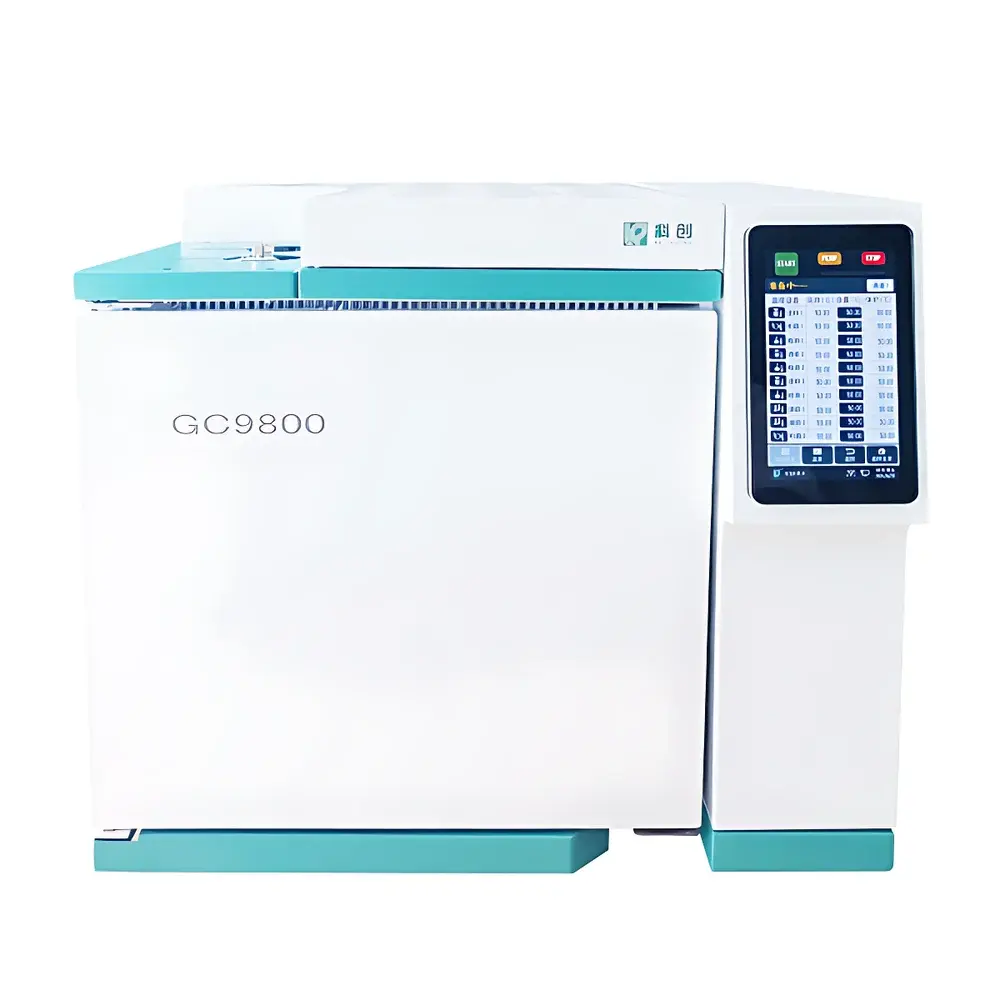
Kechuang GC9800 Laboratory Gas Chromatograph for Ethylene Oxide (EO) Residue Analysis in Sterilized Medical Devices
| Brand | Kechuang |
|---|---|
| Origin | Shanghai, China |
| Manufacturer Type | OEM Manufacturer |
| Region Category | Domestic (China) |
| Model | GC9800 |
| Price Range | USD 7,000 – 14,000 |
| Instrument Type | Benchtop Laboratory Gas Chromatograph |
| Application Scope | General-Purpose Quantitative Analysis |
| Oven Temperature Range | +5 °C above ambient to 400 °C |
| Maximum Ramp Rate | 0–40 °C/min |
Overview
The Kechuang GC9800 is a high-precision, network-enabled laboratory gas chromatograph engineered for trace-level quantification of ethylene oxide (EO) residual concentrations in sterilized medical devices, pharmaceutical packaging, and polymeric materials. It operates on the principle of capillary gas chromatography with selective detection—optimized for compliance with ISO 10993-7, USP , and ASTM F1980 methodologies for EO residue testing. The system employs a dual-column oven architecture with independent programmable temperature control, enabling simultaneous or sequential analysis of EO and its primary hydrolysis byproduct, ethylene glycol (EG), under precisely defined thermal gradients. Its robust pneumatic architecture integrates electronic pressure and flow control (EPC/EFC) for carrier gas delivery, ensuring retention time stability (RSD ≤ 0.008%) and peak area reproducibility (RSD ≤ 1.0%) across multi-day validation runs—critical for GLP-compliant release testing in regulated manufacturing environments.
Key Features
- 10-channel independent temperature control system, including two fully programmable column ovens with 16-stage (extendable to unlimited-stage) ramp profiles and cooling recovery ≤ 5 min (350 °C → 50 °C) via motorized backdoor actuation.
- Integrated RJ45 Ethernet interface supporting TCP/IP-based remote instrument control, real-time data streaming, and centralized fleet management—up to 253 units controllable from a single workstation, with audit-ready event logging aligned with FDA 21 CFR Part 11 requirements.
- Standard EPC/EFC module delivering pressure control resolution of 0.001 psi and mass flow resolution of 0.001 mL/min across up to 24 independent gas channels; supports constant-pressure, constant-flow, and multi-step programmed pressure/flow modes (up to 8 steps).
- 7-inch capacitive touchscreen HMI with embedded baseline visualization, real-time chromatogram display, and direct instrument parameter adjustment—eliminating dependency on external PC during routine operation.
- Modular detector architecture accommodating TCD, FID, ECD, and FPD configurations; all detectors feature wide-dynamic-range amplifiers (non-saturating solvent peak response) and hardware-level self-diagnostic reporting with thermal fault localization.
- Onboard 8-event external timing controller for automated valve switching, sample loop injection, and multi-cycle unattended operation—enabling continuous monitoring of EO off-gassing kinetics per ISO 10993-7 Annex C protocols.
Sample Compatibility & Compliance
The GC9800 is validated for headspace gas analysis of EO residues extracted from Class I–III medical devices (e.g., catheters, syringes, surgical drapes) using standardized vial equilibration (ISO 10993-7:2023, Clause 6.3). Compatible sample matrices include PVC, polyethylene, polypropylene, silicone elastomers, and lyophilized drug product stoppers. The system meets essential performance criteria for regulatory submissions: retention time stability (≤ 0.008% RSD), peak area precision (≤ 1.0% RSD), and detection sensitivity (FID LOD ≤ 3.0 × 10⁻¹² g/s for n-hexadecane; ECD LOD ≤ 10 fg/mL for γ-HCH). All firmware and software modules are designed to support 21 CFR Part 11-compliant electronic signatures, audit trails, and data integrity controls required for FDA, MDR, and PMDA submissions.
Software & Data Management
The GC9800 ships with Kechuang ChromaLink™ 3.2 workstation software—a GxP-ready platform featuring dual-mode acquisition (real-time signal capture and post-run reprocessing), customizable report templates (PDF/CSV/XLSX export), and integrated calibration curve management with quadratic/quartic regression options. The software enforces role-based access control (RBAC), automatic backup to network drives, and time-stamped revision history for all method files and raw data. Raw chromatograms are stored in open-standard .cdf format (NetCDF-compatible), facilitating third-party integration with LIMS (e.g., LabWare, Thermo SampleManager) and statistical process control (SPC) systems. Remote diagnostics and firmware updates are delivered via secure HTTPS channel with SHA-256 signature verification.
Applications
- Quantitative determination of EO residuals in pre-sterilized and post-sterilization medical device packaging per ISO 10993-7 and YY/T 0681.12–2022.
- Stability-indicating assay of EO degradation products (e.g., ethylene glycol, ethylene chlorohydrin) in polymer matrix extracts.
- Method transfer and validation support for QC laboratories implementing USP EO residue limits (≤ 10 ppm for implantables; ≤ 60 ppm for surface-contact devices).
- Environmental monitoring of EO sterilization chamber exhaust and workplace air samples (OSHA PEL: 1 ppm TWA).
- Raw material screening of EO-sterilized excipients (e.g., microcrystalline cellulose, lactose monohydrate) prior to API blending.
FAQ
Does the GC9800 meet ISO 10993-7 requirements for EO residue testing?
Yes—the instrument’s thermal stability, retention time repeatability, and detector sensitivity align with the instrumental performance verification criteria specified in ISO 10993-7:2023 Annex B.
Can the system be integrated into an existing LIMS environment?
Yes—via ODBC/JDBC drivers and .cdf file export; optional HL7 and ASTM E1384 interfaces available upon request.
Is ECD detection mandatory for EO analysis, or can FID be used?
FID is sufficient for most routine EO quantitation (LOQ ~ 0.1 ppm in headspace); ECD provides enhanced selectivity for low-level EG detection in complex matrices.
What is the maximum number of independent temperature zones supported?
Ten—including dual column ovens, six detector zones, and two auxiliary zones (e.g., valve box, transfer line).
Does the GC9800 support method validation per ICH Q2(R2)?
Yes—software includes built-in tools for accuracy, precision, linearity, LOD/LOQ, and robustness assessment per ICH Q2(R2) guidelines.




