
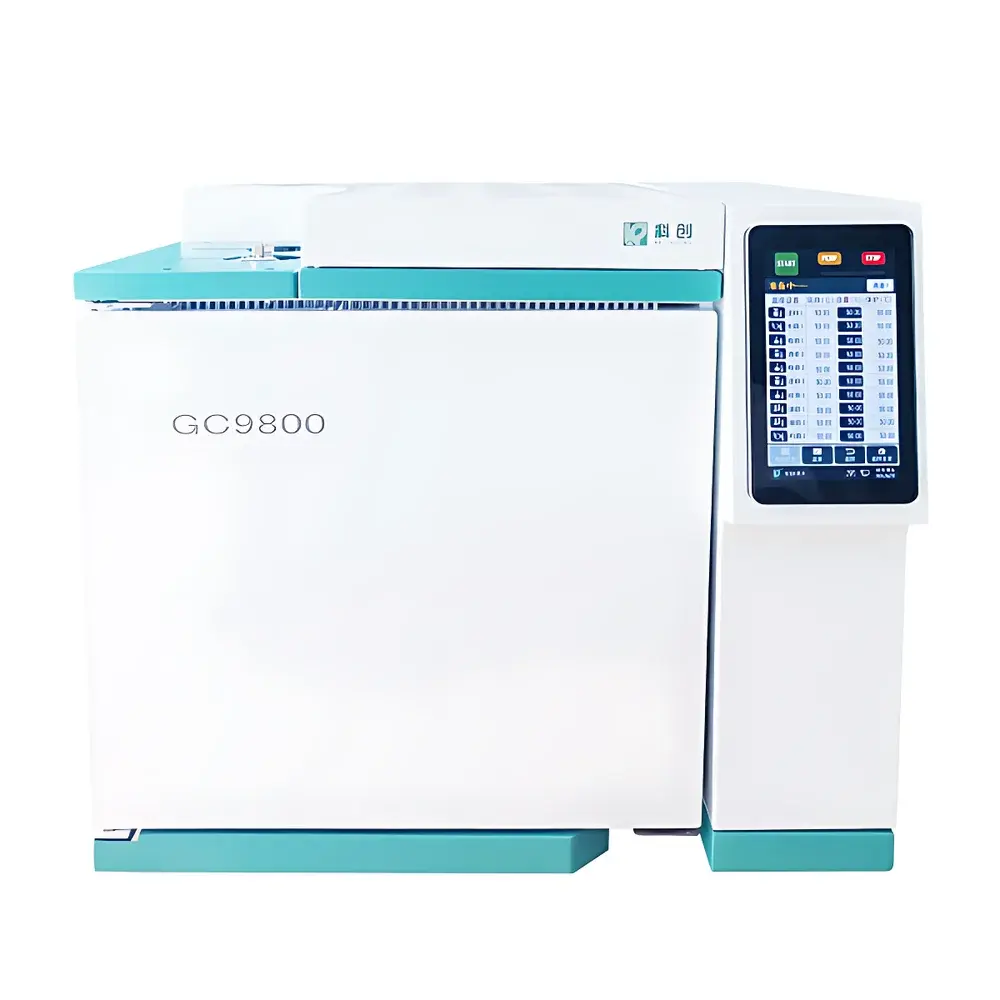
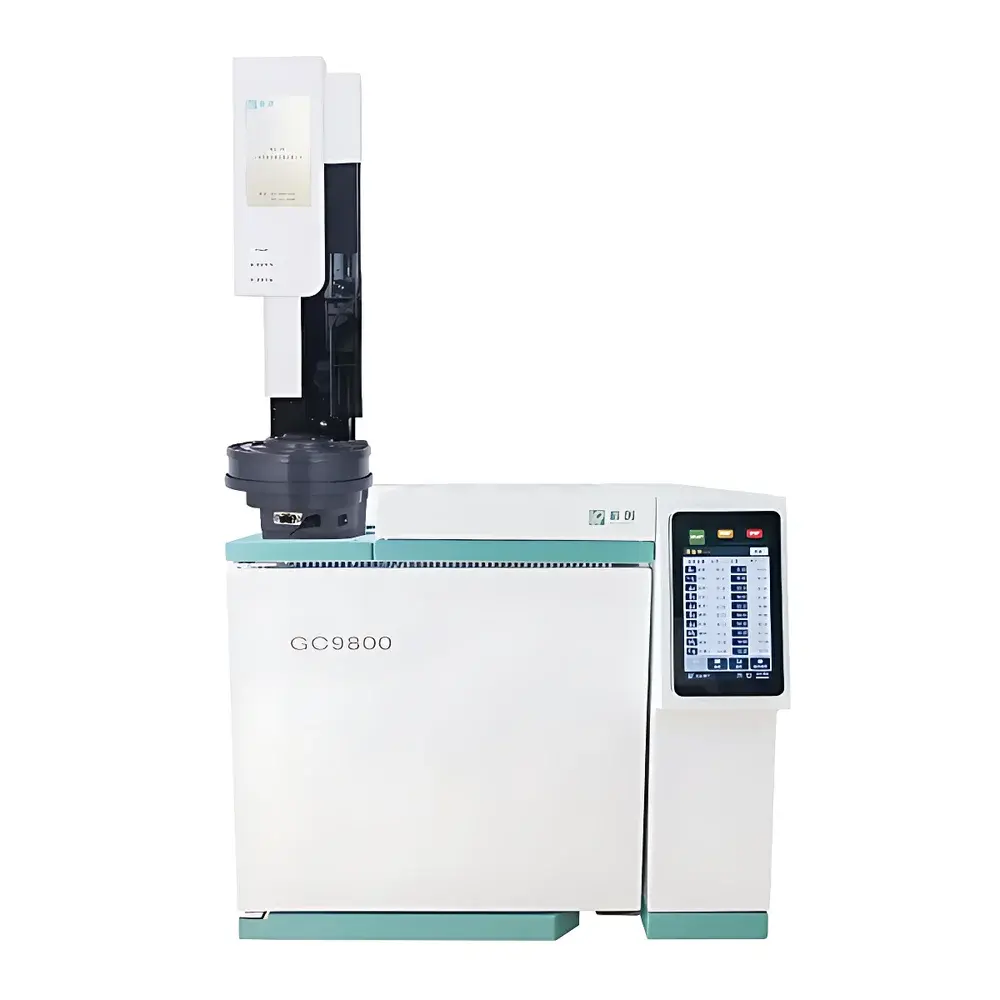
Kechuang GC9800N/F Food-Grade Fatty Acid Profiling Gas Chromatograph
| Brand | Kechuang |
|---|---|
| Origin | Shanghai, China |
| Manufacturer Type | Direct Manufacturer |
| Instrument Type | Laboratory Gas Chromatograph |
| Model | GC9800N/F |
| Temperature Control Range | Ambient + 3°C to 450°C |
| Ramp Rate | 0.1–40 °C/min |
| Cooling Rate | 350°C to 50°C in ≤5 min (with auto back-flush door) |
| Carrier Gas Flow Control Range | 0–100 mL/min |
| Carrier Gas Pressure Control Range | 0–250 kPa |
| Injector Max Temp | 300°C |
| Injector Pressure Set Range | 0–250 kPa |
| Total Injector Flow Set Range | 0–1200 mL/min |
| Detection Modes | TCD, FID, ECD, FPD (configurable) |
| Column Oven Programmable Stages | Up to 16 (expandable to unlimited) |
| EPC/EFC Precision | ±0.001 psi (pressure), ±0.001 mL/min (flow) |
| Retention Time RSD | <0.008% |
| Peak Area RSD | <1.0% |
| Power Supply | 220 V ±10%, 50 Hz ±5% |
| Dimensions (W×D×H) | 530 × 570 × 506 mm |
| Weight | ≤50 kg |
Overview
The Kechuang GC9800N/F is a dedicated gas chromatograph engineered for precise, reproducible fatty acid methyl ester (FAME) profiling in edible oils and lipid matrices. It operates on the principle of capillary gas chromatography with flame ionization detection (FID), optimized for compliance with AOAC 996.06, ISO 5508, ISO 12966-2, and USP residual solvent methodologies. The system employs a dual-column oven architecture with independent temperature control—enabling simultaneous or sequential analysis of saturated, monounsaturated, and polyunsaturated fatty acids (e.g., C12:0 to C24:1) under precisely programmed thermal gradients. Its high-stability oven design ensures thermal homogeneity across the column bed, minimizing retention time drift and enhancing quantitative accuracy in complex triglyceride hydrolysates and transesterified samples.
Key Features
- 10-channel independent temperature control system, including two programmable column ovens with 0.01°C resolution and ±0.1% stability over full operating range (ambient + 3°C to 450°C)
- Integrated electronic pressure/flow control (EPC/EFC) with 0.001 psi pressure and 0.001 mL/min flow resolution; supports constant pressure, constant flow, and multi-step program ramping (up to 8 stages)
- 7-inch industrial-grade capacitive touchscreen interface with real-time baseline monitoring, spectral overlay, and embedded acquisition logic—eliminating dependency on external PC during method execution
- RJ45 Ethernet interface enabling native TCP/IP communication; compatible with centralized laboratory informatics systems (LIMS) and remote supervision architectures per FDA 21 CFR Part 11 requirements
- Dual-detector signal routing capability: software-defined time-programmed acquisition from up to four detectors (FID/TCD/ECD/FPD) on shared or isolated data channels
- Self-diagnostic firmware with real-time fault logging—including heater failure, sensor deviation, pressure anomaly, and oven door status—with automatic thermal shutdown if any zone exceeds user-defined safety thresholds
- Expandable hardware architecture: built-in MS interface port, 8-channel external event timer for autosampler synchronization, and optional variable-frequency cooling motor for rapid oven cooldown (<5 min from 350°C to 50°C)
Sample Compatibility & Compliance
The GC9800N/F accommodates derivatized oil samples prepared via BF₃-methanol or NaOH-methanol transesterification, as specified in AOAC Official Method 996.06. It accepts standard 0.25–0.53 mm ID fused-silica capillary columns (e.g., SP-2560, CP-Sil 88, or equivalent polar cyanopropyl phases) with lengths up to 100 m. The system meets ISO/IEC 17025:2017 calibration traceability requirements when operated with NIST-traceable FAME standards (e.g., Supelco 37 Component Mix). All thermal and pneumatic parameters are auditable and exportable in CSV/CSV-TSV formats for GLP/GMP documentation. The instrument complies with IEC 61010-1 for electrical safety and EN 61326-1 for electromagnetic compatibility in laboratory environments.
Software & Data Management
The proprietary ChromaVision™ workstation provides full bidirectional instrument control, method development, peak integration (tangent skim, valley-to-valley, exponential curve fitting), and report generation compliant with ISO 17025 Annex A.2 audit trails record all user actions—including method edits, calibration updates, and result reprocessing—with timestamped digital signatures. Data files conform to ASTM E1947-compliant .CDF format and support direct import into statistical platforms (e.g., SIMCA, Unscrambler) for multivariate fatty acid pattern analysis. Remote access enables centralized validation oversight, with role-based permissions (analyst, supervisor, QA reviewer) aligned with 21 CFR Part 11 electronic signature requirements.
Applications
- Quantitative determination of individual fatty acids (C8:0–C24:1) in vegetable oils (soybean, palm, sunflower, olive), animal fats, and marine oils
- Adulteration screening—e.g., detection of cheaper oils (cottonseed, corn) in premium olive oil via C18:2/C18:3 ratio and sterol profile correlation
- Shelf-life monitoring through peroxidation-derived volatile aldehydes (hexanal, nonanal) using headspace-GC/FID
- Trans-fatty acid (TFA) quantification per WHO/FAO guidelines and EU Regulation (EC) No 1924/2006 labeling thresholds
- Support for AOAC 2012.01 (fatty acid composition in infant formula) and Codex Alimentarius STAN 256-2007 nutritional labeling compliance
FAQ
Does the GC9800N/F support automated calibration verification per ISO 80000-1?
Yes—the system includes scheduled auto-calibration routines using certified reference gases and FAME standards, with results logged in the audit trail and exportable for metrological review.
Can the instrument be integrated into an existing LIMS without custom middleware?
Yes—native HTTP API and OPC UA support enable direct LIMS connectivity without third-party drivers; configuration templates are provided for Thermo Fisher SampleManager, LabVantage, and Waters Empower.
Is method transfer validated between GC9800N/F and legacy Agilent/SHIMADZU platforms?
Method equivalency studies per ICH Q2(R2) guidelines are supported via retention time locking, relative retention indexing, and peak symmetry validation protocols included in ChromaVision™.
What carrier gases are certified for use with the EPC system?
N₂, H₂, He, and Ar are fully supported; pressure/flow profiles are pre-validated for each gas type in the firmware, with viscosity compensation algorithms embedded in the EPC control loop.
How is data integrity maintained during power interruption?
The main controller features non-volatile flash memory that preserves active method parameters, acquisition buffers, and detector baselines; resume-on-power-up functionality restores acquisition at the exact retention time point of interruption.





