
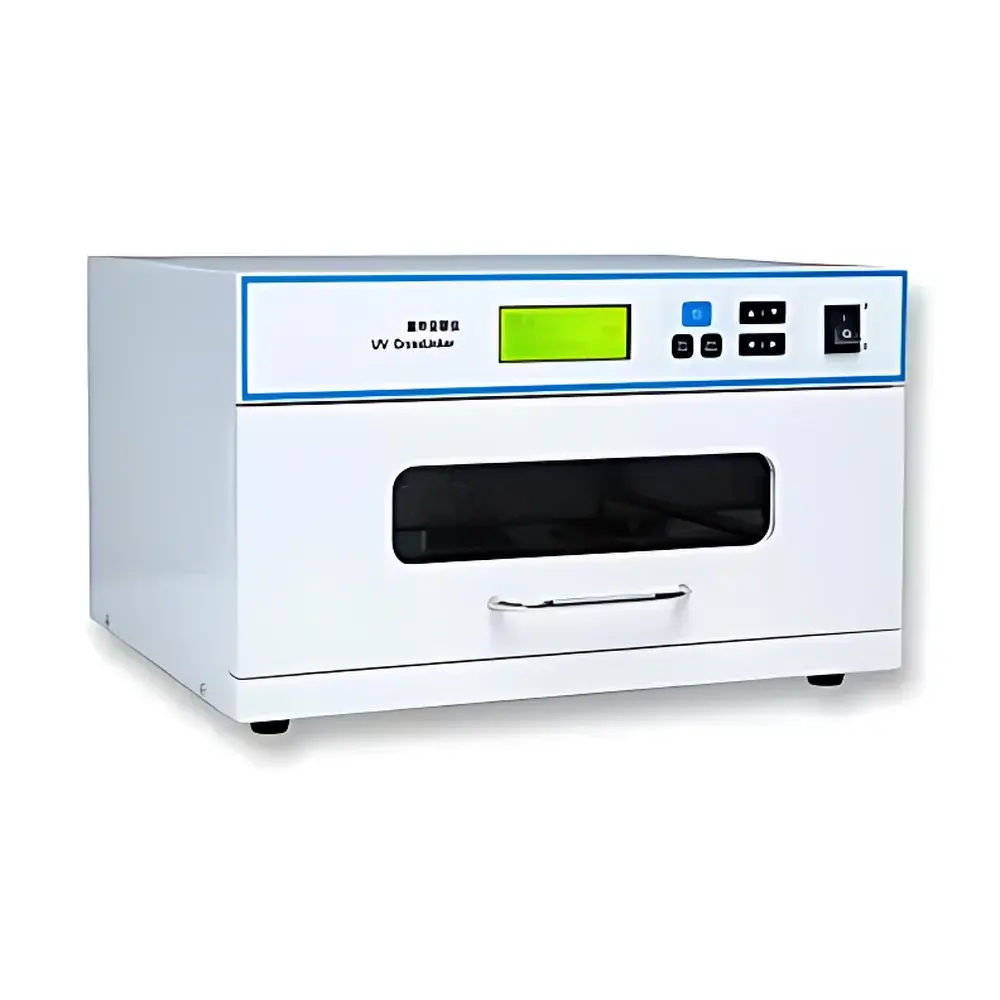
Keebio CX2000 UV Crosslinker
| Brand | Keebio |
|---|---|
| Model | CX2000 |
| UV Wavelength | 254 nm (standard), optional 312 nm & 365 nm lamps |
| UV Lamp Configuration | 5 × 10 W low-pressure mercury lamps |
| Max. UV Irradiance | 5 mW/cm² |
| Exposure Time Range | 0–999.9 min |
| Energy Dose Range | 0–99.99 J |
| Chamber Dimensions (L×W×H) | 340 mm × 260 mm × 150 mm |
| External Dimensions | 360 mm × 340 mm × 310 mm |
| Net Weight | 15 kg |
| Power Input | AC 100–230 V, 50/60 Hz, 60 W |
| Memory Storage | 9 programmable energy/time presets |
| Control Interface | Microprocessor-based with LED display |
| Safety Features | Interlocked UV viewing window and door safety switch |
| Chamber Illumination Area | 920 cm² |
| Compliance | Designed for laboratory use under standard biosafety and electrical safety guidelines (IEC 61010-1) |
Overview
The Keebio CX2000 UV Crosslinker is a microprocessor-controlled ultraviolet irradiation system engineered for precise covalent immobilization of nucleic acids onto solid supports—including nylon, nitrocellulose, and PVDF membranes—prior to hybridization in Southern blot, Northern blot, and dot/slot blot applications. It operates on the principle of UV-induced photochemical crosslinking, where short-wavelength ultraviolet light (primarily at 254 nm) generates pyrimidine dimers and other photoproducts between nucleic acid strands and reactive groups on membrane surfaces, thereby enhancing binding stability and signal reproducibility. In addition to nucleic acid fixation, the CX2000 serves as an effective tool for decontaminating PCR workspaces, pipette tips, and reusable plasticware by inactivating residual DNA templates through thymine dimer formation—reducing carryover contamination without chemical agents or heat.
Key Features
- Precision UV dosimetry: Real-time calculation and display of cumulative UV energy dose (J) and exposure time (min), enabling repeatable, protocol-driven crosslinking independent of lamp aging or ambient temperature fluctuations.
- Dual-mode operation: Selectable time-based or energy-based exposure control—ensuring consistent results across varying lamp output or chamber loading conditions.
- High-intensity uniform irradiation: Five 10 W low-pressure mercury UV lamps deliver up to 5 mW/cm² irradiance across a 920 cm² active area, verified via calibrated radiometric mapping.
- Intuitive user interface: LED display with dedicated parameter keys; automatic memory retention of nine user-defined protocols (energy/time combinations) for rapid recall and audit-ready repeatability.
- Enhanced operator safety: Integrated door interlock system disables UV emission when chamber access is opened; polycarbonate UV-blocking viewing window permits real-time observation without exposure risk.
- Ergonomic drawer-style chamber design: Facilitates quick sample placement and retrieval while minimizing ambient light interference during exposure cycles.
Sample Compatibility & Compliance
The CX2000 accommodates standard blotting membranes (up to 20 × 25 cm), multi-well plates (e.g., 96-well PCR plates), microcentrifuge tubes (0.2–2.0 mL), and glass slides. Its chamber geometry supports simultaneous treatment of multiple samples without shadowing artifacts. The instrument complies with IEC 61010-1 for electrical safety in laboratory environments and incorporates fail-safe circuitry to prevent unintended UV activation. While not certified to ISO/IEC 17025 or FDA 21 CFR Part 11, its programmable parameters, non-volatile protocol storage, and deterministic exposure logic support GLP-aligned documentation practices when integrated into validated lab workflows.
Software & Data Management
The CX2000 operates without external software—its embedded firmware manages all exposure calculations, memory storage, and safety interlocks autonomously. All settings are retained after power cycling. For laboratories requiring electronic recordkeeping, manual logging of protocol IDs, batch numbers, and exposure logs (time, energy, operator ID) is supported via printed lab notebooks or LIMS integration using standardized SOP templates. No proprietary drivers or cloud connectivity are implemented, preserving data sovereignty and minimizing cybersecurity surface area—a critical consideration for regulated molecular biology labs.
Applications
- Nucleic acid immobilization for Southern/Northern blotting, reducing background and improving hybridization sensitivity by 5–10× compared to passive baking or UV-free methods.
- UV-mediated decontamination of PCR workstations, pipette shafts, and reusable consumables to mitigate false-positive amplification.
- Covalent attachment of oligonucleotide probes or RNA standards to solid-phase carriers in diagnostic assay development.
- Photocrosslinking of RNA-protein complexes (e.g., in CLIP-seq sample prep) where controlled, sub-lethal UV doses preserve epitope integrity.
- Routine validation of UV lamp output consistency using calibrated radiometers prior to critical experiments.
FAQ
What UV wavelengths are available on the CX2000?
The unit ships with five 254 nm low-pressure mercury lamps as standard. Optional 312 nm and 365 nm lamp sets are available for applications requiring longer-wavelength UV activation (e.g., certain photoactivatable crosslinkers or UV-curable coatings).
Can the CX2000 be used for RNA crosslinking?
Yes—254 nm irradiation effectively crosslinks RNA to nylon membranes. However, prolonged exposure may cause RNA fragmentation; optimization of dose (typically 0.12–0.25 J/cm²) is recommended for intact transcript retention.
Is calibration required before first use?
While factory-calibrated, users should verify irradiance output using a NIST-traceable UV radiometer before initiating high-stakes experiments—especially after lamp replacement or extended storage.
How does the energy mode differ from time mode?
Energy mode calculates exposure duration dynamically based on real-time irradiance feedback, ensuring consistent total dose regardless of lamp intensity drift. Time mode applies fixed duration regardless of measured output—suitable for stable, well-characterized lamp sets.
Does the CX2000 meet regulatory requirements for GMP labs?
It is not pre-validated for GMP, but its deterministic control logic, protocol memory, and mechanical safety interlocks enable qualification per internal SOPs and Annex 11 principles when accompanied by documented IQ/OQ protocols.





