
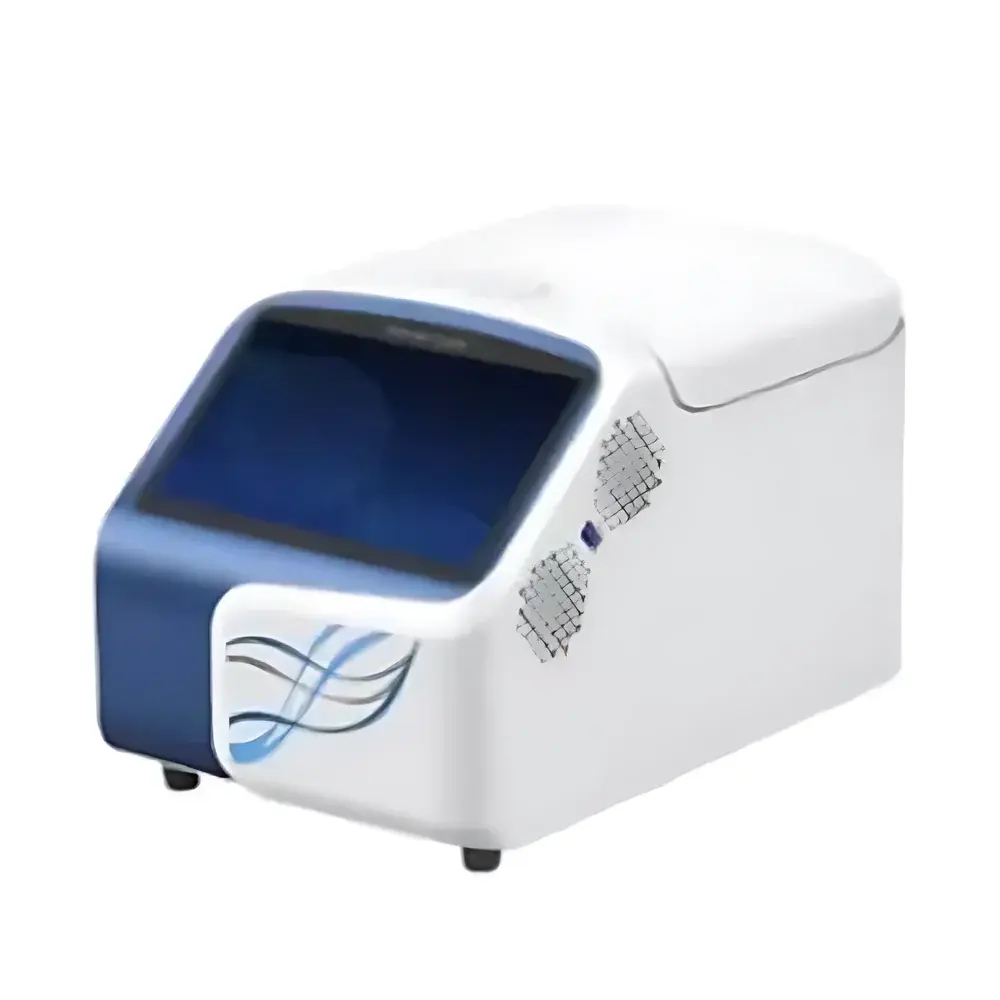
Keebio Keebio-96G Gradient Thermal Cycler with 7-inch Touchscreen
| Brand | Keebio |
|---|---|
| Origin | Shanghai, China |
| Model | Keebio-96G |
| Instrument Type | Gradient PCR Thermal Cycler |
| Sample Capacity | 96-well (0.2 mL format, compatible with full-skirted, half-skirted, non-skirted plates |
| Temperature Range | 4–99.9 °C |
| Max Heating/Cooling Rate | 5.0 °C/s |
| Block Temperature Uniformity | ±0.3 °C at 55 °C |
| Gradient Range | Up to 36 °C, accuracy ±0.5 °C |
| Temperature Accuracy | ≤±0.1 °C at 55 °C |
| Temperature Control Modes | BLOCK mode (block surface temperature), TUBE mode (algorithm-based estimation of actual sample temperature) |
| Ramp Rate Adjustment | 0.1–4.5 °C/s |
| Programmable Cycles | Up to 99 |
| Time Increment/Decrement | 0.1–9 min 59 sec |
| Temp Increment/Decrement | 0.1–9.9 °C |
| Hold Temperature | 4 °C long-term hold |
| Heat Lid Temperature Range | Room temp +5 to 110 °C |
| Heat Lid Accuracy | ±5 °C |
| Heat Lid Display Resolution | 0.1 °C |
| Power Input | 100–240 VAC, 50/60 Hz |
| Max Power Consumption | 600 W |
| Dimensions (D×W×H) | 280 × 187 × 190 mm |
| Net Weight | 7 kg |
| Display | 7-inch color capacitive touchscreen |
| Data Interface | USB port |
Overview
The Keebio Keebio-96G Gradient Thermal Cycler is an engineered solution for precise, reproducible nucleic acid amplification under demanding laboratory conditions. Based on Peltier-driven thermoelectric heating and cooling architecture, the instrument delivers rapid thermal transitions—up to 5.0 °C/s—while maintaining tight spatial and temporal temperature control across the entire 96-well aluminum block. Its dual-mode temperature regulation system (BLOCK and TUBE modes) enables method-specific optimization: BLOCK mode reports direct metal surface temperature for protocol transferability and inter-instrument comparability; TUBE mode employs a proprietary thermal simulation algorithm to estimate real-time reaction mixture temperature based on volume, tube geometry, and thermal mass—critical for high-fidelity endpoint and quantitative PCR applications. Designed for compliance with routine molecular biology workflows, the Keebio-96G supports gradient-enabled assay development, touchdown PCR, long PCR, and stepwise cycling protocols—all programmable via its intuitive 7-inch color touchscreen interface.
Key Features
- Thermoelectric (Peltier) temperature control system with industrial-grade semiconductor modules for enhanced longevity and stability
- Dual thermal control modes: BLOCK mode for standardized protocol execution; TUBE mode for volume-adaptive sample temperature estimation
- 7-inch capacitive touchscreen with graphical user interface, built-in operation guide, and multilingual menu support
- Programmable ramp rate (0.1–4.5 °C/s) and flexible cycle parameters—including time/temperature increments, up to 99 cycles, and customizable pause points
- Integrated Tm calculator supporting primer pair analysis and annealing temperature recommendation
- Smart heat lid with auto-closure upon program completion or when block temperature drops below 4 °C—reducing evaporation and enabling cold storage of amplified products
- Rear-mounted exhaust design minimizes thermal interference in multi-unit configurations, supporting dense benchtop deployment
- Robust mechanical heat lid latch ensures consistent pressure application across all 96 wells, improving seal integrity and thermal coupling
Sample Compatibility & Compliance
The Keebio-96G accommodates standard 96-well formats including full-skirted, half-skirted, and non-skirted microplates, as well as 12×8 and 8×12 strip tubes and individual 0.2 mL PCR tubes. Its uniform thermal performance (±0.3 °C at 55 °C) meets ISO 13485-aligned manufacturing consistency requirements for in vitro diagnostic (IVD) development environments. While not certified for clinical diagnostics under FDA 510(k) or CE-IVDR, the instrument’s architecture supports GLP-compliant documentation practices through USB data export and timestamped run logs. Its programmable gradient function (up to 36 °C span, ±0.5 °C accuracy) facilitates robust assay optimization per ASTM E2587-22 guidelines for thermal cycler qualification. The device operates within IEC 61010-1 safety standards for laboratory electrical equipment.
Software & Data Management
All protocols, run logs, and thermal profiles are stored locally on-device with unlimited program capacity. Data export is supported via USB 2.0 interface in CSV and PDF formats—enabling integration into LIMS or ELN systems. Timestamped run records include start/end times, cycle counts, gradient settings, ramp rates, and real-time temperature traces (sampled at 0.5 s intervals). No proprietary software installation is required; exported files are natively readable in Excel, GraphPad Prism, or Python/Pandas environments. Audit trail functionality is implemented through immutable internal logging—consistent with ALCOA+ principles for data integrity in regulated research settings. Firmware updates are delivered via USB-loaded binary packages, ensuring version traceability and controlled change management.
Applications
The Keebio-96G serves core molecular workflows across academic, industrial, and public health laboratories. It is routinely deployed in pathogen detection assays for SARS-CoV-2, influenza, and enteric viruses; foodborne pathogen screening (e.g., Salmonella, Listeria); forensic STR amplification; GMO verification; and basic gene expression profiling. Its gradient capability accelerates primer annealing optimization during assay development, while TUBE-mode precision supports low-volume (≤10 µL) qPCR setups requiring accurate thermal modeling. The 4 °C hold function allows unattended post-run storage of amplicons prior to downstream analysis—reducing manual intervention in high-throughput sequencing library prep pipelines.
FAQ
What is the difference between BLOCK and TUBE temperature modes?
BLOCK mode displays the measured temperature of the aluminum heating block surface—ideal for method transfer and inter-laboratory reproducibility. TUBE mode applies a physics-based thermal model to estimate the actual temperature of the liquid reaction mixture, accounting for tube type, volume, and thermal lag—recommended for sensitive applications like digital PCR or multiplex assays.
Does the Keebio-96G support remote monitoring or network connectivity?
No. The instrument operates as a standalone unit with local touchscreen control and USB-based data export only. It does not feature Ethernet, Wi-Fi, or cloud connectivity.
Is the heat lid pressure adjustable?
No. The mechanical latch applies fixed, calibrated pressure optimized for standard 0.2 mL thin-wall tubes and plates—eliminating user variability and wear-related drift.
Can the Keebio-96G be used for quantitative PCR (qPCR)?
It is a conventional thermal cycler without integrated optical detection. For qPCR, it must be paired with a separate real-time fluorescence detection system (e.g., plate reader or dedicated qPCR instrument).
What maintenance is required for long-term reliability?
Annual verification of temperature accuracy and uniformity using NIST-traceable reference probes is recommended. No consumables or recalibration services are required—the Peltier modules are sealed and maintenance-free.




